
Review · BERLIN TOURS
Private Berlin WWII and Cold War History Tour with Local Expert Guide
Berlin’s past is written into ordinary streets, empty lots, grand squares, and border crossings. This private walking tour connects the Nazi era and the Cold War in one long, serious, often eye-opening route, from the New Synagogue and Palace of Tears to Checkpoint Charlie, the Führerbunker site, and Museum Island.
I like the private format, which lets you ask questions, slow down, or shift the focus toward Nazi Germany, wartime Berlin, Jewish history, or the divided city. I also like the currywurst stop, a simple Berlin classic that gives your feet and brain a welcome break. The main drawback is distance: four hours on foot can become a demanding half-day, especially in cold weather.
Key points to know
- A broad historical route: Cover major WWII and Cold War sites in central Berlin, including the Holocaust Memorial, Brandenburg Gate, Checkpoint Charlie, and the Palace of Tears.
- Private guide and flexible pace: Your guide can adjust the route and provide breaks, with guides such as Dimitri, Eleni, Despina, Simon, and Lucian praised for their personal approach.
- Currywurst included: Stop for Berlin’s famous sausage with curry sauce during the walk.
- A long city walk: The advertised duration is about four hours, but some tours have run five to five and a half hours.
- Good first-day orientation: You see many major sights while learning how Berlin’s Nazi and Cold War chapters connect.
- Strong overall record: The experience is rated 4.8 out of 5, with 97 percent of participants recommending it, though one serious booking failure is worth noting.
Starting on Oranienburger Strasse
You meet your private guide at Oranienburger Strasse 28 to 30, a central location near public transportation. This is a useful starting point because the street quickly puts you in touch with several layers of Berlin’s past.
The first major stop is the Stiftung Neue Synagoge Berlin, also called Centrum Judaicum. Its grand Moorish-style facade is one of Berlin’s most striking pieces of architecture. Your guide uses the building to discuss Jewish life in Berlin and the destruction and loss caused by the Nazi period.
The tour is not simply a march from one photo stop to the next. Guides bring photographs, personal stories, and local details into the conversation. Dimitri, Eleni, Despina, Simon, Lucian, Peter, and Demetrios are among the guides associated with especially strong experiences, and the most praised quality is their ability to explain difficult subjects in a clear, human way.
Oranienburger Strasse also gives you an early sense of the tour’s style. You are outdoors, moving through the city, and learning from what remains visible rather than sitting through a formal lecture. That makes the experience lively, but it also means you should dress for the weather and wear shoes suited to several hours of walking.
More WWII History Tours in Berlin
- Berlin: Third Reich and Cold War 2 Hour Walking Tour
★ 4.9 · 6,830 reviews - Berlin: Sachsenhausen Concentration Camp Tour in English
★ 5.0 · 5,711 reviews - Berlin’s Best: 2 Hour Walking Tour Third Reich and the Cold War
★ 5.0 · 5,486 reviews
The Palace of Tears and the mechanics of a divided city
The Palace of Tears, or Tränenpalast, is one of the most effective stops on the route. This former border point handled departures between East and West Berlin. Today, its preserved interior and exhibition help explain what a crossing actually felt like for people living in a divided city.
The name sounds poetic, but the subject is painfully practical. Families were separated, visits were controlled, and leaving East Berlin was not a casual choice. Your guide can explain how people tried to flee from the Soviet-occupied eastern sector into the Allied sectors in the west, along with the risks built into every border crossing.
I find this stop especially useful because it gives the Cold War a personal scale. Checkpoint Charlie is famous, but the Palace of Tears helps you understand how division shaped everyday lives. The period details, including the 1960s interior, make the place feel less abstract.
Admission to the listed stops is included, but the tour is primarily an exterior and walking experience. Do not book it expecting long museum visits at every location. The point is to connect sites across Berlin, with your guide providing the thread between them.
Reichstag, Brandenburg Gate, and the weight of national symbols
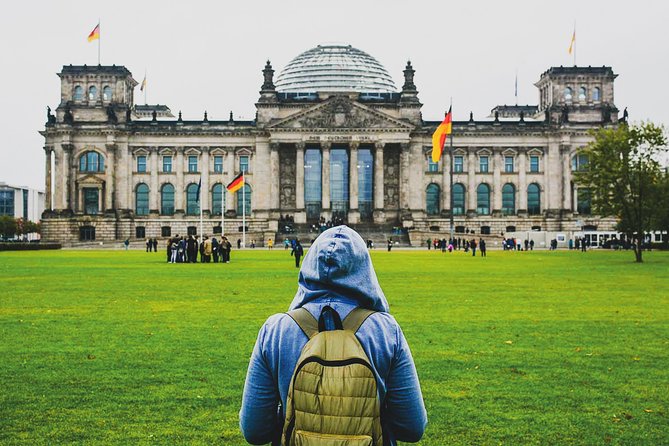
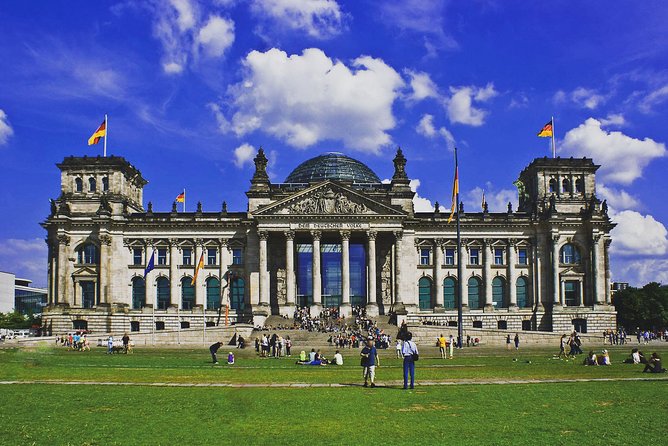
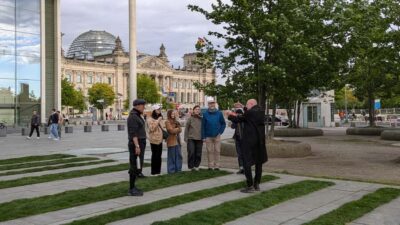
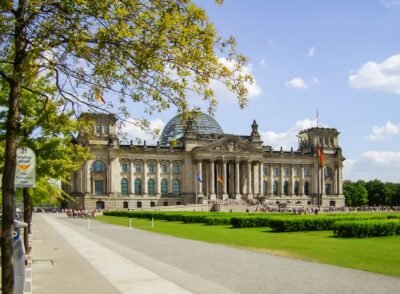
The Reichstag Building brings you into Berlin’s grand political center. Its architecture reflects older imperial ambitions, while its place in modern Germany connects it to the country’s later democratic life. The tour does not list a visit inside the building, so expect to admire it from outside and hear about its role in Berlin’s story.
A short walk brings you to Brandenburg Gate, the city’s essential symbol. It has represented royal power, national division, and reunification at different points in its life. The gate is also one of the best photo stops on the route, though the open plaza can feel busy and exposed depending on the time of day.
The value here is not just the photograph. Berlin’s central monuments changed meaning as political power changed hands. A good guide helps you read the gate and the surrounding streets as evidence of those shifts.
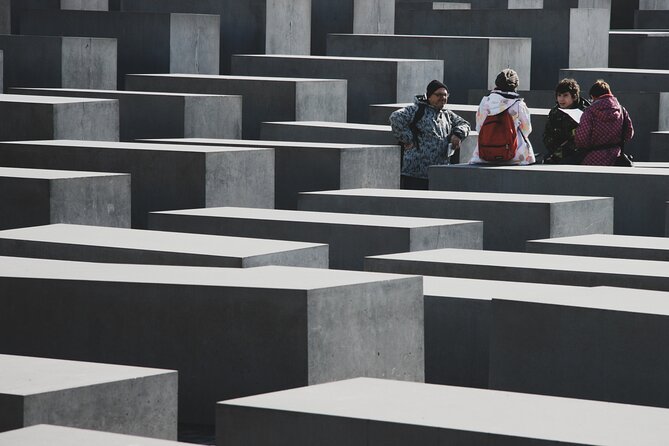
The Holocaust Memorial is nearby and requires a different mood. Its field of concrete blocks creates a powerful space for reflection, but it is not a conventional monument with a simple explanation carved into stone. Your guide can provide historical context, while the arrangement of the blocks leaves you to experience the space for yourself.
Take your time here, but follow the respectful behavior expected at a memorial site. The tour treats this as a place of remembrance and warning, not merely another stop for a quick picture.
The Führerbunker site and Berlin’s Nazi past
The Führerbunker stop is historically important but physically understated. The bunker itself is not open as a visitor attraction, and the location does not offer the dramatic underground setting some people may imagine. Instead, you stand near the site and learn about Adolf Hitler’s final days, the collapse of the Nazi regime, and the end of the war in Berlin.
That lack of spectacle is part of the point. There is no grand museum entrance or preserved room to turn into a shrine. The site asks you to confront how a place connected to one of the twentieth century’s worst regimes can now appear so ordinary.
The route also includes Wilhelmstrasse, once a center of Nazi government power. Here, the value comes from connecting offices, institutions, and political decisions to the streets where they operated. I appreciate this context because it moves the story beyond Hitler alone and toward the machinery of dictatorship.
This section can be emotionally heavy. If you are especially interested in WWII, ask your guide to spend more time here. If your group has children or wants a broader introduction to Berlin, the private format lets you keep the treatment informative without making the whole tour feel grim.
More wartime history tours in Berlin:
- Berlin: Sachsenhausen Concentration Camp Memorial Tour
★ 4.7 · 3,716 reviews - Third Reich Berlin: Hitler and WWII Walking Tour
★ 5.0 · 3,301 reviews - Sachsenhausen Concentration Camp Bus Tour in English from Berlin
★ 5.0 · 1,962 reviews - Berlin: Sachsenhausen Concentration Camp Tour in English
★ 4.8 · 1,889 reviews
Currywurst, a useful break in the middle
At some point around Wilhelmstrasse, you stop for currywurst. This is Berlin’s classic fast snack: sausage served with curry sauce. It is not a full meal, and extra food or drinks are not included, but it is a fitting local pause during a long walk.
The snack matters for practical reasons as much as culinary ones. Four hours outdoors is easier when you can sit, eat, drink, and warm up. One guide also stopped for café breaks, which is helpful if your group needs a slower pace.
Do not count on the food stop to replace lunch. Treat it as a taste of Berlin and a chance to reset before the next stretch. You may want to budget separately for additional drinks or food, since those are excluded.
Checkpoint Charlie and the Cold War in public view
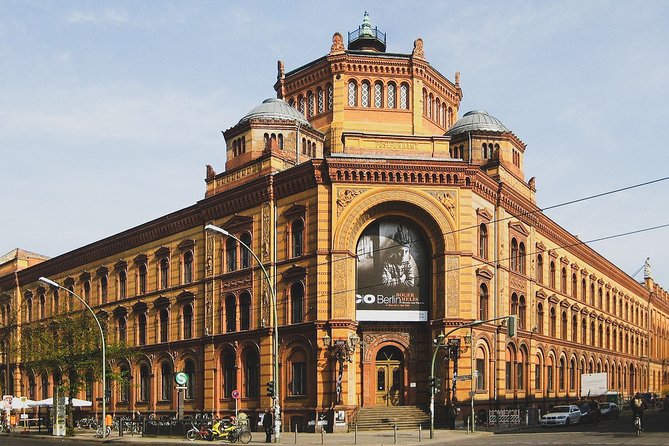
Checkpoint Charlie is the most recognizable Cold War stop on the tour. It was the best-known crossing between East and West Berlin, and its name still carries emotional weight. Your guide can explain the role of the checkpoint, the confrontation between American and Soviet forces, and the wider system of walls, controls, and escape attempts that divided the city.
The modern setting can surprise you. As with many famous historical places, the surroundings have changed, and the site can feel more like a busy urban attraction than a preserved border zone. That is why the explanation matters. Without context, you see a sign and a photo opportunity. With context, you begin to understand the danger attached to this crossing.
I would not choose this tour solely for Checkpoint Charlie. The stop is strongest when paired with the Palace of Tears and the broader walk through Mitte. Together, they show both the official border system and the human cost behind it.
Bebelplatz, book burning, and Museum Island
Bebelplatz offers a change of pace. Its architecture is among the most elegant in central Berlin, with several impressive buildings framing the square. Yet the setting also carries the memory of the Nazi book burning organized here in 1933.
This contrast is one of Berlin’s defining features. Beautiful architecture does not erase a painful past. The tour gives you space to consider how public places can hold both artistic and political meaning.
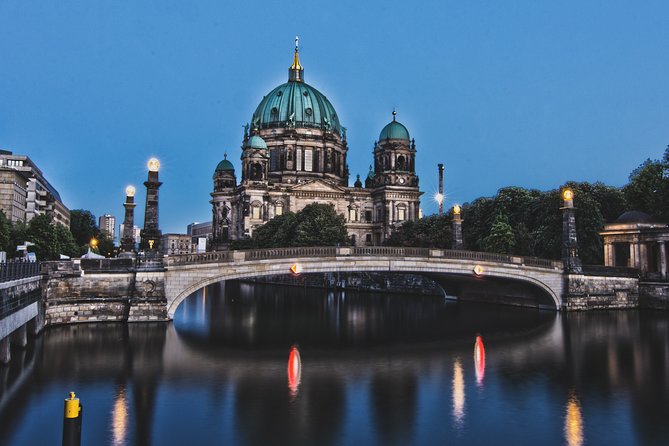
The final major area is Museum Island, the UNESCO-listed group of five world-renowned museums on the River Spree. The tour focuses on the island’s setting and story rather than providing entry to the museum collections. If you want to visit the interiors, plan a separate block of time and check museum admission arrangements independently.
Museum Island is a fine place to end the main historical sequence because it broadens the picture. Berlin is not only a city of war memorials and Cold War symbols. It is also a center of art, architecture, scholarship, and public culture.
Mitte’s smaller stories and less obvious corners
The walk finishes with smaller sites in the Mitte district, including the Missing House on Große Hamburger Strasse and the courtyards of Heckmann Höfe. These stops give the tour a more local feel after the major monuments.
The Missing House is especially striking because absence becomes the subject. A gap in the city can point to the people and buildings lost during wartime destruction and later change. It is the kind of detail you could easily pass without understanding.
Heckmann Höfe offers a more picturesque urban setting, with courtyards that reveal another side of central Berlin. This portion helps prevent the experience from becoming a checklist of famous places. You still see the icons, but you also get small discoveries that reward walking.
The tour returns to the original meeting point. Since the route can be customized, you can ask to spend more time on major sights, local details, WWII, the Cold War, or practical advice for the rest of your stay.
What the private format is worth at $129
At $129 per person, this is not the cheapest way to see Berlin. You are paying for a private guide, a route built around your interests, a currywurst, and several hours of direct conversation rather than a large group moving on a fixed schedule.
The value improves when you have two or more people sharing the experience, especially if you care about asking questions. Group discounts are available, though the exact saving is not specified. A private tour can also make sense for a family or mixed-age group because the guide can adjust the pace and take breaks.
The strongest value is time saved. You could visit many of these sites alone, but you would need to research the connections, navigate between them, and decide what deserves attention. The tour gives you a working framework on your first day, helping you understand Berlin before returning to individual museums or memorials.
The main limitation is that the route is ambitious. Four hours may feel packed, and some outings have lasted five to five and a half hours. If you prefer slow museum visits, frequent indoor stops, or a relaxed café-centered morning, this may feel too brisk. If you like covering ground and asking questions as you go, the pace can work well.
Walking conditions, guides, and smart planning
You need moderate physical fitness for this experience. The route is long, and cold weather can make it harder. Wear comfortable shoes, bring suitable layers, and plan to carry water even though the tour includes a food stop.
Multiple start times are offered, which helps you fit the walk into a short Berlin stay. Earlier in the day may be more practical than an evening departure, especially in winter. One outing took place on an icy December morning and maintained a comfortable pace, but weather still affects how enjoyable a long walk will be.
The private setup allows the guide to stop for rests and adapt to mobility needs. A guide adjusted the route and pace for a group member who could not walk easily, while other guides extended the experience when questions and conversation ran long. That flexibility is useful, but the tour remains a walking tour, not a vehicle-based sightseeing trip.
The experience is offered in English. Expert advice about places to eat and things to do after the walk is included, which adds value if you are new to Berlin. The start and finish are at Oranienburger Strasse, near public transportation.
A practical caution: one booking involved a guide failing to appear, followed by an apology and full refund from the operator. The guide was removed from the company, and this appears to be an isolated serious failure against an otherwise strong record. Still, confirm your meeting details before setting out, particularly if the tour is central to your day.
Should you book this Berlin history tour?
Book it if you want a big-picture introduction to Berlin and prefer learning through conversation rather than reading plaques alone. It suits first-time visitors, history-minded couples, families who can manage a long walk, and anyone who wants both famous sights and less obvious places in Mitte.
The tour is especially worthwhile if you can request a guide whose style fits your interests. Dimitri and Lucian are praised for depth and patience, while Eleni and Despina are noted for tailoring the route and offering practical help beyond the scheduled walk. Simon is a strong choice for a first introduction, and Peter is praised for personal stories.
Skip it if you dislike long walks, want extensive museum time, or need a tightly predictable four-hour finish. For everyone else, $129 buys a useful orientation to Berlin’s hardest subjects, a local snack, and the chance to shape the conversation around what you most want to understand.
FAQ
How long does the private Berlin history tour last?
The stated duration is approximately four hours. Some outings have lasted around five to five and a half hours, so allow extra time if your schedule is tight.
Where does the tour begin?
The meeting point is Oranienburger Strasse 28 to 30, 10117 Berlin, Germany.
Where does the tour finish?
The tour ends back at the original meeting point on Oranienburger Strasse.
Is the tour private?
Yes. Only your group participates, and the itinerary can be customized to your interests and preferences.
What language is the tour offered in?
The experience is offered in English.
Is currywurst included?
Yes. A German traditional snack, currywurst, is included. Extra food and drinks are not included.
Which major sights are included?
The route includes the New Synagogue and Centrum Judaicum, Palace of Tears, Reichstag Building, Brandenburg Gate, Holocaust Memorial, Führerbunker site, Wilhelmstrasse, Checkpoint Charlie, Bebelplatz, and Museum Island.
Can I cancel for a full refund?
Yes. You can cancel at least 24 hours before the experience start time for a full refund. Cancellations or changes made less than 24 hours before the start time are not accepted for a refund.
More Historical Tours in Berlin
- Berlin: Natural History Museum Entrance Ticket
★ 4.6 · 3,382 reviews - Berlin: World Heritage Cruise to Potsdam
★ 4.5 · 1,435 reviews - Berlin Historical Highlights Walking Tour
★ 4.9 · 657 reviews - Berlin Private Complete History All Day Walking Tour
★ 5.0 · 474 reviews
More Cold War Tours
- Berlin: DDR Museum Tickets
★ 4.3 · 3,443 reviews - Skip-the-Line: Berlin Wall Museum at Checkpoint Charlie
★ 4.1 · 2,041 reviews - Cold War, Berlin Wall, Spies and the East Side Gallery
★ 5.0 · 1,024 reviews - Berlin: Guided Bike Tour of the Berlin Wall and Third Reich
★ 4.7 · 499 reviews
Just added around Berlin
- eSIM for Germany and 34 European Countries★ 4.5 · 16 reviews
- Your ticket to The Wall Museum Berlin★ 3.0 · 60 reviews
- Walking on the Wall: 3-Hour Tour in Berlin★ 4.5 · 34 reviews
- Rickshaw Tours Berlin – Groups of up to 16 people with several rickshaws★ 4.0 · 97 reviews
- Warnemuende Shore Excursion: Private Berlin Tour★ 4.5 · 27 reviews
- Love and War in Berlin: Self-Guided Story Puzzle Walk★ 5.0 · 7 reviews
- Warnemuende Shore Excursion: Berlin Private Sightseeing Tour from Rostock★ 5.0 · 4 reviews
- Cold War Berlin – Private Live Virtual Experience★ 5.0 · 4 reviews
Berlin Tours, compared.
Reichstag, Dome and Government District Guided Tour
Read our review →
1-Hour City Tour by Boat with Guaranteed Seating
Read our review →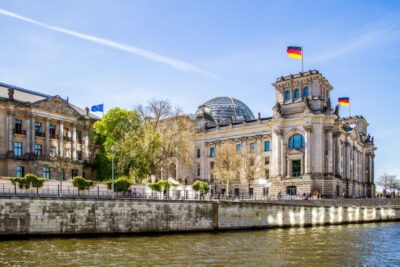

Reichstag, Plenary Chamber, Cupola & Government Tour
Read our review →
Browse the lists this tour appears in