
Review · BERLIN TOURS
Berlin’s Best: 2 Hour Walking Tour Third Reich and the Cold War
Berlin’s most important 20th-century sites fit into one brisk walk here, from the Brandenburg Gate to Checkpoint Charlie. Along the way, you confront the Reichstag fire, Hitler’s bunker, the Holocaust Memorial, the Berlin Wall, and the uneasy story of reunification.
I like the route’s strong shape: it links Nazi rule directly to the Cold War rather than treating them as separate chapters. I also like the guides’ clear, human approach. Glen and Mikhail, for example, have used old photographs to show how places once looked, while Maggie, Mikey, Tom, and others have been praised for answering questions without losing the group’s pace.
The main drawback is simple: two hours is short for such heavy material. You will see many sites from the outside, but you will not have time to explore the Reichstag, Topography of Terror, or Holocaust Memorial exhibition in detail. Berlin weather can also make the walk feel longer, so sensible shoes and warm layers matter.
Key points before you book
- A powerful route from Brandenburg Gate to Checkpoint Charlie: The walk connects the city’s Nazi and Cold War landmarks in a logical order.
- The guide shapes the experience: Names praised for clear, engaging work include Glen, Maggie, Mikey, Mikhail, Tom, James, Georgia, Peter F., and others.
- No admission fees are needed during the walk: The tour visits outdoor sites and public spaces, with museum interiors not included.
- Historic photographs add useful context: Guides may show old images at key stops, helping you compare past and present Berlin.
- A good family introduction to difficult history: An 11-year-old and a 16-year-old were able to follow the talk and ask questions comfortably.
- Plan for weather and walking: You meet 15 minutes early, walk for about two hours, and finish at Checkpoint Charlie.
Why this two-hour Berlin walk works
Berlin can feel like a history book spread across a modern city. A memorial may sit beside a government building, a piece of Wall may run along an ordinary street, and a quiet patch of pavement may mark one of the most notorious sites in Europe.
This tour gives those places a connecting thread. It begins with the symbol of German unity and ends at a former Cold War checkpoint, while the stops in between cover dictatorship, war, genocide, occupation, division, and reunification.
That structure matters. You are not simply ticking off Brandenburg Gate and Checkpoint Charlie. You are moving through the political story of Berlin in roughly chronological order, with the physical city providing the backdrop.
The guide is central to the experience. The strongest feedback focuses on clear explanations, a friendly tone, good answers to questions, and a careful balance between seriousness and occasional humor. That balance is useful here. Some subjects are grim, but a guide who speaks only in a flat, solemn voice can make two hours hard to absorb.
The group can include up to 30 people. That is not an intimate private walk, but it is still small enough for a guide to manage at street-level stops. Ask questions when there is a natural pause, particularly if you want more detail about daily life in East and West Berlin.
More WWII History Tours in Berlin
- Berlin: Third Reich and Cold War 2 Hour Walking Tour
★ 4.9 · 6,830 reviews - Berlin: Sachsenhausen Concentration Camp Tour in English
★ 5.0 · 5,711 reviews - Berlin: Sachsenhausen Concentration Camp Memorial Tour
★ 4.7 · 3,716 reviews
Brandenburg Gate: beginning with reunification
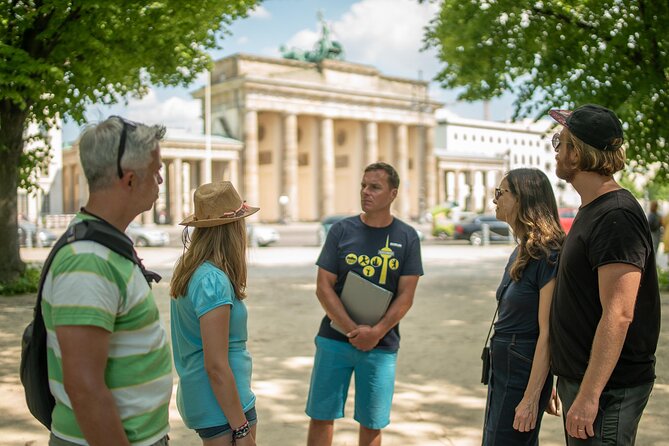
The meeting point is in front of the Tourist Information office on the Pariser Platz side of Brandenburg Gate. Look for the guide with the pink umbrella, and arrive 15 minutes before the scheduled start.
The gate is an excellent place to begin because it carries several meanings at once. It was once a grand entrance to Berlin, later became linked with division and Cold War politics, and now serves as a familiar symbol of reunified Germany.
Your guide explains why the monument matters today. This opening also gives you a quick sense of the tour’s method: a famous landmark is used as a doorway into political history.
You will not need an admission ticket for this stop. The useful thing here is the setting and the explanation, not an interior visit. Pariser Platz can be busy, so stay close enough to hear the guide and keep an eye out for the pink umbrella as the group moves on.
The Reichstag and the fire that changed Germany
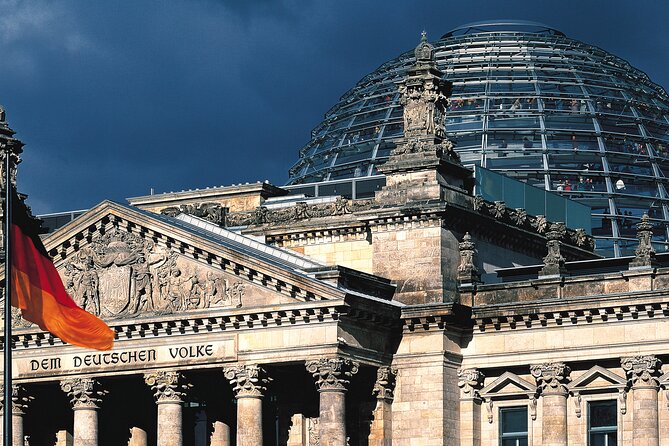
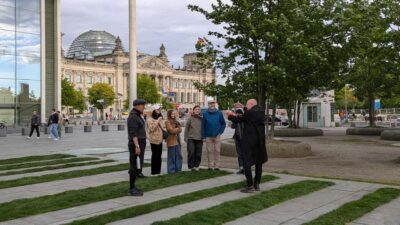
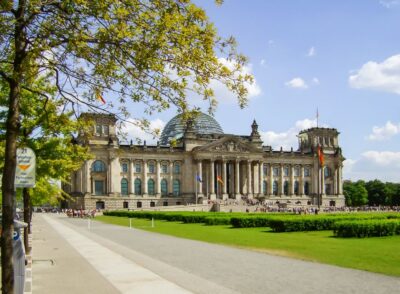
The Reichstag Building is only a short stop, but it carries an enormous amount of political weight. You hear how the building reflects Germany’s story over the past century, including the Reichstag fire of 1933 and the way Hitler used the event during his dictatorship.
This is a good example of why a walking guide adds value. From the pavement, the building may look like a grand government landmark. The commentary turns it into a place connected with the collapse of democracy and the Nazi seizure of power.
The visit is exterior only, and the stop lasts around 10 minutes. That is enough for the main story, but not enough for a full examination of the building’s architecture or modern parliament. If you want to visit inside later, treat this tour as an introduction rather than a substitute.
Soviet tanks and the Victory Column
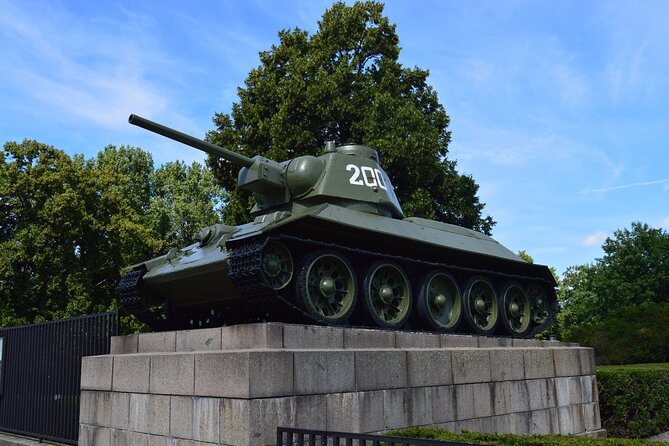
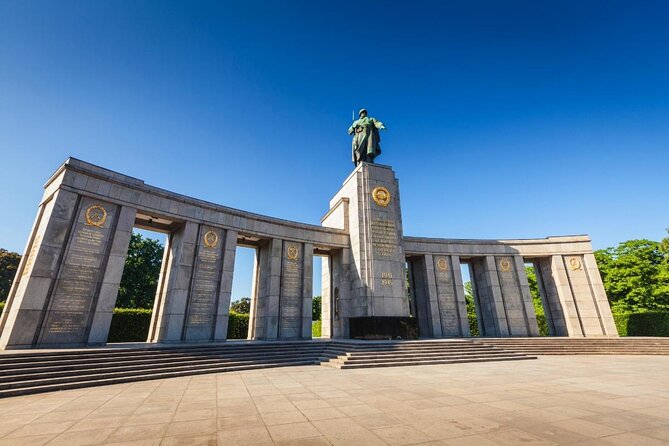
The Soviet Memorial in the Tiergarten brings the Second World War into view through military hardware. You see Soviet T-34/76 tanks and field artillery displayed at the memorial.
The stop is brief, about seven minutes, yet the physical objects make an impression. Weapons that once operated in war now sit in a public memorial setting, prompting questions about victory, occupation, and the competing memories attached to Berlin after 1945.
The route also includes the Victory Column. Here, the guide explains why Albert Speer moved the column from its original location and discusses his plans for Germania, the imagined new capital that the Nazis intended to create if Germany had won the war.
This is one of the route’s most useful links between architecture and ideology. Speer’s plans were not just grand building projects. They were part of a vision for power, control, and a transformed capital. You see the column, then hear how Nazi ideas reshaped the city in ways that went far beyond monuments.
More wartime history tours in Berlin:
- Third Reich Berlin: Hitler and WWII Walking Tour
★ 5.0 · 3,301 reviews - Sachsenhausen Concentration Camp Bus Tour in English from Berlin
★ 5.0 · 1,962 reviews - Berlin: Sachsenhausen Concentration Camp Tour in English
★ 4.8 · 1,889 reviews - Sachsenhausen Concentration Camp Memorial Tour (Max. 15 Guests)
★ 5.0 · 1,516 reviews
Walking through the Holocaust Memorial
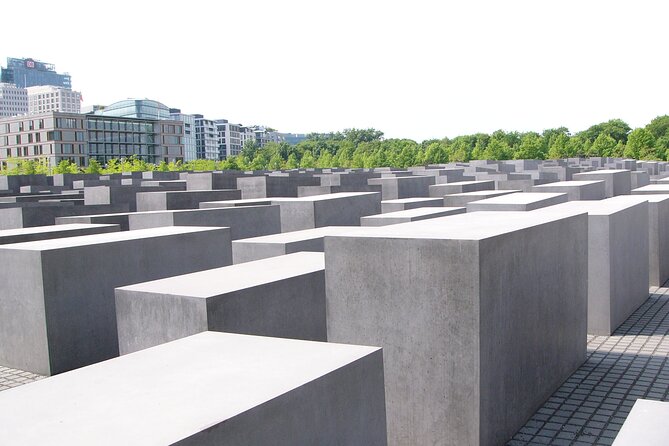
The Memorial to the Murdered Jews of Europe is one of the tour’s most affecting stops. You walk among its large field of concrete blocks, dedicated to Jewish victims of the Holocaust.
The guide gives you time to take in the space and explains its purpose. The memorial does not offer a simple statue or a single written message. Its form creates a changing physical experience as you move through it, with the blocks appearing different from various points.
This part of the tour needs quiet attention. You may find it tempting to take photographs, but the site calls for respectful behavior. The tour does not include a detailed visit to the underground information center, so return on your own if you want names, documents, and family stories connected to the victims.
The short stop gives you a first understanding of the memorial’s role. It cannot cover the full scale of the Holocaust, and that is an important limit to keep in mind.
The Führerbunker site and Berlin’s uneasy memory
You then stand above the former Führerbunker, the place associated with Hitler’s final days and his suicide on April 30, 1945. There is no dramatic preserved bunker interior to enter here. The value comes from understanding what happened beneath the ordinary modern surroundings.
The guide discusses the final days of the war and the way Germany has dealt with this destructive past. That second part is especially important. Berlin is not presenting the bunker as a shrine or spectacle. The site is marked in a restrained way, and the talk helps explain why the location can feel so strange.
This is also one of the stops where a thoughtful guide matters most. Several guides praised for this tour have been noted for handling difficult subjects with respect, using humor only where it does not make light of the dead.
Expect about 10 minutes here. You will receive the essential story, but not a long seminar on the final weeks of Nazi Germany.
The Aviation Ministry and the birth of East Germany
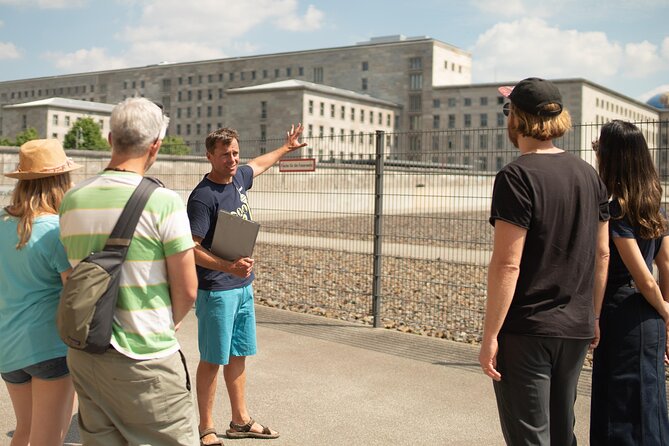
The former Aviation Ministry gives the tour a less familiar landmark. You walk along the length of Hermann Göring’s Air Ministry, a large surviving building from the Nazi period.
The building later became the location where East Germany, formally the German Democratic Republic, was proclaimed in 1949. That change in use makes the stop valuable. The same structure connects Nazi military power with the political order created in the Soviet-controlled eastern part of Germany after the war.
The stop lasts only about five minutes. It is a quick look from outside, but it adds an important layer to the route. Not every place tied to Berlin’s past is a famous monument. Some are working city buildings whose meaning becomes visible only when someone explains what happened there.
Topography of Terror: the machinery of persecution
At the Topography of Terror, you see the site where the SS, Gestapo, and SD had their headquarters under the Nazi regime. The present-day exhibition teaches about the crimes carried out by these institutions during the Second World War.
This stop helps shift the focus from Hitler and headline events to the organizations that enforced terror. It offers a clearer view of how persecution operated through offices, police bodies, records, arrests, and systematic violence.
The outdoor portion takes around 15 minutes. You may want to return later for the full exhibition, because a short walking-tour stop cannot cover its documents and historical detail. Still, the location is essential for understanding that Nazi crimes depended on an organized state system, not only on the orders of one leader.
The tour’s route makes a good choice here. You have just heard about the bunker and Nazi plans for Berlin, and now you see the institutional center that helped make dictatorship work.
The Berlin Wall on Niederkirchnerstraße
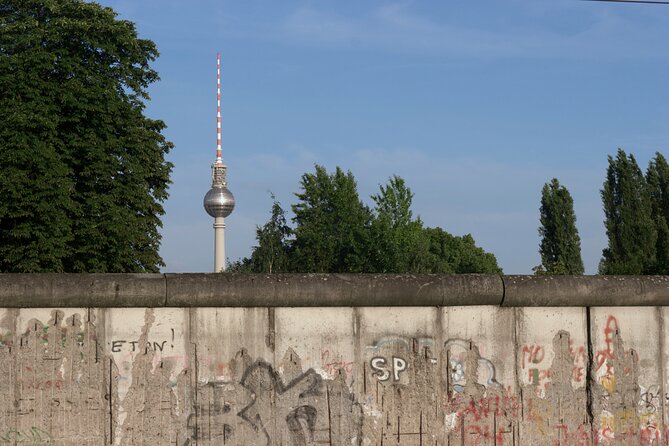
A large surviving section of the Berlin Wall appears along Niederkirchnerstraße. This is where the tour turns firmly toward the Cold War.
You hear stories of people who tried to escape across the Wall, including what happened to those who did not make it. The guide also explains daily life on both sides, in East Berlin and West Berlin.
That focus on ordinary life is important. The Wall was not only a concrete barrier and a political symbol. It cut through neighborhoods, separated families, shaped work and travel, and affected what people could say and do.
The seven-minute stop is brief, but the remaining section of Wall gives you something solid to look at while the guide talks. Historical photographs can be especially helpful here. A present-day street can look tidy and ordinary, so an old image helps you picture barriers, guard positions, and the earlier shape of the city.
Checkpoint Charlie: ending with a divided city
The tour ends at Checkpoint Charlie on Friedrichstraße, the best-known former crossing point through the Berlin Wall. The guide covers the 1961 confrontation between Soviet and American tanks, one of the Cold War’s most dangerous moments in Berlin.
You also hear how the Wall came down on November 9, 1989, and how reunification has progressed during the more than 30 years since then. Ending here makes sense because the route returns to the question raised at Brandenburg Gate: what does a united Germany mean after such a divided past?
Checkpoint Charlie is now a busy city location, and its modern presentation can feel more commercial than solemn. That is part of the place’s value as a final stop. It gives you a chance to think about how historical sites are remembered, presented, and sometimes packaged for visitors.
The walk does not claim to explain every part of reunification. Instead, it gives you a framework for understanding why this crossing became famous and how the city moved from armed standoff to open borders.
What the $24.07 price gives you
At $24.07 per person, this is strong value if you want a guided introduction to central Berlin’s Nazi and Cold War history. The price covers a professional English-speaking local guide and a two-hour walking route through several major sites.
There are no admission tickets included because the stops are public outdoor locations. That keeps the cost down, but it also means you should not expect museum entry or an interior visit to the Reichstag, Topography of Terror, or Holocaust Memorial information center.
I see the tour as a useful first step rather than a complete history program. You receive the city’s basic sequence, learn which places deserve more of your time, and finish with enough context to explore independently.
It is particularly good value if you have only a short stay in Berlin. In two hours, you can cover ground that would take much longer to understand on your own. The tradeoff is that each stop gets only a few minutes.
Timing, meeting point, and walking comfort
The walk lasts about two hours and is offered in English only. The start is easy to identify at Brandenburg Gate, with the pink umbrella serving as a practical marker.
The finish at Checkpoint Charlie is near public transportation, which makes it useful for continuing your day. The route also passes through central areas where you can arrange your next stop without needing a long transfer.
Wear comfortable shoes. You will be outside for the full experience, and winter can be cold enough to affect your attention. Bring gloves and warm layers in colder months, and use the restroom before setting out because the walk has no stated scheduled break.
Most people can take part, and service animals are allowed. The maximum group size is 30, so this suits you if you prefer a lively public tour over a private guide. If you need a slower pace or extensive time at each memorial, a private or longer tour may fit better.
The guide makes or breaks the walk
The company uses different guides, so the exact tone will vary. Names associated with especially strong experiences include Glen, Ben, Maggie, Rebecca, Tom, Joachim, Peter F., Simon, Paul, Mikey, Georgia, James, Jamie S., Mikhail, Eyan, Xavier, Ronja, and others.
The common strengths are clear explanations, a willingness to answer questions, and an ability to keep the group moving without making the talk feel rushed. Some guides use historic images, which can make a major difference at locations altered by war and redevelopment.
Mikey has been praised for making younger members of a family feel comfortable asking questions. Georgia has been noted for combining respect for Nazi atrocities with a friendly manner. Peter F. has also been appreciated for offering practical Berlin suggestions after the walk.
Of course, a named guide is not guaranteed unless your booking specifically identifies one. The safest expectation is a well-organized English walk with a guide whose skill determines how much detail and personality you receive.
Who should book this Berlin history tour?
I would choose this for a first visit to Berlin, especially if you want a clear introduction before visiting museums on your own. It also suits families with older children and teenagers who can manage serious subjects and two hours on foot.
The route is useful for anyone interested in the Second World War, Nazi Germany, the Holocaust, the Berlin Wall, or the Cold War. You do not need prior knowledge. The guide builds the story from recognizable places and explains why each one matters.
I would be more cautious if you want a quiet memorial experience with lots of personal time. A group walk has a schedule, and the tour moves on after each stop. It is also not the best choice for someone seeking detailed museum interpretation or access to historic interiors.
Cancellation is free up to 24 hours before the start time for a full refund. Changes or cancellations made within 24 hours are not refunded, so check your plans before that cut-off.
FAQ
How long is the Berlin’s Best walking tour?
The tour lasts approximately two hours.
Where does the tour begin?
It begins at Brandenburg Gate, at Pariser Platz in front of the Tourist Information office on the Brandenburg Gate side.
How do I find the guide?
Arrive 15 minutes before the start time and look for the guide carrying a pink umbrella.
Where does the tour end?
The walk ends at Checkpoint Charlie, at Friedrichstraße 43-45.
What language is the tour offered in?
The tour is offered in English only.
Are entrance tickets included?
The tour includes the walking route and guide. The listed stops have free admission, and the experience does not include paid museum or building entry.
How many people can join the tour?
The maximum group size is 30 people.
Can I cancel for a refund?
You can cancel at least 24 hours before the experience begins for a full refund. Cancellations or changes made less than 24 hours before the start time are not refunded.
Should you book it?
Book this tour if you want Berlin’s major Nazi and Cold War sites explained in one affordable, well-paced walk. The route is smart, the finish at Checkpoint Charlie is practical, and the guide can turn familiar landmarks into places with real meaning.
Skip it if you prefer long museum visits, private guiding, or a slower pace at memorials. For most first-time visitors, though, $24.07 buys a useful two-hour foundation. Bring warm clothes, wear good shoes, arrive early for the pink umbrella, and leave room in your schedule to return to the Topography of Terror or Holocaust Memorial afterward.
More Walking Tours in Berlin
- Discover Berlin Half-Day Walking Tour
★ 5.0 · 9,624 reviews - Berlin: Discover Berlin Walking Tour
★ 4.9 · 5,998 reviews - Berlin: Hidden Backyards Guided Walking Tour
★ 4.8 · 5,360 reviews - Berlin: Alternative Berlin Walking Tour
★ 4.6 · 1,204 reviews
More Cold War Tours
- Berlin: DDR Museum Tickets
★ 4.3 · 3,443 reviews - Skip-the-Line: Berlin Wall Museum at Checkpoint Charlie
★ 4.1 · 2,041 reviews - Cold War, Berlin Wall, Spies and the East Side Gallery
★ 5.0 · 1,024 reviews - Berlin: Guided Bike Tour of the Berlin Wall and Third Reich
★ 4.7 · 499 reviews
Just added around Berlin
- Berlin: Battle for Seelow Heights WW2 tour -Clash of Titans★ 5.0 · 27 reviews
- From Berlin: Gardens & Palaces of Potsdam Bike Tour★ 5.0 · 61 reviews
- From Berlin: Historical Gems of Potsdam Private Day Trip★ 4.4 · 4 reviews
- Berlin: Französischer Dom 360° Panorama & Crémant to go★ 3.9 · 5 reviews
- Explore Berlin Tour: History and Highlights★ 4.7 · 5 reviews
- Berlin: Evening Yacht Cruise with Aperitif & Dinner Upgrade★ 4.6 · 178 reviews
- Berlin: Expats in Berlin Comedy Show Ticket★ 4.7 · 182 reviews
- Berlin: The Epic Comedy Club Friday Night Showcase★ 4.8 · 28 reviews
Berlin Tours, compared.
Reichstag, Dome and Government District Guided Tour
Read our review →
1-Hour City Tour by Boat with Guaranteed Seating
Read our review →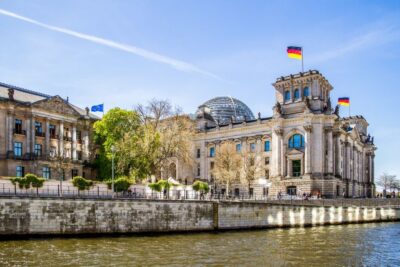
Reichstag, Plenary Chamber, Cupola & Government Tour
Read our review →
Browse the lists this tour appears in