

Review · BERLIN TOURS
Love and War in Berlin: Self-Guided Story Puzzle Walk
Berlin’s central streets become your game board on this self-guided walk about love, war, propaganda, and memory. Starting at the World Clock on Alexanderplatz, you solve clues at public landmarks and follow the story toward the Memorial to the Murdered Jews of Europe and the site of Hitler’s former bunker. Berlin’s past is right under your feet, not sealed away in a museum.
I like the freedom to begin when it suits you and stop for coffee, lunch, or a closer look at a monument. I also like the low price: at $6 per person, this is an inexpensive way to get your bearings in central Berlin. The tradeoff is that you are on your own. Some clues are very easy, while others demand exact answers, and crowded events can force you to make a small detour.
Key points at a glance
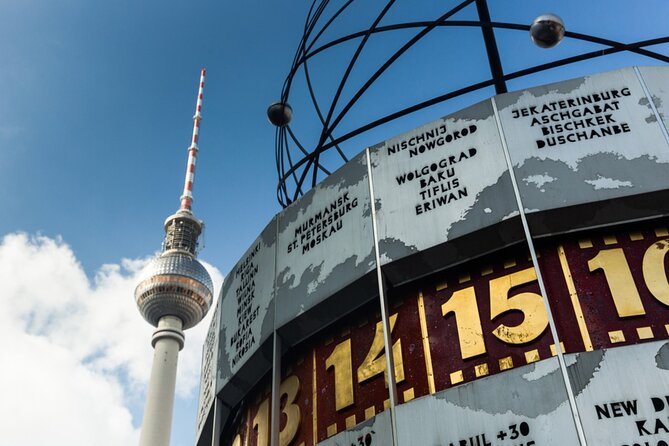
- Start at Alexanderplatz: Find your first clue beside the Urania World Clock, a public landmark showing the time in 148 cities.
- Follow Berlin’s changing identities: The route moves from Prussian architecture to Nazi crimes, Communist-era memory, and modern German remembrance.
- Solve clues at real locations: Each challenge uses details you can find around the monument or square.
- Reach the former bunker site: The story includes the place connected with Hitler’s final wartime headquarters.
- Play at your own pace: You can begin any day, pause whenever you wish, and continue later.
- Expect a private, guide-free outing: Your group plays alone, with no physical guide and no required internet connection during the game.
A self-guided history walk with a puzzle attached
This experience is best understood as a city walk wrapped in a story game. You receive access for your group, use your mobile device to move from one point to the next, and answer questions before the next location opens.
That format changes the pace. A regular walking tour keeps you moving behind a guide. Here, you stop when a detail catches your eye. You can also take a break without holding up anyone else. If you are visiting Berlin with family or friends, the puzzle gives everyone a small job to do.
The subject is serious. The route deals with World War II, Nazi propaganda, the Holocaust, the former bunker, and the difficult ways Berlin has remembered its past. The game format may make the walk more approachable, but it does not remove the weight of the places you see.
The advertised duration is about one hour. The route is described as manageable and not too far, but your actual time will depend on how quickly you solve the clues, how often you stop, and how crowded the squares are. Give yourself extra time if you want to read memorial panels or look closely at the buildings.
More walking tours in Berlin:
- Discover Berlin Half-Day Walking Tour
★ 5.0 · 9,624 reviews - Berlin: Third Reich and Cold War 2 Hour Walking Tour
★ 4.9 · 6,830 reviews - Berlin: Discover Berlin Walking Tour
★ 4.9 · 5,998 reviews
Alexanderplatz and the World Clock
The walk begins at Alexanderplatz, one of the easiest places in central Berlin to reach by public transport. Your first task takes place around the World Clock, also called the Urania World Clock.
The clock’s metal rotunda lists cities from around the world. It is not just a meeting point. It gives the opening challenge a clear purpose: you must inspect the object around you and find the detail needed to continue.
I like this start because it asks you to look up and around before the route gets into heavier material. Alexanderplatz also gives you a useful sense of Berlin’s scale. It is a broad public square, and the opening clue should help you get oriented quickly.
Do not rush the first question. One useful lesson from the game is that answers can be very precise. If the app rejects an answer, check spelling, numbers, and the exact detail requested rather than guessing wildly.
The Rathaus and Neptune Fountain
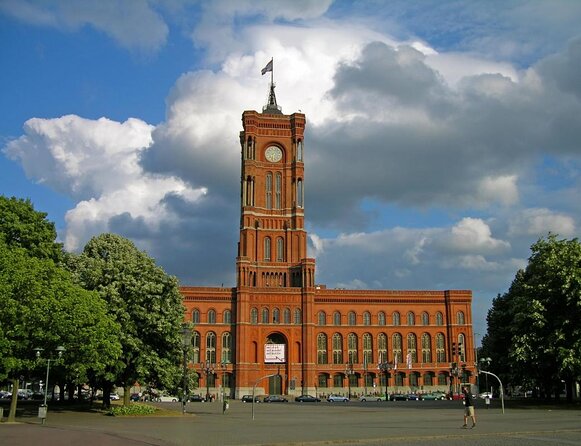
From Alexanderplatz, the route leads toward Berlin’s Red Town Hall, or Rathaus. The building was constructed from 1861 to 1869 in a Northern Italian High Renaissance style. Its design drew on the old town hall in Toruń, Poland, while its tower recalls Notre-Dame de Laon in France.
This stop gives you a look at Berlin before the twentieth-century disasters that shape much of the story. The red brick, tower, and formal civic setting make a useful contrast with the modern square at Alexanderplatz.
The Neptune Fountain is nearby. Built in 1891 and designed by Reinhold Begas, it places the Roman god Neptune at the center of an elaborate public monument. The fountain is a visual break in the route, and it is also one of the longer listed stops, with about ten minutes suggested for the visit.
Here, the puzzle encourages you to study the monument rather than merely pass it. That is one of the better features of the format. You may notice details you would miss while following a guide through a busy street.
Marx-Engels-Forum and the former East Berlin
Next comes Marx-Engels-Forum, a public park named for Karl Marx and Friedrich Engels, the authors of The Communist Manifesto. The park was created by the authorities of the former German Democratic Republic in 1986.
This is an important change in tone. The route is no longer dealing only with imperial Berlin or Nazi Germany. It also points toward the city’s division after the war and the official imagery of East Germany.
The setting is open and public, which makes it easy to pause and work through the clue. If you already know Berlin well, this section may still give you a new angle on familiar streets. One person who had lived in Berlin for years found the game offered fresh information, and that is a fair expectation here: the route uses ordinary public places to tell less obvious stories.
More self-guided routes in Berlin:
- Berlin: Solar Powered Sunset Catamaran Cruise & Audio Guide
★ 4.6 · 1,043 reviews - Berlin: Panoramic Boat Tour with Bilingual Audio Guide
★ 4.1 · 136 reviews - Berlin: Self-Guided Family and School Class Scavenger Hunt
★ 4.6 · 128 reviews - Berlin: Scavenger Hunt Self-Guided Tour
★ 4.6 · 79 reviews
Lustgarten and Neue Wache
Lustgarten sits on Museum Island near the former Berlin City Palace. Its role has changed many times. It has served as a pleasure garden, parade ground, rally site, and public park.
That shifting use makes it a fitting stop for a story about power. A square can look calm today while carrying memories of ceremonies, crowds, and political display. The puzzle asks you to read the space as more than scenery.
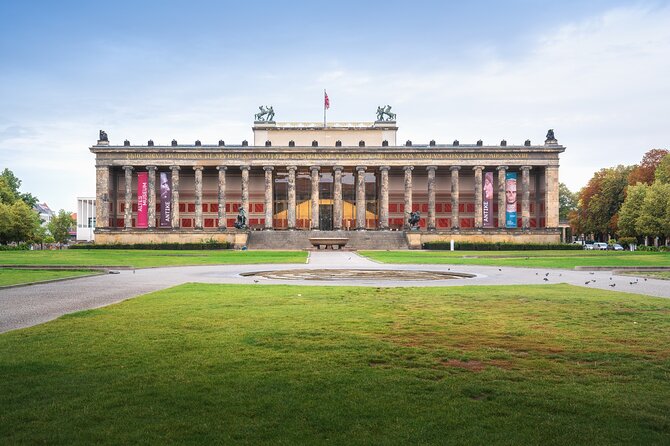
The Neue Wache, on Unter den Linden, was built between 1816 and 1818 from plans by Karl Friedrich Schinkel. It began as a guardhouse for the royal palace and a memorial to the wars of liberation. Today, it is a major example of Prussian Neoclassical architecture and a place of remembrance.
These stops work well together because they show how Berlin repeatedly changes the meaning of its monuments. A royal guardhouse, a public garden, and a parade setting can all become part of later national stories. You do not need a guide standing beside you to notice that the city keeps rewriting its own symbols, though a guide would naturally provide more background.
Bebelplatz and the crime of book burning
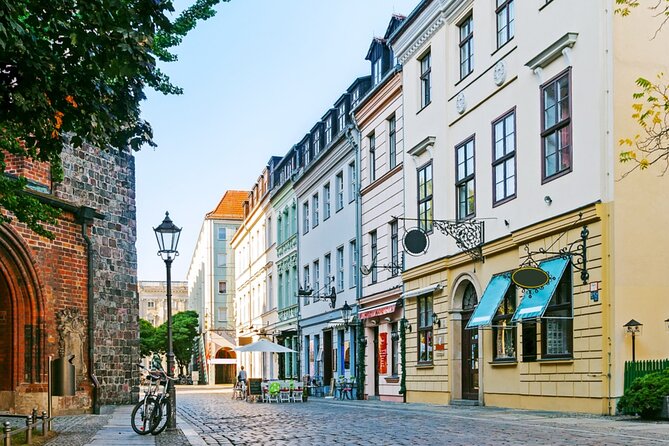
Bebelplatz is one of the most powerful stops on the route. It was the site of a Nazi book burning on May 10, 1933, one of many such ceremonies held in German university cities.
The event was organized by the nationalist German Student Association. The goal was not simply to destroy books. Public book burnings helped create a climate in which censorship, exclusion, and political violence could appear acceptable.
The game brings you to the square and asks you to search for the answer needed to proceed. The challenge gives you a reason to examine the site, but take a moment to absorb the meaning of the place beyond the game. Bebelplatz is a reminder that persecution often begins with public language and organized pressure before it becomes physical terror.
This is another listed ten-minute stop. That time is useful. You can solve the puzzle, locate the memorial details, and look at the surrounding buildings without feeling pushed along.
Gendarmenmarkt and the walk through power
Gendarmenmarkt is one of Berlin’s grandest squares. Its name comes from the Gens d’Armes cuirassier regiment, whose stables once occupied the site before Friedrich II had them demolished.
The square is framed by two churches and the Konzerthaus Berlin, formerly a theatre. The architecture is formal and carefully arranged, giving the place a very different mood from Marx-Engels-Forum or Alexanderplatz.
Here, the route keeps showing you how Berlin’s public spaces were built for ceremony, authority, and display. The puzzle is not a substitute for a full architectural tour, but it helps you connect the visual setting with the political story.
The route then passes the Berlin representation of Hamburg. This classicist town house is used by the Free and Hanseatic City of Hamburg for political work, meetings, and public events. The 16 German states use such representations in Berlin, and Hamburg holds more than 500 events and encounters there each year.
That detail adds a modern layer to the walk. Berlin is not only a city of old monuments and wartime scars. It is also the working capital of present-day Germany, where regional governments take part in federal politics.
The former bunker site and the final memorial
The story includes the site of Hitler’s former war bunker, a place tied to the final days of the Nazi regime. The bunker itself is not presented as a grand attraction, and that matters. There is no dramatic ruin to tour. The value comes from understanding the location and the events linked to it within the wider route.
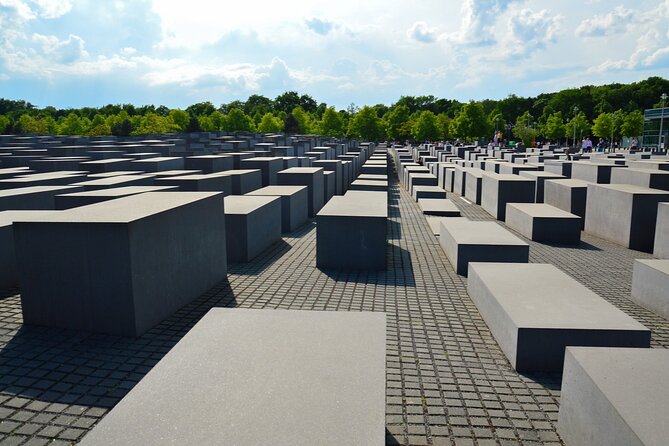
The walk ends at the Memorial to the Murdered Jews of Europe on Cora-Berliner-Straße. Germany’s parliament decided in 1999 to create a central memorial. The design competition was won by New York architect Peter Eisenman, and the memorial opened in 2005.
The field of concrete stelae is deliberately open to personal response. The game gives you a final destination and a story thread, but you should not treat the memorial as merely the finish line of a scavenger hunt. Walk through it quietly and take time to consider the scale of the memorial and the people it represents.
This final section is where the route’s title makes sense. The walk connects personal stories, political power, war, and the city’s effort to remember mass murder. It is not a full World War II course, but it offers a useful first framework for seeing Berlin’s center.
What the puzzle format does well
The strongest feature is control. You can start at any hour, pause at any time, and resume later. That works well if your schedule is broken up by museum visits, meals, or changing weather.
The activity is private, so only your group takes part. You do not need to keep up with strangers, and you can discuss each answer before entering it. Group discounts may make the price even better for families or friends traveling together.
The game is also designed to work offline. That matters if you do not want to rely on mobile data while walking. You still use your phone to play, but an internet connection is not required during the game.
The clues make familiar places more active. Instead of glancing at the Neptune Fountain or walking straight across Bebelplatz, you search for specific information. Several people found the questions easy to follow and enjoyable to solve, while others found some answers too exact. That is the fair balance: the game is accessible, but you may need to enter an answer with care.
Where the experience falls short
The absence of a physical guide is both the point and the limitation. You get flexibility and privacy, but you cannot ask a historian to explain a confusing detail or answer a follow-up question.
The route also appears best for people who enjoy light problem solving. If you want a straight historical walk with every fact explained in order, this may feel thin. If you like being sent to look closely at a building or monument, it should feel more involving.
Crowds can interfere with the route. A Christmas market once blocked access to parts of the walk, forcing some maneuvering. That is a practical warning for anyone visiting during seasonal events. The game may still work, but you should be ready to move around temporary stalls or busy public spaces.
The one-hour estimate can also be optimistic if you stop properly at the memorials. I would treat it as a brisk playing time, not a complete visit to every place along the way.
Price, timing, and who will enjoy it
At $6 per person, this is strong value for a central Berlin activity. You are paying less than the cost of many guided walks, while still getting a planned route, a historical theme, and interactive challenges.
The low price also makes it easy to use as a first-day orientation walk. You can see major areas of Mitte, learn how the central streets connect, and decide which places deserve a longer visit later.
The experience is offered in English. Confirmation arrives at booking, and the activity is listed as available every day, with operating hours shown as 5:00 AM to 9:00 PM. The general description also promotes flexible start times, so I would choose daylight or normal public-hours timing for the clearest view of monuments and memorial details.
Most people can take part, and service animals are allowed. The route is near public transportation, with the start at Alexanderplatz and the end at Cora-Berliner-Straße. Free cancellation is available if you cancel at least 24 hours before the local start time. Inside that window, no refund is provided.
Should you book Love and War in Berlin?
Book it if you want an inexpensive, private way to explore central Berlin while solving clues and connecting major sites. It suits couples, families, friends, and repeat visitors who want a fresh reason to examine places they may have already passed.
Skip it if you need a live guide, detailed historical lectures, or a fully predictable route through crowded streets. For the price, the puzzle format offers a lot, but you must bring your own curiosity and patience.
My practical advice is to allow more than one hour, use the route as an introduction rather than the final word on Berlin’s past, and slow down at Bebelplatz, the former bunker site, and the Holocaust Memorial. That approach gives you the fun of the game without losing sight of the serious places it visits.
FAQ
How long does the Love and War in Berlin walk take?
The advertised duration is approximately one hour. Your time may be longer if you pause, study the memorials, or need extra time to solve a clue.
Where does the activity start and end?
It starts at Alexanderplatz, at Alexanderpl. 1, 10178 Berlin. It ends at Cora-Berliner-Straße 1, 10117 Berlin, near the Memorial to the Murdered Jews of Europe.
Is a guide included?
No. This is a self-guided activity, and no physical tour guide is included.
Do I need an internet connection?
No internet connection is required to play the city game offline. You do need a mobile device to take part.
Is the activity private?
Yes. Only your group participates, with no other participants added to your experience.
Is the walk offered in English?
Yes. The activity is offered in English.
Can I cancel for a full refund?
Yes, if you cancel at least 24 hours before the experience’s start time. Cancellations made less than 24 hours before the start are not refunded.
Just added around Berlin
- eSIM for Germany and 34 European Countries★ 4.5 · 16 reviews
- Your ticket to The Wall Museum Berlin★ 3.0 · 60 reviews
- Walking on the Wall: 3-Hour Tour in Berlin★ 4.5 · 34 reviews
- Rickshaw Tours Berlin – Groups of up to 16 people with several rickshaws★ 4.0 · 97 reviews
- Warnemuende Shore Excursion: Private Berlin Tour★ 4.5 · 27 reviews
- Warnemuende Shore Excursion: Berlin Private Sightseeing Tour from Rostock★ 5.0 · 4 reviews
- Cold War Berlin – Private Live Virtual Experience★ 5.0 · 4 reviews
- Berlin’s Gay, Lesbian, and Queer Scene Small-Group Walking Tour★ 4.5 · 66 reviews
Berlin Tours, compared.

Reichstag, Dome and Government District Guided Tour
Read our review →
1-Hour City Tour by Boat with Guaranteed Seating
Read our review →
Reichstag, Plenary Chamber, Cupola & Government Tour
Read our review →
Browse the lists this tour appears in