
Review · BERLIN TOURS
Berlin: Private Bike Tour of the Berlin Wall and Third Reich
Berlin’s hardest history becomes easier to grasp from a bicycle. In three hours, you can connect the former Nazi center, Hitler’s bunker, the Holocaust Memorial, the Reichstag, and the Berlin Wall without spending the day shuffling between distant sites. The bike is the key advantage, not a side detail.
I like the personal route, since your guide can adjust the emphasis for your group, and I like the number of less obvious stops, including the Günter Litfin memorial and the Flak Tower at Humboldthain. The possible drawback is simple: three hours is brisk for this much history, and the tour operates with a minimum of four people.
Key points to know before booking
- See Berlin’s Wall history in places where its physical impact is still clear, especially at the Berlin Wall Memorial and Mauerpark.
- Connect Nazi and Cold War sites in one route, including the Reichstag, Führerbunker, Holocaust Memorial, and Checkpoint Charlie.
- Ride with only your own group, with a guide who designs the route rather than following one fixed script.
- Cover more ground than on foot, an important benefit when you have just a few days in Berlin.
- Expect a history-focused tour, with only short stops at most locations and no interior visit to the Reichstag.
- Bring weather-ready clothing, since the tour runs in all conditions and finishes back at the starting point.
Why a bicycle works so well for Berlin’s divided past
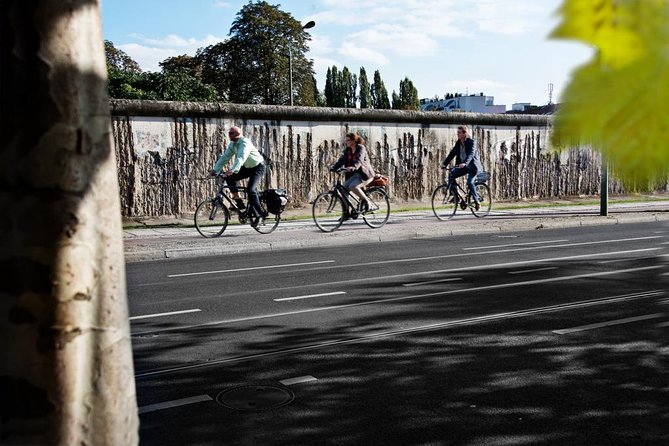
Berlin’s historical sites are spread across a wide area. A walking tour can explain one district well, but it may leave you choosing between the Wall, the Nazi government quarter, and Checkpoint Charlie. On a bicycle, you can link these places in one outing.
The tour lasts about three hours and includes the bicycle and helmet. That gives you enough time to reach a long list of sites, though not enough time for lengthy museum visits or extended reflection at every memorial. Most stops last about five or ten minutes, with a longer fifteen-minute stop at Spreebogenpark.
That pace suits you if you want a strong first look and a clear historical framework. It is less suitable if you prefer to spend half an hour at each memorial or read every inscription in detail.
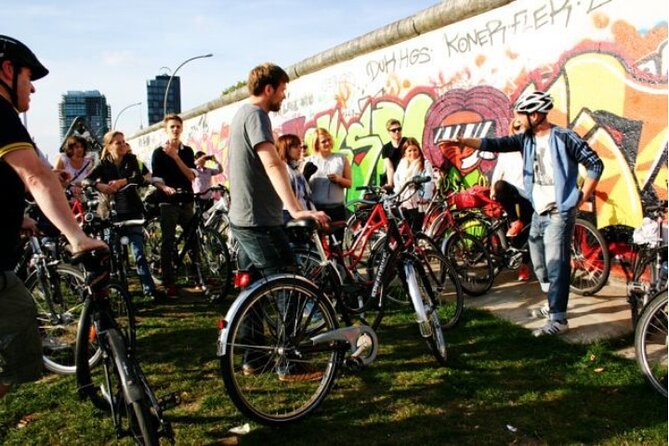
The tour is private, so only your group takes part. That matters here. Berlin’s past raises difficult questions, and a private guide can spend more time on the topics your group finds most meaningful. The Free Berlin concept also lets the guide design the route, so the exact order and emphasis can vary.
The listed price is $107.42 per person. That is not a bargain for a three-hour ride, but it covers a private tour, bicycle, helmet, and a route built around your group. Group discounts may improve the value, especially if you are traveling with family or friends. Keep in mind that the tour requires at least four people, so it is not designed for a solo booking or a couple traveling alone unless the operator accepts a larger shared arrangement.
More WWII History Tours in Berlin
- Berlin: Third Reich and Cold War 2 Hour Walking Tour
★ 4.9 · 6,830 reviews - Berlin: Sachsenhausen Concentration Camp Tour in English
★ 5.0 · 5,711 reviews - Berlin’s Best: 2 Hour Walking Tour Third Reich and the Cold War
★ 5.0 · 5,486 reviews
Nikolaiviertel and the New Synagogue: starting with Berlin’s older layers
The meeting point is Free Berlin Bike Tours & Rental at Poststraße 11, in central Berlin. The first stop, Nikolaiviertel, is presented as Berlin’s only real old town. That claim needs a little context: much of what you see today reflects reconstruction, especially after the wartime destruction that hit Berlin.
That makes the opening useful. You begin by asking what old means in a city rebuilt after bombing, division, and reunification. The stop is short, about ten minutes, so expect an introduction rather than a detailed architectural walk.
At the New Synagogue, the focus shifts to civil courage during the Night of Broken Glass. The story centers on a police officer who helped protect the building. You spend only about five minutes here, but the stop adds a human choice to a period often told through dates and government policy.
The synagogue exterior is especially useful early in the route because it sets up the tour’s larger theme: Berlin’s history is not only about rulers and armies. It is also about individual decisions, public memory, and what a city chooses to preserve.
Memorials to deportation and Holocaust victims
Several stops concern Nazi persecution and the Holocaust. The route includes a memorial to victims of deportation and the Holocaust that was designed during the East German period. Its style and political setting differ sharply from the better-known memorial near Brandenburg Gate.
The tour also includes memorials for major victim groups of the Holocaust. The supplied route description does not identify each memorial by name, so you should treat these as brief historical stops rather than plan around a particular museum or interior exhibit.
The main Holocaust Memorial, officially the Memorial to the Murdered Jews of Europe, receives about ten minutes. Its field of concrete blocks is large, serious, and intentionally open to interpretation. The guide explains its place in German memory and why its scale matters.
You will not have unlimited time to walk through the entire memorial at a slow pace. I would think of this stop as a guided orientation. If the memorial is a major reason for your Berlin visit, return later on your own when you can give it more time.
The Berlin Wall Memorial and Mauerpark
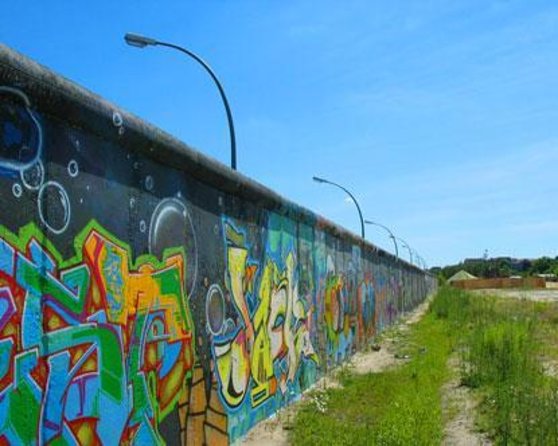
The Berlin Wall Memorial is the strongest part of the route for understanding how the Wall functioned. The tour description points out that Berlin has three places where the Wall remains especially legible, and calls this the only one where you can really grasp what the barrier did to the city.
That is a valuable distinction. A remaining section of concrete can look like an isolated piece of street furniture. At the Wall Memorial, the border system is easier to picture as a controlled zone that divided neighborhoods, families, streets, and daily routines.
You spend about ten minutes here. The stop is short, but the guide’s explanation helps connect the physical remains with the human cost. This is likely to be the most useful part of the tour for anyone who knows the Wall mainly through photographs.
Mauerpark follows, with another ten-minute stop. Today it is best known for its Sunday flea market, but its historical role is more severe. The site reflects repeated attempts by East German authorities to create what they considered a secure border.
That contrast between a popular public park and its former role as a controlled edge is exactly what makes Berlin interesting. Places change use, but the ground can still carry the outline of earlier systems. If your tour falls on a Sunday, the market may affect the feel of the stop, but no special market activity is promised as part of the tour.
More wartime history tours in Berlin:
- Berlin: Sachsenhausen Concentration Camp Memorial Tour
★ 4.7 · 3,716 reviews - Third Reich Berlin: Hitler and WWII Walking Tour
★ 5.0 · 3,301 reviews - Sachsenhausen Concentration Camp Bus Tour in English from Berlin
★ 5.0 · 1,962 reviews - Berlin: Sachsenhausen Concentration Camp Tour in English
★ 4.8 · 1,889 reviews
Humboldthain Flak Tower and Günter Litfin’s watchtower
At Humboldthain, you see the remains of a massive flak tower built during the Nazi period. It served as a fortress and air-raid shelter, and the stop offers a panoramic view along with an explanation of Nazi building plans.
This is one of the more unusual choices on the route. Many first-time visitors focus on memorials and government buildings, while the Flak Tower shows how ideology, military planning, and concrete construction shaped Berlin itself. The view also gives you a chance to pause from the denser memorial material.
The tour then visits the Günter Litfin Memorial. The preserved watchtower recalls Günter Litfin, identified here as the first person shot at the Wall. The tower gives the Cold War story a name and a specific human cost.
The stop lasts about ten minutes. It is not simply another Wall fragment. The preserved structure helps you picture the surveillance system and the danger built into the border.
Invalidenfriedhof and the divided cemetery
Invalidenfriedhof was created for figures regarded as heroes of German military history. The Wall later cut through the burial ground, turning a cemetery into another example of Berlin’s division.
The guide also addresses the uncomfortable difference between remembering someone and honoring them. That distinction is useful in a country still working through military tradition, dictatorship, war guilt, and public memory.
You get about ten minutes here. It is a quieter stop than Checkpoint Charlie, and that may be welcome after several emotionally heavy memorials. At the same time, cemetery history is less immediately visual than a preserved Wall section, so it may appeal most to you if you enjoy political and military history.
Spreebogenpark, the Reichstag, and Hitler’s planned capital
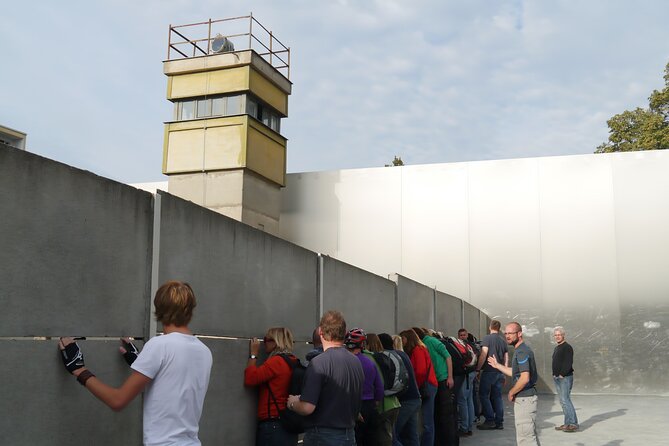
Spreebogenpark provides a broad view of Berlin’s government quarter. From here, the tour discusses Albert Speer, Hitler’s architect, and the proposed Great Hall. The planned building would have held 180,000 people.
This is a powerful way to explain Nazi architecture. You are not only looking at what was built. You are also considering the monumental city Hitler wanted to create, and the scale of power he hoped to project.
The stop lasts about fifteen minutes, the longest on the route. That extra time makes sense because the guide can connect the river, government district, Nazi plans, wartime destruction, and the later democratic capital.
At the Reichstag, the guide discusses Hitler’s rise to power and Germany’s democratic history. You stop outside for about five minutes. There is no time to go inside, so do not book this tour expecting a dome visit or an interior tour.
Still, the exterior stop has real value. The Reichstag lets the guide explain how a democratic institution was manipulated and how the building later became part of modern Germany’s political life. For an interior visit, you would need to arrange that separately.
The Holocaust Memorial and Führerbunker
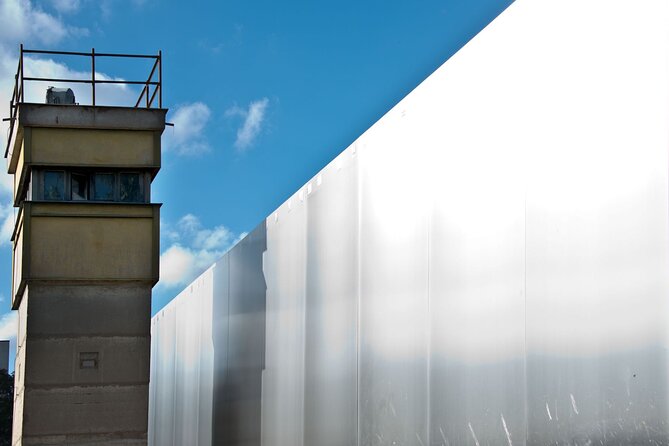
The route moves back into the central memorial district for the Holocaust Memorial. The stark grid of blocks can feel abstract at first. With a guide, you get the historical frame needed to understand why the memorial occupies such a prominent site and why its size is part of its message.
Next comes the Führerbunker site. Today, all you can see is a parking lot. That plain setting is intentional and gives the guide a chance to explain what happened there during the final weeks of the war, including Hitler’s suicide, and why the bunker was not preserved as a public monument.
This is a good example of Berlin’s restrained approach to dangerous symbols. There is no grand entrance, plaque-filled museum, or dramatic ruin to photograph. The absence is the point, and the guide’s explanation supplies the context.
You spend about ten minutes at the site. Expect history told through location and explanation, not through an intact building.
Checkpoint Charlie and the Cold War finish
Checkpoint Charlie is included only on the English version of the tour. It was the most famous Cold War border crossing and the only shared station between the American and Soviet sectors described in the route. The confrontation here came close to a wider conflict.
The stop lasts about ten minutes. It is one of Berlin’s most recognizable historical locations, but the modern setting can feel busy and commercial. That makes the guide especially useful, since you need explanation to connect the present-day street with the armed standoff and divided city of the Cold War.
If you are booking in German, confirm the route because Checkpoint Charlie is specified for the English tour only. English is offered regularly, while German is also available, with Dutch, French, and Spanish possible on request.
Practical details that shape the day
The tour offers several departure times, which makes it easier to fit around museum visits and other plans. You return to the same meeting point at Poststraße 11. Hotel pickup and drop-off are not included, and food and drinks are not included unless specifically stated.
Children are welcome when accompanied by an adult. Infant seats can be provided on request, so ask for one before the tour rather than assuming it will be ready. Helmets are included, and most people can take part.
The ride operates in all weather. Berlin weather can change quickly, so wear layers and bring clothing suitable for rain or wind. Comfortable clothes matter more than dressing up, and you should plan for a working bike ride rather than a passive sightseeing outing.
The guide speaks English on the main version of the tour. Clear English is particularly important for this subject, since the value comes from understanding connections between places. The tour has earned a 4.9 rating from 23 reviews, with 96 percent recommending it, and the praise focuses strongly on how quickly the bikes connect the sights and how clearly the guide explains them.
Who should book this private Berlin bike tour?
I would choose this tour if you want a strong historical overview early in your Berlin stay. It works especially well for history-minded families, friends traveling together, and anyone who wants to cover both the Wall and the Third Reich in one compact outing.
It is also a good choice if walking long distances is not appealing. The bicycle lets you reach more sites, and one direct review noted that seeing the attractions on foot would have taken about twice as long.
I would hesitate if you want long museum visits, a Reichstag interior tour, or a slow photographic tour. The stop times are short, and the route covers serious material at a steady pace.
Should you book it?
Book this tour if your priority is connection and context. You will see famous places such as the Holocaust Memorial, Reichstag, Führerbunker, and Checkpoint Charlie, but you will also reach harder-to-find Wall sites and a Nazi Flak Tower.
The price makes the most sense for a group of four or more, especially with a group discount. Confirm the language and Checkpoint Charlie inclusion, request an infant seat if needed, and dress for the weather.
For a compact, private introduction to Berlin’s 20th-century past, this is a strong choice. Just leave time afterward to revisit the places that deserve more than ten minutes.
FAQ
How long does the Berlin bike tour last?
The tour lasts approximately three hours.
What is included in the price?
The tour includes a professional guide, bicycle, helmet, and private guiding for your group. Infant seats can be provided on request.
Is this a private tour?
Yes. Only your group participates, and the route is designed by the guide.
Where does the tour start and end?
It starts at Free Berlin Bike Tours & Rental, Poststraße 11, 10178 Berlin, Germany, and ends back at the same meeting point.
Is Checkpoint Charlie included on every tour?
Checkpoint Charlie is included only in the English version of the tour.
What languages are available?
The tour is offered in English and German. Dutch, French, and Spanish may be possible on request.
Can children take part?
Yes. Children are welcome but must be accompanied by an adult. Infant seats are available on request.
More Bike Tours in Berlin
- Berlin: Sights and Highlights Bike Tour with a Local Guide
★ 4.8 · 2,698 reviews - Berlin Highlights 3-Hour Bike Tour
★ 5.0 · 948 reviews - Berlin City Bike Tour with Beer Garden Stop
★ 5.0 · 917 reviews - Berlin Highlights: 3-Hour Bike Tour
★ 4.9 · 809 reviews
More Cold War Tours
- Berlin: DDR Museum Tickets
★ 4.3 · 3,443 reviews - Skip-the-Line: Berlin Wall Museum at Checkpoint Charlie
★ 4.1 · 2,041 reviews - Cold War, Berlin Wall, Spies and the East Side Gallery
★ 5.0 · 1,024 reviews - Berlin: Guided Bike Tour of the Berlin Wall and Third Reich
★ 4.7 · 499 reviews
Just added around Berlin
- eSIM for Germany and 34 European Countries★ 4.5 · 16 reviews
- Your ticket to The Wall Museum Berlin★ 3.0 · 60 reviews
- Warnemuende Shore Excursion: Private Berlin Tour★ 4.5 · 27 reviews
- Walking on the Wall: 3-Hour Tour in Berlin★ 4.5 · 34 reviews
- Rickshaw Tours Berlin – Groups of up to 16 people with several rickshaws★ 4.0 · 97 reviews
- Love and War in Berlin: Self-Guided Story Puzzle Walk★ 5.0 · 7 reviews
- Warnemuende Shore Excursion: Berlin Private Sightseeing Tour from Rostock★ 5.0 · 4 reviews
- Cold War Berlin – Private Live Virtual Experience★ 5.0 · 4 reviews
Berlin Tours, compared.

Reichstag, Dome and Government District Guided Tour
Read our review →
1-Hour City Tour by Boat with Guaranteed Seating
Read our review →




Reichstag, Plenary Chamber, Cupola & Government Tour
Read our review →
Browse the lists this tour appears in