
Review · BERLIN TOURS
Third Reich Berlin & World War II Private Walking Tour
Berlin’s most important Nazi and World War II sites are spread across central Berlin, but this three-hour private walk ties them together in a clear route from Brandenburg Gate to Checkpoint Charlie. You move from propaganda and military power to persecution, defeat, and the physical remains of the regime.
I like the one-group format, which gives your guide room to shape the discussion around your interests. I also like the serious range of stops: the Holocaust Memorial, Soviet tanks, Hitler’s bunker site, the former Luftwaffe headquarters, and the Topography of Terror. The main drawback is the price, $224.76 per person, especially since most stops are outdoor sites and only one listed admission is included.
Key points to know before booking
- The route links six major sites between Brandenburg Gate and Checkpoint Charlie in about three hours.
- You get a private guide and a personalized route, rather than a fixed group experience.
- The Topography of Terror admission is included, while admission is not included at several other stops.
- The former Luftwaffe headquarters is still in use as Germany’s Finance Ministry, an unusual surviving Nazi-era building.
- The tour handles difficult subjects directly, including the Holocaust, the Battle of Berlin, and Hitler’s final days.
- Named guides praised in the feedback include Sven, Alex, Alexander, Sigrid, and Madeleine, with one account describing a French-language tour.
A serious walk through Berlin’s Nazi past
This is not a general sightseeing stroll with a few wartime facts added on. The route is built around the Third Reich, World War II, and the collapse of Nazi Germany. That focus matters because central Berlin can otherwise feel like a collection of grand squares, government buildings, and busy streets with little visible connection between them.
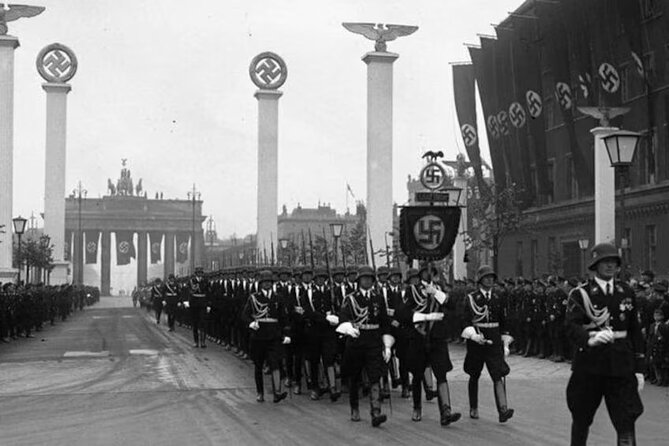
Your guide’s job is to make those connections clear. At one point you are looking at the Reichstag and Brandenburg Gate, symbols used by the Nazi regime for political theater. Later, you are standing near the unmarked site of Hitler’s bunker, then moving on to the former SS and Gestapo headquarters. The places are close enough to walk between, but their meaning changes sharply from stop to stop.
The private format should help if you have a family member who wants detail, a school-age child with a strong interest in the period, or a group that prefers to ask questions without holding up a larger party. One account specifically describes a son with a strong interest in the Third Reich who enjoyed the depth of the visit.
The tone is educational and sober. That is appropriate here. You should not expect theatrical reenactments or light entertainment. You can expect a history lesson set on the streets where the events happened.
More WWII History Tours in Berlin
- Berlin: Third Reich and Cold War 2 Hour Walking Tour
★ 4.9 · 6,830 reviews - Berlin: Sachsenhausen Concentration Camp Tour in English
★ 5.0 · 5,711 reviews - Berlin’s Best: 2 Hour Walking Tour Third Reich and the Cold War
★ 5.0 · 5,486 reviews
Brandenburg Gate and Reichstag: symbols turned into propaganda
The tour begins at Brandenburg Gate on Pariser Platz. The gate is one of Berlin’s best-known landmarks, but the guide uses it as a starting point for Nazi propaganda and the Battle of Berlin rather than treating it as a quick photo stop.
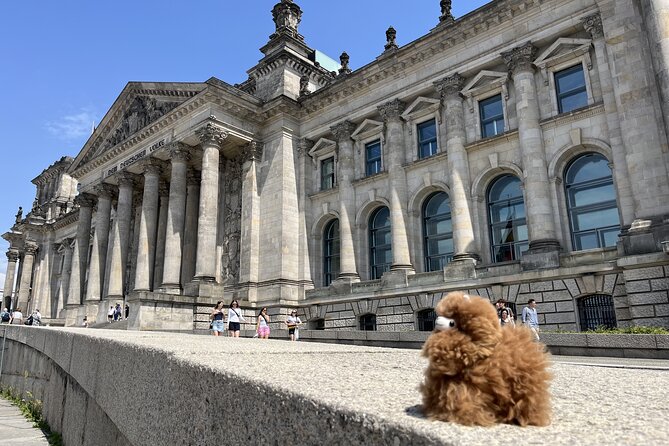
The nearby Reichstag adds another layer. Its role in German politics made it useful for political messaging, and the final battle for Berlin gave the building a lasting place in the story of the war’s end. In about 20 minutes, your guide introduces the political and military setting for the rest of the walk.
This opening is valuable because it gives you a framework. You are not simply hearing isolated facts about buildings. You are learning how Nazi power presented itself in public, then how that power ended in the ruins of the capital.
The stop is outside, and admission is not included. That is not a major problem for this particular tour, since the listed experience is a walking visit rather than an interior tour of the Reichstag. Still, anyone hoping to see the Reichstag dome should know that it is not part of the advertised route.
The Holocaust Memorial: space for reflection
The Memorial to the Murdered Jews of Europe is a short stop of about 10 minutes. Its field of concrete blocks creates a stark setting for discussing the six million Jewish victims of the Nazi regime.
Ten minutes is not long, so you should see this as an introduction rather than a full museum visit. The guide can explain the memorial’s purpose and connect it to the persecution and murder of European Jews, but you may want additional time on your own if this is the part of Berlin you most want to study.
The memorial is one of the tour’s most important stops because it shifts the focus from Nazi power to the human cost of that power. The route does not let military history crowd out the Holocaust. That balance is essential.
Admission is listed as not included. The tour details do not promise an indoor exhibition visit, so confirm your expectations if you want a longer memorial-center experience.
Soviet Memorial Tiergarten: the battle for Berlin in stone and steel
The Soviet Memorial Tiergarten takes about 20 minutes. Its most striking features are the Soviet tanks and artillery displayed at the site, along with the memorial’s tribute to the 80,000 Soviet soldiers who died in the Battle of Berlin.
For you, this stop gives the final battle a physical scale. Numbers can feel abstract in a book, but military hardware and a large commemorative monument make the fighting easier to picture. The stop also adds a Soviet perspective to a route that otherwise concentrates on Nazi Germany and its institutions.
The memorial is a useful counterpoint to the Reichstag and Brandenburg Gate. Those sites help explain how the regime presented itself. This one helps explain the force that defeated it in Berlin.
The visit is listed without an included admission ticket. Since the tour description does not promise entry to an indoor facility here, the key value comes from the guide’s explanation and the monument itself.
More wartime history tours in Berlin:
- Berlin: Sachsenhausen Concentration Camp Memorial Tour
★ 4.7 · 3,716 reviews - Third Reich Berlin: Hitler and WWII Walking Tour
★ 5.0 · 3,301 reviews - Sachsenhausen Concentration Camp Bus Tour in English from Berlin
★ 5.0 · 1,962 reviews - Berlin: Sachsenhausen Concentration Camp Tour in English
★ 4.8 · 1,889 reviews
Hitler’s bunker site: an unmarked place with a heavy story
The tour then reaches the location of the Führerbunker, described as an unmarked site. The stop lasts about 20 minutes and covers Hitler’s final days and the end of the Nazi regime.
The lack of a grand memorial is part of what makes this stop unusual. You are not entering a preserved command center or touring a dramatic ruin. Instead, the guide explains what happened at a place that is easy to miss without context.
That restraint is fitting. The site should not be treated as a shrine, and the unmarked setting keeps attention on the facts rather than on spectacle. Your guide can help separate documented events from the myths and popular images that have grown around Hitler’s final days.
This is also where the tour’s chronological flow becomes clear. You began with public power at the Reichstag and Brandenburg Gate. Now you are at the end of the regime, considering its last decisions and its defeat. The route turns a central Berlin walk into a story with a beginning, middle, and end.
The listed details do not include entry to the bunker site. You are visiting the location and hearing the explanation from outside.
The former Luftwaffe headquarters: a working piece of Nazi-era Berlin
The former Luftwaffe headquarters receives the longest outdoor stop, about 30 minutes. The building is one of the few remaining Nazi-era structures in Berlin and now houses Germany’s Finance Ministry.
That current use is what makes the stop especially interesting. You are not looking at a sealed ruin or a museum reconstruction. You are seeing a surviving government building that has passed through different political eras and now serves a modern democratic state.
The guide can use the building to explain the machinery of Nazi government and military administration. Its survival also raises a practical question for you: how should a city handle structures tied to dictatorship? Berlin’s answer is often to keep the buildings in public view while changing their function and adding historical explanation.
Admission is free. The tour details do not indicate an interior visit, so expect to examine the building from outside unless your guide says otherwise.
Topography of Terror: the tour’s main indoor history stop
The Topography of Terror is the most substantial museum stop, with about 30 minutes and admission included. It occupies the former site of the SS and Gestapo headquarters, making it one of the strongest places on the route for understanding how persecution was organized.
This is where the tour moves from symbols and battlefield sites into the structure of state terror. The former headquarters help show that Nazi crimes were not carried out by a vague force called the regime. They depended on offices, police agencies, orders, records, and people who carried out those orders.
Half an hour is enough for a focused introduction, but it is not enough to study every display in detail. If you have a serious interest in the SS, Gestapo, or the wider Nazi system, you may want to return independently. Still, including admission here is a real benefit. It gives the walking route a place where you can see documentary material rather than relying only on buildings and monuments.
The Topography of Terror also gives the tour a strong ending before you continue to Checkpoint Charlie. The route has moved from propaganda to persecution and then to defeat. The museum helps explain the organized violence behind that story.
Ending at Checkpoint Charlie
The tour ends at Checkpoint Charlie on Friedrichstraße. This former Cold War crossing point is not itself a central World War II site, but it gives the walk a useful postwar endpoint.
The connection is simple: the Nazi dictatorship ended in 1945, but Berlin’s political division continued for decades. Ending at Checkpoint Charlie reminds you that the city’s twentieth-century story did not stop when the war ended.
It is also a practical finish. From here, you are near public transportation and can continue exploring central Berlin. The tour details give no promise of a final museum entry or extended visit, so think of Checkpoint Charlie as the route’s endpoint rather than another long guided stop.
What the private format adds
A private tour changes the experience more than a small headcount alone might suggest. Your guide can adjust the pace, spend longer at a site that matters to you, or answer questions about a particular part of the period.
The named guides associated with the experience include Sven, Alex, Alexander, Sigrid, and Madeleine. One account describes Sven combining the walk with lunch at a location connected to the Nazi period. That detail should not be treated as a standard inclusion, since the advertised tour includes a private guide and personalized route, not lunch. But it does suggest that the company may help shape the day around your interests.
Another account describes a guide called Madeleine leading a special tour in French. The booking information lists English as the offered language, so if you need French, ask before booking rather than assuming it is always available.
The feedback also points to guides with serious academic backgrounds. One account describes a guide as holding a PhD in World War II history. The advertised information does not assign a specific guide to each booking, so you cannot guarantee that exact qualification. You can, however, request a guide who suits the level of detail your group wants.
Is $224.76 per person a fair price?
At $224.76 per person, this is an expensive walking tour if you measure value by admission tickets alone. The Topography of Terror admission is included, the former Luftwaffe headquarters is free, and several other stops are outdoor locations without included admission.
The stronger value comes from the private format. You are paying for a guide dedicated to your group, a personalized route, and an organized explanation of sites that can be difficult to interpret on your own. For two people, the total cost is substantial. For a family or small group, the per-person price may feel more reasonable because the guide’s time is shared only among your party.
I would book it if you care about asking questions and want a connected explanation rather than a quick overview. I would hesitate if you prefer to explore museums at your own speed or mainly want to see Berlin’s landmarks without extended historical discussion.
The six posted ratings produce a 5 out of 5 summary, though the individual display supplied here does not show numerical scores. The strongest praise centers on education, guide quality, and the personal attention of the experience. Alex is described as amazing, Alexander as a strong guide for a serious lesson, and Sigrid as helping make the subject accessible during a wider European trip.
Who will get the most from this walk?
This tour suits you if you:
- Want a focused introduction to Nazi Berlin and World War II.
- Prefer a private conversation to a large group.
- Have children or teenagers who are already interested in the period.
- Want to connect political buildings, memorials, battlefield history, and Nazi institutions.
- Value a guide who can recommend places to eat or suggest further sites after the walk.
- Need a route that uses central Berlin landmarks as a clear historical framework.
It may not suit you if you want a light city walk, extensive indoor museum time, or a full-day study of the Holocaust. The short 10-minute memorial stop and 30-minute museum visit provide structure, but they cannot replace a longer visit to Berlin’s major historical museums.
Most people can participate, service animals are allowed, and the route is near public transportation. The experience is offered in English according to the supplied booking details. Confirmation is received at booking, and free cancellation is available up to 24 hours before the start time. Changes or cancellations inside that window are not accepted for a refund.
Should you book it?
Book this tour if you want Berlin’s Nazi and World War II sites explained as one connected story, with a private guide who can adjust the discussion to your group. The route is especially useful on a first visit, when the city’s memorials and government buildings can otherwise seem disconnected.
The price is the deciding factor. You are not buying a long list of included admissions. You are buying three hours of private interpretation, with the Topography of Terror included and several powerful outdoor sites along the way. For a family with a serious interest in the period, or for anyone who wants a focused and respectful lesson, that can be worthwhile. If you mainly want free landmarks and brief facts, choose a less costly option and spend the difference on extra museum time.
FAQ
Where does the tour begin?
The tour begins at Brandenburg Gate, at Pariser Platz, 10117 Berlin, Germany.
Where does the tour end?
The tour ends at Checkpoint Charlie, at Friedrichstraße 43-45, 10117 Berlin, Germany.
How long is the walking tour?
The tour lasts approximately three hours.
Is the tour private?
Yes. Only your group participates, and the experience includes a private guide and a personalized route.
What language is offered?
English is listed as the offered language. One account describes a special tour in French with a guide named Madeleine, so ask about French availability before booking if that matters to you.
Is admission included?
Admission to the Topography of Terror is included. Admission is not included at the Reichstag and Brandenburg Gate stop, the Holocaust Memorial, or the Soviet Memorial Tiergarten. The former Luftwaffe headquarters stop is listed as free.
Does the tour enter the Reichstag?
The supplied details describe a 20-minute stop at the Reichstag and Brandenburg Gate, but they do not state that interior entry or a visit to the dome is included.
Does the tour enter Hitler’s bunker?
The tour visits the unmarked location of the Führerbunker and discusses Hitler’s final days. The supplied details do not describe entry into the bunker.
Is the tour suitable for most people?
Yes. Most people can participate, and service animals are allowed. The experience is also near public transportation.
Can I cancel for a full refund?
Yes, if you cancel at least 24 hours before the experience begins. Cancellations or changes made less than 24 hours before the start time are not refunded.
More Walking Tours in Berlin
- Discover Berlin Half-Day Walking Tour
★ 5.0 · 9,624 reviews - Berlin: Discover Berlin Walking Tour
★ 4.9 · 5,998 reviews - Berlin: Hidden Backyards Guided Walking Tour
★ 4.8 · 5,360 reviews - Berlin: Alternative Berlin Walking Tour
★ 4.6 · 1,204 reviews
Just added around Berlin
- eSIM for Germany and 34 European Countries★ 4.5 · 16 reviews
- Your ticket to The Wall Museum Berlin★ 3.0 · 60 reviews
- Walking on the Wall: 3-Hour Tour in Berlin★ 4.5 · 34 reviews
- Rickshaw Tours Berlin – Groups of up to 16 people with several rickshaws★ 4.0 · 97 reviews
- Warnemuende Shore Excursion: Private Berlin Tour★ 4.5 · 27 reviews
- Love and War in Berlin: Self-Guided Story Puzzle Walk★ 5.0 · 7 reviews
- Warnemuende Shore Excursion: Berlin Private Sightseeing Tour from Rostock★ 5.0 · 4 reviews
- Cold War Berlin – Private Live Virtual Experience★ 5.0 · 4 reviews
Berlin Tours, compared.

Reichstag, Dome and Government District Guided Tour
Read our review →
1-Hour City Tour by Boat with Guaranteed Seating
Read our review →




Reichstag, Plenary Chamber, Cupola & Government Tour
Read our review →
Browse the lists this tour appears in