
Review · BERLIN TOURS
Private Walking Tour Berlin Third Reich Hitler and World War II
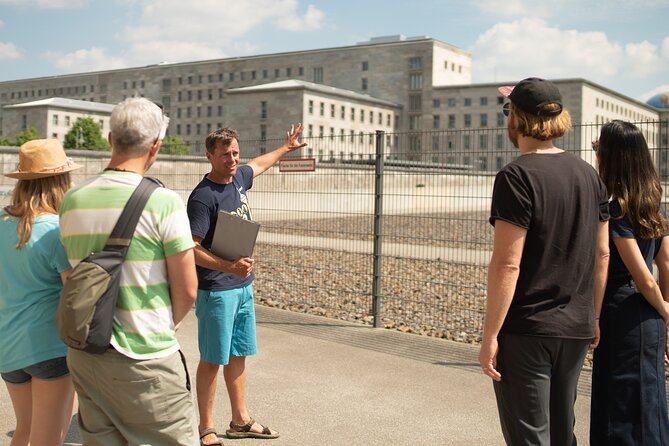
Berlin’s Nazi past is not confined to one museum. It is spread across ordinary streets, government buildings, train stations, memorials, and empty patches of ground. This private tour connects those scattered places, from the Soviet Memorial in Tiergarten to the site of the Führerbunker, giving you a clear route through Hitler’s rise, the machinery of terror, the war’s final days, and Germany’s effort to remember.
I like the private format, since your guide can adjust the pace, skip places you already know, and answer the questions that matter to your group. I also like the hotel pickup and drop-off, a real help when you are dealing with a large city and a serious subject. The main drawback is the amount covered in three to four hours. Several stops are brief, and the most important indoor sites deserve a longer return visit.
- The Führerbunker site and Holocaust Memorial provide two of the tour’s most sobering moments.
- The private guide can tailor the route, with guides such as Daniel, Jimmy, Emma, Jasper, Simon, and Georgia praised for clear explanations and flexibility.
- The Topography of Terror and German Resistance Memorial Center add substance beyond the usual Hitler landmarks.
- Hotel pickup and drop-off save time, though exact meeting arrangements should be confirmed.
- The tour covers 12 locations, so expect a fast-moving overview rather than long museum visits.
- The $192.97 price is easiest to justify for a small group, especially if you value a private guide and customized pacing.
A three-hour route through Berlin’s Nazi past
This is not a casual city stroll. The subject is the Nazi dictatorship, the Holocaust, the Second World War, and the destruction of Berlin. You will spend much of the tour outdoors, moving between sites that often look surprisingly ordinary today.
That contrast is one of the tour’s strengths. A modern office building may occupy the former headquarters of a Nazi ministry. A quiet square may mark a notorious book burning. A nondescript area near Potsdamer Platz may conceal the site of Hitler’s final refuge.
The itinerary lists 12 stops, with visits generally lasting 10 to 20 minutes. That timing tells you how the tour works. You get the historical setting and the guide’s explanation at each place, then move on. The Topography of Terror and German Resistance Memorial Center are especially valuable, but you may want to return to them later for a slower look.
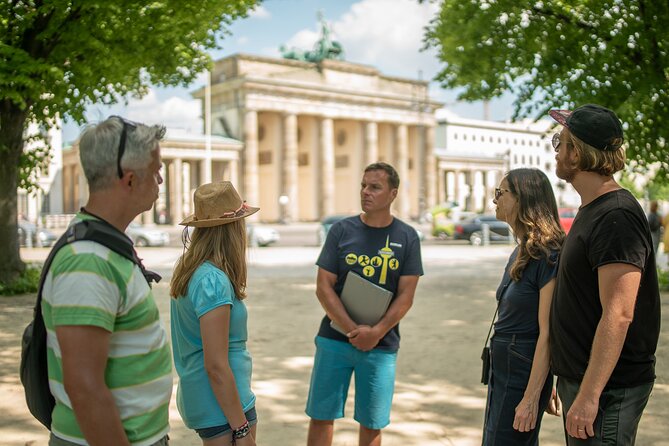
The tour is offered in English and is private, meaning only your group participates. The operator also accommodates hotel pickup and drop-off. Some experiences described by customers began at a hotel even when the meeting point was not initially obvious, so I would confirm the pickup details when booking.
Beginning at the Soviet Memorial in Tiergarten
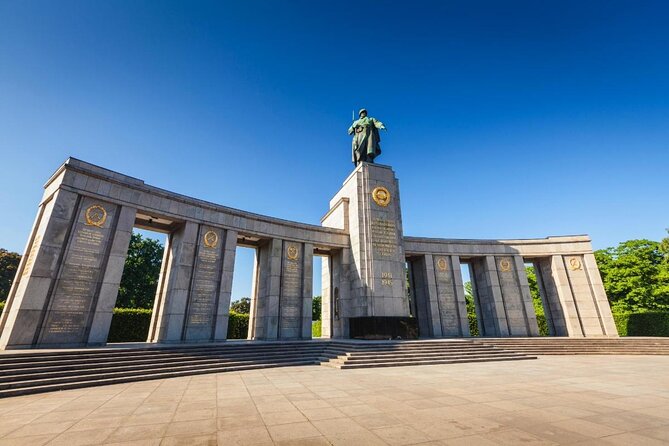
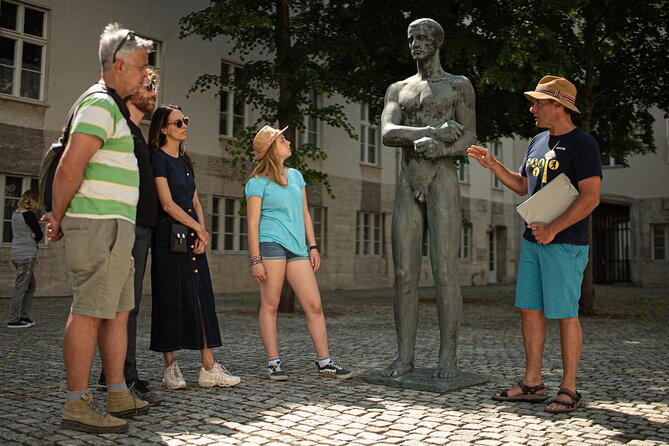
The Soviet Memorial in Tiergarten opens the tour with the Battle of Berlin and the final defeat of Nazi Germany. Built in 1949, the memorial honors Soviet soldiers who died during the 1945 battle.
The large statue of a Soviet soldier, holding a sword and shield, gives the place a clear message of victory and sacrifice. Your guide can explain the Soviet Army’s role in the defeat of Germany and the memorial’s place in both Soviet and German memory.
The stop is listed at about 10 minutes. That is enough for an introduction and a few questions, but not a long examination of the site. Its location in Tiergarten also offers a useful reminder that major wartime events took place in areas that are now parks, roads, and everyday city spaces.
More WWII History Tours in Berlin
- Berlin: Third Reich and Cold War 2 Hour Walking Tour
★ 4.9 · 6,830 reviews - Berlin: Sachsenhausen Concentration Camp Tour in English
★ 5.0 · 5,711 reviews - Berlin’s Best: 2 Hour Walking Tour Third Reich and the Cold War
★ 5.0 · 5,486 reviews
Wilhelmstraße and the machinery of Nazi government
Wilhelmstraße was the center of German government during the Nazi period. Walking along it helps you see how dictatorship operated through ministries, offices, paperwork, military planning, and propaganda, not only through dramatic speeches and battlefield decisions.
The Detlev-Rohwedder-Haus, once built for the Reichsbank and later used by the Ministry of Aviation under Hermann Göring, is one of the key buildings here. Your guide can explain how economic and political power worked inside the Third Reich and point out how the building changed after the war, when it became the German Federal Treasury.
The Aviation Ministry stop lasts about 10 minutes, while the wider walk along Wilhelmstraße is listed at around 20 minutes. That combination gives you a compact look at the avenue and its surviving structures. Do not expect to enter the former ministry as part of the tour. The value is in reading the street with historical context.
Topography of Terror: the strongest museum stop
The Topography of Terror is located on the former grounds of the SS and Gestapo headquarters. Its indoor and outdoor exhibitions use photographs, documents, and personal accounts to show how Nazi political repression worked.
This is one of the most important stops because it shifts the focus away from Hitler alone. You learn about the institutions that arrested opponents, enforced Nazi rule, and used fear against people who resisted or were simply targeted by the regime.
The planned visit is about 20 minutes, which is short for the material on display. I would treat the tour stop as an introduction, then return independently if your schedule allows. One customer specifically used the tour’s brief visit to plan a longer visit the next day.
A good guide matters here. Simon was praised for explaining the sites clearly and for giving practical suggestions about places to revisit. The private format also lets you ask about a photograph, document, or event that catches your attention instead of following a fixed group script.
The German Resistance Memorial Center at Bendlerblock
At the Bendlerblock, the German Resistance Memorial Center honors people who opposed the Nazi regime. The focus includes Claus von Stauffenberg and the July 20, 1944, attempt to assassinate Hitler.
This stop adds needed balance to the story. It does not soften the scale of German support for or cooperation with Nazism, but it shows that resistance took different forms and that people faced grave personal risks when they opposed the dictatorship.
The memorial area is intended for reflection, and the visit lasts around 20 minutes. Your guide can explain the motives, choices, and consequences faced by those involved. That human scale is useful for families and students, since it moves the discussion from dates and military operations to moral responsibility.
More wartime history tours in Berlin:
- Berlin: Sachsenhausen Concentration Camp Memorial Tour
★ 4.7 · 3,716 reviews - Third Reich Berlin: Hitler and WWII Walking Tour
★ 5.0 · 3,301 reviews - Sachsenhausen Concentration Camp Bus Tour in English from Berlin
★ 5.0 · 1,962 reviews - Berlin: Sachsenhausen Concentration Camp Tour in English
★ 4.8 · 1,889 reviews
Bebelplatz and the danger of censorship
Bebelplatz is associated with the Nazi book burning of May 10, 1933. Thousands of books considered un-German were destroyed there, making the square a lasting reminder of censorship and the attack on free expression.
The square is also framed by major buildings, including the State Opera House and Humboldt University. Beneath the pavement, an empty bookshelf memorial symbolizes the lost literature. From street level, the memorial can be easy to miss, which is exactly why a guide adds value.
The stop takes about 10 minutes. You will not spend long studying the square, but the setting offers a clear lesson: authoritarian control begins with ideas, language, and the removal of competing voices, long before the most extreme violence occurs.
The Reichstag and the Reichstag Fire
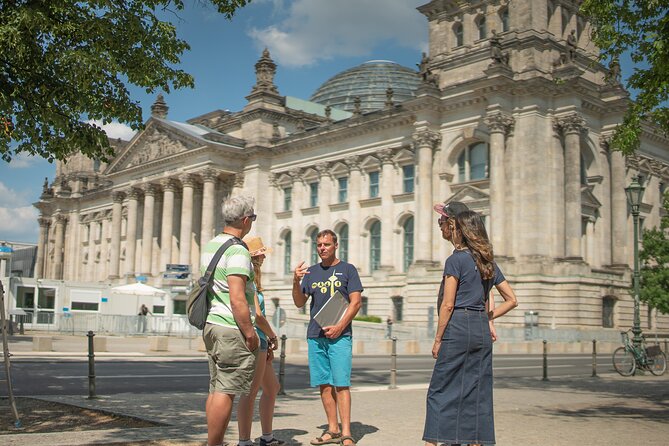
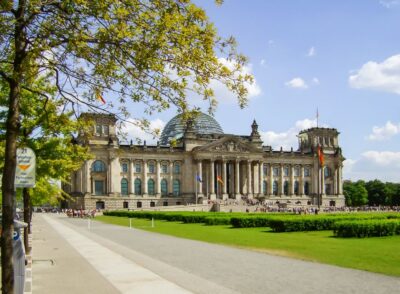
The Reichstag connects Imperial Germany, the Nazi seizure of power, wartime destruction, and modern democracy. Completed in 1894, the building became central to the political crisis that followed the Reichstag Fire in 1933.
Your guide will explain how the Nazis used the fire to suppress opposition and strengthen their control. You will also hear how the building was damaged during the war and later restored as a symbol of democratic government.
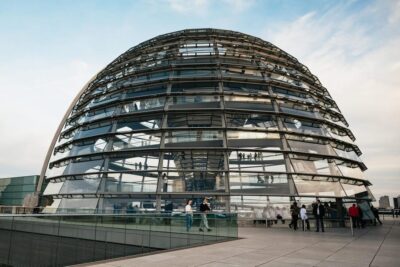
The listed visit lasts around 15 minutes, and admission is not included. This is an exterior-focused historical stop unless separate entry has been arranged. The tour is not a visit to the Reichstag dome, so if you want the glass cupola and interior, plan that separately.
The Holocaust Memorial and a necessary pause
The Memorial to the Murdered Jews of Europe is made up of 2,711 concrete slabs, or stelae, set in a grid. They vary in height and create an unsettling sense of disorientation as you walk among them.
Your guide will place the memorial within the history of Nazi persecution and the murder of Europe’s Jews. The space is open to individual interpretation, but it should not be treated as a photo backdrop or rushed through like any other sightseeing stop.
The official stop is about 15 minutes. I would allow yourself quiet time here, even if that means separating briefly from the group or returning later. The tour gives you the context; your own response to the memorial may take longer.
The Führerbunker site and the final days of the regime
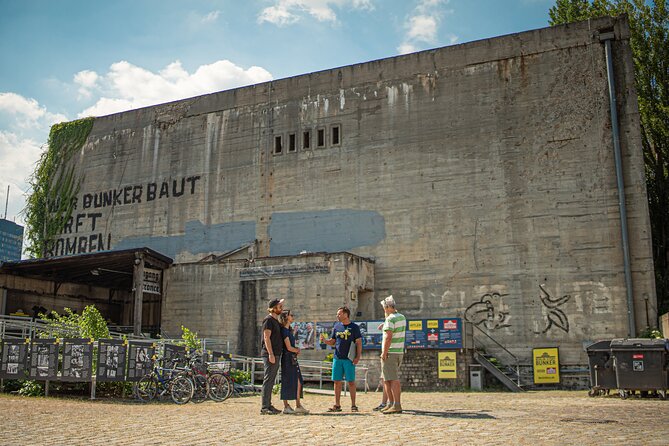
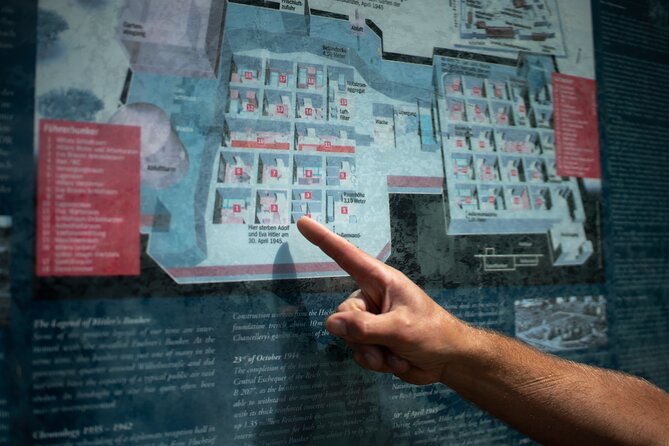
The Führerbunker stop is unusual because there is no grand surviving entrance to explore. You stand above the former underground complex, which served as Hitler’s last refuge during the final months of the war.
Much of the original structure was destroyed after 1945. The location is now intentionally understated, and that absence is part of the lesson. Your guide can describe the bunker’s layout, the decisions made there, and the atmosphere as Soviet forces closed in on Berlin.
The visit lasts about 10 minutes. Do not book this expecting an underground attraction or preserved rooms. Its purpose is to locate the final scene of the Nazi leadership and consider the consequences of totalitarian power, not to glorify Hitler or turn the site into a spectacle.
Anhalter Bahnhof and the reality of deportation
Anhalter Bahnhof was once one of Berlin’s major railway stations. During the Nazi period, it became connected with the forced transportation of Jews toward concentration camps.
Today, the remaining façade and memorial elements make the location a powerful place to discuss deportation. Railway history can feel abstract until you connect it to families being separated and sent away from a familiar city.
The stop lasts about 10 minutes. The station is important for the human story, but the short visit means your guide will need to be selective. Listen for the link between ordinary transport systems and state persecution. The Nazi regime relied on administration, schedules, police orders, and railway movements as well as violence.
The T4 Memorial and Nazi murder of disabled people
The T4 Memorial at Tiergartenstraße 4 commemorates victims of the Nazi euthanasia program. The program targeted people with mental illnesses and disabilities who were labeled unworthy of life.
This is one of the tour’s most important stops because it introduces a part of Nazi crime that receives less attention than the Holocaust and the war. It also raises direct questions about medical ethics, discrimination, state power, and the danger of stripping people of their human dignity.
The memorial includes design elements and information about the program and its victims. The planned visit is about 10 minutes, so the guide provides the framework rather than a full museum session. I find this stop especially useful for anyone studying how Nazi persecution expanded from political opponents to groups defined by ideology and prejudice.
Moltkebrücke and the Battle of Berlin
The Moltkebrücke is linked to the final battle for Berlin. Soviet forces crossed the bridge in 1945 during their assault on the city, making it a useful location for explaining how the war ended on Berlin’s streets.
Your guide can describe the fighting nearby, the Soviet advance, and the changing military situation during the last days of the Nazi regime. Unlike a memorial museum, the bridge gives you a physical sense of movement and strategy. You can see why crossings and routes mattered during an urban battle.
The stop is scheduled for about 10 minutes. It is best understood as part of the larger sequence, not as a major attraction on its own. After hearing the story, the bridge becomes a marker of how quickly the Nazi state’s control collapsed.
What the private format adds
A private tour is most useful here because the subject is dense and personal. You can ask for more detail about the Holocaust, military history, resistance, Nazi architecture, or the Cold War without waiting for a group to catch up.
The guide can also change the emphasis. Daniel met one group at its hotel, asked what they wanted to see, and formed a plan around those interests. Georgia adjusted her route from a hotel starting point and ended near the Berlin Wall, while other guides adapted the pace or avoided places guests had already visited.
Names praised for their teaching, storytelling, and flexibility include Jimmy, Daniel, Emma, Jasper, Simon, Georgia, Oren, Tobi, Callum, Martin, Ariel, Maria, Xavier, Artie, and Mikhaïl. You are not guaranteed a particular guide, but these comments show the range of guiding styles available. Some guides focus tightly on the Third Reich and WWII; others connect the period to the Cold War and modern Berlin.
The best guides make room for questions. That matters more than simply reciting dates. You should feel free to say if you need a slower pace, more explanation, or a change in emphasis.
Price, pace, and practical value
At $192.97 per person, this is expensive for a walking tour if you are traveling alone or as a couple. The price becomes easier to defend for a family or small group, since you are paying for a private guide rather than several individual public-tour tickets.
Hotel pickup and drop-off add convenience, especially if you are staying outside central Berlin or want to avoid figuring out the first meeting point. Food and drinks are not included, and admission is not included for the Reichstag. The listed stops themselves are free.
The tour operates in all weather, so bring suitable clothing and shoes. The route involves outdoor walking, and one group reported reaching roughly 10,000 steps. Another group found the experience worthwhile even in very cold conditions, but cold, rain, or heat will affect how much you enjoy a long history lesson outside.
Most people can participate, and the tour is near public transportation. The schedule may use walking along with city transport between areas, as the route covers a wide section of Berlin. Ask the operator how your specific pickup and route will work if mobility or weather is a concern.
The experience is highly rated, with a stated 5.0 rating from 360 reviews and a 99 percent recommendation rate. Those numbers do not remove the need to choose carefully, but they match the strongest pattern in the feedback: guides are valued for clear teaching, warm personalities, and the ability to shape the tour around a group.
Who should book this Berlin history tour?
You should consider it if this is your first serious visit to Berlin’s Nazi-era sites and you want the geography explained as you go. It also suits families with older children, history students, and anyone who prefers asking questions instead of listening to a fixed script.
It is a good choice if you have only one day for this subject. The route links sites that would be difficult to organize efficiently on your own, and the guide helps explain how they fit together.
You may prefer a museum-focused tour if you want hours inside exhibitions. The short stops at Topography of Terror and the German Resistance Memorial Center are useful introductions, but they are not substitutes for a full visit.
You should also think about emotional stamina. The Holocaust Memorial, Anhalter Bahnhof, T4 Memorial, and Führerbunker site make this a heavy morning or afternoon. The subject deserves attention, and the pace may leave little room to process each stop before moving on.
Should you book it?
Book this tour if you want a personal, fast-moving introduction to Berlin’s Third Reich and WWII sites, especially with a family or small group. The combination of hotel service, a private English-speaking guide, and a flexible route gives it real value when time is short.
Do not book it expecting a preserved bunker, extended museum visits, or a relaxed sightseeing walk. Think of it as a well-connected historical framework. Use the tour to understand the city, then return to the Topography of Terror, Holocaust Memorial, Reichstag, or Resistance Memorial Center on your own for more time.
Free cancellation is available up to 24 hours before the start time. Changes or cancellations made later are not accepted for a refund.
FAQ
How long does the private Berlin Third Reich tour last?
The tour lasts approximately three to four hours.
What language is the tour offered in?
The tour is offered in English.
Is hotel pickup included?
Yes. Hotel pickup and hotel drop-off are included.
Is the tour private?
Yes. Only your group participates in the activity.
Is admission to the Reichstag included?
No. Admission to the Reichstag is not included.
Are food and drinks included?
No. Food and drinks are not included.
Can I cancel for a full refund?
Yes, if you cancel at least 24 hours before the experience starts. Cancellations made less than 24 hours before the start time are not refunded.
More Walking Tours in Berlin
- Discover Berlin Half-Day Walking Tour
★ 5.0 · 9,624 reviews - Berlin: Discover Berlin Walking Tour
★ 4.9 · 5,998 reviews - Berlin: Hidden Backyards Guided Walking Tour
★ 4.8 · 5,360 reviews - Berlin: Alternative Berlin Walking Tour
★ 4.6 · 1,204 reviews
Just added around Berlin
- From Berlin: Gardens & Palaces of Potsdam Bike Tour★ 5.0 · 61 reviews
- Berlin: Battle for Seelow Heights WW2 tour -Clash of Titans★ 5.0 · 27 reviews
- From Berlin: Historical Gems of Potsdam Private Day Trip★ 4.4 · 4 reviews
- Berlin: Französischer Dom 360° Panorama & Crémant to go★ 3.9 · 5 reviews
- Explore Berlin Tour: History and Highlights★ 4.7 · 5 reviews
- Berlin: Evening Yacht Cruise with Aperitif & Dinner Upgrade★ 4.6 · 178 reviews
- Berlin: Expats in Berlin Comedy Show Ticket★ 4.7 · 182 reviews
- Berlin: The Epic Comedy Club Friday Night Showcase★ 4.8 · 28 reviews
Berlin Tours, compared.
Reichstag, Dome and Government District Guided Tour
Read our review →
1-Hour City Tour by Boat with Guaranteed Seating
Read our review →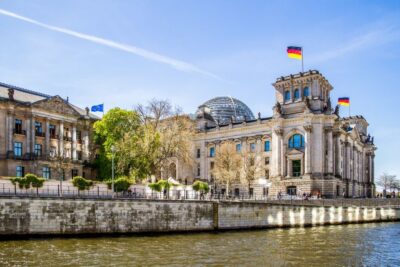
Reichstag, Plenary Chamber, Cupola & Government Tour
Read our review →
Browse the lists this tour appears in