
Review · BERLIN TOURS
Private Sachsenhausen Concentration Camp tour with train
Sachsenhausen is not a sightseeing stop you simply check off. It is a place built to show how Nazi power turned imprisonment, forced labor, and murder into a system. I like that this private tour begins on the train, where your guide can explain the camp’s place in Nazi Germany before you reach the memorial. I also like the personal pace: guides such as Martin, Ioana, Maria, Klaus, and Natalie have been praised for answering questions, adjusting their approach, and knowing when to pause. The catch is the long day on foot, often 11,000 to 16,000 steps, with uneven pavement and a train journey rather than a private car.
You pay about $338.15 per person, a serious price for a six-hour outing. The value comes from door-to-door help, a private guide, and historical explanation that starts before you enter the camp. If you mainly want transportation or a quick look around, a cheaper group option may suit you better.
Key points to know before booking
- The train ride is part of the tour: You travel from Berlin to Oranienburg by public transportation, not in a private vehicle.
- The guide stays with your group: This is a private experience, so you can ask questions and set the pace within the available time.
- Oranienburg adds local context: The town was tied to the camp through forced labor and businesses involved in Nazi war production.
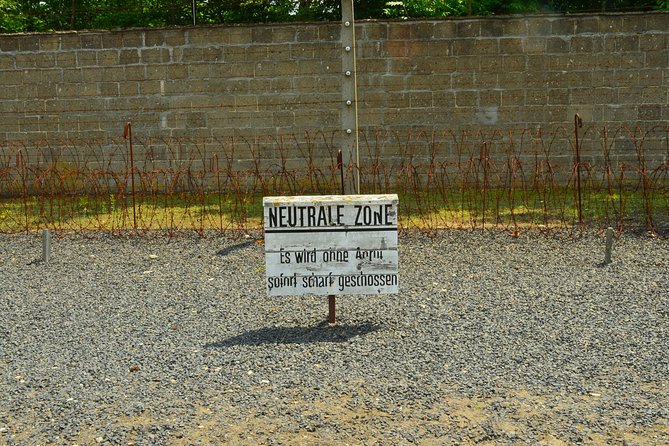
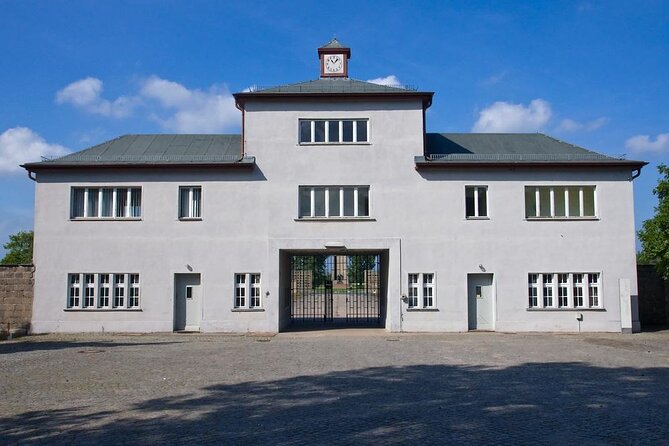
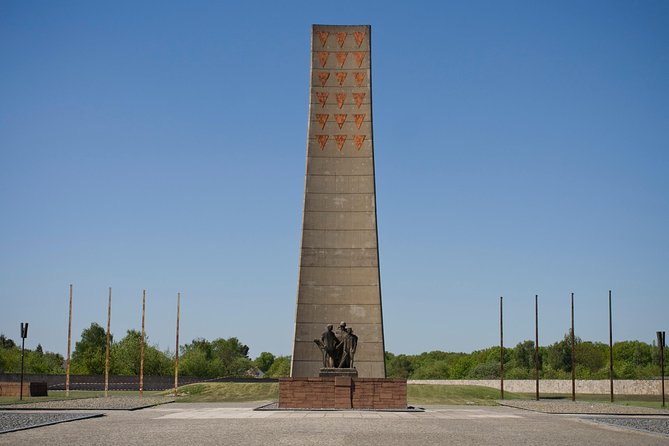
- Expect a sobering visit: The camp memorial includes places such as Tower A, the roll call square, and Station Z, each carrying heavy historical meaning.
- Plan for walking: The route can reach 11,000 steps or more, and much of the ground is uneven.
- Bring water and food: Amenities are limited during much of the day, and lunch is not included.
Why Sachsenhausen deserves a full day from Berlin
Berlin has no shortage of Nazi and Second World War sites. Sachsenhausen is different because you are not only viewing documents or reconstructed rooms. You are walking through the grounds of a concentration camp, seeing how its layout and surviving structures supported control, punishment, forced labor, and killing.
The camp was built just north of Berlin in 1936, during the period when Nazi Germany hosted the Olympics. Prisoners were forced to construct the new camp, which was intended for political enemies of the regime. Over the next decade, about 200,000 people were imprisoned there.
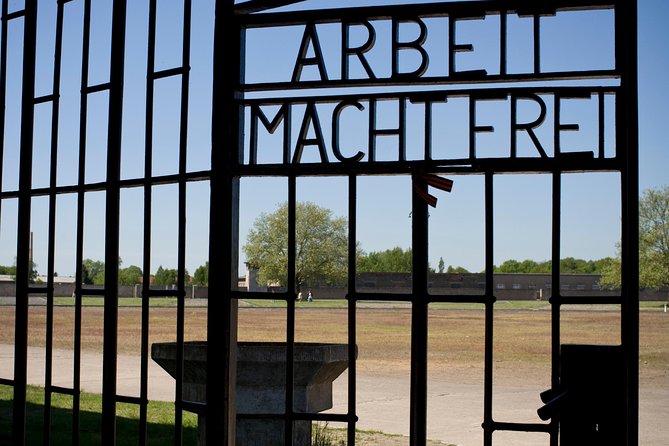
That number matters, but the physical setting makes the system easier to understand. The triangular design, the controlled entrance at Tower A, the roll call square, the barracks, and Station Z show how architecture served Nazi authority. Your guide can connect these points to the daily routine of prisoners and to the wider growth of the concentration camp network.
This is a memorial, not a theme park or a dramatic performance. The right guide gives you facts without turning suffering into spectacle. The strongest guides on this tour, including Martin, Ioana, Xavier, Daniel, Paul, and Chloe, have been praised for explaining difficult material clearly while allowing quiet when words are not enough.
More WWII History Tours in Berlin
- Berlin: Third Reich and Cold War 2 Hour Walking Tour
★ 4.9 · 6,830 reviews - Berlin: Sachsenhausen Concentration Camp Tour in English
★ 5.0 · 5,711 reviews - Berlin’s Best: 2 Hour Walking Tour Third Reich and the Cold War
★ 5.0 · 5,486 reviews
The train from Berlin to Oranienburg
The tour begins with pickup at your hotel. Your guide then accompanies you through Berlin’s public transport system and onto the train to Oranienburg. That arrangement has two clear benefits: you do not need to find the memorial alone, and the history begins before you arrive.
The train ride also gives your guide time to explain how Sachsenhausen fitted into Nazi rule, the rise of Hitler, and the use of concentration camps against political opponents and other targeted groups. Some guides also add information about Berlin and the surrounding area, which helps you see the camp as part of a working region rather than an isolated site.
You should understand the transport arrangement before paying. Hotel pickup and drop-off mean your guide meets you and escorts you through the journey. They do not necessarily mean a private car. The tour title makes clear that the trip is by train, and one disappointing experience came from expecting a vehicle.
Train tickets may be handled differently by the guide or operator, so ask what is included before departure. Some guides have supplied transit passes or return tickets, while another booking involved guests already having their own tickets. This is a small detail, but it can affect the price and your peace of mind.
After arriving in Oranienburg, you may walk toward the memorial, take a local bus, or use a taxi depending on the guide’s plan and the needs of your group. The walk from the station can take around 20 to 25 minutes. A taxi may cost about 6 euros each way, based on one reported experience, but that cost is not listed as included.
Oranienburg and the local story
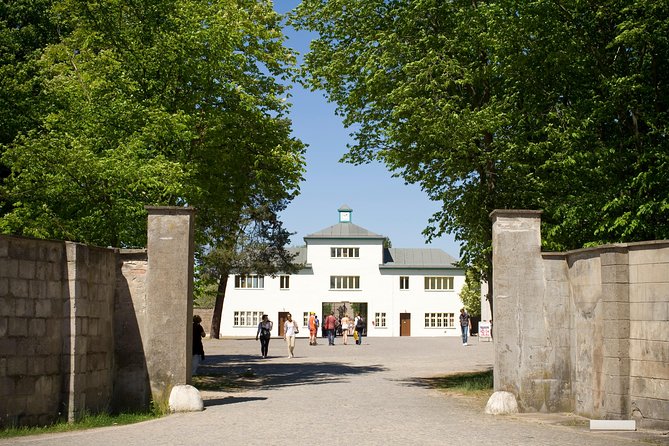
The short walk through Oranienburg is more useful than it may first sound. The town was closely connected to Sachsenhausen, both because of its location and because local businesses used prisoners as forced labor.
Factories in the area, including those making war materials, relied on the camp’s prisoner workforce. That means the camp was not cut off from ordinary life. Economic activity and Nazi persecution existed side by side, with some residents directly involved and others aware of what was happening but unwilling to confront it.
Your guide can use Oranienburg to explain how forced labor supported the Nazi war effort. This part also raises an uncomfortable question: how much did nearby communities know, and what did they choose to ignore?
The town segment lasts about 25 minutes and has no separate admission fee. It is not the main event, but it gives the memorial a wider setting. I would keep it, especially if you want to understand how the camp functioned within the local economy.
Entering the Sachsenhausen Memorial
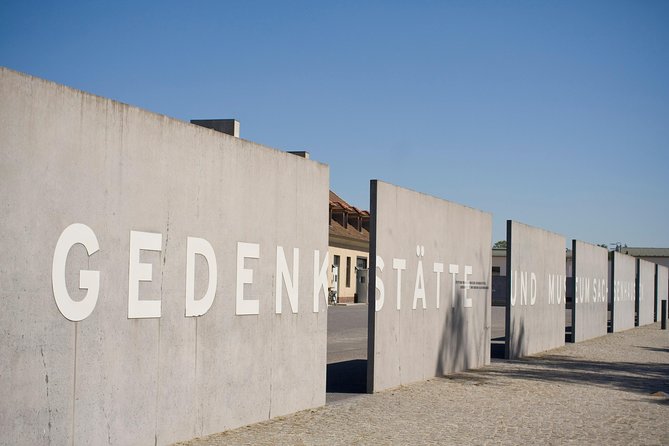
The main visit lasts roughly three hours across the planned memorial stops. The first portion introduces the Memorial and Museum Sachsenhausen, followed by a longer walk through the former camp grounds with your guide.
The camp entrance is one of the first places that carries real force. Tower A was the controlled gateway into the site, while Station Z was presented by the Nazi system as the final destination for prisoners selected for murder. The contrast between the official entrance and the killing facility helps explain the deliberate design of the camp.
The roll call square is another key stop. Prisoners could be forced to stand there for long periods, sometimes in severe weather, while guards counted them. Your guide may explain how roll calls, punishment, forced labor, and overcrowding worked together to break people physically and mentally.
Barracks and living areas show the cruelty of overcrowding. One account used during the tour described around 700 prisoners being packed into a barrack designed for about 150. Numbers like these are difficult to grasp until you connect them with the small spaces, poor conditions, and forced routines on the ground.
The memorial also addresses forced labor designed not simply to produce goods, but to wear prisoners down. Work could be pointless, punishing, or structured to reduce a person to physical usefulness. A good guide explains this without rushing from one grim fact to the next.
More wartime history tours in Berlin:
- Berlin: Sachsenhausen Concentration Camp Memorial Tour
★ 4.7 · 3,716 reviews - Third Reich Berlin: Hitler and WWII Walking Tour
★ 5.0 · 3,301 reviews - Sachsenhausen Concentration Camp Bus Tour in English from Berlin
★ 5.0 · 1,962 reviews - Berlin: Sachsenhausen Concentration Camp Tour in English
★ 4.8 · 1,889 reviews
Survivor testimony and the human scale
Dates and statistics are necessary, but they are not enough. The best part of a private tour is the chance to ask how the system affected ordinary prisoners, families, and communities.
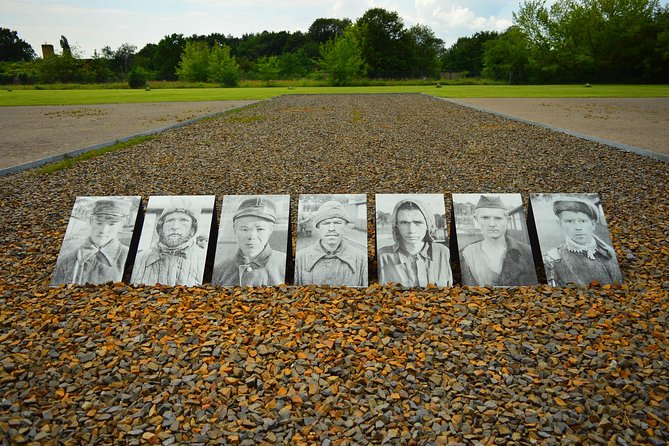
Guides on this experience bring in survivor testimony to give the site a human scale. One image describes a prisoner feeling like an insect trapped in a jar. Another stresses that survival depended on hope and community, because a person could not survive a camp alone.
These accounts should not be treated as decoration. They help you understand that prisoners were not a single group with one experience. People came from different countries and backgrounds, and their treatment could vary according to Nazi racial and political categories, assigned work, health, and the decisions of guards.
The tour also explains the SS system that ran the camp and the deliberate dehumanization behind it. You learn about the camp’s leadership, daily operation, punishment, and the larger Nazi plan. One of the most valuable features is the way guides connect individual suffering to institutional decisions.
Because the tour is private, you can spend longer at a particular section if you need to, or ask for more context when a subject is unclear. Guides have been praised for tailoring the depth to a family’s age, background, and interest. That flexibility is hard to get in a large group.
The Soviet special camp after 1945
Sachsenhausen’s story did not end when Nazi Germany collapsed. After the camp was evacuated by the Soviets in 1945, the site was used for another five years as a Soviet special camp.
Around 60,000 people were imprisoned there during that period, including Nazi war criminals and collaborators. This later chapter can complicate a simple good-versus-evil reading of the site. It does not erase the Nazi crimes, but it shows how a place of imprisonment continued to serve another political system after the war.
Several guides also explain life in communist East Germany and the way the memorial was treated and preserved. Martin, who grew up in the area and worked at the memorial, has been singled out for his local understanding of both Sachsenhausen and East German history.
I value this section because it places remembrance within a longer political story. Memorials are shaped by the governments and societies that maintain them. Understanding that helps you think more carefully about what is displayed, what is emphasized, and how public memory changes.
The guide makes or breaks the experience
A private tour is only as good as the person leading it. Here, the guide quality appears to be the strongest reason to pay more.
The praised guides have different styles. Klaus has been noted for arriving early, offering useful Berlin tips, and knowing when to stop talking. Natalie adjusted the route for a family member using a wheelchair. Chloe allowed extra time at specific areas and kept a group of eight from feeling hurried. Walid arranged taxis when several people struggled with the walking.
Other guides, including Maria, Xavier, Daniel, Paul, Nickolai, Hannah, Taylor, Brian Bell, Pip, and Ioana, have been praised for historical detail, clear explanations, patience, and respectful presentation. You should not assume you will receive one particular guide, but the range of strong names suggests that the operator has a substantial team.
A private guide can also adjust the emotional pace. This is not about making the subject easier. It is about giving you room to think, ask questions, or remain quiet without feeling that you are holding up a large group.
The operator is highly rated, with a 4.9 score from 205 reviews and recommendation from 99 percent of customers. Those numbers point to consistent satisfaction, but they do not remove the main question of value: do you want personal guidance enough to justify the cost?
Walking, weather, and basic comfort
The physical demands deserve plain warning. This is a large site, and the route from the train station or bus stop adds distance before the memorial visit even begins.
You might walk around 11,000 steps on a typical outing. One particularly long day reached 16,000 steps by the time the guest returned to the hotel. Uneven pavement can be tiring, especially in rain or cold.
Wear sturdy, comfortable shoes. Bring water, and pack food because meals and drinks are not included and amenities can be limited for much of the day. A small lunch is sensible.
The tour is not recommended for people with limited mobility or walking impairments. That is the official guidance, but the practical picture is more flexible. Natalie found an accessible route for a wheelchair user, and other guides have arranged taxis to reduce the hardest stretches. You should discuss your needs before booking rather than rely on a last-minute solution.
Weather matters too. You are outside for long periods, and one guide kept the tour useful through heavy rain and storms. Still, bring suitable clothing and do not expect the memorial to feel comfortable in bad weather.
Is $338.15 per person fair?
At $338.15 per person, this is not a budget day trip. You are paying for a private English-speaking guide, hotel pickup and drop-off, transport assistance, and roughly six hours of concentrated attention.
The value is strongest for families, couples, and small groups who want to ask many questions or need a flexible pace. It is also useful if you are uneasy about navigating regional trains, Oranienburg, and the walk to the memorial on your own.
The value is weaker if you are comfortable with public transportation, happy to use a museum audio guide, or mainly want a ride to the camp. A group tour or a cheaper option with bus transportation may leave more money for other Berlin sights.
Remember that food and drinks are not included. Train arrangements should also be confirmed. The tour offers free cancellation up to 24 hours before the start time, but changes or cancellations inside that window are not refunded.
Who should book this Sachsenhausen tour?
I would choose this tour if you want the camp explained in its Nazi and postwar context, not just pointed out stop by stop. It suits people who value a serious guide, want to ask questions, and prefer hotel-to-hotel assistance.
It is especially helpful for a family group with mixed knowledge of German history. A guide can explain difficult ideas at the right level and point out other historical places in Berlin along the way.
I would hesitate if you dislike public transportation, need a vehicle rather than a train, or have limited stamina. You can sometimes reduce the walking with taxis, but that may add cost and cannot change the basic size of the memorial.
Should you book it?
Book this private Sachsenhausen tour if personal attention, careful historical context, and help with the journey matter more to you than saving money. The strongest guides make the train ride, town walk, and memorial visit feel like one connected lesson rather than separate pieces.
Do not book it expecting a private car or a short excursion. You will spend much of the day walking, thinking, and standing outside. That is demanding, but for many people it is also the reason the visit carries weight.
FAQ
How long does the private Sachsenhausen tour last?
The experience lasts approximately six hours, including the journey from Berlin, time in Oranienburg, and the memorial visit.
Is transportation included?
Hotel pickup and drop-off are included, and the tour travels by public train. Local transport arrangements can vary, so confirm whether train or bus tickets are supplied for your booking.
Is this a private tour?
Yes. Only your group participates, allowing you to ask questions and discuss the pace with your guide.
Is the tour conducted in English?
Yes. The experience is offered in English with a licensed guide trained by the memorial authority.
How much walking is involved?
You should expect substantial walking, including the route between Oranienburg station and the memorial. The day can reach about 11,000 steps, and some outings have reached 16,000 steps. Parts of the route have uneven pavement.
Are food and drinks included?
No. Food and drinks are not included. Bring water and consider packing lunch because amenities are limited during much of the day.
Can I cancel for a full refund?
Yes, if you cancel at least 24 hours before the experience begins. Cancellations or changes made less than 24 hours before the start time are not refunded.
More Rail Days in Berlin
- Private Day Trip to Potsdam from Berlin by Train
★ 4.5 · 27 reviews - From Berlin to Sachsenhausen Camp: Private Tour by Car or Train
★ 5.0 · 3 reviews - Dachau Concentration Camp Memorial Site Tour from Munich by Train
★ 4.5 · 5,637 reviews - Nuremberg: City Tour with the Bimmelbahn Train
★ 4.4 · 2,475 reviews
Just added around Berlin
- eSIM for Germany and 34 European Countries★ 4.5 · 16 reviews
- Your ticket to The Wall Museum Berlin★ 3.0 · 60 reviews
- Walking on the Wall: 3-Hour Tour in Berlin★ 4.5 · 34 reviews
- Rickshaw Tours Berlin – Groups of up to 16 people with several rickshaws★ 4.0 · 97 reviews
- Warnemuende Shore Excursion: Private Berlin Tour★ 4.5 · 27 reviews
- Love and War in Berlin: Self-Guided Story Puzzle Walk★ 5.0 · 7 reviews
- Warnemuende Shore Excursion: Berlin Private Sightseeing Tour from Rostock★ 5.0 · 4 reviews
- Cold War Berlin – Private Live Virtual Experience★ 5.0 · 4 reviews
Berlin Tours, compared.

Reichstag, Dome and Government District Guided Tour
Read our review →
1-Hour City Tour by Boat with Guaranteed Seating
Read our review →




Reichstag, Plenary Chamber, Cupola & Government Tour
Read our review →
Browse the lists this tour appears in