
Review · BERLIN TOURS
Berlin & The Third Reich Private Guided Tour
Berlin’s darkest story is written into ordinary streets, grand squares, and modern office blocks. This private four-hour walk connects the places where Hitler’s government took power, directed war, and finally collapsed in 1945.
I like the private format, which gives your group its own guide and room to ask questions. I also like the route itself: the Führerbunker site, now a plain parking area, and the Holocaust Memorial carry far more weight when you understand what happened around them.
The main drawback is that this is an outdoor walking tour with many stops, not a museum visit. You will see important locations, but entry to the Reichstag dome or any indoor Nazi-era site is not included, and the non-refundable booking terms call for careful planning.
Key points at a glance
- A four-hour private walk: Your group alone takes part, with a limit of up to 15 people.
- Berlin’s central power corridor: The route links Pariser Platz, Brandenburg Gate, the Reichstag, and the former Nazi government district.
- The Führerbunker location: You visit the unmarked-feeling site where Hitler spent his final days and died in 1945.
- History across several eras: The tour moves from the Nazi rise and Second World War to Berlin Wall division and reunification.
- A strong guide can shape the day: Walid, Campbell, and Gregor are among the guides associated with this experience.
- Simple meeting point: The walk begins at Brandenburg Gate and ends back there, with pickup also offered.
Why this four-hour walk works in Berlin
Berlin can feel like a history book with several chapters printed on top of one another. A royal gate leads to a Nazi-era government center, a memorial to murdered Jews, a Cold War checkpoint, and a rebuilt modern square, often within a short walk of each other.
That is the great strength of this tour. Instead of treating each place as a separate sight, your guide links them into one story. You learn how the Nazi movement fought its way to power, how the dictatorship used government buildings and propaganda, how the war scarred the city, and how Berlin later became the front line of the Cold War.
The private setup matters here. With only your own group, you can pause when a subject needs more explanation or move along when the group has had enough. A four-hour walk can cover a lot, but the actual quality depends on how well your guide handles the balance between dates, politics, buildings, and human suffering.
The experience has been led by guides including Walid, Campbell, and Gregor. Walid is associated with a particularly smooth four-hour stroll that links the major sites without making the route feel like a checklist. Campbell guided a private early-June visit, while Gregor is noted for explaining Berlin’s modern history in a clear and engaging way.
You should expect a serious tour, not a light sightseeing loop. The subject is dictatorship, persecution, war, mass murder, and political collapse. That makes the experience valuable, but you will want to allow some quiet time afterward rather than packing another demanding activity immediately after it.
More WWII History Tours in Berlin
- Berlin: Third Reich and Cold War 2 Hour Walking Tour
★ 4.9 · 6,830 reviews - Berlin: Sachsenhausen Concentration Camp Tour in English
★ 5.0 · 5,711 reviews - Berlin’s Best: 2 Hour Walking Tour Third Reich and the Cold War
★ 5.0 · 5,486 reviews
Pariser Platz and Brandenburg Gate: power in plain sight
The meeting point is at Brandenburg Gate, on Pariser Platz. This is one of Berlin’s grandest public spaces, but the tour uses it for more than a quick photograph.
Pariser Platz sits at the end of Unter den Linden and has long been tied to Berlin’s political and royal identity. Brandenburg Gate was once one of 18 city gates and served as a royal entrance for the Hohenzollern family. Its later history is even more dramatic: Napoleon passed through Berlin, the gate survived the Second World War, and it was trapped beside the Berlin Wall for nearly three decades.
Your guide uses this opening to establish a useful theme: the meaning of a place can change as governments change. Brandenburg Gate was once linked to Prussian power, later became a symbol of division, and now represents German reunification.
You spend about 15 minutes at Pariser Platz and another 15 minutes at Brandenburg Gate. That is enough time to get the political setting without lingering so long that the four-hour route loses momentum.
The Reichstag: parliament, fire, and battle
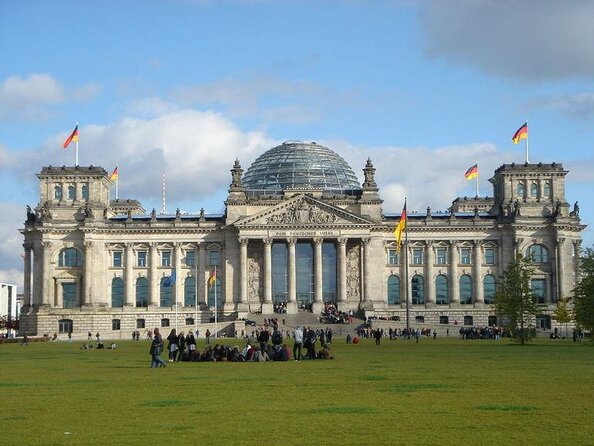
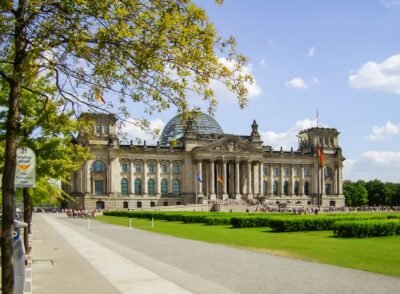
The next major stop is the Reichstag Building, Germany’s parliament. The building is now topped by a glass dome designed by British architect Sir Norman Foster, giving it a bright, modern appearance that contrasts sharply with its wartime history.
The Reichstag is tied to one of the key turning points in Hitler’s rise. The fire in 1933 helped the Nazi government claim emergency powers and crush political opposition. Your guide explains how an event at this building became part of the process that allowed Hitler to take total control.
The building also figured in the final Battle of Berlin. German and Soviet forces fought over the city in 1945, and the Reichstag became one of the best-known symbols of the conflict’s closing days.
The planned stop is about 10 minutes. That is a short look from outside, so do not expect a full parliament visit or access to the glass dome. This is a useful distinction when comparing the tour with an indoor museum program. The value here is the guide’s explanation of how one building connects democracy, dictatorship, war, and modern Germany.
The Holocaust Memorial: a place that asks for your attention
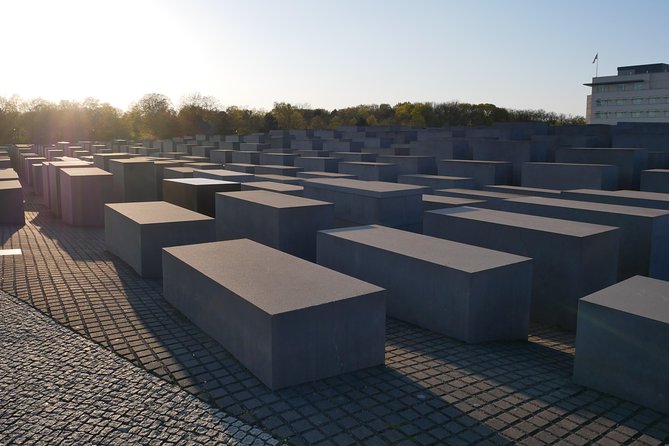
The Memorial to the Murdered Jews of Europe covers a large area near the Brandenburg Gate with rows of dark stone stelae. It is Germany’s central memorial to Jewish victims of the Holocaust.
You spend about 20 minutes here, the longest scheduled stop on the route. That extra time is appropriate. The memorial is not a conventional statue with a simple inscription and a quick photo opportunity. Its scale and layout call for a slower visit, and the meaning is best handled with care.
Your guide can place the memorial within the larger story of Nazi persecution. This is one of the points where a private tour can be especially useful, since you can ask questions about the memorial itself and about the policies that led to the Holocaust.
The schedule does not include a visit to the underground information center, so treat this as an exterior memorial stop. If you want extensive documentation, survivor testimony, or a longer study of Nazi genocide, you will need another visit elsewhere in Berlin.
More wartime history tours in Berlin:
- Berlin: Sachsenhausen Concentration Camp Memorial Tour
★ 4.7 · 3,716 reviews - Third Reich Berlin: Hitler and WWII Walking Tour
★ 5.0 · 3,301 reviews - Sachsenhausen Concentration Camp Bus Tour in English from Berlin
★ 5.0 · 1,962 reviews - Berlin: Sachsenhausen Concentration Camp Tour in English
★ 4.8 · 1,889 reviews
The Führerbunker site: an ordinary place with an extraordinary past
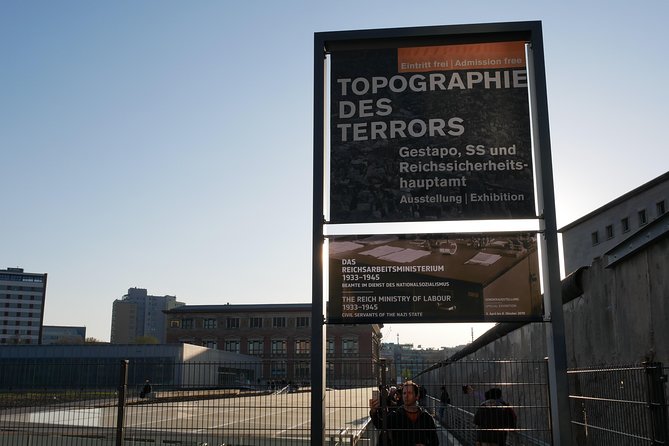
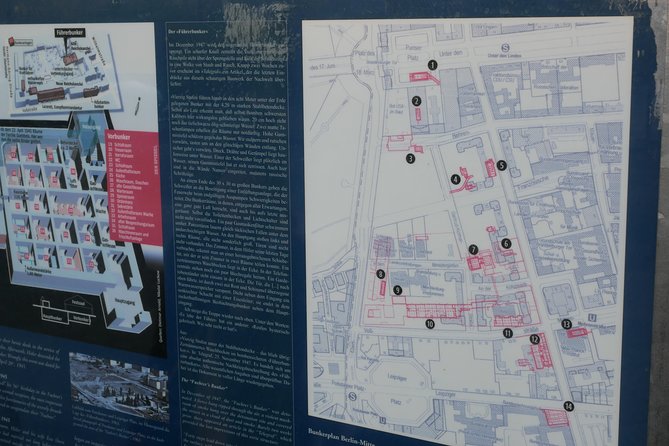
The former Führerbunker is one of the most striking stops because it is so visually unremarkable. Today, the location is a parking lot with a simple sign. There is no dramatic entrance, preserved chamber, or grand marker.
This is where Hitler spent his final days, married Eva Braun, and committed suicide as the war in Europe reached its final stage in 1945. The plain setting helps strip away the dangerous mythology that can gather around sites connected with dictators. You see a normal part of the city and learn what happened below it.
The stop lasts about 15 minutes. That is enough for the guide to explain the final days of the Nazi regime, but not enough for an extended discussion of every detail surrounding the bunker. Still, the contrast between the ordinary parking area and the enormous consequences of the events that took place there makes this one of the most memorable parts of the walk.
You should also expect the guide to focus on historical facts rather than spectacle. That is a good fit for anyone who wants context and a sober account of the dictatorship’s end.
Potsdamer Platz: destruction followed by reinvention
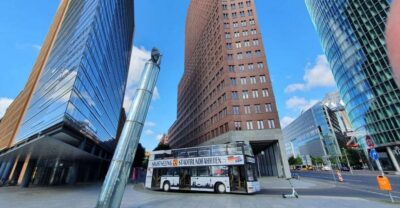
Potsdamer Platz gives the tour a useful change of pace. In the 1920s, it was one of Europe’s busiest traffic intersections. The Second World War destroyed much of the area, leaving it divided and neglected during the years of Berlin’s separation.
During the 1990s and early 2000s, Potsdamer Platz was rebuilt as one of Berlin’s most modern precincts. The contrast is sharp: a place once known for traffic and city life became a wartime ruin, then a showcase for contemporary redevelopment.
The stop is about 10 minutes. That may seem brief, but it works as a visual lesson. You are not only hearing about destruction; you are looking at an area rebuilt after war and political division. The modern architecture also reminds you that Berlin’s story did not end in 1945.
This is another place where your guide’s ability to connect old and new matters. Without explanation, you may simply see offices, plazas, and commercial buildings. With context, the site becomes part of the city’s long recovery.
Checkpoint Charlie: the Cold War enters the story
Checkpoint Charlie shifts the focus from the Nazi period to Berlin’s postwar division. The crossing was a famous frontline checkpoint, manned by American and Soviet forces during the Cold War.
It is an important stop because the tour does not treat 1945 as the final chapter. The fall of Nazi Germany brought occupation, competing political systems, and eventually a divided city. Checkpoint Charlie helps show how Berlin moved from one dictatorship and war into a tense confrontation between East and West.
The stop lasts about 10 minutes. The site is historically important, but the modern presentation can feel more commercial than solemn. That is a point to keep in mind. You are visiting a famous Cold War location, but the surrounding city has changed greatly since the checkpoint was active.
The route then returns to Brandenburg Gate, where the activity ends. That return gives the tour a neat geographic and symbolic finish. The same gate introduced Berlin as a city shaped by power and division, and it now represents reunification.
What the price means for your group
The listed price is $329.92 per group of up to 15 people. That is not a cheap walking tour for one or two people, but it can be good value if you share it with family or friends.
For a full group of 15, the cost works out to about $22 per person. For two people, it is roughly $165 each. The private format is the key factor in judging the price. You are paying for a dedicated guide rather than joining a large public group, and you get four hours to shape the conversation around your interests.
For a couple, the cost is harder to justify unless private guiding is a priority. For a family, multigenerational group, school-style party, or group of friends, the value improves quickly. You also avoid the limits of a large group, where questions may be rushed or the guide must keep everyone moving at the same pace.
Pickup is offered, but the published meeting point is Brandenburg Gate at Pariser Platz, and the walk ends there. Since the route is presented as a walking experience, confirm the pickup arrangement before booking if you do not plan to begin at the gate.
The tour is typically booked about 12 days in advance. That is a useful planning signal, especially if you want a particular guide or a specific date. The booking cannot be refunded or changed, so do not reserve it until your schedule is firm.
Who will get the most from this experience
I would recommend this tour to you if you want a clear narrative linking Berlin’s main central sites. It suits first-time visitors who have seen the Brandenburg Gate or Checkpoint Charlie but want to understand how the places fit together.
It is also a good choice for people who prefer conversation to exhibits. You will not spend hours reading panels or moving through a museum. Instead, you walk between sites and stop for explanations at each one.
The experience should suit most people who can take part in a four-hour walking activity. Service animals are allowed, and the meeting point is near public transportation. The supplied information does not give a detailed route profile, surface description, or pace, so ask about those points if mobility is a concern.
This is less suitable if you want access to the Reichstag dome, a full Holocaust museum visit, or preserved wartime interiors. It also may not be the right pick for young children who are not ready for difficult subjects involving genocide, war, and suicide.
The tour can also work well near the start of your Berlin stay. You will pass several major central sights, and the historical connections may help you understand later visits. Just remember that the schedule is full, so it is not designed for long independent exploration at each stop.
Practical tips for making the walk worthwhile
Wear shoes you can use comfortably for four hours. The route includes several stops, but the experience is still a walking tour, and the information is spread across central Berlin rather than contained in one building.
Bring water and allow time for pauses. The tour is scheduled tightly, with stops ranging from 10 to 20 minutes. Your guide may stop for discussion at key locations, but you should not assume there will be a long café break or a chance to explore each site on your own.
Keep your expectations clear. The tour is about seeing the locations and hearing the story, not entering every building. At the Reichstag, you see the parliament building and learn about its role. At the Führerbunker, you visit the present-day site rather than an intact bunker. At the Holocaust Memorial, you see the stone field, but the underground information center is not part of the stated route.
A private tour gives you a chance to set the emphasis. If your main interest is the Nazi rise to power, ask for more detail at Pariser Platz, the Reichstag, and the Führerbunker. If you want the wider twentieth-century story, ask your guide to connect Potsdamer Platz and Checkpoint Charlie more fully to Berlin’s later division.
Guides can make a major difference in a subject this serious. Walid, Campbell, and Gregor are named guides connected with the experience, and each is associated with a strong focus on explanation and historical context. Since guide availability can vary, check who is assigned if that matters to you.
Should you book the Berlin and Third Reich Private Guided Tour?
Book it if you want a private, guide-led introduction to Berlin’s Nazi and Cold War history, especially if you are traveling with enough people to share the cost. The route covers an impressive number of important sites in four hours, and the private format gives you room to ask questions rather than simply follow a flag through the city.
Think twice if you are traveling alone or as a couple on a tight budget. The fixed group price can be high for a small party, and the tour does not include major indoor visits. You should also be comfortable with a serious subject and a non-refundable reservation.
For many visitors, the best reason to choose it is the connection between places. The Brandenburg Gate, Reichstag, Holocaust Memorial, Führerbunker site, Potsdamer Platz, and Checkpoint Charlie are not just isolated photo stops. Together, they trace Berlin’s movement from royal capital to Nazi center, wartime ruin, divided city, and reunified capital.
FAQ
Where does the tour begin?
The tour begins at Brandenburg Gate in Pariser Platz, Berlin, Germany.
Where does the tour end?
The activity ends back at the meeting point at Brandenburg Gate.
How long does the tour last?
The tour lasts approximately four hours.
Is this a private tour?
Yes. Only your group participates, with up to 15 people included in the group price.
How much does the tour cost?
The listed price is $329.92 per group of up to 15 people.
Does the tour include pickup?
Pickup is offered. The stated meeting point is Brandenburg Gate, so confirm the pickup details when booking.
Can I enter the Reichstag building or dome?
The route includes a stop at the Reichstag Building, but the provided information does not state that entry to the building or glass dome is included.
Is the tour accessible by public transportation?
The meeting point is near public transportation. Service animals are allowed, and most people can participate, but detailed route and mobility information is not provided.
Can I cancel or change the booking?
No. The experience is non-refundable and cannot be changed for any reason.
Just added around Berlin
- eSIM for Germany and 34 European Countries★ 4.5 · 16 reviews
- Your ticket to The Wall Museum Berlin★ 3.0 · 60 reviews
- Walking on the Wall: 3-Hour Tour in Berlin★ 4.5 · 34 reviews
- Rickshaw Tours Berlin – Groups of up to 16 people with several rickshaws★ 4.0 · 97 reviews
- Warnemuende Shore Excursion: Private Berlin Tour★ 4.5 · 27 reviews
- Love and War in Berlin: Self-Guided Story Puzzle Walk★ 5.0 · 7 reviews
- Warnemuende Shore Excursion: Berlin Private Sightseeing Tour from Rostock★ 5.0 · 4 reviews
- Cold War Berlin – Private Live Virtual Experience★ 5.0 · 4 reviews
Berlin Tours, compared.
Reichstag, Dome and Government District Guided Tour
Read our review →
1-Hour City Tour by Boat with Guaranteed Seating
Read our review →
Reichstag, Plenary Chamber, Cupola & Government Tour
Read our review →
Browse the lists this tour appears in