
Review · BERLIN TOURS
Berlin: Sachsenhausen Concentration Camp Bus Tour in English
Sachsenhausen is not a quick sightseeing stop. It is a difficult, carefully preserved memorial where the layout of the camp helps you understand how the Nazi system controlled, punished, and killed people. This tour adds useful context on the bus ride and takes you directly from central Berlin to the site.
I especially like the air-conditioned bus transfer, which saves you the local train ride and long walk from Oranienburg station. I also like the guides’ reported approach: names such as Ariel, Paul, Jamie, Lewis, and Nickolai come up often for clear, sensitive explanations. The main drawback is time. About two hours at the memorial can feel short for such a large and serious place.
Key points at a glance
- Tower A and the camp entrance: Begin at the gate marked by the words Arbeit Macht Frei and see how the entrance was designed to intimidate prisoners.
- A direct ride from Berlin: The bus takes about 50 minutes each way and avoids the extra walk from Oranienburg station.
- A serious, guided visit: Expect discussion of crematoria, gas chamber remains, execution areas, infirmaries, punishment cells, and prisoner barracks.
- Useful historical framing: Your guide explains Sachsenhausen’s place in the wider Nazi camp system and how the camp affected the surrounding town.
- A compact four-hour outing: The tour works well if you have limited time in Berlin, though you will not see every part of the memorial in depth.
- Good value at $49: Transport, entry, a professional guide, a camp map, driver, and a €3 memorial donation are included.
Why Sachsenhausen matters in Berlin
Sachsenhausen lies in Brandenburg, outside Berlin, near Oranienburg. It was the first concentration camp designed and built from the beginning according to a planned model for control and expansion. That design is important: the camp was not an improvised prison, but part of an organized system run with military and administrative precision.
The site helps you see that system in physical form. The broad central area, barracks, guard towers, punishment areas, and administrative buildings were arranged to give the authorities control over prisoners. Your guide explains not only what happened inside the fences, but also how the camp fitted into the wider network of Nazi camps.
The camp held political prisoners, forced laborers, prisoners of war, and people persecuted by the Nazi regime. Around 35,000 people were murdered there or died from disease, starvation, abuse, and brutal living conditions. That number is difficult to grasp in the abstract. Walking through the remaining structures gives the figure a more human and immediate weight.
A useful part of this tour is its attention to the world outside the camp. You drive through Oranienburg and hear about the work prisoners were forced to perform and the question of what local people knew. The tour does not treat the camp as an isolated place. It shows how a large camp system could affect daily life beyond the wire.
More WWII History Tours in Berlin
- Berlin: Third Reich and Cold War 2 Hour Walking Tour
★ 4.9 · 6,830 reviews - Berlin: Sachsenhausen Concentration Camp Tour in English
★ 5.0 · 5,711 reviews - Berlin’s Best: 2 Hour Walking Tour Third Reich and the Cold War
★ 5.0 · 5,486 reviews
Meeting your guide at Friedrichstrasse
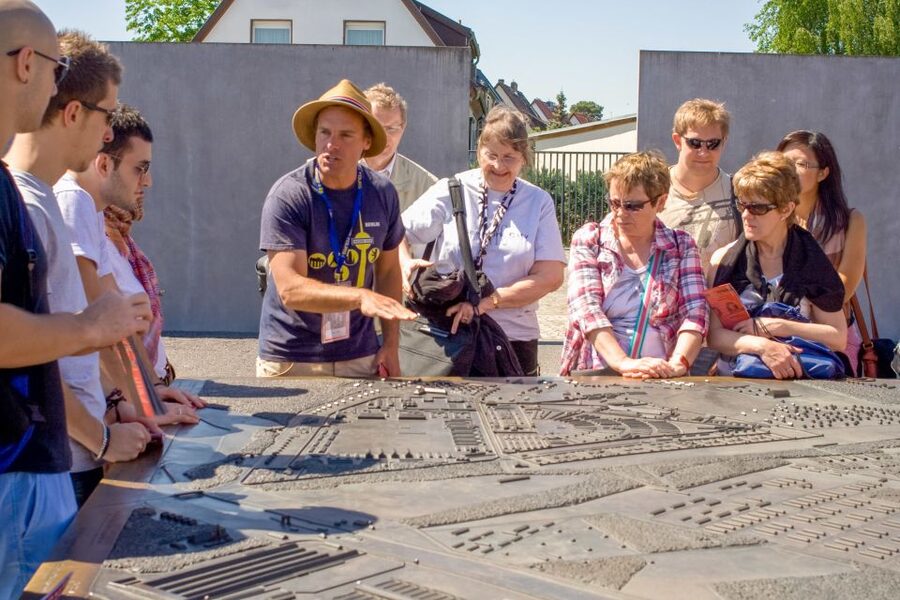
The standard meeting point is outside Friedrichstrasse train station, on the square between the station and the Tränenpalast, also called the Palace of Tears. The guide carries a yellow umbrella and wears a blue lanyard with a yellow name tag.
This is a practical meeting point in central Berlin, but allow a little extra time to find the correct side of the station. The instructions specifically place the meeting area beside the Tränenpalast, at Reichstagufer 17, 10117 Berlin. The activity ends back at the meeting point, although the listed drop-off information also identifies Reichstagufer 17.
Private and small-group options are available. The standard experience uses shared transport, while private options can include pickup by your guide five minutes before the start. Check the exact option you book, since starting times and pickup arrangements depend on availability.
The 50-minute ride to Oranienburg
The bus journey takes about 50 minutes each way. That is more than just dead travel time. Your guide provides background during the ride, connecting Berlin’s political history with the camp you are about to visit.
Several guides receive special praise for using this time well. Lewis, Jamie, and Joseph are noted for explaining the city and the camp before arrival, while Paul is described as adding broader context about German government and wartime history. Ariel is praised for answering questions and helping people place the visit within a larger Berlin itinerary.
The bus is air-conditioned, and a driver handles the route. That matters because the memorial is outside the city and public transport requires more planning. The bus also avoids the walk from Oranienburg station to the memorial entrance, a detail that became especially valuable in rain and wind.
Bring a drink and a light snack. They are not included, and the tour lasts four hours. Keep your clothing weather-ready, since much of the memorial visit takes place outdoors. Comfortable shoes are essential. The site is large, and this is a walking tour rather than a museum visit where you sit for most of the time.
Entering through Tower A
At Sachsenhausen, the guided portion lasts about two hours. The visit begins around the entrance and Tower A, the most recognizable part of the site. The gate’s Arbeit Macht Frei inscription is a stark reminder of the lies used to disguise a system of forced labor and murder.
Your guide helps you read the layout instead of simply moving from one building to the next. The arrangement of the camp, the guard positions, the open spaces, and the barracks all served the same purpose: surveillance and control. This is where a live guide adds real value. A map can show the plan, but a guide can explain how that plan shaped the prisoners’ daily lives.
The entrance area can feel deceptively orderly. That contrast is part of what makes it so disturbing. The site was designed with administrative efficiency, yet behind that order were overcrowding, disease, violence, starvation, and arbitrary punishment.
More wartime history tours in Berlin:
- Berlin: Sachsenhausen Concentration Camp Memorial Tour
★ 4.7 · 3,716 reviews - Third Reich Berlin: Hitler and WWII Walking Tour
★ 5.0 · 3,301 reviews - Sachsenhausen Concentration Camp Bus Tour in English from Berlin
★ 5.0 · 1,962 reviews - Berlin: Sachsenhausen Concentration Camp Tour in English
★ 4.8 · 1,889 reviews
Barracks and daily prisoner life
The barracks show the cramped and harsh conditions imposed on prisoners. You hear about daily routines, forced labor, discipline, and the brutal treatment used to break people physically and mentally.
The exact buildings open during a visit can depend on the memorial’s current arrangements, but the tour specifically includes the interior of the camp and prisoner barracks. The map provided with the tour helps you follow the former layout and remember what you have seen after the guided portion ends.
This is also where you should expect a sober pace. Guides such as Campbell, Scott, Rebecca, and Martin are praised for presenting the subject carefully and clearly. The strongest guides do not turn the site into a performance. They give names, facts, and context, then leave room for the place itself to affect you.
The infirmaries and medical crimes
The infirmary barracks are among the most difficult areas on the tour. They were not simply places where sick prisoners received care. Medical experimentation took place there during the war, adding another layer of cruelty to the camp system.
Your guide explains how medicine was twisted into a tool of persecution and control. The buildings make this subject especially concrete. You are not hearing only about policy in Berlin; you are seeing where prisoners were treated as objects rather than people.
The tour also covers punishment cells and isolation areas. These spaces reveal how camp authorities used confinement, fear, and physical abuse as regular instruments of control. If you find this part emotionally heavy, that is a normal response. Give yourself permission to walk quietly and take a moment when needed.
Crematoria, gas chamber, and execution area
The crematoria area, gas chamber remains, and execution trench are among the most serious stops. These locations document the camp’s killing process and the deliberate effort to hide or manage evidence of murder.
The guide explains the function of each area and places it within the larger operation of the camp. This is an important distinction. You are not being shown isolated ruins. You are learning how forced labor, imprisonment, punishment, medical abuse, mass death, and administrative planning worked together.
The tour’s language and tone matter here. The most praised guides, including Nickolai, Gregory, Maria, and James, are described as respectful, sensitive, and careful with difficult questions. That is exactly what you want at Sachsenhausen. You need clear facts, but you also need a guide who understands that this is a memorial to human beings, not a collection of dramatic attractions.
Photography is listed among the things you may bring, but use judgment. You can record architectural details or the map for personal reference, yet some parts of the site call for quiet attention rather than camera use. Alcohol and drugs are not allowed.
How much can you see in two hours?
Two hours is enough for a structured introduction to the main areas, but it is not enough for every corner of Sachsenhausen. One guide described the tour as a good choice for someone with limited time while also noting that the site deserves much longer.
That is the central tradeoff. A guided visit keeps you moving and ensures that you see the key locations. You will not waste time figuring out the layout or missing the crematoria area, infirmaries, barracks, and punishment spaces. On the other hand, you have less time to read every display, pause at each memorial, or explore independently.
I would choose this tour if you have only a day or two in Berlin and want a well-organized first visit. If Sachsenhausen is a main reason for your trip, a longer visit may suit you better. The bus tour gives you a strong framework, but you should not expect an exhaustive study of the entire memorial.
The guide makes the difference
The tour is sold in English and Spanish, with a live guide. The individual guide can vary, but many names appear in the available feedback: Ariel, Paul, Jamie, Lewis, Nickolai, Joseph, Maria, Rebecca, Gregory, Scott, Martin, Campbell, Shawn, and Dr Thomas.
The repeated strengths are clear. Guides are praised for clear English, thorough explanations, thoughtful storytelling, patience with questions, and respectful handling of the subject. Several also use the bus journey to explain other parts of Berlin or offer practical ideas for the rest of your day.
Ariel is noted for bringing the people and events of the camp’s past into focus while answering questions. Paul receives praise for linking Sachsenhausen to German political and wartime history. Nickolai is described as both precise and sensitive, while Jamie is singled out for providing useful information during the transfers as well as at the memorial.
Of course, guide quality can never be guaranteed by name alone. Staff assignments change. Still, the pattern here suggests that guide training and presentation are major strengths of the experience. At a site this serious, a calm and well-prepared guide is worth paying for.
Is $49 a fair price?
At $49 per person, the tour is priced sensibly for a four-hour outing from central Berlin. The cost includes the air-conditioned vehicle, driver, professional licensed guide, Sachsenhausen Memorial entry, a €3 donation to the memorial, and a map of the former camp.
The value comes mainly from convenience and explanation. You could arrange the journey yourself, but you would need to manage the trip outside Berlin, find the memorial entrance, learn the layout, and decide how to use limited time. The bus brings you close to the site and returns you to central Berlin, while the guide fills the journey and walk with context.
The price does not include hotel pickup and drop-off for the standard group option. Food and drinks are also not included. If you want a private experience, expect the price and arrangements to depend on the selected option.
For many people, the bus is the deciding factor. It is especially useful in poor weather or if you do not want to spend part of the day changing trains and walking from the station. If you are comfortable planning public transport and reading the memorial’s own material, independent travel may cost less. You will also need to provide your own historical framework.
Who should book this experience?
This tour suits first-time visitors to Sachsenhausen, people with limited time in Berlin, and anyone who prefers a guide to explain a difficult site in person. It is also a sensible choice if you want transport handled from the city center.
You should be ready for a serious four-hour outing. This is not suitable for someone looking for light sightseeing or a casual half-day trip. The camp contains material about murder, disease, abuse, executions, medical experimentation, and forced labor.
I would also recommend it for visitors planning to see another camp memorial later. One person used the tour as preparation for a planned visit to Auschwitz, and the broader explanation of the camp system can help you understand how different sites fit into the same history.
Practical advice before you go
Wear comfortable walking shoes and weather-appropriate clothing. The memorial visit takes place largely outside, so rain, wind, heat, or cold can shape your experience.
Bring a small drink and light snack, since neither is included. A camera is allowed as an item to bring, but treat the site with restraint and follow any memorial instructions.
Plan to arrive early at the Friedrichstrasse meeting point. Look for the yellow umbrella near the Tränenpalast, not simply somewhere outside the station. The tour can be booked with free cancellation up to 24 hours before departure, and reserve-now, pay-later options are available, which helps if your Berlin plans are still shifting.
Should you book the Sachsenhausen bus tour?
Book it if you want a well-organized introduction to Sachsenhausen without spending time arranging the journey yourself. The combination of central pickup, a 50-minute ride, a live English or Spanish-speaking guide, and a focused two-hour visit makes the experience practical and meaningful.
Think twice if you want several hours of independent exploration or detailed reading at every exhibit. The schedule is compact, and the subject requires time to process.
For most first-time visitors, I think the $49 price is justified. The bus saves effort, the guide adds essential context, and the visit covers the most important parts of the memorial. Go prepared for a quiet, sobering day, and you will come away with a clearer understanding of Sachsenhausen and the system it served.
FAQ
How long does the Sachsenhausen bus tour last?
The full activity lasts about four hours. The bus ride takes roughly 50 minutes each way, and the guided visit at Sachsenhausen lasts about two hours.
Where does the tour begin?
The meeting point is outside Friedrichstrasse train station, on the square between the station and the Tränenpalast, also known as the Palace of Tears. The address is Reichstagufer 17, 10117 Berlin.
How do I find the guide?
Look for a guide holding a yellow umbrella. Guides also wear a blue lanyard and yellow name tag.
Is transport included?
Yes. Transportation by private air-conditioned vehicle and a driver are included in the tour price.
Is admission to Sachsenhausen included?
Yes. Sachsenhausen Memorial entry is included, along with a €3 donation per person to the memorial and a map of the former camp.
What languages are available?
The tour is offered with a live English or Spanish-speaking guide.
Is hotel pickup included?
Hotel pickup and drop-off are not included in the standard tour. Pickup is available for private options, with the guide collecting you five minutes before the tour begins.
Can I cancel the booking?
You can cancel up to 24 hours in advance for a full refund. A reserve-now, pay-later option is also available.
Just added around Berlin
- From Berlin: Gardens & Palaces of Potsdam Bike Tour★ 5.0 · 61 reviews
- Berlin: Battle for Seelow Heights WW2 tour -Clash of Titans★ 5.0 · 27 reviews
- From Berlin: Historical Gems of Potsdam Private Day Trip★ 4.4 · 4 reviews
- Berlin: Französischer Dom 360° Panorama & Crémant to go★ 3.9 · 5 reviews
- Explore Berlin Tour: History and Highlights★ 4.7 · 5 reviews
- Berlin: Evening Yacht Cruise with Aperitif & Dinner Upgrade★ 4.6 · 178 reviews
- Berlin: Expats in Berlin Comedy Show Ticket★ 4.7 · 182 reviews
- Berlin: The Epic Comedy Club Friday Night Showcase★ 4.8 · 28 reviews
Berlin Tours, compared.
Reichstag, Dome and Government District Guided Tour
Read our review →
1-Hour City Tour by Boat with Guaranteed Seating
Read our review →
Reichstag, Plenary Chamber, Cupola & Government Tour
Read our review →
Browse the lists this tour appears in