
Review · BERLIN TOURS
Private Third Reich Walking Tour of Berlin
Berlin hides much of its Nazi past in plain sight. A parking area marks the former Führerbunker. A government office occupies the old Aviation Ministry. A memorial of concrete slabs asks you to confront the murder of Europe’s Jews. This private walk connects those places and explains how they fit together.
I like the private format, since your guide can adjust the pace and answer difficult questions without a large group slowing things down. I also like the route’s mix of major sites and lesser-known reminders, including Georg Elser’s attempt to kill Hitler in 1939. The main drawback is time: two hours is enough for a focused introduction, but not enough for every major Nazi-era site in central Berlin.
Key points to know before booking
- The route begins at Brandenburg Gate and ends at the Topography of Terror, with the walk passing through some of Berlin’s most important memorial sites.
- The Führerbunker site is now unmarked and ordinary-looking, which makes the historical explanation especially important.
- The Topography of Terror includes a free exhibition, and you can visit it after the guided walk.
- You get a private guide for your own group, with room to ask questions and shape the discussion around your interests.
- Guides such as Stefan and Alexander have led detailed tours, with a style that works well for families, teenagers, and first-time visitors.
- The walk is mostly about context, not grand Nazi architecture or dramatic ruins. Berlin’s traces are often fragments, plaques, memorials, and reused buildings.
Why this two-hour walk matters in Berlin
Berlin is not a city where the Nazi past sits neatly behind museum glass. You walk past ministries still used by the German government, cross open squares, and pass memorials that ask you to think rather than simply look. The challenge is making sense of what remains.
This tour gives you a clear thread. It begins near Brandenburg Gate, a symbol of Berlin that has witnessed several political eras, then moves through locations connected to Nazi power, persecution, resistance, and defeat. You finish at the Topography of Terror, where the machinery of the regime is explained through documentation and photographs.
That order works well. You first see the political center of the city, then confront the places where decisions were made and crimes were organized. By the end, you have a stronger framework for visiting other Berlin sites on your own.
The guide matters a great deal here. A historian can explain what has disappeared, what was rebuilt, and what remains in use. Guides named Stefan and Alexander have been praised for clear, detailed explanations, friendly conversation, and the ability to tailor the walk to a group’s interests. Those qualities are useful on a subject that can quickly become a string of dates and grim facts.
More WWII History Tours in Berlin
- Berlin: Third Reich and Cold War 2 Hour Walking Tour
★ 4.9 · 6,830 reviews - Berlin: Sachsenhausen Concentration Camp Tour in English
★ 5.0 · 5,711 reviews - Berlin’s Best: 2 Hour Walking Tour Third Reich and the Cold War
★ 5.0 · 5,486 reviews
Starting at Brandenburg Gate
The meeting point is Brandenburg Gate at Pariser Platz. This is a practical place to begin because it is easy to identify and already puts you in the heart of central Berlin.
Do not expect the gate itself to be the main focus of the tour. Its value here is as a starting point for understanding the Nazi seizure of public space and political power. Your guide can place the surrounding area within the story before leading you toward the memorials and former government buildings farther south.
The walk is private, so you do not need to stay with an unfamiliar crowd. If you have teenagers with you, the guide can spend more time on questions and explain the period in a way that does not feel like a school lecture. One family specifically found the experience engaging for two teenagers, which says something about the importance of having a guide who can tell the story plainly.
The Führerbunker site and the value of an unmarked place
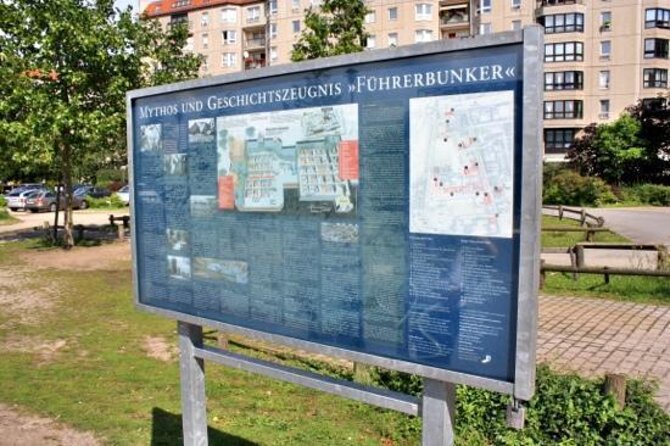
The former Führerbunker is one of the most striking stops because there is so little to see. Hitler spent his final days there and committed suicide shortly before the end of the Second World War. Today, the site is associated with an ordinary parking area rather than a preserved underground complex.
That contrast is the point. There is no grand entrance, dramatic ruin, or museum built around the bunker. Without explanation, you could pass the spot without knowing what happened beneath it. Your guide supplies the missing context and explains the final days of the Nazi leadership.
I find this more useful than a theatrical presentation would be. The plain setting keeps attention on the historical facts and on the choices made to prevent the site from becoming a shrine. You should come ready for a serious stop, not a photo opportunity.
The visit is listed as taking about 20 minutes. That is enough time to locate the former bunker, hear its role in the final stage of the war, and ask questions. It is not enough for a full study of Berlin in 1945, so anyone wanting a detailed account of the battle for the city will need another museum or book.
Walking through the Memorial to the Murdered Jews of Europe
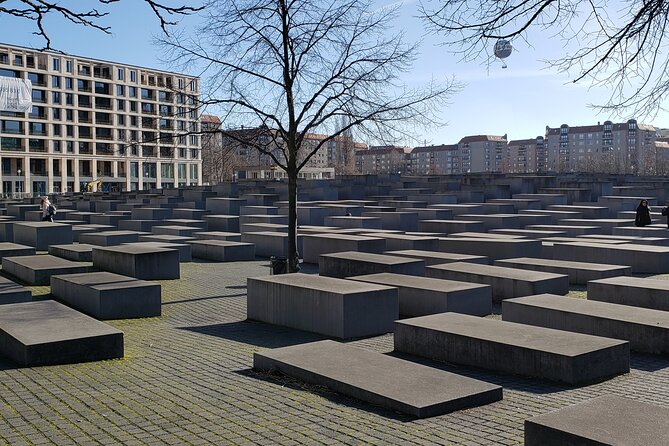
The Holocaust Memorial, formally called the Memorial to the Murdered Jews of Europe, covers a large area with rows of concrete slabs. You walk among them while the ground changes beneath your feet and the blocks rise and fall around you.
The memorial is not meant to provide a complete historical explanation. Its strength is emotional and physical. Your guide can connect the space to the persecution and murder of Europe’s Jews under the Nazi regime, helping you read the memorial with more care than you might on a quick independent visit.
The planned stop lasts about 20 minutes. That gives you time to walk through part of the memorial and discuss its purpose. It is worth remembering that this is a place of remembrance, not a conventional attraction. Keep your voice low, follow the site’s respectful tone, and allow the experience to remain serious.
The memorial is also one reason a private tour can help. You can pause to ask how the design works, why the memorial takes this form, or how it fits into Berlin’s wider approach to public memory. The guide can answer without forcing the whole group to move on.
The route also passes other memorials in central Berlin, including memorials for Roma and Sinti and for homosexual victims of Nazi persecution. These additional sites were part of one reported tour route, though the exact balance can depend on your guide and the pace of your group. If these memorials matter to you, mention them when booking or at the start.
More wartime history tours in Berlin:
- Berlin: Sachsenhausen Concentration Camp Memorial Tour
★ 4.7 · 3,716 reviews - Third Reich Berlin: Hitler and WWII Walking Tour
★ 5.0 · 3,301 reviews - Sachsenhausen Concentration Camp Bus Tour in English from Berlin
★ 5.0 · 1,962 reviews - Berlin: Sachsenhausen Concentration Camp Tour in English
★ 4.8 · 1,889 reviews
The former Aviation Ministry on Niederkirchnerstraße
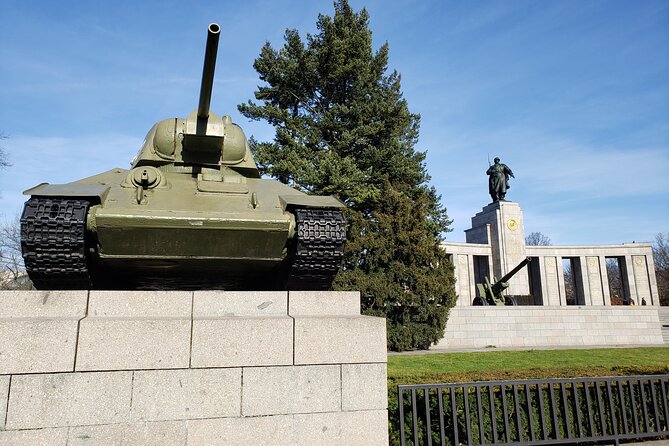
The large building now used by the Federal Ministry of Finance was once the Aviation Ministry. Its size and severe architectural style reflect the public image favored by the Nazi state.
This is a useful stop because it shows how the regime operated through buildings and offices, not only through rallies and symbols. The structure remains part of modern government, creating a direct link between Berlin’s past and present. Your guide can explain what the building was used for and point out the architectural features associated with Nazi-era state construction.
You will not be entering the ministry as part of this tour. The value comes from seeing the exterior and understanding its place in the former government district. A 20-minute stop is enough for the building, its history, and questions before continuing.
This part of the route also shows why Berlin works best when you look beyond isolated monuments. A building may have changed purpose, but its walls still form part of the city’s historical record. You get a more honest picture of the period by seeing both preserved memorials and structures that have been reused.
The Georg Elser memorial and the story of resistance
The Georg Elser sculpture honors a German carpenter who tried to kill Hitler with a bomb in 1939. His attempt came before the war had reached its later scale, making the story an important reminder that resistance existed from the early years of the regime.
The stop is shorter, about 10 minutes, but its subject adds needed balance to the route. Much of the tour deals with Nazi power and mass persecution. Elser’s memorial shifts the focus to individual opposition and the personal danger involved in challenging Hitler.
I like this inclusion because it avoids presenting German society as politically uniform. It also gives your guide a chance to explain the difference between isolated acts of resistance and organized movements. The sculpture itself is a compact stop, so it works well in a two-hour walk without taking time away from the larger memorials.
If resistance history interests you, ask for more detail here. The private format makes that possible, although the overall tour still needs to keep moving to fit the scheduled time.
Ending at the Topography of Terror
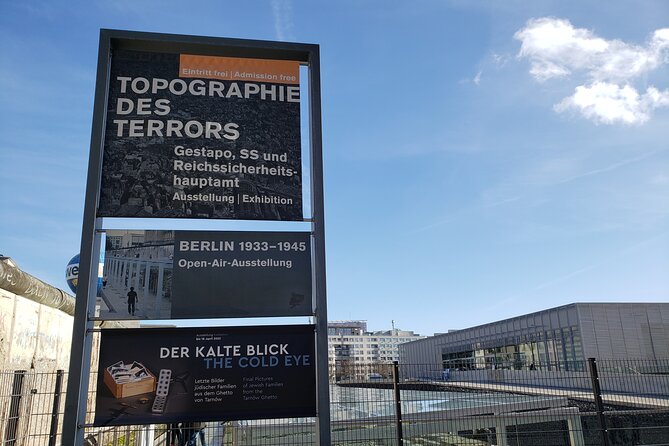
The tour ends at the Topography of Terror on Niederkirchnerstraße. This site once held the headquarters of major Nazi terror organizations. Today, a documentation center and exhibition explain how the regime’s institutions planned and carried out persecution.
The exhibition visit is listed as free and takes about 20 minutes within the guided route. You can also stay afterward and visit the documentation center without paying an additional admission charge. That extra time is one of the best practical features of the tour. The guide introduces the site, then you have the option to continue learning at your own pace.
The end point is especially convenient for anyone who wants a fuller account of the Nazi state. The walk gives you a map of the places and personalities. The exhibition gives you documents and visual evidence that help fill in the structure behind them.
Afterward, the nearest underground station is about a 10-minute walk away, and the guide can show you how to reach it. Since the tour does not return to Brandenburg Gate, plan your next stop from the ending point rather than assuming you will finish where you began.
How much walking and discussion to expect
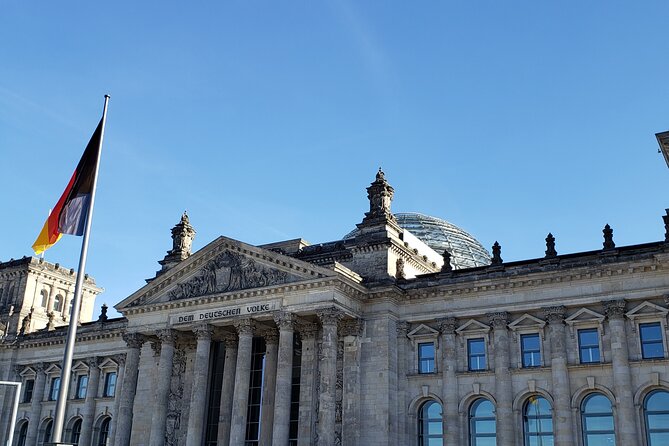
The tour lasts about two hours and is conducted on foot. The listed stops add up to roughly 90 minutes, leaving the rest of the time for walking, explanations, and questions between locations.
That makes this a fairly concentrated experience. You will be moving through central Berlin rather than entering a series of indoor museums. Wear comfortable shoes and expect the guide to keep a steady pace. Most people can take part, and the route is near public transportation, but the tour still involves walking between sites.
The amount of discussion can change depending on your group. A private booking lets you ask more questions than you usually can on a large public walk. It also means you can tell the guide if you want more attention on military history, Nazi propaganda, resistance, memorial design, or the personal stories connected to the sites.
The tour is offered in English. The operator asks you to provide your hotel address during booking, and confirmation is normally sent at booking time. If you book within nine days of the tour, confirmation may arrive within 48 hours, subject to availability.
Is $150.51 per person good value?
At $150.51 per person, this is not a budget walking tour. The price makes the most sense for a small private group that wants a focused guide rather than a basic orientation walk.
You are paying for the private arrangement and for the chance to have a historian guide shape the conversation around your interests. If your group includes several people, group discounts may improve the value. For a couple or a small family, the cost is easier to justify if you care strongly about the subject and want detailed answers.
The free admission at the listed stops helps, but it is not the main value. You could walk past most of these places without paying an entrance fee. What you cannot easily reproduce is the connection between them: the former terror headquarters, the bunker site, the Holocaust Memorial, the Aviation Ministry, and the memorial to Georg Elser.
I would not choose this tour simply to collect sights. I would choose it for interpretation. If you already have a strong understanding of Nazi Berlin and prefer to read at your own pace, the price may feel high. If this is your first visit and you want a serious introduction without joining a large group, the cost is more defensible.
Who will get the most from this experience
This tour suits first-time visitors who want to understand how Berlin’s Nazi-era sites relate to one another. It is also a good fit for families with older children or teenagers, especially when the guide can adjust explanations and invite questions.
History students, museum-minded visitors, and people interested in memorial design will find plenty to discuss. The route covers state power, the Holocaust, resistance, architecture, and the final collapse of the regime in a compact period.
It may be less suitable if you want extensive indoor time, a full-day study of the war, or access to the Führerbunker itself. The bunker is not open as a preserved attraction, and the tour does not promise entry into the Federal Ministry of Finance.
The subject is difficult. You should be prepared for accounts of persecution, murder, suicide, and political terror. That seriousness is not a flaw, but it does mean this is better placed when you have the time and attention to think about what you are seeing.
Booking, cancellation, and practical details
The activity is private, so only your group participates. It is available in English, accepts mobile tickets, allows service animals, and is near public transportation. Most people can participate.
Free cancellation is available if you cancel at least 24 hours before the local start time. Cancellations made less than 24 hours before the start, as well as late changes, are not refunded.
The meeting point is Brandenburg Gate, Pariser Platz, 10117 Berlin. The end point is the Topography of Terror, Niederkirchnerstraße 8, 10963 Berlin. Since the tour ends elsewhere, allow a few minutes to orient yourself before making a tightly timed reservation afterward.
Should you book this Berlin history walk?
Book it if you want a private, serious introduction to Berlin’s Nazi past and value a guide who can connect locations that otherwise seem unrelated. The strongest parts are the explanations at the unmarked Führerbunker site, the thoughtful walk through the Holocaust Memorial, and the free Topography of Terror exhibition at the end.
I would especially recommend it for a first visit, a family with teenagers, or a group with different levels of historical knowledge. Ask for the subjects that matter most to you, since the private format allows the discussion to become more personal.
Skip it if you are seeking a low-cost walk, a broad survey of all Berlin sights, or entry into the bunker and government buildings. For the right audience, though, the price buys something useful: a clear way to read a city where some of the most important evidence is no longer obvious.
FAQ
Where does the Private Third Reich Walking Tour of Berlin begin?
The tour begins at Brandenburg Gate on Pariser Platz, 10117 Berlin, Germany.
Where does the tour end?
The tour ends at the Topography of Terror at Niederkirchnerstraße 8, 10963 Berlin, Germany.
How long does the tour last?
The walking tour lasts approximately two hours.
Is the tour private?
Yes. Only your group participates in the activity.
What language is the tour offered in?
The tour is offered in English.
Does the tour enter the Führerbunker?
The tour visits the site of the former Führerbunker, where Hitler committed suicide shortly before the end of the Second World War. The provided details do not state that visitors enter the bunker.
Is admission to the Topography of Terror included?
The Topography of Terror stop includes a free exhibition. You may also visit the documentation center for free after the guided tour.
Can I cancel for a full refund?
Yes, if you cancel at least 24 hours before the experience start time. Cancellations made less than 24 hours before the start time are not refunded.
More Walking Tours in Berlin
- Discover Berlin Half-Day Walking Tour
★ 5.0 · 9,624 reviews - Berlin: Discover Berlin Walking Tour
★ 4.9 · 5,998 reviews - Berlin: Hidden Backyards Guided Walking Tour
★ 4.8 · 5,360 reviews - Berlin: Alternative Berlin Walking Tour
★ 4.6 · 1,204 reviews
Just added around Berlin
- eSIM for Germany and 34 European Countries★ 4.5 · 16 reviews
- Your ticket to The Wall Museum Berlin★ 3.0 · 60 reviews
- Walking on the Wall: 3-Hour Tour in Berlin★ 4.5 · 34 reviews
- Rickshaw Tours Berlin – Groups of up to 16 people with several rickshaws★ 4.0 · 97 reviews
- Warnemuende Shore Excursion: Private Berlin Tour★ 4.5 · 27 reviews
- Love and War in Berlin: Self-Guided Story Puzzle Walk★ 5.0 · 7 reviews
- Warnemuende Shore Excursion: Berlin Private Sightseeing Tour from Rostock★ 5.0 · 4 reviews
- Cold War Berlin – Private Live Virtual Experience★ 5.0 · 4 reviews
Berlin Tours, compared.
Reichstag, Dome and Government District Guided Tour
Read our review →
1-Hour City Tour by Boat with Guaranteed Seating
Read our review →
Reichstag, Plenary Chamber, Cupola & Government Tour
Read our review →
Browse the lists this tour appears in