
Review · BERLIN TOURS
The Memorial Tour: Visit to Sachsenhausen Concentration Camp (licensed guide)
Sachsenhausen is not a sightseeing stop in the usual sense. It is a place of imprisonment, forced labor, medical abuse, and murder, where the remaining buildings and open grounds make Nazi terror painfully concrete. This five-hour memorial tour gives you a structured way to face that past, with a licensed English-speaking guide explaining what happened and why the camp was built.
I like two things right away: the small group of up to 15 people, which allows real questions, and the guided trip from Berlin, which adds useful context before you reach the camp. Guides such as Paul, Aaron, and Stephen have been praised for clear, respectful explanations, though your assigned guide may be different.
The main drawback is the amount of walking and the emotional weight of the visit. You will need an ABC public transport ticket, costing €4.70 if you do not already have a valid pass, and the day can feel physically demanding as well as sad.
Key points to know before you book
- Sachsenhausen is about 30 kilometers north of Berlin, near Oranienburg, so this is a half-day outing rather than a quick city attraction.
- Tower A, Station Z, the prison, barracks, infirmary buildings, and camp kitchen form the core of the visit.
- The guide-led journey matters, since historical background begins on the way from central Berlin, not only at the memorial.
- The group is limited to 15 people, making it easier to ask questions and stay close to the guide.
- Allow for several hours of walking, plus train and local transport or a longer walk from Oranienburg station.
- The tone is factual and respectful, but this is an emotionally difficult place and should not be treated as ordinary entertainment.
Why a guided visit helps at Sachsenhausen
Sachsenhausen can be visited without a guide, but the site covers a wide area and contains more information than most people can absorb in one afternoon. A good guide helps you decide what deserves your attention, explains the purpose of each building, and connects the camp to the wider Nazi system.
That context begins at the meeting point outside Hopfingerbräu on Ebertstraße, beside Brandenburg Gate. The group meets at 10:00 a.m. with Birchys Berlin Tours, then travels north by public transport. One guide, Paul, has been noted for helping with tickets and explaining the Nazi regime during the journey. That early preparation is useful. You arrive with a basic framework instead of walking into the memorial cold.
The guide’s role is not to soften the facts. It is to explain them clearly and with care. At Sachsenhausen, many buildings are gone, altered, or represented through foundations and open spaces. Without background, the site can feel like a broad, quiet field with scattered ruins. With guidance, the layout begins to show how control, punishment, labor, illness, and killing were organized.
The small group size is another practical advantage. A maximum of 15 people is modest enough for the guide to hear questions without turning the visit into a lecture from far away. Past guide names associated with this experience include Paul, Aaron, and Stephen. Their approach has been described as patient, interactive, and sensitive, but you should not assume a particular guide will lead your departure.
More WWII History Tours in Berlin
- Berlin: Third Reich and Cold War 2 Hour Walking Tour
★ 4.9 · 6,830 reviews - Berlin: Sachsenhausen Concentration Camp Tour in English
★ 5.0 · 5,711 reviews - Berlin’s Best: 2 Hour Walking Tour Third Reich and the Cold War
★ 5.0 · 5,486 reviews
The journey from Brandenburg Gate to Oranienburg
The trip to Sachsenhausen is part of the experience, not dead time. The camp lies on the outskirts of Oranienburg, around 30 kilometers from Berlin, and the journey takes roughly an hour by train according to the tour account. Your guide uses this time to explain pre-war Germany, the rise of National Socialism, and the role of concentration camps under the Third Reich.
You need an ABC ticket for the full trip. The stated cost is €4.70 per person if you do not already have a suitable Berlin transport pass. Bus fare is not included, so ask the guide for help before leaving. One account describes taking the RE5 train to Oranienburg, followed by a local connection or a walk toward the memorial.
The final approach can add a little work. If you do not make the bus from the station, the walk to Sachsenhausen takes about 20 minutes according to the practical guidance given during the tour. Another account describes about a mile of walking from the station. The exact route may vary, but the lesson is simple: wear solid walking shoes and do not plan a tight appointment immediately after the tour.
This trip also gives you time to ask questions privately or in a relaxed setting. That can be helpful before entering a place where the material becomes much harder to process. It also means the five-hour duration includes transport, not five full hours inside the camp.
Tower A and the camp entrance
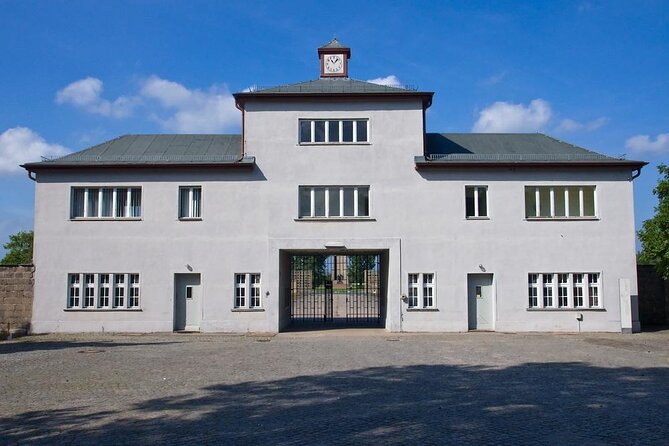
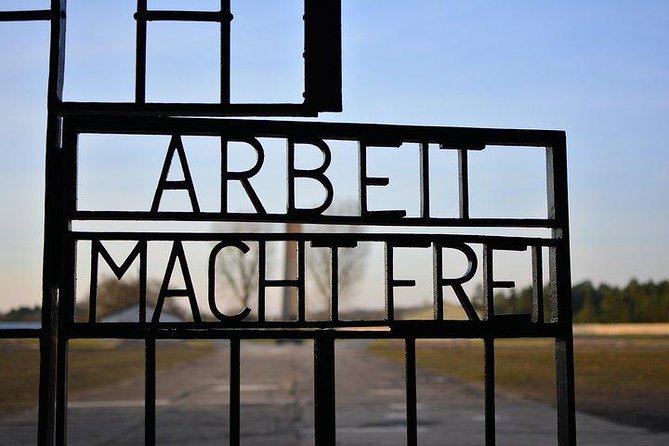
The visit begins at Tower A, the entrance into the main camp compound. This is one of the most important points on the site because the gate controlled movement into the prisoner area and framed the camp’s system of authority.
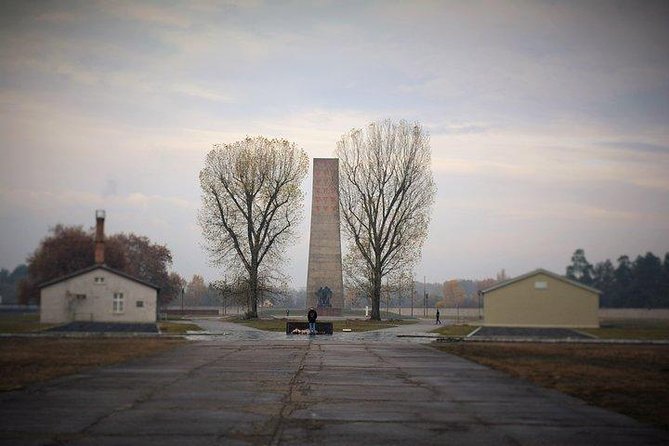
Your guide explains the layout from here and helps you understand the relationship between the entrance, the roll-call area, prisoner barracks, administrative buildings, and the SS-controlled parts of the camp. The grounds are large and exposed, so the physical arrangement matters. You can see how visibility and control shaped daily life.
The roll-call area is especially stark. Prisoners could be forced to stand there for long periods while being counted, inspected, or punished. The space is not dramatic in the way a grand monument might be, and that is part of its force. A plain open area becomes disturbing when you understand how it was used.
This is also a point where a guide can keep the visit from becoming a rushed photo stop. You will have time to look, but the emphasis is on understanding what the space meant to the people forced to stand there.
Infirmaries, pathology, and the mortuary cellar
The pathology building, infirmary buildings, and mortuary cellar show the camp’s medical side, which was not separate from its system of cruelty. These areas help explain how illness, neglect, medical experiments, and the treatment of prisoners’ bodies formed part of camp life.
The word infirmary may sound reassuring, but it should not lead you to expect a normal hospital. At Sachsenhausen, medical spaces existed within a system that ranked human lives, denied proper care, and used prisoners as subjects. Your guide gives the buildings their proper meaning and helps you take the information at a manageable pace.
This section can be among the hardest parts of the visit. You may want to pause, step back, or take a quiet break. The tour allows time for rests and bathroom breaks, and that matters on a site where the emotional pressure can build over several hours.
More wartime history tours in Berlin:
- Berlin: Sachsenhausen Concentration Camp Memorial Tour
★ 4.7 · 3,716 reviews - Third Reich Berlin: Hitler and WWII Walking Tour
★ 5.0 · 3,301 reviews - Sachsenhausen Concentration Camp Bus Tour in English from Berlin
★ 5.0 · 1,962 reviews - Berlin: Sachsenhausen Concentration Camp Tour in English
★ 4.8 · 1,889 reviews
Station Z, the execution facility
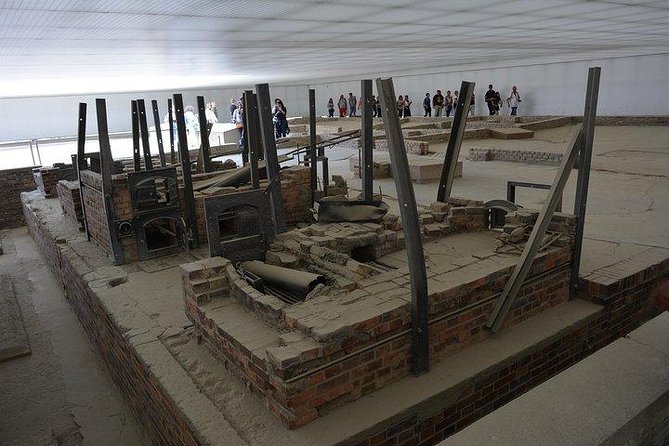
Station Z was a purpose-built execution facility. Its name and function are central to understanding that Sachsenhausen was not simply a prison or labor camp. The camp system used different sites and structures for different forms of imprisonment, punishment, forced labor, and killing.
The remains and exhibits here provide direct evidence of organized murder. A guide explains the purpose of the facility and places it within the broader history of the camp. This is a section where clear language is more useful than dramatic presentation. The material is already powerful enough.
Sachsenhausen is sometimes described as not being an extermination camp in the narrow sense, but that distinction must not create a false impression. The site still records mass death and deliberate killing. Station Z makes that reality impossible to ignore.
The former camp kitchen and prisoner barracks
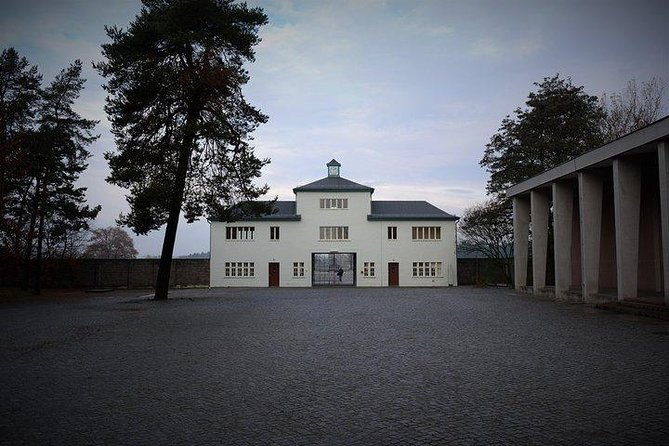
The exhibition in the former camp kitchen adds another layer to the visit. Kitchens may sound like ordinary service buildings, yet food was tied to survival, punishment, labor, and control. The exhibition helps show how basic needs were managed inside the camp system.
The former prisoner barrack block gives you a clearer sense of the daily environment. Barracks were not merely sleeping quarters. They were part of a tightly controlled routine in which overcrowding, poor conditions, forced labor, and constant surveillance shaped every hour.
Some of the original structures and exhibits are preserved, while other parts of the camp are marked by foundations or reconstructed elements. That mixture requires attention. You are not looking at a fully intact camp, and the guide helps explain what is original, what has been altered, and how the memorial presents the site.
The buildings are spread out. You will walk between them over open ground, often stopping to listen before moving on. Good footwear is essential, and comfortable clothing is sensible even if the weather looks mild at the meeting point. One account describes a sudden change from cool sunshine to cold, strong wind during the visit, so a jacket is wise.
The SS and Gestapo Prison
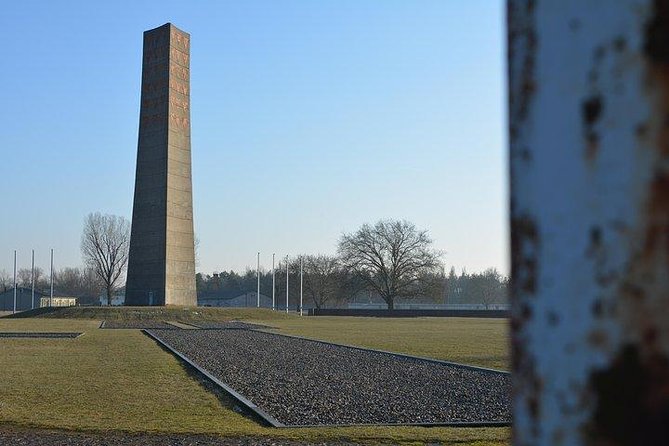
The former SS and Gestapo Prison shows how punishment operated inside the wider camp. It was used for political prisoners and others singled out for especially harsh treatment. The building adds an important distinction to the main compound: imprisonment within the camp could take different forms, with separate rules and levels of cruelty.
This stop can be easy to rush because enclosed rooms may seem less visually striking than the open camp grounds. I would give it time. The smaller spaces make the machinery of interrogation, isolation, and punishment feel more immediate.
Your guide’s commentary is especially useful here because the building’s meaning is not always obvious from its walls alone. Ask questions if you need help connecting this prison to the SS administration and the camp’s larger structure.
What the five-hour schedule feels like
The advertised duration is about five hours, with roughly three hours devoted to the memorial itself. The rest covers meeting, public transport, the approach from Oranienburg, and the return to central Berlin. The activity ends back at the original meeting point.
That schedule is sensible for the distance. A shorter outing would leave you rushing through the memorial or trying to fit too much into a limited visit. Even so, five hours is a serious block of your day. Do not pair it with another demanding tour that begins immediately afterward.
You should be able to walk for several hours, though the experience is described as accessible for people with limited mobility. The two points are not contradictory, but they do need context. Accessibility support is available, while the wide site, transport connections, and long periods on foot may still require planning. Ask the guide for help with pacing and transport if needed.
Food and drinks are not included. Bring what you need for the half-day, since the tour does not provide refreshments. Animals and pets are allowed according to the activity details, though a memorial of this nature calls for quiet, respectful behavior.
Is $41.12 a fair price?
The listed price is $41.12 per person, before the €4.70 ABC ticket and any bus fare. That makes the true cost a little higher, but the price remains reasonable if you value a guide who handles the route and gives three hours of focused interpretation at the memorial.
You are not paying for transport alone. The useful part is the explanation on the train, the orientation at the site, and the help selecting key buildings from a large memorial complex. A self-guided visit may cost less, but you would need to arrange the route, buy the correct ticket, find your way from Oranienburg, and build your own historical framework.
The small group improves the value. With no more than 15 people, you have a fair chance to ask about a difficult detail or request clarification without holding up a large crowd. The price is less attractive if you already know the site well or prefer to read exhibits at your own pace, but first-time visitors are likely to get more from guided structure.
One administrative caution is worth noting. A booking has been canceled the night before in one reported case, causing trouble for someone with limited time in Berlin. The stated policy allows free cancellation up to 24 hours before the start, with a full refund. If the minimum group is not reached and the operator cancels, you are offered another date or experience, or a full refund. I would still avoid placing this tour on the only open morning of a short Berlin stay.
Who will get the most from this memorial tour?
This is a strong choice if you want a serious historical visit with a guide who can answer questions in English. It suits adults, older children, students, and anyone who prefers a clear route through a large and emotionally difficult site.
It is also a good fit if public transport in Berlin feels confusing. The meeting point is easy to identify beside Brandenburg Gate, and guides can help with the ABC ticket. The journey gives you an introduction to the subject before you arrive.
You may prefer an independent visit if you need complete control over timing, want to spend longer with individual exhibits, or find group discussion distracting at memorial sites. The guided schedule includes rest stops, but it still moves as a group and returns according to the planned timetable.
The subject should guide your decision. This is not an attraction for light entertainment or casual photographs. Go because you want to understand the Nazi concentration camp system and remember the people imprisoned and killed there.
Should you book it?
Book this tour if you want context, a manageable route, and direct access to an English-speaking guide during a half-day visit from Berlin. Paul, Aaron, and Stephen have each been associated with a style of guiding that is clear, respectful, and open to questions, though no specific guide is guaranteed.
The strongest reasons to choose it are the small group, transport help, and careful coverage of Tower A, the roll-call area, Station Z, the prison, barracks, kitchen, and medical buildings. The main costs are the extra transport ticket, the long walk, and the emotional strain.
Wear good shoes, carry a jacket and water, and leave room in your schedule to think afterward. If you can give Sachsenhausen the attention it deserves, this tour offers a practical and serious way to visit one of Germany’s most important memorial sites.
FAQ
Where does the Sachsenhausen tour start?
It starts outside Hopfingerbräu at Ebertstraße 24, 10117 Berlin, next to Brandenburg Gate. The start time is 10:00 a.m.
How long does the experience last?
The full activity lasts about five hours. Approximately three hours are spent at the Sachsenhausen Concentration Camp Memorial, with the remaining time used for transport and the return to Berlin.
Is public transportation included?
Public transportation is not included in the listed price. You need an ABC ticket, which costs €4.70 per person if you do not already have a suitable travel pass. Bus fare is also excluded.
Is the tour offered in English?
Yes. The activity is offered in English and uses an English-speaking guide.
How many people can join the tour?
The group can include a maximum of 15 travelers.
What is the cancellation policy?
You can cancel up to 24 hours before the local start time for a full refund. Cancellations or changes made less than 24 hours before the start are not accepted for a refund.
Just added around Berlin
- eSIM for Germany and 34 European Countries★ 4.5 · 16 reviews
- Your ticket to The Wall Museum Berlin★ 3.0 · 60 reviews
- Walking on the Wall: 3-Hour Tour in Berlin★ 4.5 · 34 reviews
- Rickshaw Tours Berlin – Groups of up to 16 people with several rickshaws★ 4.0 · 97 reviews
- Warnemuende Shore Excursion: Private Berlin Tour★ 4.5 · 27 reviews
- Love and War in Berlin: Self-Guided Story Puzzle Walk★ 5.0 · 7 reviews
- Warnemuende Shore Excursion: Berlin Private Sightseeing Tour from Rostock★ 5.0 · 4 reviews
- Karl-Marx-Allee Tour: Life and Architecture in East Berlin★ 5.0 · 19 reviews
Berlin Tours, compared.

Reichstag, Dome and Government District Guided Tour
Read our review →
1-Hour City Tour by Boat with Guaranteed Seating
Read our review →




Reichstag, Plenary Chamber, Cupola & Government Tour
Read our review →
Browse the lists this tour appears in