
Review · BERLIN TOURS
Private Walking Tour: World War 2 and Cold War Sites in Berlin
Berlin’s most important 20th-century sites are scattered across the city, and a good guide turns those disconnected places into one understandable story. This private tour links the Brandenburg Gate, Hitler’s bunker site, the Holocaust Memorial, Checkpoint Charlie, the Berlin Wall, and other key locations while explaining how dictatorship, war, occupation, and division reshaped Berlin.
I especially like the private format, since your guide can focus on World War II, the Cold War, or a mix of both. I also like the chance to adjust the pace and content around what you have already seen. Guides including Hannah, Daniel, Glen, Maria, Jamie G, Ariel, and Joerg are praised for strong historical explanations and personal attention.
The main catch is distance. The full menu of possible stops stretches well beyond a comfortable four-hour walk, so you cannot expect to explore every place listed in detail. Tell the company your priorities before the tour, and be ready for several hours on foot with no food or drinks included.
Key points to know before booking
- Choose your historical focus: Build the tour around Nazi Germany, the Cold War, or both.
- See Berlin’s central landmarks: The route can include the Reichstag, Brandenburg Gate, Holocaust Memorial, Hitler’s bunker site, and Checkpoint Charlie.
- Expect a real walking tour: The experience lasts about three to four hours and covers a lot of ground.
- Use private time wisely: Your guide can skip places you have already seen and spend longer on subjects that matter to you.
- Ask for the Wall sites specifically: East Side Gallery and the Berlin Wall Memorial are not guaranteed unless they fit your agreed route.
- Hotel pickup and drop-off are included: The tour begins and ends at a central Berlin hotel lobby.
Why a private history tour works well in Berlin
Berlin can feel like an open-air history book with several chapters printed on top of one another. A Nazi government building may later have served East Germany. A Cold War crossing may now be surrounded by shops and traffic. A strip of concrete can mark the place where families were separated for decades.
That is why a private guide can add real value. You are not just looking at the Brandenburg Gate or a piece of wall. You are asking what happened there, who controlled it, and how the meaning of the place changed.
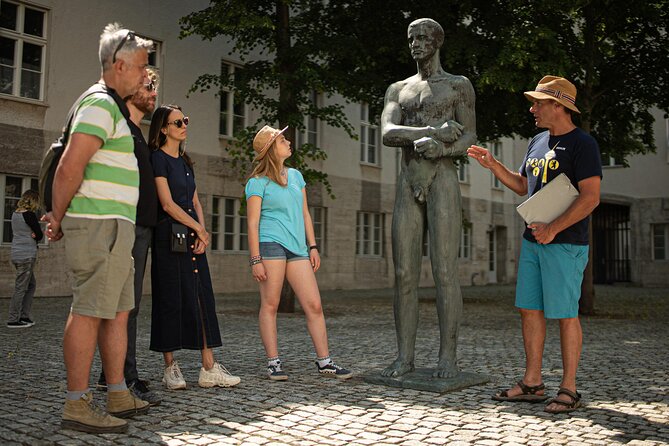
The tour begins with a lobby meeting at a central Berlin hotel. You can choose a morning or afternoon departure, then discuss your interests with the guide. Since this is a private activity, only your group participates, which makes it easier to ask basic questions, pause for photographs, or request more detail without holding up a larger group.
The guide roster includes people such as Jeff, Hannah, Emma, Daniel, Glen, Jamie G, Ariel, Maria, Joerg, Jim, Klaus, Callum, Peter, Steve, and Rohan. The strongest feedback consistently centers on clear explanations, enthusiasm, flexibility, and the ability to adjust the pace. That matters here because Berlin’s history is complicated, and a guide who can answer follow-up questions is more useful than one who simply recites dates.
More Wall and Cold War walks:
- Berlin: Third Reich and Cold War 2 Hour Walking Tour
★ 4.9 · 6,830 reviews - Berlin’s Best: 2 Hour Walking Tour Third Reich and the Cold War
★ 5.0 · 5,486 reviews - Berlin: DDR Museum Tickets
★ 4.3 · 3,443 reviews
Reichstag and Brandenburg Gate: power, war, and reunification
The Reichstag Building is a natural place to begin a discussion of modern Germany. You can hear about the Nazi-era plans for Berlin, including Albert Speer’s proposed Germania, and the destruction that followed during the Battle of Berlin.
The conversation may also touch on people who opposed Hitler, including Claus von Stauffenberg, as well as the Soviet victory and the final collapse of the Third Reich. You will not enter the Reichstag as part of the listed walking stops, but the exterior provides an important reference point for understanding Germany’s political past and present.
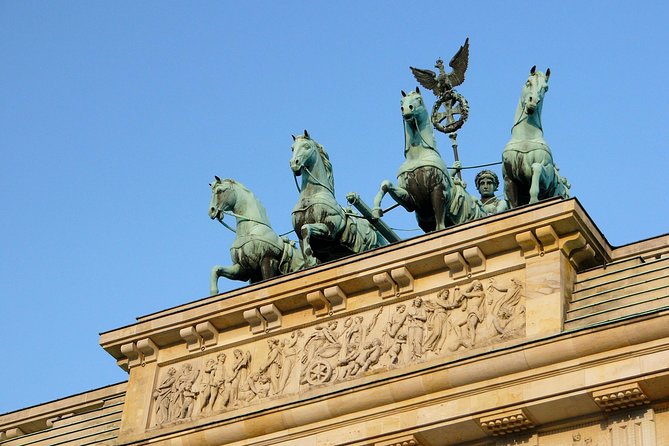
A short walk brings you to the Brandenburg Gate. Built as a royal entrance, it later became one of the clearest symbols of a divided Berlin. During the Cold War, the gate sat beside the Wall in an area inaccessible to ordinary East Berlin residents and most people from the West.
Today, it represents German unity. That change in meaning is one of the most useful themes on this tour: Berlin’s monuments are not frozen in one era. Their symbolism has shifted with the city around them.
The Reichstag and Brandenburg Gate are close enough to combine easily, but the tour may spend only about ten minutes at each listed stop. If you want detailed architectural information or interior visits, tell your guide in advance. This experience is mainly about historical interpretation from the streets, not long indoor sightseeing.
Holocaust Memorial and Hitler’s bunker site
Near the Brandenburg Gate, the Memorial to the Murdered Jews of Europe is one of Berlin’s most serious places. Its 2,711 concrete slabs form a grid, but the blocks vary in height and the ground changes under your feet. Walking among them can feel disorienting and enclosed, even though the memorial is in the center of the city.
A guide can explain the memorial’s design and place it within the Nazi campaign to murder Europe’s Jews. The underground information center contains personal accounts and historical material, but the tour stop itself is brief and does not include a listed admission charge. If the information center is important to you, ask how much time the schedule allows.
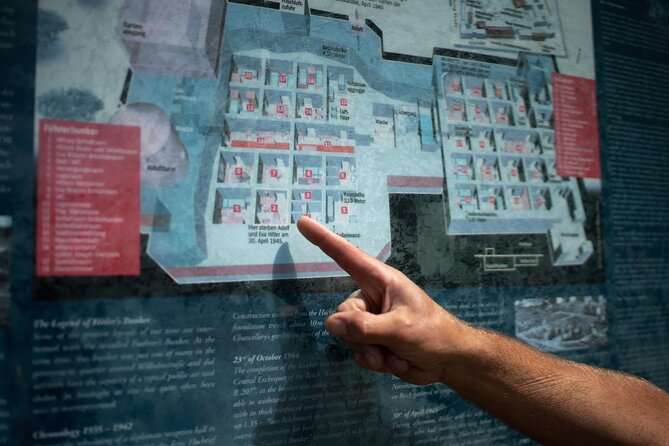
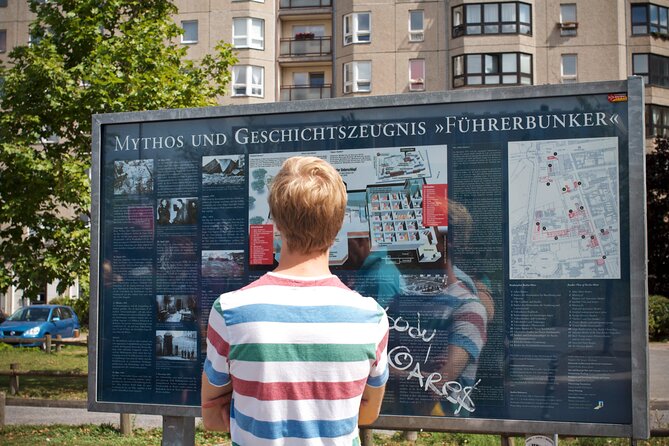
The nearby site of Hitler’s bunker is less dramatic than many people expect. There is no preserved bunker interior to visit. The location is marked in an ordinary urban setting, and that is part of the point. The regime’s final headquarters is now a place where you must use imagination and context rather than look at a grand ruin.
This stop works best when your guide explains the final days of the Nazi leadership, the Battle of Berlin, and what happened to the site after the war. It is not a conventional attraction, so do not book this tour expecting a museum entrance or a subterranean visit.
Aviation Ministry and Topography of Terror
The former Reich Air Ministry is one of the most striking surviving Nazi-era buildings in central Berlin. Completed in 1936, it housed the Luftwaffe and was closely linked to Hermann Göring. Its size and severe design were meant to project state power.
The building survived wartime damage and later became East Germany’s Ministry of Transport. Today, it is used by the German government, so you view it from outside. Its changing role gives your guide a chance to explain how Berlin reused, concealed, or confronted structures inherited from dictatorship.
Nearby, the Topography of Terror exhibition occupies the former headquarters area of the SS, Gestapo, and SD. The open-air and indoor displays focus on the institutions and people who carried out Nazi persecution. This is an important distinction: the site emphasizes the machinery of repression and the perpetrators, not only the victims.
Allow yourself time to read if you return independently. On the walking tour, the stop is typically around fifteen minutes, enough for orientation and explanation but not enough for a complete museum visit. I would treat the guided stop as an introduction, then come back later if the subject interests you.
More walking tours in Berlin:
- Discover Berlin Half-Day Walking Tour
★ 5.0 · 9,624 reviews - Berlin: Discover Berlin Walking Tour
★ 4.9 · 5,998 reviews - Berlin: Hidden Backyards Guided Walking Tour
★ 4.8 · 5,360 reviews - Third Reich Berlin: Hitler and WWII Walking Tour
★ 5.0 · 3,301 reviews
Checkpoint Charlie and the Palace of Tears
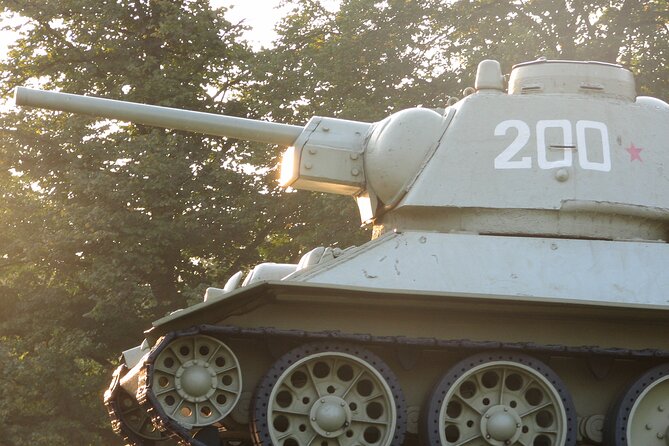
Checkpoint Charlie was the best-known crossing between East and West Berlin. In October 1961, American and Soviet tanks faced one another here during a tense confrontation that showed how quickly the Cold War could turn dangerous.
The crossing also carried a human cost. Families and friends were separated, escape attempts were planned, and the Wall became a daily barrier backed by armed guards and strict rules. Your guide can connect the checkpoint to the broader story of surveillance, escape, and life in a divided city.
The modern setting is busy and commercial, and the reconstructed guardhouse can make the place feel more like a photo stop than a preserved border crossing. The historical explanation is therefore essential. Without it, the site can be underwhelming.
The Palace of Tears at Friedrichstrasse Station offers a more personal view of division. This departure hall was where East Germans said goodbye to relatives and friends leaving for West Berlin between 1961 and 1989. The name comes from those painful farewells.
The museum inside presents personal stories and explains how travel restrictions affected ordinary life. The stop is listed at about twenty minutes, so you may get an introduction rather than a full museum visit. If personal accounts interest you more than military strategy, make this clear when planning your route.
Berlin Wall Memorial on Bernauer Strasse
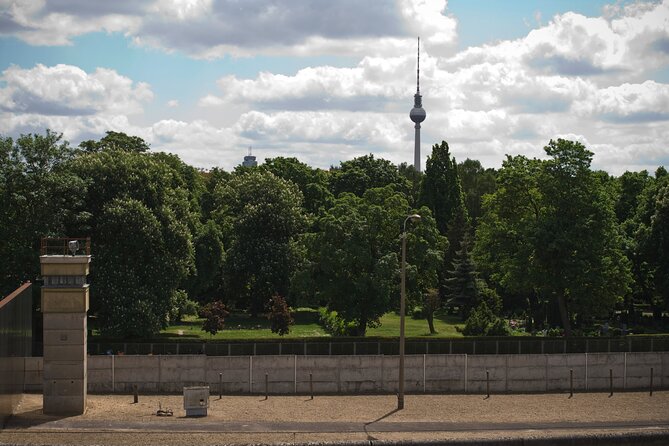
The Berlin Wall Memorial on Bernauer Strasse is one of the most meaningful Wall sites in the city. When the barrier went up in 1961, it cut through the street and separated neighbors. People on the western side watched as East Berlin residents lost homes, access routes, and freedom of movement.
The memorial preserves sections of the Wall, a watchtower, and parts of the former border system. It also explains escape attempts, including Tunnel 29, which helped 29 people reach West Berlin in 1962, and Tunnel 57, used by 57 people in 1970.
This area is especially useful because it shows that the Wall was not just a slab of concrete. It was a controlled border system with fences, patrols, watchtowers, and a lethal zone. The open spaces make the former layout easier to understand than the isolated Wall fragments found elsewhere.
The stop is listed at about twenty-five minutes, but you may want more time. If you are most interested in the Wall, ask your guide to make Bernauer Strasse a priority rather than trying to squeeze in every Nazi and Cold War location.
East Side Gallery and Tempelhofer Feld
The East Side Gallery is the longest surviving stretch of the Berlin Wall and one of the world’s longest permanent open-air art displays. Murals cover the concrete with images tied to freedom, justice, peace, and political change.
It is visually lighter than the Holocaust Memorial or Bernauer Strasse, but it has its own value. The paintings show how Berliners and international artists reclaimed a structure that once represented fear and control. The area can be popular, so your guide’s historical background helps connect the artwork to the Wall’s fall.
Be precise when booking: East Side Gallery is one possible stop, not a promise that it will appear on every customized route. It is farther from many central Nazi-era locations, and seeing it may require reducing time elsewhere.
Tempelhofer Feld offers another unusual chapter. The former airport was built during the Nazi period and later played a major role in the 1948 and 1949 Berlin Airlift, when Allied aircraft supplied West Berlin during the Soviet blockade.
The airport no longer functions as an airport. Its vast former runways and open grounds are now used as public recreation space. A stop here adds physical scale to the story of the Airlift, though it is not as central as Checkpoint Charlie or the Brandenburg Gate. Include it if aviation history or everyday Berlin life appeals to you.
Prenzlauer Berg and the story of repression after 1945
A former NKVD prison in Prenzlauer Berg offers a reminder that Berlin’s story did not end in 1945. The site was later used by East Germany’s Stasi, which employed interrogation and detention methods against people viewed as threats or opponents.
This stop helps connect Nazi repression with the later Soviet and East German systems without suggesting that the two regimes were identical. It also lets you examine how Germany deals with difficult places from its past.
The listed stop is brief, about ten minutes. You may hear about the prison’s former use and its present purpose, but a full museum visit would require separate time. Add it when you want a less familiar site and are willing to give up one of the better-known central monuments.
How much can you really see in four hours?
The tour is advertised as roughly three to four hours, and the suggested route contains twelve possible stops. That should tell you something important: the itinerary is a menu, not a promise to see every location in depth.
A route focused on central World War II sites might include the Reichstag, Brandenburg Gate, Holocaust Memorial, bunker site, Aviation Ministry, and Topography of Terror. A Cold War route could emphasize Checkpoint Charlie, the Palace of Tears, Bernauer Strasse, and perhaps East Side Gallery.
Trying to include Tempelhofer Feld, Prenzlauer Berg, and East Side Gallery in the same short outing may leave little time at each place. Tell the company what you most want to understand, not just what you want to photograph.
The walking is substantial. One person found four hours of continuous walking difficult because there was no planned rest or drink break. Other guide feedback highlights good pacing, including Peter adjusting the route for an older group and Steve’s three-hour tour being enough for one couple.
Wear comfortable shoes, carry water, and mention mobility concerns when arranging the tour. Hotel pickup and drop-off are included, but the experience itself remains a walking tour. A morning departure is useful on your first full day because it can help you get your bearings and plan later sightseeing.
Price, private attention, and overall value
At $192.97 per person, this is expensive compared with a standard group walking tour. The price makes more sense for a small group that wants a custom route, has limited time, or needs a guide who can answer many questions.
For two people, the total cost is significant. One couple still felt the private format was worth it because the guide adapted the route and gave them a much clearer understanding of Berlin. If you are comfortable researching on your own and only want to see the main monuments, this may not be the best use of your budget.
The value comes from the interpretation, not admission tickets. The listed stops are free, food and drinks are not included, and the tour does not promise extended indoor visits. You are paying for a private historian and a route shaped around your interests.
The strongest guide feedback centers on personal attention. Daniel, Glen, Ariel, Maria, and Rohan are described as flexible and able to adjust the content to match what each group had already seen. Jamie G was praised for answering many questions patiently, while one guide used a picture book to make the Wall’s changing appearance easier to understand.
That kind of help is particularly valuable if you have watched documentaries or read about Berlin but find the geography confusing. A private guide can show you where events happened and explain how each site fits into the next chapter.
Who should book this Berlin walking tour?
I would recommend it to first-time visitors who want a serious introduction to Berlin’s Nazi and Cold War past. It also suits families and mixed-interest groups because the route can shift between military history, political change, personal stories, architecture, and modern Berlin life.
It is a good choice if you have already visited a few central sights on your own. Tell the guide what you have seen, and the tour can focus on places you missed. It is also useful for people who want help using Berlin’s public transport, since one guide helped an older couple learn the U-Bahn and S-Bahn during their day.
You should think twice if you dislike long walks, want extensive museum time, or expect every listed stop to be included. The tour is strongest when you choose three or four priorities and let the guide build a sensible route around them.
Free cancellation is available up to 24 hours before the start time. After that, the payment is not refunded, and late changes are not accepted. Confirmation is immediate in most cases, although bookings made within two days may be confirmed within 48 hours, subject to availability.
Should you book it?
Book this tour if you want Berlin’s difficult 20th-century story explained at the places where it happened, and if private flexibility matters more to you than a low price. Before paying, send a short list of your must-see sites, especially East Side Gallery, Bernauer Strasse, Tempelhofer Feld, or the Palace of Tears.
Skip it if you mainly want quick photographs of the Brandenburg Gate and Checkpoint Charlie. For everyone else, the combination of hotel pickup, a private English-speaking guide, and a route built around your questions can make the cost worthwhile, provided you plan the priorities clearly.
FAQ
How long does the private Berlin history tour last?
The tour lasts approximately three to four hours. A shorter three-hour format may also be suitable, depending on your plans and the route selected.
Is hotel pickup included?
Yes. The tour begins with a meeting in the lobby of a central Berlin hotel, and hotel drop-off is included at the end.
Can I choose between World War II and Cold War history?
Yes. You can focus on World War II, focus on the Cold War, or request a combination of both.
Can the walking route be customized?
Yes. This is a private activity, and you should provide specific attractions and subjects you want included when booking.
Is the tour offered in English?
Yes. The experience is offered in English with a professional guide.
Does the tour include the East Side Gallery?
East Side Gallery is one of the possible stops, but it is not guaranteed on every route. Request it when booking if it is important to you.
Does the tour include the Berlin Wall Memorial?
The Berlin Wall Memorial on Bernauer Strasse is listed as a possible stop. Because the route is customized, confirm that you want it included.
Are admission tickets, food, and drinks included?
The listed outdoor stops have no admission charge. Food and drinks are not included.
What is the cancellation policy?
You can cancel at least 24 hours before the experience begins for a full refund. Cancellations or changes made less than 24 hours before the start time are not accepted for a refund.
Just added around Berlin
- eSIM for Germany and 34 European Countries★ 4.5 · 16 reviews
- Your ticket to The Wall Museum Berlin★ 3.0 · 60 reviews
- Warnemuende Shore Excursion: Private Berlin Tour★ 4.5 · 27 reviews
- Walking on the Wall: 3-Hour Tour in Berlin★ 4.5 · 34 reviews
- Rickshaw Tours Berlin – Groups of up to 16 people with several rickshaws★ 4.0 · 97 reviews
- Love and War in Berlin: Self-Guided Story Puzzle Walk★ 5.0 · 7 reviews
- Warnemuende Shore Excursion: Berlin Private Sightseeing Tour from Rostock★ 5.0 · 4 reviews
- Cold War Berlin – Private Live Virtual Experience★ 5.0 · 4 reviews
Berlin Tours, compared.

Reichstag, Dome and Government District Guided Tour
Read our review →
1-Hour City Tour by Boat with Guaranteed Seating
Read our review →




Reichstag, Plenary Chamber, Cupola & Government Tour
Read our review →
Browse the lists this tour appears in