
Review · BERLIN TOURS
Berlin Wall History Small Group Cycling Tour
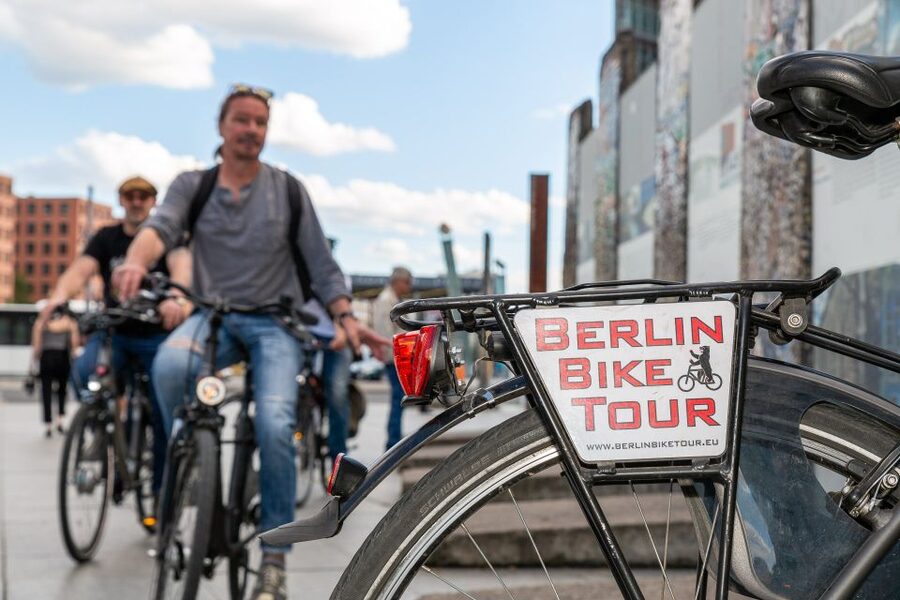
Berlin’s Wall story becomes clearer when you follow it by bicycle. This four-hour ride links former border crossings, watchtowers, parts of the Death Strip, memorials, and the places where the divided city finally opened in 1989. You begin at Bornholmer Straße, where the first East German citizens crossed into the West, and finish back where you started.
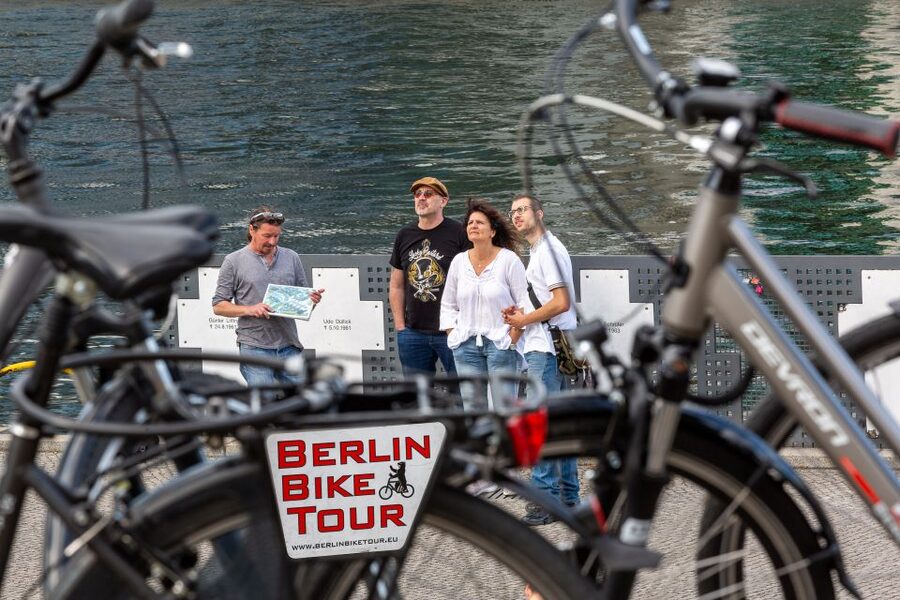
I like the small group of no more than eight, which gives guides such as Marcus and Kathrin room to explain the hard parts of Berlin’s past rather than simply point at them. I also like the route itself: it reaches famous sights such as Brandenburg Gate and Checkpoint Charlie, but uses quieter streets through the city center.
The main consideration is that the live tour is conducted in German. The ride also runs in all weather, and large bags are not allowed, so pack lightly and bring a rain layer or use the provided poncho.
Key points at a glance
- Begin at Bornholmer Straße: Start at the Square of the 9th November 1989, beside an original watchtower and traces of the former Death Strip.
- Ride through Mauerpark and Bernauer Straße: See some of Berlin’s clearest Wall memorials and follow the route toward a former ghost station.
- Visit several former crossings: Chausseestraße, Invalidenstraße, Bornholmer Straße, and Checkpoint Charlie show how controlled movement once was.
- Reach central Berlin by bike: The route includes the Parliament of Trees, Brandenburg Gate, Potsdamer Platz, Friedrichstraße, and the Tränenpalast.
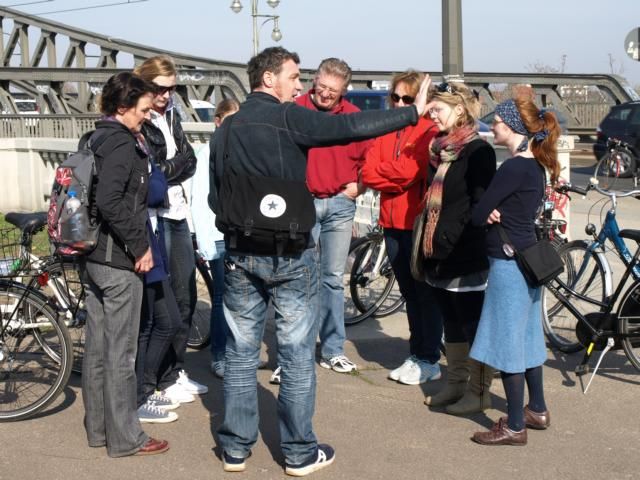
- Keep the group personal: With three to eight participants, you can hear detailed explanations and ask questions without a large crowd.
- Pay $36 for four hours: The bicycle, guide, fees, and rain poncho when needed are included, making this a strong value for a history-focused city tour.
Starting where the Wall first opened
The tour begins at 75 Bornholmer Straße, a practical starting point for a route about division and reunion. The meeting place is close to public transport, just one minute from the Björnsonstraße tram stop and about two minutes from S-Bahn station Bornholmer Straße.
You begin at the Square of the 9th November 1989. This gives the tour an immediate sense of place. You are not first shown a museum display or a polished monument. You are taken to the point connected with the first East German citizens who crossed the border when the system began to break apart.
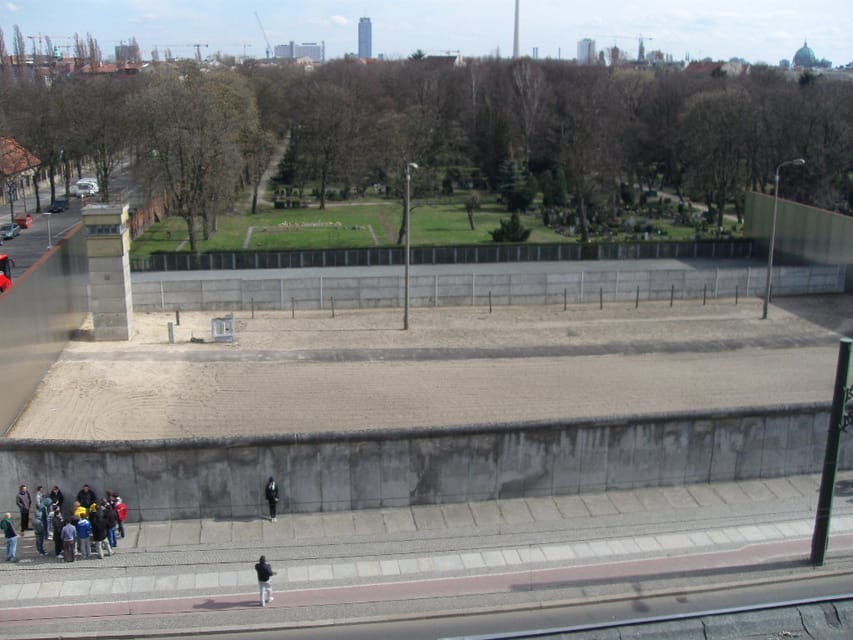
The area also introduces several details that are easy to miss on a normal city ride. You see an original watchtower and part of the former Death Strip, along with the cherry trees planted on Bornholmer Straße. The guide explains how those trees came to be there, adding a human detail to what could otherwise feel like a bare strip of pavement and open space.
I appreciate this beginning because it gives you a fixed point for the rest of the day. Berlin’s Wall was not one solid line in a single location. It cut across streets, parks, railway lines, cemeteries, and government districts. Starting at a former crossing helps you understand that this was a working border, not just a length of concrete.
More Wall and Cold War walks:
- Berlin: Third Reich and Cold War 2 Hour Walking Tour
★ 4.9 · 6,830 reviews - Berlin’s Best: 2 Hour Walking Tour Third Reich and the Cold War
★ 5.0 · 5,486 reviews - Berlin: DDR Museum Tickets
★ 4.3 · 3,443 reviews
Mauerpark and the first stretch of the Wall route
From Bornholmer Straße, you cross the former border-control area and cycle through Mauerpark. The park is one of the better places to see how the old dividing line has been absorbed into everyday Berlin.
The name refers to the Wall, and your guide follows the traces of the former route rather than presenting the park as an isolated green stop. This is useful because very little of the Wall remains. In many places, you need markings, photographs, memorial signs, or an explanation to understand what once occupied the space.
The bicycle makes this section work well. You can cover ground between the northern Wall sites without spending the whole morning on foot. The route also helps you connect places that appear separate on a city map.
Do not expect a preserved fortress or a continuous barrier. The value is in the fragments and the explanation around them. You may see a watchtower, an open strip, a memorial, or a line in the pavement, then move on to a normal neighborhood. That sharp change is part of the lesson.
Bernauer Straße and the clearest memorial evidence
Bernauer Straße is one of the most important stops on the ride. The Wall Memorials here preserve a larger sense of how the border affected homes, streets, and movement through the city.
Your guide brings the route into focus with photographs and stories, including the rabbit images on the ground. These pictures guide you toward the Brandenburg Gate and provide a visual thread through a city where the physical Wall has mostly disappeared.
This is the part of the tour where the past can feel most tangible. You are not only hearing about watchtowers and patrol zones. You are seeing memorial spaces built around the former border line and learning how ordinary urban life was shaped by it.
The possible drawback is that Berlin’s Wall sites can feel spread out and visually uneven. Some are carefully marked, while others require context. That is exactly why the guide matters here. A self-guided ride can show you the same streets, but it may not explain why one section matters more than another.
Chausseestraße, the ghost station, and controlled movement
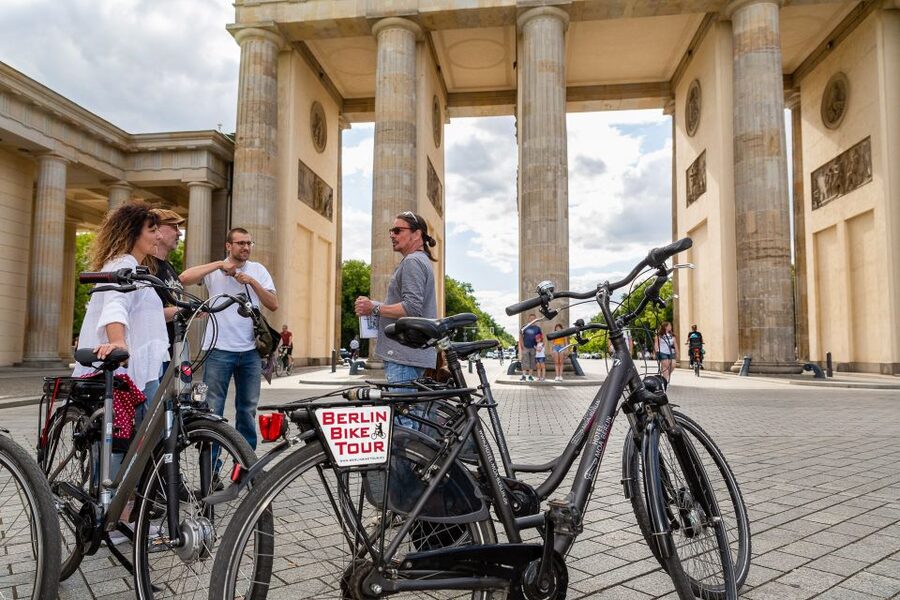
The route continues to Chausseestraße, where you see a former border crossing and visit the ghost-station area. This stop adds another layer to the Wall story because the division affected not only roads and buildings but also public transport.
The phrase ghost station refers to stations in the divided city where trains passed through without stopping. At Chausseestraße, the guide connects the railway system with the border-control system, showing how travel through Berlin could be restricted even below street level.
This is a strong stop for anyone interested in the Cold War because it moves beyond the familiar image of a concrete wall. The city was divided through checkpoints, rail lines, crossings, watchtowers, and controlled routes. You get a better sense of how many parts of daily movement were shaped by the border.
The guide’s German narration is important here. Stories about escape attempts, restrictions, and tragic outcomes depend on detail. If you do not understand German well, this section may lose much of its value, so the language should be a serious part of your booking decision.
More bike days around Berlin:
- Berlin: Sights and Highlights Bike Tour with a Local Guide
★ 4.8 · 2,698 reviews - Berlin Highlights 3-Hour Bike Tour
★ 5.0 · 948 reviews - Berlin City Bike Tour with Beer Garden Stop
★ 5.0 · 917 reviews - Berlin Highlights: 3-Hour Bike Tour
★ 4.9 · 809 reviews
Invaliden Graveyard and the former Invalidenstraße crossing
The ride then reaches the Invaliden Graveyard and the former border crossing at Invalidenstraße. This stop changes the mood again. A cemetery beside a former border route creates a quieter setting for stories about the people and events connected with Berlin’s divided past.
The route is not simply a checklist of surviving Wall pieces. It moves through places where the border sat alongside ordinary city functions, including transport routes and burial grounds. That variety keeps the four-hour ride from becoming repetitive.
You will also see how central Berlin can feel close to the Wall route. The city’s grand sights are not far removed from places marked by fear, surveillance, and separation. The ride keeps placing those two versions of Berlin next to one another.
Because the tour covers many stops, you should expect explanations rather than long visits at every location. The guide has to keep the group moving to reach the central sights later in the day. If you prefer one memorial with a very slow, detailed museum visit, this cycling route may feel brisk.
Along the Government Bank to the Parliament of Trees
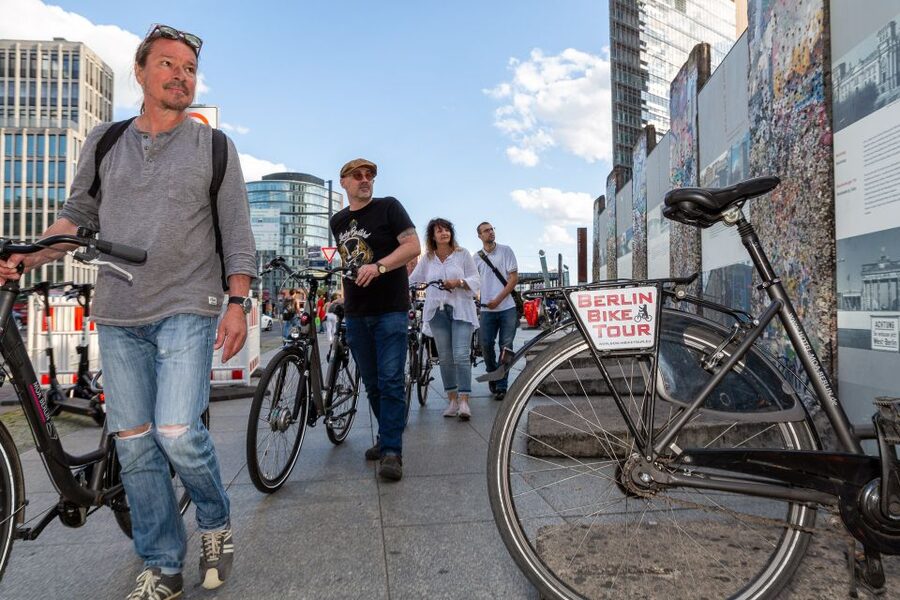
One of the more unusual parts of the ride follows the Government Bank to the Parliament of Trees. This section moves the story toward the modern government district and the open spaces beside the river.
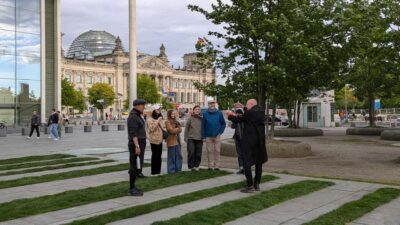
The Parliament of Trees is a memorial space connected with the Wall. Its name alone signals a different approach to remembrance. Instead of another surviving tower or section of concrete, you encounter a place that asks you to consider the Wall through trees, open ground, and memorial design.
Cycling is especially useful here because the route connects the northern sections to the government area without requiring a long transfer by public transport. You see Berlin changing around you as the route moves from former border infrastructure toward national symbols and parliamentary buildings.
A guide can also point out the contrast between the old boundary and the present-day city. The route does not pretend that every trace remains. Instead, it shows you how memorials and city planning preserve selected evidence.
Brandenburg Gate, Friedrichstraße, and the Palace of Tears
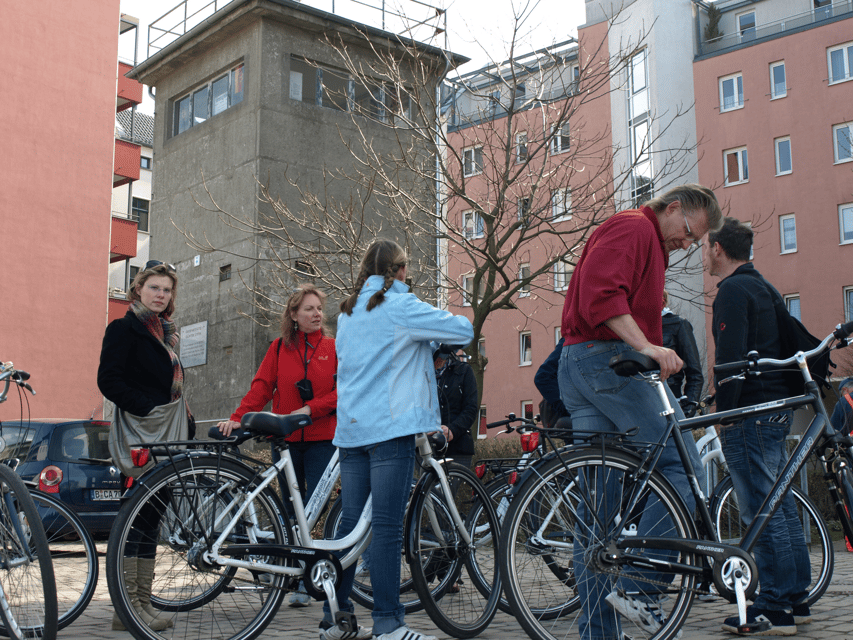
The route reaches the Brandenburg Gate, one of Berlin’s best-known sights. You cycle to it by following the rabbit images on the ground, then pass through the gate toward Friedrichstraße.
The Brandenburg Gate is especially effective in this tour because it is not treated as a stand-alone photo stop. It becomes part of the former border route. You see a celebrated symbol of Berlin alongside the places that once made crossing the city so difficult.
The ride continues past Friedrichstadt Palace, Museum Island, the New Synagogue, and the Old Berlin Post Office. These sights broaden the tour beyond the Wall itself. You get a quick look at some of central Berlin’s major cultural and architectural points while staying connected to the route’s main subject.
On Friedrichstraße, the Tränenpalast, or Palace of Tears, brings the focus back to personal separation. The name refers to the emotional departures associated with the former border crossing. It is a useful stop because it shows the human side of official control. A checkpoint is not only barriers and paperwork. It is also a place where people said goodbye under difficult conditions.
The central section is a good reason to choose this tour over a narrow Wall-only outing. You receive Cold War history and a broad orientation to central Berlin in the same four hours. The tradeoff is that the stops at Brandenburg Gate, Museum Island, and the other central sights are part of a moving route, not full guided visits inside them.
Potsdamer Platz, Checkpoint Charlie, and the route’s final chapter
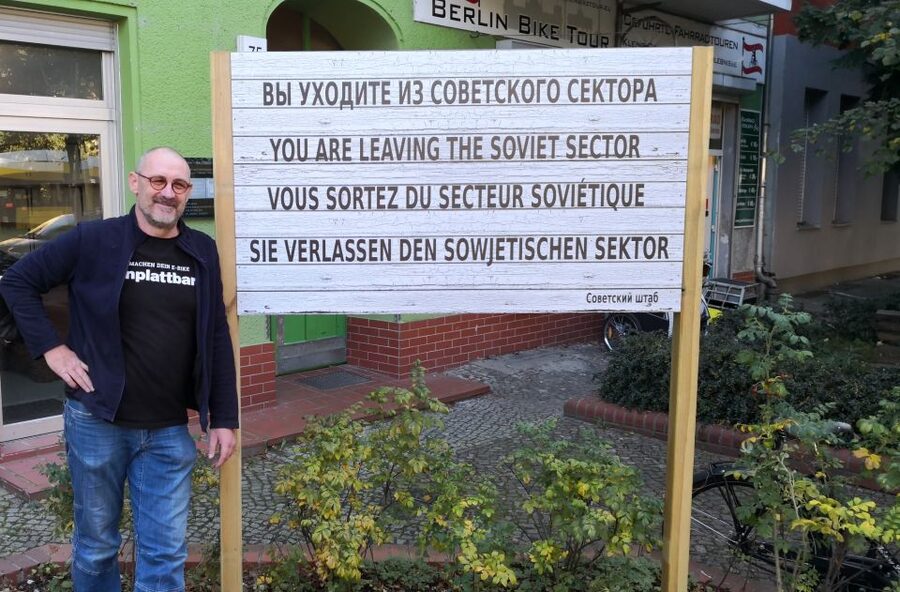
The final part includes Potsdamer Platz and Checkpoint Charlie. These are among the most familiar names associated with divided Berlin, so seeing them after the smaller sites gives you useful context.
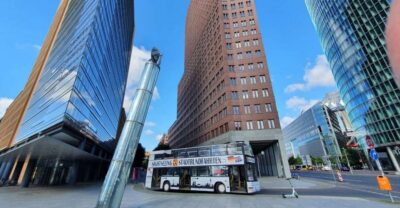
Potsdamer Platz represents the city’s dramatic change over time. On this ride, it appears as part of the former Wall route rather than simply as a modern public square. The contrast between present-day development and the traces of division is one of the clearest themes of the day.
Checkpoint Charlie is another major former crossing. It is famous, but fame can make a place feel simplified. The earlier stops at Bornholmer Straße, Bernauer Straße, Chausseestraße, and Invalidenstraße help you understand that this was one crossing in a much larger border system.
The route also includes Friedrichstraße and the Tränenpalast, giving you more than one view of controlled passage. That variety is valuable. You see where people crossed, where trains moved through without stopping, and where a city street became an international symbol.
The tour ends back at the original meeting point. That makes planning easier because you do not need to arrange a return transfer from central Berlin. You can continue your day from there using nearby tram and S-Bahn connections.
What the $36 price gives you
At $36 per person, this is a reasonably priced four-hour activity. The fee includes the bicycle, guide, tour fees, and a rain poncho when necessary. Food and drink are not included, so plan to eat before or after the ride.
The strongest part of the value is the amount of ground covered with a live guide. Berlin’s Wall sites are scattered, and reaching all of these locations independently would take time and some route planning. The bicycle handles the distance while the guide supplies the background.
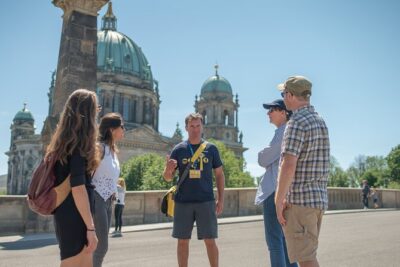
The group limit also matters. A maximum of eight participants is small enough for a more relaxed pace of explanation. Marcus is described as professional and careful with the route, guiding the group through quieter streets even in central Berlin. Kathrin is noted for personal insight and clear explanations. Those details suggest that the quality of the guide is a major part of what you are paying for.
The tour is conducted in German, and the group requires at least three participants. You should confirm the starting time when booking because several start times may be available.
Weather, clothing, and practical planning
The tour runs in all weather. On rainy days, you receive a rain poncho, but you should still dress for a four-hour outdoor activity. Sunglasses and a sun hat are specifically recommended, as is a camera.
Large bags and luggage are not allowed. Bring only what you need for the ride, and carry your passport or ID card as requested. The tour provider includes the bicycle, so you do not need to arrange one separately.
The ride begins near excellent transport connections. Björnsonstraße tram stop is about one minute away, Bornholmer Straße S-Bahn station is about two minutes away, and Schönhauser Allee is roughly ten minutes on foot. The same meeting point is used at the end.
I would avoid scheduling a tight appointment immediately afterward. Four hours is the stated duration, and cycling in changing weather can make a fixed onward plan uncomfortable. Give yourself room to finish, return the bicycle, and make your next connection.
Who will get the most from this ride
This tour suits you best if you want Berlin’s Wall story explained through places rather than delivered as a lecture in one museum. It works particularly well for anyone interested in the Cold War, political history, urban change, or the personal stories behind former border crossings.
It is also a good choice if you want to see major central sights without spending the whole day on foot. The route includes famous places, but it also reaches quieter streets and less obvious traces that you could easily miss on a standard city tour.
The small group is a clear advantage for people who like to ask questions. The relaxed pace praised in the tour feedback also makes it appealing if you want a serious history outing without a stiff, formal atmosphere.
You should think twice if your German is limited. The guide is live and German-speaking, and the stories are the main reason to book. You should also reconsider if you dislike cycling, carry large luggage, or want long indoor visits at museums and memorial buildings.
Should you book the Berlin Wall cycling tour?
Book it if you want a compact but wide-ranging way to understand Berlin’s divided past. For $36, you receive a bicycle, four hours of guiding, a small group, and a route that joins major sights with watchtowers, memorials, former crossings, and the remains of the Death Strip.
The best reason to choose it is the route’s balance. You get Bornholmer Straße and Bernauer Straße, where the Wall’s traces are especially meaningful, then move through Chausseestraße, Invalidenstraße, the Parliament of Trees, Brandenburg Gate, Potsdamer Platz, and Checkpoint Charlie.
Skip it if you need an English-language tour or prefer to explore at your own pace. For German-speaking visitors who want history, personal stories, and plenty of Berlin covered in one morning or afternoon, this is a very strong value.
FAQ
How long does the Berlin Wall cycling tour last?
The tour lasts four hours. Starting times vary, so check availability when choosing your date.
Where does the tour begin?
The meeting point is 75 Bornholmer Straße, Berlin 10439. It is about one minute from Björnsonstraße tram stop and about two minutes from Bornholmer Straße S-Bahn station.
Where does the tour finish?
The activity ends back at the original meeting point on Bornholmer Straße.
What language is the tour conducted in?
The live tour guide speaks German. German is the listed tour language.
How large is the group?
The tour is limited to eight participants and requires a minimum of three participants.
Is a bicycle included?
Yes. The bicycle, tour fees, and city guide are included in the price.
What happens if it rains?
The tour operates in all weather. A rain poncho is provided when necessary.
Can I bring luggage or a large bag?
No. Luggage and large bags are not allowed. Bring a passport or ID card, sunglasses, a sun hat, and a camera instead.
More Historical Tours in Berlin
- Berlin: Natural History Museum Entrance Ticket
★ 4.6 · 3,382 reviews - Berlin: World Heritage Cruise to Potsdam
★ 4.5 · 1,435 reviews - Berlin Historical Highlights Walking Tour
★ 4.9 · 657 reviews - Berlin Private Complete History All Day Walking Tour
★ 5.0 · 474 reviews
Just added around Berlin
- From Berlin: Gardens & Palaces of Potsdam Bike Tour★ 5.0 · 61 reviews
- Berlin: Battle for Seelow Heights WW2 tour -Clash of Titans★ 5.0 · 27 reviews
- From Berlin: Historical Gems of Potsdam Private Day Trip★ 4.4 · 4 reviews
- Berlin: Französischer Dom 360° Panorama & Crémant to go★ 3.9 · 5 reviews
- Explore Berlin Tour: History and Highlights★ 4.7 · 5 reviews
- Berlin: Evening Yacht Cruise with Aperitif & Dinner Upgrade★ 4.6 · 178 reviews
- Berlin: Expats in Berlin Comedy Show Ticket★ 4.7 · 182 reviews
- Berlin: The Epic Comedy Club Friday Night Showcase★ 4.8 · 28 reviews
Berlin Tours, compared.
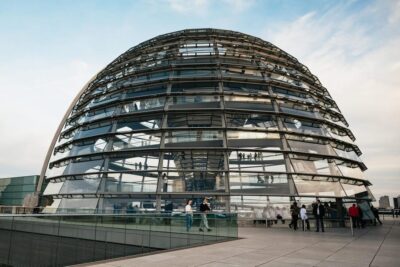
Reichstag, Dome and Government District Guided Tour
Read our review →
1-Hour City Tour by Boat with Guaranteed Seating
Read our review →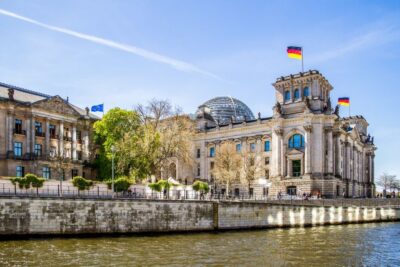
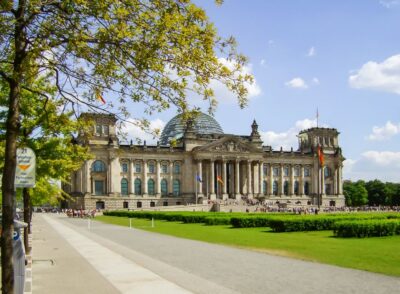
Reichstag, Plenary Chamber, Cupola & Government Tour
Read our review →
Browse the lists this tour appears in