
Review · BERLIN TOURS
Berlin: The Wall and Cold War – a Private Walking Tour
Berlin’s Cold War story makes most sense when you walk the former border itself. This private tour starts at Bernauer Strasse, where an open-air documentation site brings the Wall’s construction, escape attempts, and human cost into view, then follows the old dividing line toward central Berlin.
I like the private format, since you can ask about the details that catch your eye instead of keeping pace with a large group. I also like the route’s strong bookends: Bernauer Strasse gives you the clearest physical remains, while Checkpoint Charlie shows how the divided city became a symbol known around the world.
The main consideration is time. Two hours is enough for a focused introduction, not a full study of Berlin’s Cold War sites. The viewing platform over the former death strip is available only if open, and the tour ends at Checkpoint Charlie rather than returning you to the starting point.
Key points to know before booking
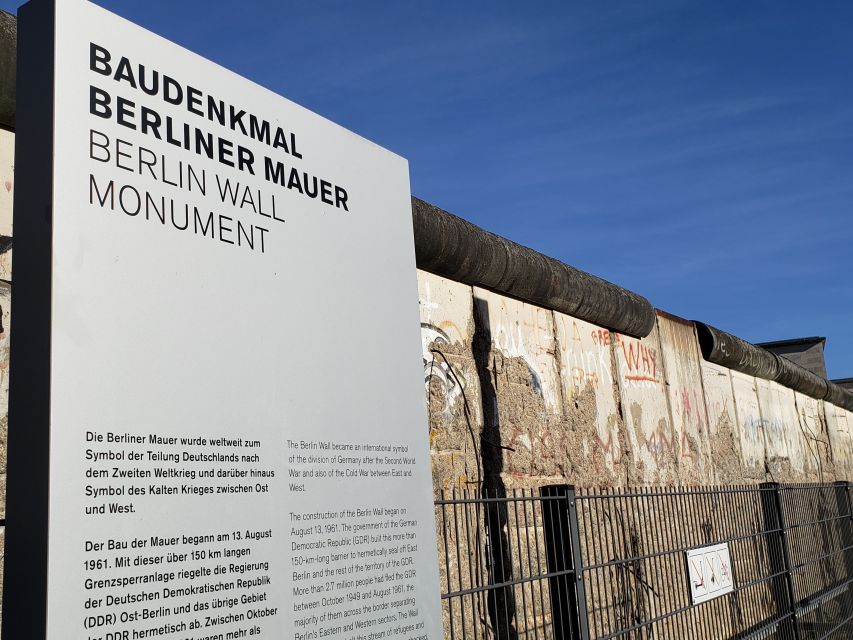
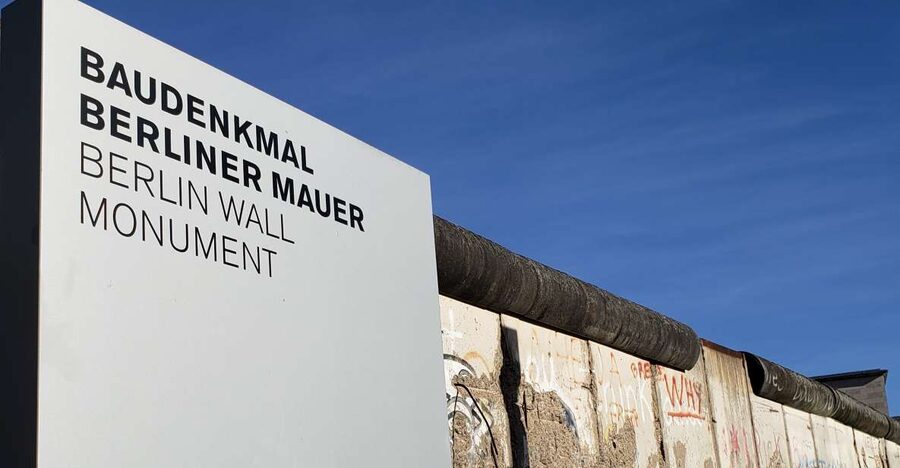
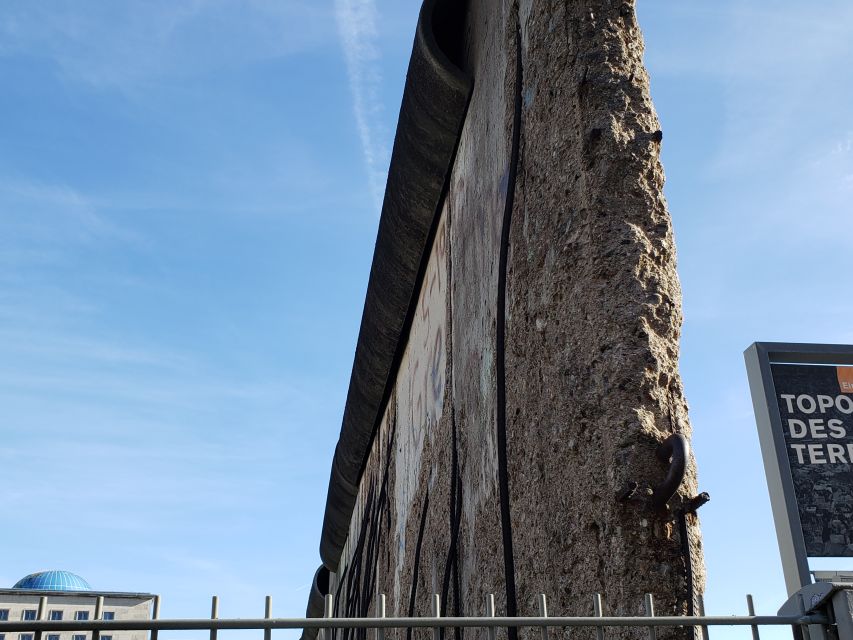
- Bernauer Strasse gives the tour its strongest start, with Wall remains, an open-air documentation museum, and a former border zone that is easier to understand on foot.
- The route connects real border stations, including the Palace of Tears and Checkpoint Charlie.
- Personal stories are central, with guides explaining how division affected everyday life and how people tried to escape.
- The tour is private and bilingual, offered in German or English, with past guides including Stephanie and Stefan.
- The viewing platform is conditional, so you should treat the view of the former death strip as a possible extra, not a guarantee.
- At $22 per person, the tour offers good value for a short private introduction, especially if your group wants questions answered along the way.
Starting at Bernauer Strasse, where the Wall split a street
Meet your guide upstairs at the U Bernauer Straße underground station, at the exit marked Bernauer Strasse. Look for a sign with your name. This is a practical meeting point, but give yourself enough time to find the correct exit, since an underground station can have more than one way out.
Bernauer Strasse is a smart place to begin because the history is not reduced to a few scraps of concrete. The street became one of the most dramatic sections of the Berlin border, and the open-air documentation museum now explains how the Wall changed homes, sidewalks, and family life.
From here, your guide follows the former borderline toward the center. You are not simply moving between unrelated sights. The walk creates a physical line through the city, helping you see how a political boundary once cut across ordinary routes.
That matters because Cold War Berlin can feel abstract when presented only through dates and famous names. At Bernauer Strasse, the division is tied to buildings, streets, and attempts to get from one side to the other. Your guide can put the remaining Wall sections and the former border area into that setting.
More Wall and Cold War walks:
- Berlin: Third Reich and Cold War 2 Hour Walking Tour
★ 4.9 · 6,830 reviews - Berlin’s Best: 2 Hour Walking Tour Third Reich and the Cold War
★ 5.0 · 5,486 reviews - Berlin: DDR Museum Tickets
★ 4.3 · 3,443 reviews
What the Wall changed for daily life
The tour explains the building and fall of the Berlin Wall, but its best use is showing what those events meant between the headlines. You hear about daily life in a city divided by a border, including the limits placed on movement and the ways people tried to escape.
This focus gives the walk a human scale. You are not only learning when the Wall went up or came down. You are considering how a normal trip across town could become impossible, how families and friends were separated, and why escape routes carried such high risks.
The guide also points out places connected with escape attempts. The supplied details do not promise a specific tunnel, house, or escape device at every stop, so you should expect explanation tied to the route rather than a large collection of preserved interiors.
That is one reason a private guide can work well here. If your group is interested in escape stories, you can ask for more detail. If children need a simpler explanation, the guide can adjust the conversation. One booking included German and English explanations for Canadian friends and children, showing how useful the bilingual setup can be for mixed-language groups.
The Palace of Tears and the mechanics of separation
The route includes the Tränenpalast, known in English as the Palace of Tears. This former border crossing station is not just another Cold War name on a map. It represents the emotional side of crossing controls, particularly the goodbyes that took place there.
Your guide provides a guided visit at this stop and explains its role as a crossing point. The name itself gives you a clue to the mood of the place, but the tour helps connect that mood to the practical system of the divided city.
The Palace of Tears is especially useful after Bernauer Strasse. At the first stop, you see how the border shaped a neighborhood. Here, you focus on the controlled movement of people through an official station. Together, the two stops show both the street-level and administrative sides of division.
Keep your expectations measured. This is a two-hour walking tour, not a museum day with time for every display. If the Palace of Tears sparks your interest, you may want to return on your own for a slower look, but the guided stop gives you a clear reason for its place in Berlin’s Cold War story.
Looking over the former death strip
If the viewing platform is open, the guide takes you up for a view over the former death strip. This adds a useful visual layer to the tour, since you can look across the area once designed to stop escape attempts.
The conditional wording matters. The platform may not be open when you visit, so do not book this walk solely for that viewpoint. The rest of the route remains the main experience, with Bernauer Strasse, the Palace of Tears, the former borderline, and Checkpoint Charlie all forming part of the plan.
A view from above can help you understand the border as a system rather than a single wall. From ground level, you may notice fragments and markers. From a higher point, you can better grasp the space between barriers and why crossing it was so dangerous.
Your guide’s explanation is important here. Without context, an open strip of city can look ordinary. The tour gives that space its Cold War meaning by connecting the physical layout with the policy behind it.
More walking tours in Berlin:
- Discover Berlin Half-Day Walking Tour
★ 5.0 · 9,624 reviews - Berlin: Discover Berlin Walking Tour
★ 4.9 · 5,998 reviews - Berlin: Hidden Backyards Guided Walking Tour
★ 4.8 · 5,360 reviews - Third Reich Berlin: Hitler and WWII Walking Tour
★ 5.0 · 3,301 reviews
Ending at Checkpoint Charlie, a famous but complicated symbol
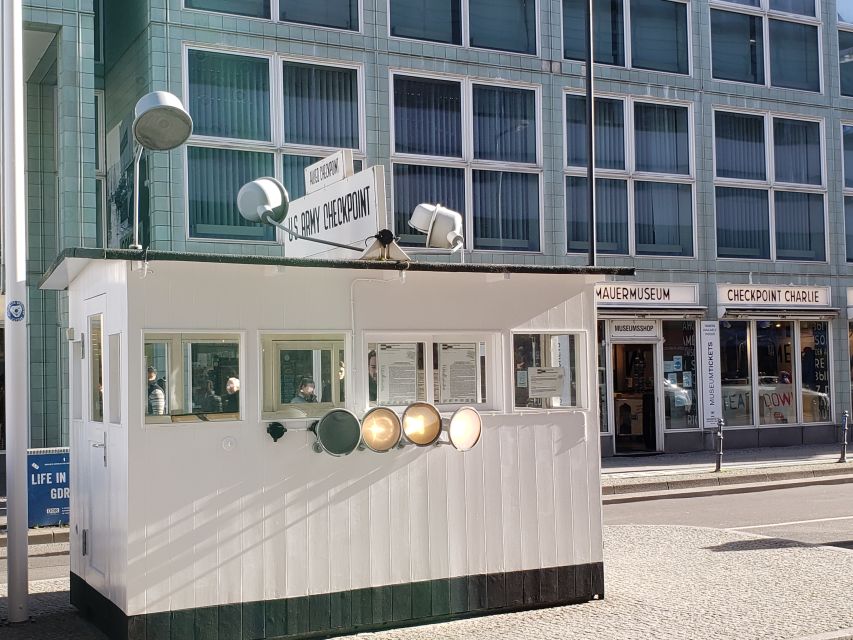
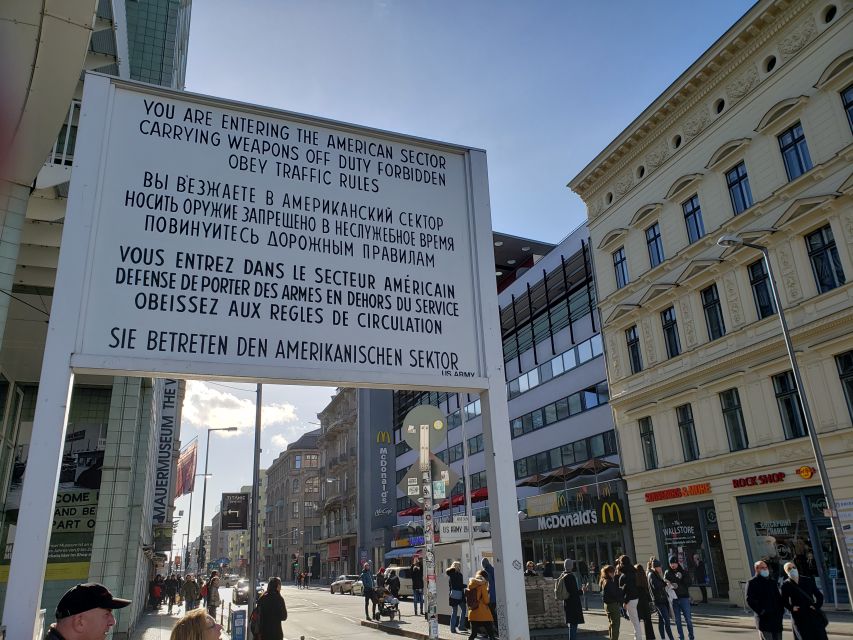
The walk concludes at Checkpoint Charlie, another former border crossing station. It is one of Berlin’s best-known Cold War locations, and its fame can make it feel more like a photo stop than a place of history.
That is precisely why it helps to reach it with the earlier stops fresh in your mind. After walking the former border and learning about daily life, escape attempts, and official crossings, you can place Checkpoint Charlie in the larger story instead of treating it as an isolated landmark.
The tour does not promise that Checkpoint Charlie will be the quietest or most atmospheric part of the route. Its fame has made it a busy central sight, and the end point is better for orientation than for a long, private moment. Still, it is a logical finish because the crossing is closely tied to the image many people carry of divided Berlin.
Ending there also gives you a useful central location for continuing your day. The activity itself does not include transport afterward, so plan your next stop before you arrive if you want to keep moving.
Why a private guide changes the experience
A private group is the tour’s biggest practical advantage. You are paying for a guide who can keep the route focused on your group’s interests, rather than listening to a fixed script designed for strangers with different ages and backgrounds.
The guide language is German or English. That makes the experience workable for mixed-language groups, and the past use of both languages during one tour suggests that a guide may be able to explain the material in both when arranged for the group. Still, you should confirm your preferred language when booking.
Specific guides associated with past bookings include Stephanie and Stefan. Stephanie was praised for authentic storytelling and friendly delivery, while Stefan led a strong explanation of the Cold War and its meaning for a divided Berlin. These details point to the style you should hope for: history told through individual experiences, not just a list of dates.
Do not expect a theatrical performance. The value comes from having a local person explain what you are seeing and answer questions while you walk. If your group likes conversation, this format is likely to suit you better than a large scheduled walk.
The two-hour pace and physical side
Two hours gives the tour a brisk, manageable shape. You cover several important places without giving up a whole morning or afternoon, which is useful if Berlin is part of a longer trip.
You should still expect to walk outdoors between stops. The meeting point is at a subway station, the route follows the former borderline, and the tour ends at Checkpoint Charlie. The activity is listed as wheelchair accessible, which is an important point for anyone who needs an accessible tour option, though you may still want to confirm the exact route conditions and the viewing platform before departure.
Because the walk is short, the guide has to choose what to emphasize. You will get the Wall’s construction and fall, everyday life, escape attempts, border stations, and the former death strip. You will not get every Cold War museum or memorial in Berlin.
I see that as a strength for a first visit. The tour gives you a clear framework, and you can then choose whether to spend more time at the Wall Memorial, the Palace of Tears, or another related site.
Is $22 per person a good value?
At $22 per person, this is a modest price for a two-hour private walking tour. The value is strongest when you are traveling with several people who want a shared introduction and the chance to ask questions directly.
A private tour usually costs more than joining a large group, so the per-person price becomes more attractive as your party grows. You also avoid spending time sorting out how Bernauer Strasse, the Palace of Tears, and Checkpoint Charlie fit together.
The price does not include a meal, transport, or a long museum visit. It pays for the local guide and the private walk. That makes the tour a good choice if you value interpretation and route planning more than added extras.
I would compare it with the cost of visiting several places without context. You can see parts of the Wall on your own, but the guide’s job is to connect them. For a short visit to Berlin, that connection is the main reason to book.
Who will get the most from this walk?
This tour suits first-time visitors who want a clear Cold War introduction without committing to a full day of museums. It also fits families, since the guide can explain difficult events in a way that matches the group, and the bilingual option may help families or friends using both German and English.
History-minded visitors should appreciate the focus on daily life and escape attempts. Those subjects make the tour more personal than a basic sightseeing walk built around photographs at Checkpoint Charlie.
It is also useful for people who prefer a compact route. You begin at Bernauer Strasse and finish in central Berlin, with no need to spend time arranging transport between each major stop.
You may want a different plan if your main goal is to visit every Cold War museum, spend a long time reading archival material, or guarantee the viewing platform. This tour offers a guided overview, not an exhaustive museum program.
Booking details that matter
The guide meets you upstairs at the U Bernauer Straße exit marked Bernauer Strasse. The guide carries a sign with your name, and the voucher includes a phone number for the local partner’s office if you are late or cannot find the meeting point.
The activity is offered in German or English and is wheelchair accessible. It lasts two hours, but starting times depend on availability, so check the schedule that fits your day.
You can cancel up to 24 hours in advance for a full refund. The reserve-now, pay-later option also lets you hold a place without paying on the day of booking, which is useful when your Berlin plans are still shifting.
Should you book the Berlin Wall and Cold War walk?
Book it if you want the former border explained by a guide rather than pieced together from scattered signs. The combination of Bernauer Strasse, the Palace of Tears, possible viewing-platform access, and Checkpoint Charlie gives you a well-shaped introduction in two hours.
The strongest reason to choose it is the private storytelling. Guides such as Stephanie and Stefan have shown that the walk can move beyond basic facts and explain what division meant for real people. At $22 per person, that personal attention is a fair deal for a group that wants history with room for questions.
Skip it if you need a full museum visit, a guaranteed platform view, or a slower day built around archival exhibits. For most first-time visitors with limited time, though, this is a practical way to understand why Berlin’s Wall was more than a line on a map.
FAQ
Where does the tour begin?
The tour begins at the U Bernauer Straße underground station, upstairs at the exit marked Bernauer Strasse. Your guide will hold a sign with your name.
Where does the tour finish?
The tour finishes at Checkpoint Charlie, a former border crossing station in central Berlin.
How long does the walking tour last?
The tour lasts two hours.
Is the tour private?
Yes. It is arranged for a private group with a local guide.
Which languages are available?
The tour is available in German and English.
Is the viewing platform guaranteed to be open?
No. The viewing platform overlooking the former death strip is visited if it is open.
Just added around Berlin
- From Berlin: Gardens & Palaces of Potsdam Bike Tour★ 5.0 · 61 reviews
- Berlin: Battle for Seelow Heights WW2 tour -Clash of Titans★ 5.0 · 27 reviews
- From Berlin: Historical Gems of Potsdam Private Day Trip★ 4.4 · 4 reviews
- Berlin: Französischer Dom 360° Panorama & Crémant to go★ 3.9 · 5 reviews
- Explore Berlin Tour: History and Highlights★ 4.7 · 5 reviews
- Berlin: Evening Yacht Cruise with Aperitif & Dinner Upgrade★ 4.6 · 178 reviews
- Berlin: Expats in Berlin Comedy Show Ticket★ 4.7 · 182 reviews
- Berlin: The Epic Comedy Club Friday Night Showcase★ 4.8 · 28 reviews
Berlin Tours, compared.

Reichstag, Dome and Government District Guided Tour
Read our review →
1-Hour City Tour by Boat with Guaranteed Seating
Read our review →

Reichstag, Plenary Chamber, Cupola & Government Tour
Read our review →
Browse the lists this tour appears in