
Review · BERLIN TOURS
Private Tour: Jewish Heritage Walking Tour of Berlin
Berlin’s Jewish story is best understood through places that still carry the marks of daily life, courage, loss, and renewal. This private tour links the Hackesche Höfe, the New Synagogue, Rosenstraße, Gleis 17, and the Holocaust Memorial into one serious, well-paced introduction.
I like the personal format, since your guide can answer family-history questions and adjust the pace for children or rain. I also like the mix of famous memorials and smaller sites, especially the Otto Weidt Museum, where the story becomes personal rather than purely political. The main consideration is distance: this is a four-hour outing with a fair amount of walking and public transport, so sturdy shoes and a Berlin transit ticket are essential.
Key points to know before booking
- Gleis 17 puts deportation into a real Berlin setting, with transport dates and names recorded on metal plaques at the former Grunewald station.
- The Otto Weidt Museum is small but powerful, preserving the workshop where Jewish workers received protection during Nazi rule.
- Private guiding makes room for questions, including family research, difficult wartime subjects, and present-day Jewish life.
- The route covers several districts, so you will need a Berlin AB Zone ticket costing 2.70 euros, in addition to the tour price.
- The Holocaust Memorial comes near the end, giving you a quiet place to think after hearing the city’s longer story.
- The guide can shape the experience, with English offered and German or Hebrew possible depending on availability.
Why a private Jewish Berlin tour can be worth the price
The cost is $191.62 per person, which is a serious price for a four-hour walking tour. Your value depends heavily on group size. For two people, it is a costly half-day. For a family or group of several people, the private format becomes easier to justify because the price buys exclusive guiding rather than a seat on a standard group walk.
You also pay for a route that would be awkward to assemble alone. The sites are spread across Berlin, and the story moves from Jewish neighborhood life to Nazi persecution, resistance, deportation, and remembrance. A good guide provides the links between those places. Without that context, some stops can feel like isolated plaques and courtyards.
The strongest reason to book is the ability to ask questions as you go. Guides named in past bookings include Eran, Ioana, Nikolai, Zvika, Oren, Asaf, Ariel, and Sarah. The feedback describes guides who handled family stories, younger children, difficult historical subjects, and changes caused by rain. That matters on a subject where a fixed script can feel too narrow.
The tour is offered in English. A multilingual guide may also operate in German or Hebrew, but you should confirm the language when booking. Pickup is offered, which can make the start easier, though the tour still requires public transport during the day.
More history-led days in Berlin:
- Berlin: Natural History Museum Entrance Ticket
★ 4.6 · 3,382 reviews - Berlin: World Heritage Cruise to Potsdam
★ 4.5 · 1,435 reviews - Berlin Historical Highlights Walking Tour
★ 4.9 · 657 reviews
Hackesche Höfe: Jewish Berlin before the catastrophe
The tour begins at Hackesche Höfe, a connected group of courtyards off Rosenthaler Straße. The complex dates from the late 19th century and once housed Jewish artisans, merchants, and immigrants. It was not simply a residential address. Shops, workshops, homes, and social life all met here.
I like starting in this setting because it gives you something important before the Holocaust enters the story: a sense of Jewish Berlin as a living urban community. You can picture work, trade, family life, and cultural activity rather than viewing Jewish history only through persecution.
The visit here lasts about 15 minutes and admission is free. That is enough time for an introduction and a close look at the architecture, but not enough for a long architectural tour. Your guide’s explanation is the main reason the stop works. The courtyards may look attractive and polished today, yet the historical weight comes from learning who lived and worked there.
This is also a useful reminder that Jewish Berlin was not confined to one quarter. Jewish residents helped shape the city’s economy and culture across many districts. The tour uses Hackesche Höfe to put ordinary life first.
The New Synagogue and the memory of Jewish cultural life
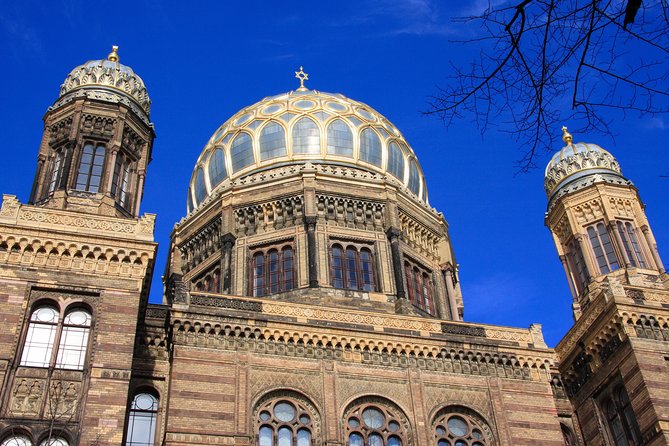
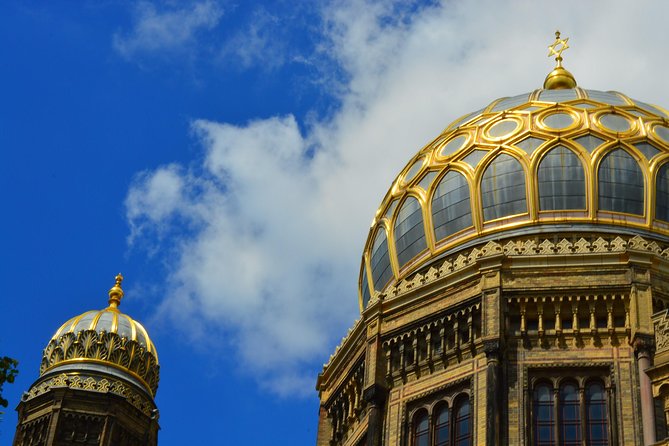
The next stop focuses on the Stiftung Neue Synagoge Berlin, also called the Centrum Judaicum. The building first opened in 1866 and is known for its impressive dome and carefully restored exterior.
You should expect a short visit of about 10 minutes with free admission listed for the stop. The schedule emphasizes the exterior and the institution’s role as a center for Jewish history, remembrance, exhibitions, lectures, and cultural programs. Do not assume that this part includes a long indoor museum visit. The time is brief, so ask your guide what is open and included on your date.
The New Synagogue helps explain the scale and confidence of Jewish life in Berlin before World War II. Its architecture reflects a community with religious, artistic, educational, and civic importance. The building’s later damage and restoration also connect the prewar city with present-day efforts to preserve Jewish memory.
I find this stop most useful when your guide connects the building to the people who used it, rather than treating the dome as a photo stop. It is a good place to ask about Jewish Berlin before 1933 and about how the city approaches remembrance today.
The Otto Weidt Museum: a small room with a large human story
The Museum Blindenwerkstatt Otto Weidt is one of the most affecting parts of the route. It occupies the former workshop of Otto Weidt, a blind brush maker who employed and protected Jewish workers during the Nazi period.
The museum tells how Weidt tried to keep his employees safe, including the use of false papers and personal influence. You can see preserved work areas and learn about the people who worked there, the dangers they faced, and the efforts made to prevent deportation.
About 25 minutes are assigned here, with free admission. That is not a great deal of time for a museum, but the site is small and focused. The compact setting is part of its power. Instead of confronting you with a large collection, it puts you close to a workplace and to individual acts of help.
This is the stop I would prioritize if you have limited time in Berlin. It gives the tour a human scale. The Holocaust was carried out through systems, orders, and transport, but people also made choices inside those systems. Otto Weidt’s workshop shows the danger of resistance and the practical ways one person tried to protect others.
The museum can be especially useful for families, though the subject is painful. Guides have handled tours with children aged 10 and 12, and one guide adjusted a visit around rain while keeping younger members involved. If your group includes children, tell the guide at the start so the explanations can match their age.
More walking tours in Berlin:
- Discover Berlin Half-Day Walking Tour
★ 5.0 · 9,624 reviews - Berlin: Third Reich and Cold War 2 Hour Walking Tour
★ 4.9 · 6,830 reviews - Berlin: Discover Berlin Walking Tour
★ 4.9 · 5,998 reviews - Berlin’s Best: 2 Hour Walking Tour Third Reich and the Cold War
★ 5.0 · 5,486 reviews
Gleis 17: reading the deportation record under your feet
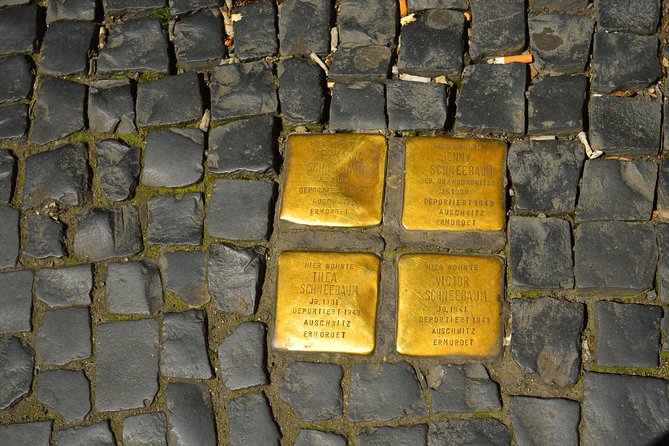
Gleis 17, or Platform 17, is at Grunewald station. From here, thousands of Jewish people were deported between 1941 and 1945 to concentration camps and extermination sites across Europe.
The memorial uses metal plaques set into the ground. They record deportation dates and the names of those transported. This approach is stark and direct. You are not looking at a grand monument. You are standing at a railway site and reading the record of what happened there.
The stop lasts about 15 minutes and admission is free. That timing allows for explanation and quiet attention, though you may want more time if you wish to read many of the plaques. The memorial is also farther from the central sites, which is why the 2.70 euro Berlin AB Zone transport ticket matters. The route is not one continuous stroll through Mitte.
Gleis 17 is valuable because it links policy to place. Deportation can sound abstract when presented only as a number. Here, the railway setting shows how people were removed from Berlin through an organized transport network. Your guide can supply the broader context, while the plaques keep the focus on individual people and dates.
I would bring a quiet frame of mind to this stop. It is not a scenic break or a quick photo opportunity. The short visit may feel emotionally heavy, and that is part of its purpose.
The Old Jewish Cemetery and Berlin’s earlier community
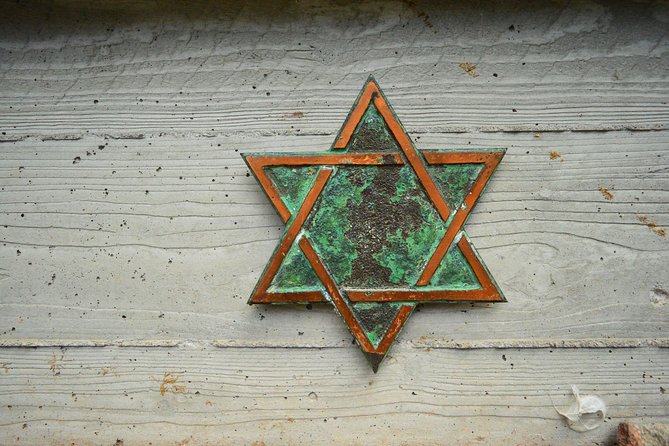
The Alter Jüdischer Friedhof, or Old Jewish Cemetery, offers a change in mood. Its graves and memorials recall scholars, philosophers, and community leaders who helped shape Jewish life in Berlin over many years.
The visit lasts about 15 minutes and admission is free. You will see tombstones with varied designs and inscriptions, each offering a small clue about the person remembered. The cemetery is a place for quiet reflection, but it also supports the tour’s wider point: Jewish Berlin did not begin with the Nazi period.
This stop broadens the timeline. After seeing sites of deportation and rescue, you return to the ordinary work of a community building institutions, honoring its dead, and passing on memory. The cemetery can also prompt useful questions about Jewish burial customs and the changing role of Jewish communities in Berlin.
Because the route moves quickly, you may not have time to study individual graves in detail. If cemetery history is a main interest, tell your guide. A private tour gives you a better chance of shifting attention toward the subjects you care about most.
Rosenstraße and the women who protested
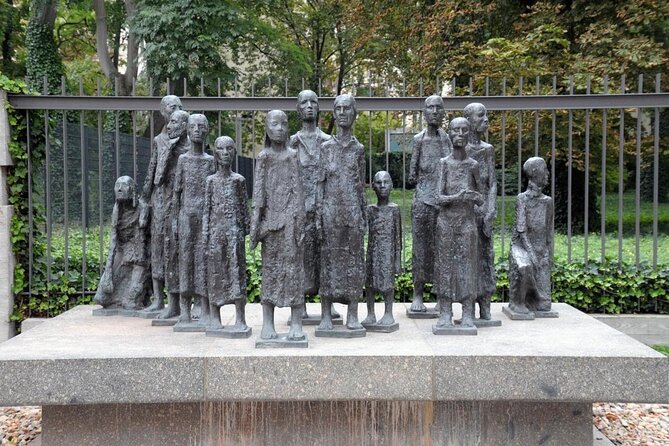
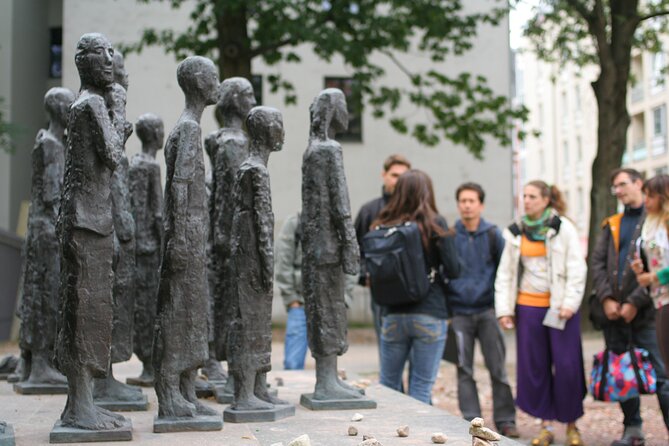
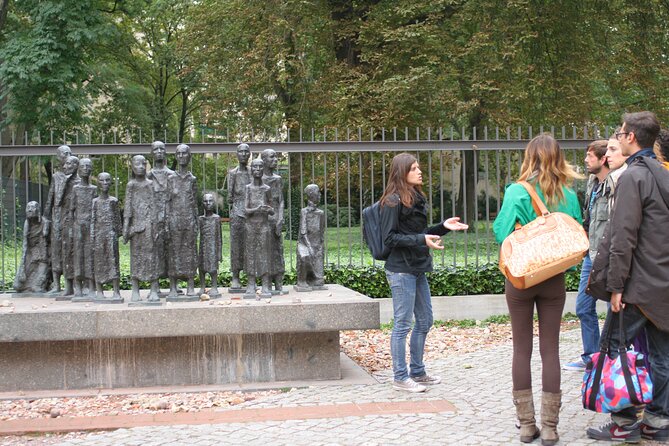
At Rosenstraße, the Block der Frauen memorial recalls a remarkable protest in 1943. Jewish men had been arrested for deportation, and their non-Jewish wives gathered to demand their release. The protest continued for several days outside the police headquarters.
The memorial explains what happened and honors the women who risked their safety by refusing to leave quietly. This is one of the tour’s most important stops because it presents resistance in a form that is easy to overlook. Not every act of opposition looked like a secret network or armed revolt. Sometimes it was a public gathering by people demanding the return of their families.
The visit is planned for about 15 minutes and is free. The memorial is relatively modest, so the guide’s story does most of the work. Ask about the limits and risks of protest under the Nazi regime, as well as what happened to the families involved.
This stop also helps prevent an overly simple picture of helplessness. The women’s action did not erase the wider machinery of persecution, but it showed that public pressure could matter in specific circumstances. A careful guide can explain both the courage of the protest and its limits.
The Holocaust Memorial: a difficult final pause
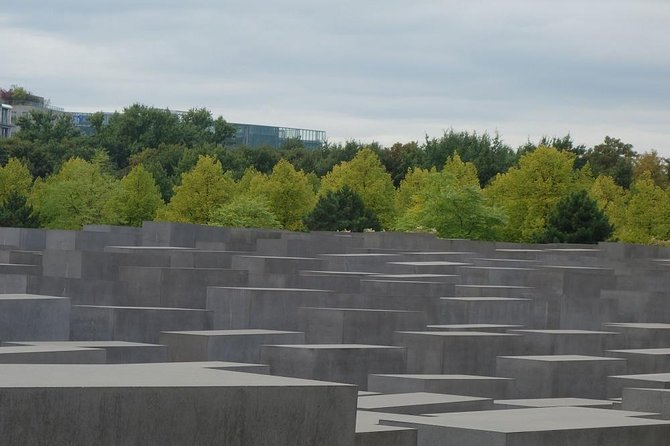
The Memorial to the Murdered Jews of Europe is located in central Berlin. Architect Peter Eisenman designed its 2,711 concrete slabs, arranged across an uneven field of paths and changing heights.
You enter the space rather than merely viewing it from the edge. As the slabs rise and the ground shifts, the experience becomes disorienting. There are no long explanatory panels inside the field, so your response is personal and physical. The site asks you to think about the scale and incomprehensibility of the Holocaust without reducing it to a single image.
The scheduled visit lasts about 20 minutes and admission is free. That is enough for a guided introduction and a walk through part of the memorial. You may want to return later on your own if you prefer a slower visit.
Ending here works well. The earlier stops have shown neighborhood life, religious culture, rescue, deportation, burial, and protest. The memorial gathers those themes into a broad public place of remembrance. It is also a useful location for discussing how modern Berlin presents its Nazi past.
Do not expect the memorial to answer every historical question. Its design creates an emotional and reflective experience, while the tour guide supplies the facts and connections. The underground information center is not listed as part of the scheduled stop, so confirm what your tour includes if that matters to you.
Walking, transit, weather, and the four-hour pace
The outing lasts about four hours and involves a moderate amount of walking. Good shoes are not optional for most people. You should also dress for the forecast because the tour runs in all weather conditions.
The route covers several parts of Berlin, including central sites and Grunewald. A Berlin AB Zone ticket costing 2.70 euros is not included. Food and drinks are also not included, so eat beforehand or plan a break around the schedule. The tour description does not promise a meal stop, and seven sites in four hours leave limited spare time.
Pickup is offered, and the tour operates near public transport. Ask where the guide will meet you and how the transport portion will work. A private guide can help you navigate the Berlin subway, an especially useful benefit if you are still learning the city’s system.
The schedule is brisk but sensible. The stops range from 10 to 25 minutes, with the Otto Weidt Museum receiving the most time. You will hear a lot, so consider keeping notes or asking the guide to point out places worth revisiting later.
Who will get the most from this experience
I would recommend this tour to anyone who wants Jewish Berlin explained through places rather than a museum collection alone. It suits first-time visitors who want a clear introduction, as well as returning visitors who want to connect sites they have seen separately.
It is also a good choice for families with older children. The subject is difficult, but guides have adapted explanations for younger participants and answered questions patiently. Tell the guide if your group includes children or if a family connection to Berlin is central to your visit.
You do not need to be Jewish to benefit. The route examines the city’s Jewish community, Nazi persecution, individual rescue efforts, public protest, and modern remembrance. Guides have also helped people understand family history and navigate the city itself.
I would think twice if you want a relaxed sightseeing walk with long stops, cafés, or plenty of free time. The route is serious, the transport adds movement, and four hours can feel full. It is also not the best fit if your main goal is an extended visit inside the New Synagogue or Holocaust Memorial information center.
What the high rating means in practical terms
The tour has a 4.9 rating from 29 reviews, with 100 percent recommended. The repeated strengths are clear: guides are praised for strong subject knowledge, friendly communication, patience, flexibility, and the ability to answer hard questions.
Specific guides named in past bookings include Eran, Ioana, Nikolai, Zvika, Finn, Oren, Asaf, Ariel, Sarah, and Mickail. The experience can vary by guide, but the private setup gives each guide room to respond to your interests instead of delivering a speech to a large crowd.
The most useful pattern is the attention to detail. Guides have added lesser-known locations, discussed modern Jewish life, helped with public transport, and adjusted the plan for rain. Those touches matter more than a long list of stops. Ask questions early, mention your family background, and say which periods interest you most.
Cancellation is free up to 24 hours before the start time for a full refund. Changes or cancellations inside that window are not accepted for a refund. Most people can participate, but the walking and public transport should be part of your decision.
Should you book the Jewish Heritage Walking Tour of Berlin?
Book it if you want a private, serious introduction to Jewish Berlin and value conversation with a guide. The strongest stops are Hackesche Höfe, the Otto Weidt Museum, Gleis 17, Rosenstraße, and the Holocaust Memorial. Together, they show both community life and persecution, along with courage, grief, and remembrance.
The price is easiest to justify for a family or small group. For a couple, it is a premium experience, but the private attention can be worthwhile if you have family-history questions or want to explore difficult subjects at your own pace.
Skip it if you prefer a slow museum day or a tour limited to central Berlin. Otherwise, bring good shoes, a transit ticket, curiosity, and enough emotional energy for a demanding four hours. This is a thoughtful way to meet Berlin’s Jewish past without reducing it to a list of monuments.
FAQ
How long does the Jewish Heritage Walking Tour of Berlin last?
The tour lasts approximately four hours.
How much does the tour cost?
The listed price is $191.62 per person.
Is this a private tour?
Yes. Only your group participates, and a private guide is included.
Is the tour offered in English?
Yes. English is offered. Depending on availability, the guide may also operate in German or Hebrew.
Does the tour include hotel pickup?
Pickup is offered. Confirm the meeting details when booking.
Is public transportation included?
No. A Berlin AB Zone ticket costing 2.70 euros is not included.
Are admission tickets included?
The listed stops show free admission. Food and drinks are not included.
Can I cancel for a full refund?
Yes. You can cancel at least 24 hours before the experience start time for a full refund. Cancellations or changes made less than 24 hours before the start time are not accepted for a refund.
Just added around Berlin
- eSIM for Germany and 34 European Countries★ 4.5 · 16 reviews
- Your ticket to The Wall Museum Berlin★ 3.0 · 60 reviews
- Walking on the Wall: 3-Hour Tour in Berlin★ 4.5 · 34 reviews
- Rickshaw Tours Berlin – Groups of up to 16 people with several rickshaws★ 4.0 · 97 reviews
- Warnemuende Shore Excursion: Private Berlin Tour★ 4.5 · 27 reviews
- Love and War in Berlin: Self-Guided Story Puzzle Walk★ 5.0 · 7 reviews
- Warnemuende Shore Excursion: Berlin Private Sightseeing Tour from Rostock★ 5.0 · 4 reviews
- Cold War Berlin – Private Live Virtual Experience★ 5.0 · 4 reviews
Berlin Tours, compared.
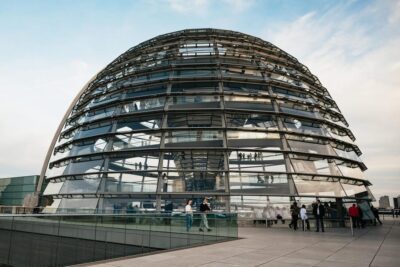
Reichstag, Dome and Government District Guided Tour
Read our review →
1-Hour City Tour by Boat with Guaranteed Seating
Read our review →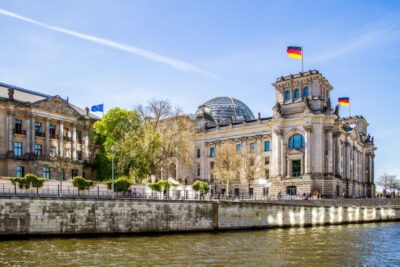

Reichstag, Plenary Chamber, Cupola & Government Tour
Read our review →
Browse the lists this tour appears in