
Review · BERLIN TOURS
Explore The Berlin Wall: Cold War Berlin and Behind the Berlin Wall
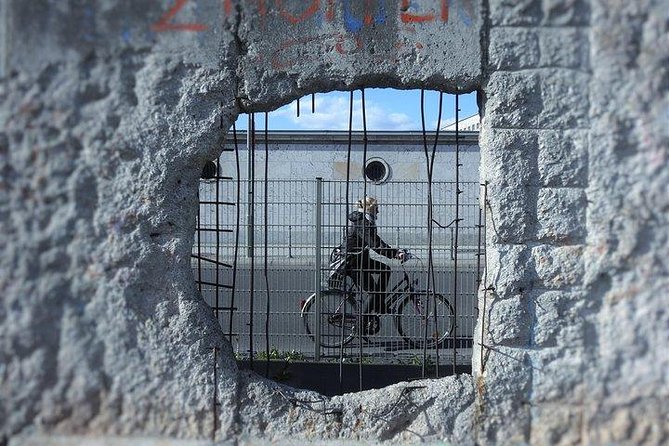
Berlin’s Wall story is scattered across the city, and this three-hour tour brings the key pieces together. You’ll see the preserved death-strip section at the Berlin Wall Memorial, the famous checkpoint, a surviving watchtower, and the modern city built over former border ground.
I like the small-group format and the way guides such as Ciaran, Eugen, Paul, and Steve connect political events with escape attempts and daily life. I also like the use of old photographs, which helps you compare the Wall then and Berlin now. The main drawback is the pace: there is quite a bit of walking, and three hours can feel short for such a large subject.
Key points to know before booking
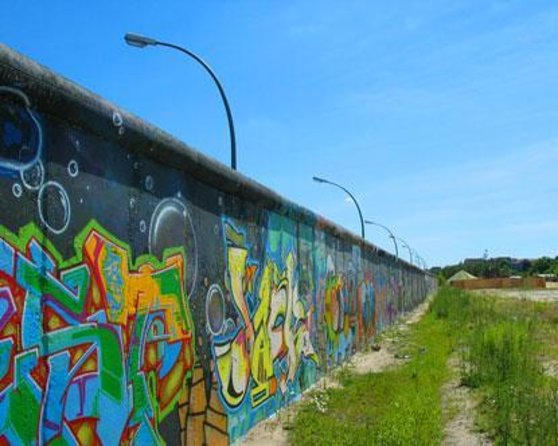
- The Berlin Wall Memorial gets the most time, with about 1 hour and 20 minutes at the city’s best-preserved Wall site.
- The tour links several separated locations, so you avoid spending your own morning finding surviving Wall fragments.
- Guides explain escape stories and Cold War politics, not just dates and photo stops.
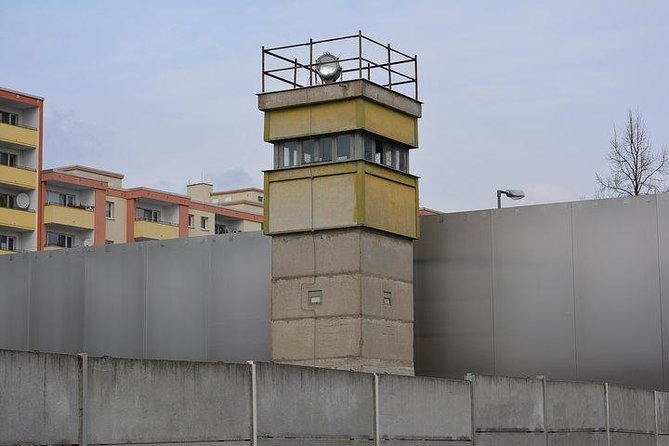
- A surviving GDR watchtower is included, with a chance to go inside or ascend it if access is available.
- Public transport may be part of the route, allowing you to see how the former East and West areas connect today.
- The price is $32.67 per person, with free cancellation up to 24 hours before the 10 a.m. start.
Why this Berlin Wall tour works
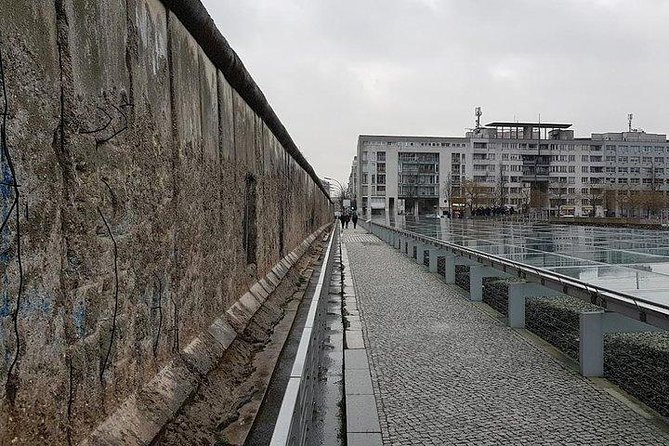
The Berlin Wall is easy to misunderstand if you only visit Checkpoint Charlie. That famous crossing point is useful, but it is surrounded by modern buildings, souvenir shops, and traffic. The physical Wall has also vanished from much of central Berlin.
This tour solves that problem by taking you to several surviving traces in one morning. You get the memorial, a checkpoint, a Wall fragment beside the former Nazi security district, a watchtower, and Potsdamer Platz, where the old border once cut through empty ground.
I like that range. You are not shown one isolated slab of concrete and left to imagine the rest. Instead, you can see how the border worked, how people tried to cross it, and how reunified Berlin filled in the spaces it had once divided.
The strongest part is the human scale. Escape tunnels, hidden routes, failed attempts, armed border controls, and families split by the border make the political story easier to grasp. Guides also answer questions beyond the planned route, so you can ask about the Cold War, East Berlin, West Berlin, or the wider history of the city.
The tone seems best suited to someone who wants substance. It is not a quick photo walk. Guides have been praised for explaining difficult political events clearly, including the differences between life in East and West Berlin. Some, including Ciaran, have used family photographs from visits to the Wall in the early 1980s to show how much the city has changed.
More Wall and Cold War walks:
- Berlin: Third Reich and Cold War 2 Hour Walking Tour
★ 4.9 · 6,830 reviews - Berlin’s Best: 2 Hour Walking Tour Third Reich and the Cold War
★ 5.0 · 5,486 reviews - Berlin: DDR Museum Tickets
★ 4.3 · 3,443 reviews
Starting at Ebertstraße at 10 a.m.
The tour begins at Birchys Berlin Tours, Ebertstraße 24, 10117 Berlin, at 10 a.m. It ends back at the same meeting point.
The meeting area is near public transportation, and previous tour groups have used the subway and tram during the route. That matters because the sites are spread across Berlin. You should plan to arrive ready to move rather than expecting a single, continuous walk through one compact district.
The group is advertised with maximum sizes of both 15 and 21 people in the supplied details. That inconsistency is worth checking when you book, though the experience is clearly intended to be a small-group tour rather than a large coach outing.
A small group helps in two ways. You can hear the guide more easily, and you have a better chance to ask questions. One group was as small as three people, allowing the guide to spend as much time as the group wanted at each stop. That is not guaranteed, but it shows the kind of personal format you might find.
Bring water and a snack. Neither is included. The tour can involve a good amount of walking and time outside, so comfortable shoes matter. One group completed it in cold, snowy conditions and still found it worthwhile, but that is a useful reminder to check the weather and dress accordingly.
The Berlin Wall Memorial: the most important stop
You spend about 1 hour and 20 minutes at the Berlin Wall Memorial, making it the clear centerpiece of the tour.
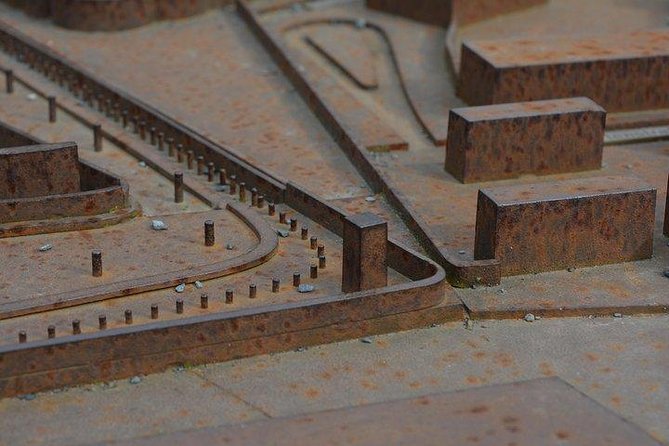
This is the place to understand the Wall as a fortified border rather than a single concrete barrier. The memorial stretches for more than a kilometer and includes the only preserved complete cross-section of the Berlin Wall and its death-strip area.
That cross-section is valuable because it shows the layered system that made crossing so dangerous. A photograph of a painted Wall panel tells only part of the story. Here, the preserved arrangement helps you see the relationship between the border barrier, patrol space, and the area separating East Berlin from West Berlin.
The memorial is also tied to tragic deaths and successful escapes. Your guide can place individual stories against the physical setting, which gives the site emotional weight without reducing it to a collection of dramatic anecdotes.
This is where Ciaran, Eugen, Paul, Steve, or another assigned guide can make a major difference. The praised guides do more than recite facts. They explain how policy, surveillance, border enforcement, and personal decisions shaped the lives of people on both sides.
Give yourself room to pause here. The schedule allows substantial time, but the material can be heavy. If you are mainly seeking quick photographs, the stop may feel long. If you want to understand how the border operated, it is the time well spent.
Checkpoint Charlie and the 1961 confrontation
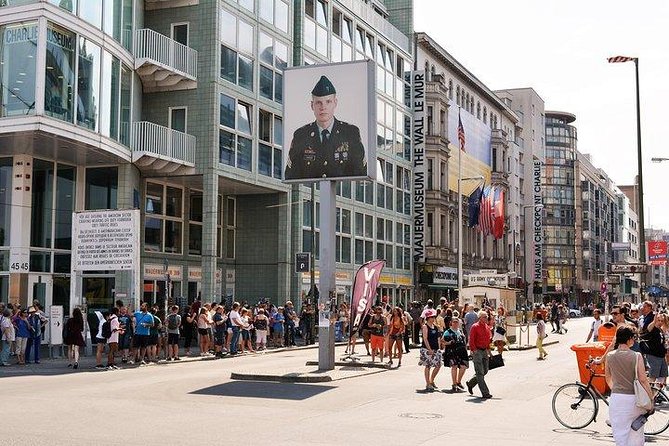
Checkpoint Charlie receives about 15 minutes. It is a short stop, but it covers one of the best-known locations of the divided city.
The checkpoint was the most famous crossing point between East and West Berlin. It was also the setting for escape attempts and the tense confrontation between American and Soviet forces in autumn 1961.
I would treat this as a context stop rather than the emotional center of the tour. Checkpoint Charlie is famous, but the modern surroundings do not preserve the Cold War scene in full. The guide’s explanation is what gives the location meaning.
Fifteen minutes is enough to orient yourself, hear the key story, and take photographs. It also keeps the tour moving toward less obvious remnants of the Wall. That balance is sensible. You get the iconic name without allowing it to take over the morning.
A few more Berlin half-days to weigh up
- Berlin: Reichstag, Dome and Government District Guided Tour
★ 4.7 · 18,288 reviews - Berlin: 1-Hour City Tour by Boat with Guaranteed Seating
★ 4.3 · 16,993 reviews - Berlin: Boat Tour Along the River Spree
★ 4.4 · 11,252 reviews - Discover Berlin Half-Day Walking Tour
★ 5.0 · 9,624 reviews
The Wall fragment at the Topography of Terror
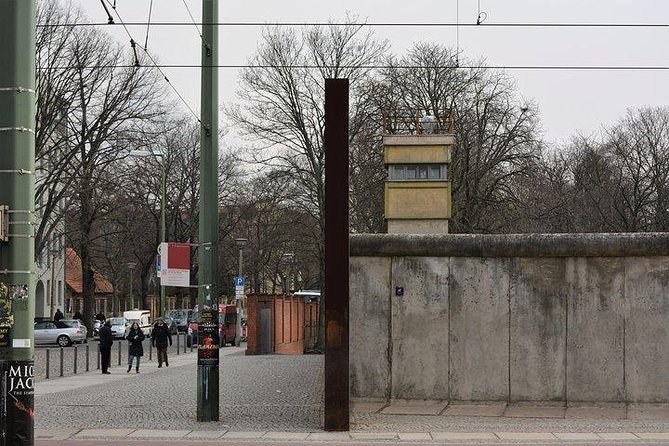
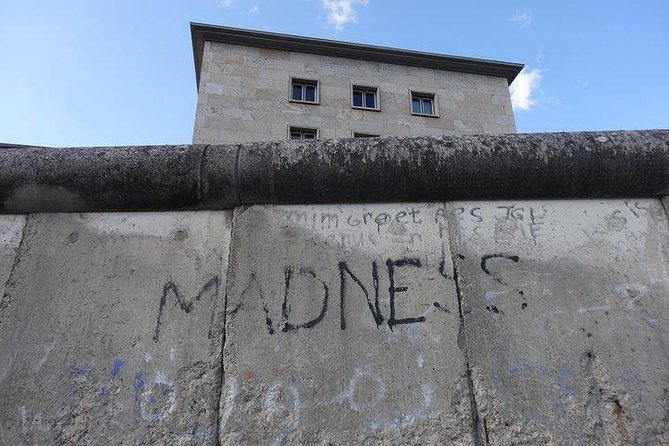
The next stop lasts about 10 minutes at the Topography of Terror on Niederkirchnerstrasse.
This is the only surviving Wall fragment in that part of central Berlin. Its setting adds another historical layer: it sits beside the former Luftwaffe headquarters, a building later used during the East German period as the House of Ministries.
That combination makes the stop unusually dense. In a short distance, you are looking at the remains of the Nazi period, the East German state, and the Wall that divided Berlin during the Cold War.
The site is also linked to an extraordinary escape into West Berlin. Your guide can explain how that attempt fitted into the wider pattern of people trying to cross the border.
Ten minutes is not enough to explore every nearby exhibit, so you should not book this tour expecting a full visit to the Topography of Terror museum. The stop is designed to connect the Wall with its surroundings, not replace a separate museum visit.
A rare GDR watchtower near the former border
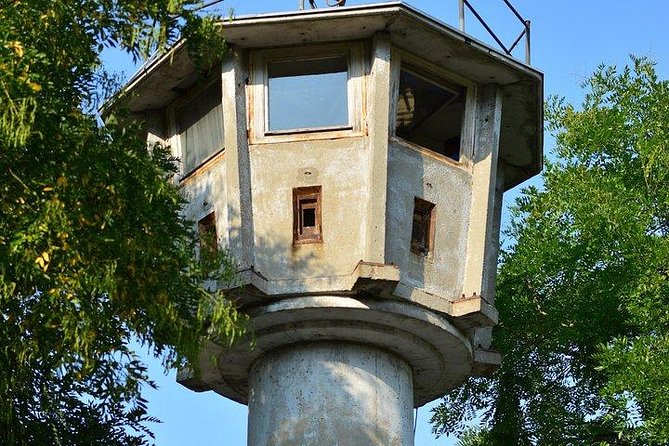
The GDR watchtower stop lasts about 15 minutes and includes admission.
You visit one of the last surviving BT-variant watchtowers that once surrounded West Berlin. It survived through a private effort, making it a rare physical reminder of the border system.
The chance to enter and possibly ascend the tower is one of the tour’s most distinctive features. Access may depend on the conditions at the time, so you should read the wording as a possibility rather than a promise of guaranteed ascent.
This stop gives you a different view of the Wall. At the memorial, you study the border from ground level. At the watchtower, you can think about surveillance and visibility from the guards’ position.
The included admission is also useful when judging value. Most of the other stops are outdoor public sites with no separate entry fee, but this is one place where the tour handles an admission cost for you.
Potsdamer Platz and the rebuilt city
Potsdamer Platz gets about 10 minutes, yet it makes an important closing point.
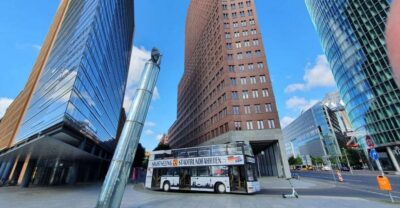
During the division of Berlin, this area was desolate and sat in or beside the death-strip. Today it is a high-rise business and entertainment district. The change is so sharp that you need the guide to explain what stood here before the modern buildings appeared.
I like ending with this contrast. The Wall Memorial shows the border’s structure and human cost. Potsdamer Platz shows what happened after reunification, when formerly unusable ground became part of a rebuilt capital.
It also makes clear why a Wall tour should not focus only on surviving concrete. In many places, the most important evidence is the absence of the Wall and the way the city now connects spaces that were once separated.
The stop is brief, so use it as a final comparison rather than a full architectural visit. You will have time to see the transformation and take in the modern setting, but not to study the whole district in detail.
The guides make the difference
The most highly praised part of this experience is the guiding. Names appearing in the tour feedback include Ciaran or Cairan, Eugen or Eugene, Paul, Steve, and Aurel G.
The spelling varies in the supplied information, and you may not be able to choose a specific guide when booking. Still, the repeated strengths are clear: strong command of Berlin’s Cold War story, clear English, patience with questions, and an ability to connect major events with personal experiences.
Ciaran is described as bringing old family photographs from the early 1980s. Those images helped one family compare the Wall as it looked before its fall with the same places in modern Berlin. That kind of visual comparison can make a familiar historical subject feel immediate.
Eugen is praised for bringing the Wall and its people to life, while Paul is noted for explaining complex Berlin history in an accessible way. Steve is described as a public historian who linked different strands of East and West Berlin’s story. Aurel is noted for a personal connection to the subject.
You should expect the exact style to vary by guide. The consistent aim is clear explanation rather than theatrical performance. That is a good fit if you want to ask questions and understand causes, not just collect facts.
Price, pace, and overall value
At $32.67 per person, this is a strong value if you want several Wall locations explained in one organized morning.
The price does not cover snacks or bottled water, and most of the outdoor stops have no admission fee. So you are mainly paying for the guide’s time, route planning, transport coordination, historical interpretation, and access to the watchtower.
That is important. You could visit some of these locations independently, but you would need to work out their order and supply the connecting context yourself. The tour’s value rests on turning separate fragments into one clear story.
The three-hour length is long enough to cover the main sites without using your whole day. It is also short enough to pair with a museum visit or another Berlin activity later.
The tradeoff is pace. You cover a lot of ground, and one account specifically notes quite a bit of walking. You may also use public transport between locations. If you want long periods at every site, this schedule will feel tight. If you want an efficient introduction, it works well.
Free cancellation is available if you cancel at least 24 hours before the 10 a.m. start. Changes or cancellations inside that window are not accepted for a refund. The activity also requires a minimum number of bookings, and if that minimum is not reached, you are offered another date or experience, or a full refund.
Who should book this experience
I would recommend it most strongly to people interested in the Cold War, modern German history, political borders, and the personal stories behind major events.
It also suits first-time visitors who want a structured introduction before exploring Berlin alone. The tour helps you understand why the Wall Memorial matters, why Checkpoint Charlie is famous, and why a modern office district can still be part of the Wall story.
Families with teenagers may find the personal escape stories and old photographs easier to connect with than a long museum timeline. The guides also appear comfortable answering questions, which helps when different ages bring different levels of background knowledge.
You should think twice if you dislike walking, outdoor sightseeing, or political history. This is not a relaxed sightseeing loop with lots of free time. It is an active history lesson spread across several parts of central Berlin.
Most people can participate, and service animals are allowed. You receive confirmation at booking and can present either a paper or electronic voucher.
Should you book the Berlin Wall tour?
I would book this tour if you want the Berlin Wall explained as a living part of the city rather than as a single memorial or famous checkpoint.
The best reasons are the long visit to the Berlin Wall Memorial, the rare watchtower, the escape stories, and the guides’ ability to answer detailed questions. The use of public transport and old photographs adds useful context, too.
Skip it if your schedule cannot handle a three-hour route with substantial walking, or if you only want a quick photograph at Checkpoint Charlie. For everyone else, $32.67 buys a focused, well-planned morning and a clearer understanding of how divided Berlin shaped the city you see today.
FAQ
Where does the Berlin Wall tour start?
The tour starts at Birchys Berlin Tours, Ebertstraße 24, 10117 Berlin, Germany.
What time does the tour begin?
The tour begins at 10 a.m.
How long does the experience last?
The experience lasts approximately three hours.
Where does the tour finish?
The activity ends back at the meeting point on Ebertstraße.
Is admission to the watchtower included?
Yes. Admission to the GDR watchtower is included.
Are snacks and bottled water included?
No. Snacks and bottled water are not included.
What language is the tour offered in?
The tour is offered in English.
What is the cancellation policy?
You can cancel for a full refund up to 24 hours before the experience start time. Cancellations or changes made less than 24 hours before the start are not accepted for a refund.
Just added around Berlin
- eSIM for Germany and 34 European Countries★ 4.5 · 16 reviews
- Your ticket to The Wall Museum Berlin★ 3.0 · 60 reviews
- Walking on the Wall: 3-Hour Tour in Berlin★ 4.5 · 34 reviews
- Rickshaw Tours Berlin – Groups of up to 16 people with several rickshaws★ 4.0 · 97 reviews
- Warnemuende Shore Excursion: Private Berlin Tour★ 4.5 · 27 reviews
- Love and War in Berlin: Self-Guided Story Puzzle Walk★ 5.0 · 7 reviews
- Warnemuende Shore Excursion: Berlin Private Sightseeing Tour from Rostock★ 5.0 · 4 reviews
- Cold War Berlin – Private Live Virtual Experience★ 5.0 · 4 reviews
Berlin Tours, compared.
Reichstag, Dome and Government District Guided Tour
Read our review →
1-Hour City Tour by Boat with Guaranteed Seating
Read our review →
Reichstag, Plenary Chamber, Cupola & Government Tour
Read our review →
Browse the lists this tour appears in