
Review · BERLIN TOURS
Explore Berlin History and Highlights Sightseeing Walking Tour
Berlin’s past is packed into this 3.5-hour walk from Brandenburg Gate to Museum Island. In one morning, you move from Prussian grandeur to Nazi terror, Cold War division, and the rebuilt capital of today. The route covers the big sights, but the guide’s explanations are what give them meaning.
I like the small maximum group of 15, which leaves room for questions and makes it easier to hear. I also like the broad timeline: the tour does not treat Berlin as only a Nazi or Cold War city. The main drawback is simple but important: this is a long walking tour, so it is not a good choice if you have trouble walking for several hours.
Key points to know before booking
- Brandenburg Gate to Museum Island: The route links many of central Berlin’s major sights without requiring entrance tickets.
- A full sweep of Berlin’s past: Expect Prussian kings, the German Empire, Nazi rule, the Holocaust, the Cold War, and reunification.
- Small-group format: The tour is limited to 15 people, though some departures may be much smaller.
- Guide-led storytelling: Guides including Aurel, Cairan, Rhys, Eugen, Steve, Paul, and Aaron have been praised for clear explanations, humor, and personal touches.
- Bring water and a snack: The tour lasts about three and a half hours, with no meal stop included.
- English only: The tour is offered in English and uses a mobile ticket.
Why this route gives you a useful first look at Berlin
Berlin can feel scattered at first. A grand boulevard leads to a memorial, a modern government building appears beside a scarred wall, and a car park may mark one of the most terrible places in 20th-century history. This tour helps you connect those pieces.
You start at Brandenburg Gate and finish on Museum Island. Along the way, the guide builds a basic chronology of the city. You see how Berlin grew under Prussian rule, became the capital of imperial Germany, carried out Nazi crimes, was split by the Cold War, and later became the capital of a reunited Germany.
That order matters. A guide can point out why a building looks the way it does, what it was used for, and how war or political change altered it. Several guides also use photos, maps, or personal material on an iPad to make lost buildings and divided streets easier to picture.
The tour is especially useful at the start of a Berlin stay. You get a framework for the city, then you can return to the places that deserve more time. It is not a substitute for the museums themselves, but it helps you choose which museums and memorials to visit later.
More history-led days in Berlin:
- Berlin: Natural History Museum Entrance Ticket
★ 4.6 · 3,382 reviews - Berlin: World Heritage Cruise to Potsdam
★ 4.5 · 1,435 reviews - Berlin Historical Highlights Walking Tour
★ 4.9 · 657 reviews
Brandenburg Gate and the Reichstag: symbols of a changing capital
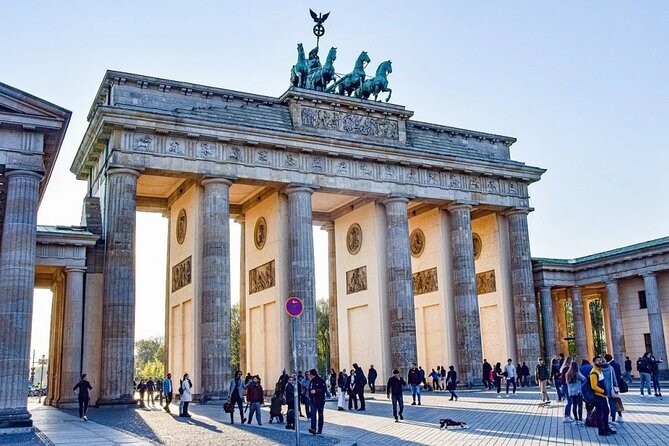
The meeting point is at Wurst 🙂 am Brandenburger Tor, at Ebertstraße and Scheidemannstraße. The tour begins at 10:00 a.m., beside the city’s most familiar landmark.
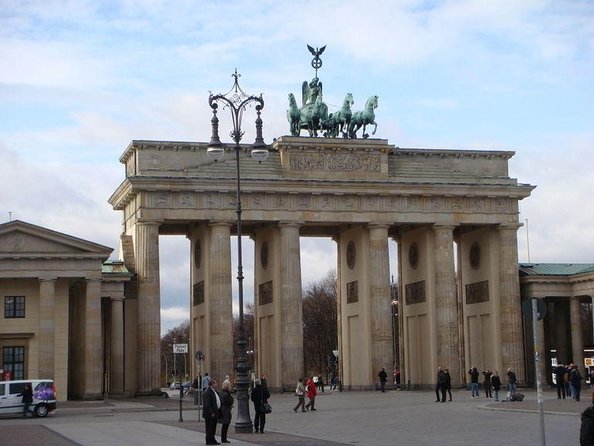
Brandenburg Gate was built as a ceremonial entrance to Berlin and later became a symbol used by competing political systems. The guide explains the gate’s role in major events across Berlin’s past, rather than leaving you with a quick photo and a name.
You have about 20 minutes here. That gives you time to look at the columns, quadriga, and broad space around the gate while the guide explains how the site changed from royal gateway to national symbol and, later, to an image of reunification.
The Reichstag is next, with another 20-minute stop. The building served as the parliament during Germany’s imperial period, suffered the infamous fire shortly after Adolf Hitler became Chancellor, and was a key target during the Soviet capture of Berlin at the end of the Second World War.
The tour does not include a ticket or a visit inside the Reichstag dome. That is worth noting if the dome is high on your list. Still, seeing the building with its political context makes a later visit more rewarding, if you arrange one separately.
The Holocaust Memorial and the Führerbunker site
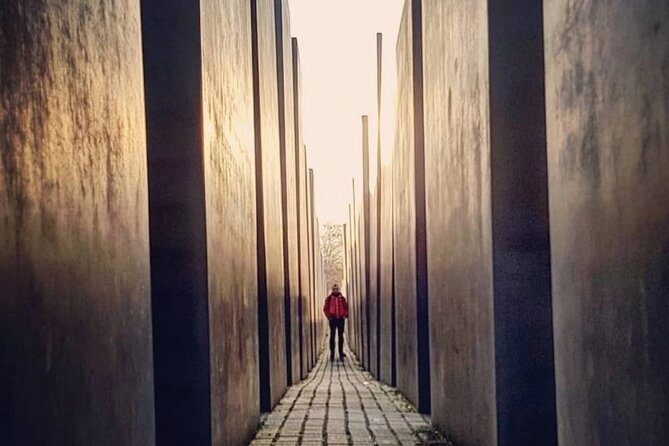
The Memorial to the Murdered Jews of Europe is one of the most serious stops on the route. You spend about 15 minutes among the concrete stelae, while the guide explains the memorial’s purpose, design, and the crimes that led to its creation.
The memorial is not presented as a decorative photo stop. Its open-ended design invites questions about how Germany remembers the murder of Europe’s Jews and how a modern capital deals with a criminal past. You should allow extra time here on your own if you want to read the information center or think through the memorial at a slower pace.
The nearby Führerbunker site is another brief but striking stop. Today, it is an ordinary car park. Beneath the area was the bunker where Hitler spent his final days and ended his life as Berlin fell.
There is no dramatic building to enter and no preserved bunker interior on this tour. That absence is part of the point. The guide explains the former location and the decisions made to prevent the site from becoming a shrine. You are looking at an unremarkable place that carries an enormous historical weight.
The former Luftwaffe headquarters and Topography of Terror
The former Luftwaffe headquarters is now the Federal Ministry of Finance. You have about 15 minutes to hear how the building was designed and used during the Nazi period, followed by its later Cold War role.
This stop is useful because it adds architecture to the political story. Rather than focusing only on famous speeches and leaders, the guide shows you how government buildings, ministries, and streets can reveal the structure of a regime.
At the Topography of Terror, you spend about 20 minutes learning about the former headquarters of the SS, Gestapo, and SD. The site focuses on the machinery of Nazi persecution, not just its most recognizable figures.
The memorial and exhibition area also raises a harder question: how should a city mark a place where crimes were planned and carried out? The guide connects the Nazi-era site with postwar efforts to remember and explain what happened there.
This part of the tour can be emotionally heavy. The pace is brisk, and 20 minutes is enough for an introduction, not for reading every exhibit in detail. If this subject matters deeply to you, plan to return later with more time.
More walking tours in Berlin:
- Discover Berlin Half-Day Walking Tour
★ 5.0 · 9,624 reviews - Berlin: Third Reich and Cold War 2 Hour Walking Tour
★ 4.9 · 6,830 reviews - Berlin: Discover Berlin Walking Tour
★ 4.9 · 5,998 reviews - Berlin’s Best: 2 Hour Walking Tour Third Reich and the Cold War
★ 5.0 · 5,486 reviews
Checkpoint Charlie and the practical story of divided Berlin
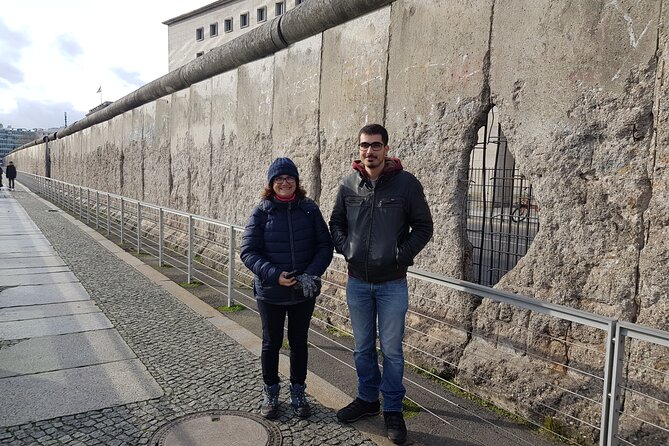
Checkpoint Charlie receives about 20 minutes. The crossing became one of the best-known symbols of Cold War Berlin, when the city was divided between East and West and movement across the border was tightly controlled.
The guide explains the checkpoint’s place in the wider Cold War story. You learn why this location mattered and how Berlin became a front line between opposing political systems.
Checkpoint Charlie can feel commercial today, with souvenir shops and heavy foot traffic around the area. A guide helps you separate the modern tourist setting from the serious history of escape attempts, military tension, and life in a divided city.
Do not expect a preserved border crossing with a large original complex. The value here comes from the setting and the explanation. The tour gives you the background needed to understand why this intersection became so famous.
Gendarmenmarkt and Bebelplatz reveal Berlin’s Prussian face
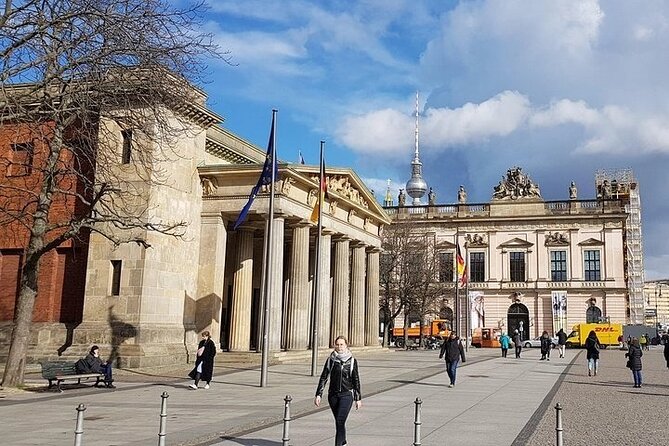
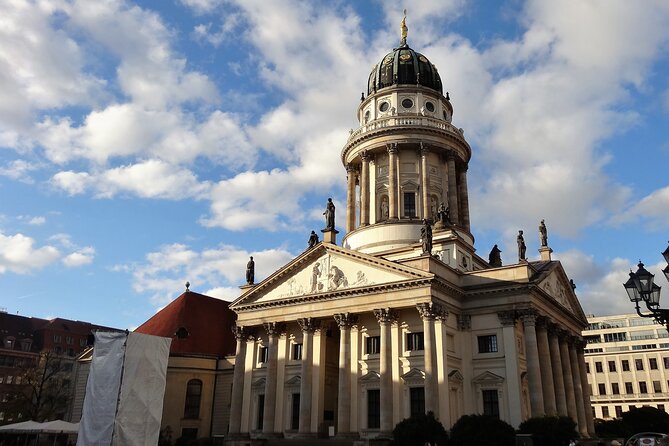
Gendarmenmarkt shifts the mood. After several stops tied to dictatorship and war, you reach one of central Berlin’s grandest squares, with its 18th- and 19th-century architecture.
You spend about 15 minutes hearing how the square was founded and developed. The surrounding buildings help explain the ambitions of Berlin’s Prussian rulers and the city’s effort to present itself as a European capital.
This stop is a good reminder that Berlin is not only a city of ruins, memorials, and political scars. Its architectural story includes ceremony, religion, royal power, and urban planning. You get a chance to enjoy the setting while keeping the larger chronology in view.
Bebelplatz offers another 15-minute stop and another sharp change in tone. The square is surrounded by the grand buildings of Frederick the Great’s Prussian capital, but it also marks the 1933 Nazi book burning.
The memorial is easy to miss if you walk through quickly. Your guide points it out and explains why the event mattered. The contrast between the square’s elegant buildings and the memory of censorship and destruction is exactly what makes this stop effective.
Unter den Linden connects power, education, and remembrance
The tour continues along the eastern end of Unter den Linden for about 20 minutes. This famous boulevard brings several themes together: the old Prussian capital, intellectual life, war memory, and national museums.
You hear about Humboldt University, one of Berlin’s most important academic institutions. The guide also discusses the Memorial to the Victims of War and Tyranny, then connects the boulevard to the German Historical Museum.
This is a walking section rather than one single landmark. Pay attention to the spaces between the buildings. Berlin’s history often appears in the relationships among monuments, avenues, and institutions, not only in the buildings themselves.
The guide’s role is particularly helpful here. Architectural details can seem random when you are exploring alone, but the story of Frederick the Great, Prussian planning, university life, war, and modern remembrance gives the route a clear shape.
Museum Island and the view toward Alexanderplatz
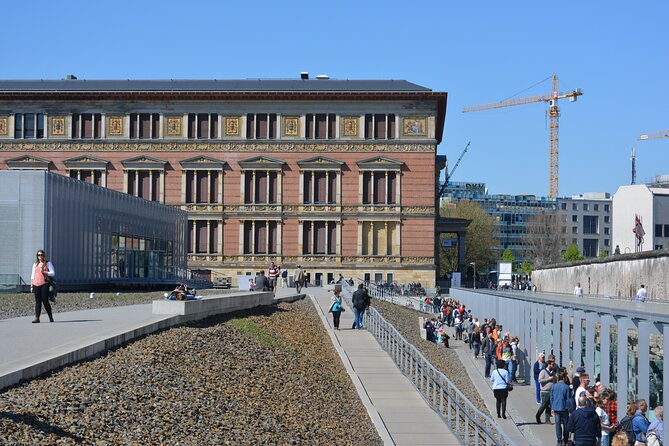
Museum Island is the final stop, with about 20 minutes devoted to the area. You cross into what was medieval Berlin, the historic center associated with the City Palace from the 15th century.
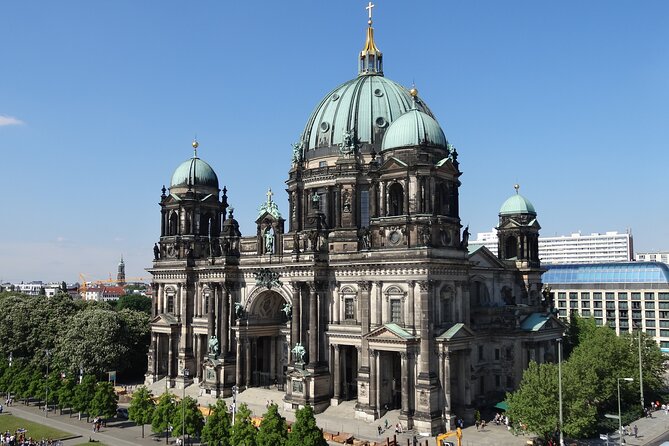
From here, the route takes in the Berlin Cathedral and the island’s five world-class museums. The tour does not include museum admission, so consider this a preview rather than a museum visit. If you plan to enter later, the guide’s overview can help you decide how to use your time.
From the eastern side of the island, you also look toward Alexanderplatz, the center of postwar East Berlin. This final view brings the story into the 20th century and helps connect the old center with the former East German capital.
The tour ends at Museum Island, at 10 Berlin. That is a useful finish because you can continue into a museum, walk toward Alexanderplatz, or use the area as a base for further sightseeing.
How the guides shape the experience
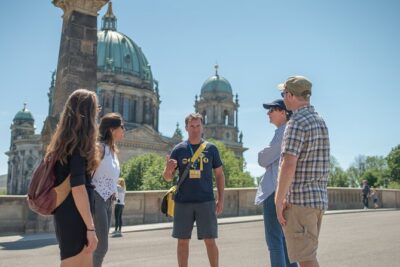
The tour depends heavily on the individual guide, and the names associated with it include Aurel, Cairan, Rhys, Eugen, Steve, Paul, Aaron, Al, and Ciaran. The strongest pattern is clear: the guides are valued for clear historical explanations, an easy manner, and the ability to answer questions without turning the walk into a lecture.
Aurel is noted for connecting architecture with political history and for explaining why buildings were constructed, damaged, rebuilt, or repurposed. Cairan is described as using thoughtful exercises and visual material to make difficult subjects more personal. Rhys is known for mixing humor with key facts and for making the material accessible to people with basic English.
Steve has been praised for arranging the story in a clear chronological order, while Paul is noted for patience with children and easy-to-follow English. These details matter because a three-and-a-half-hour history walk can become tiring if the guide simply recites dates.
Some departures may be extremely small, even a private-style experience when only a few people book. The official maximum is 15, so you should expect an intimate group rather than a large crowd. That makes it easier to ask about subjects such as the Nazi period, East Berlin, architecture, or reunification.
Price, pace, and what you should bring
At $32.58 per person, this is good value if you want a broad introduction to central Berlin. You are paying for an expert guide and several hours of interpretation, not for museum entry or transport.
The tour visits 11 locations, and the listed stops alone add up to a substantial amount of talking and walking. You should wear comfortable shoes, bring water, and pack a snack. One practical note from the experience is that there is no meal break, so do not arrive hungry.
The pace may feel full. You stop often, but many locations receive only 15 or 20 minutes. That is ideal for a first orientation, photos, and a clear explanation. It is less suitable if you prefer to linger at every memorial or read every museum panel as you go.
The tour is offered in English and uses a mobile ticket. It begins at 10:00 a.m., and the meeting point is near public transportation. Service animals are allowed, and most people can participate, but the walking demand should be taken seriously.
Free cancellation is available when you cancel at least 24 hours before the start time. Changes or cancellations made within 24 hours are not accepted for a refund.
Who should book this Berlin walk
I would choose this tour if you are visiting Berlin for the first time, want the main historic sights in one morning, or find the city’s history difficult to organize on your own. It is also a strong choice for English speakers who want more than a quick photo tour.
Families can benefit from the clear route and the guides’ patient approach, though children need to manage several hours on foot and some serious subject matter. History fans will appreciate the range, especially the links between architecture, politics, war, and memorial design.
I would skip it if you need frequent sitting breaks, want extensive time inside museums, or dislike group walking tours. The route covers a lot, and the itinerary is designed for breadth rather than slow exploration.
Should you book it?
Book this tour if you want to get your bearings fast while still learning why Berlin looks and feels the way it does. The combination of Brandenburg Gate, Nazi-era sites, Checkpoint Charlie, Prussian squares, Unter den Linden, and Museum Island gives you an unusually broad first look at the capital.
Just be ready for the walking. Bring water, wear good shoes, and treat the tour as a well-guided introduction rather than the final word on each site. Afterward, return to the Holocaust Memorial, Topography of Terror, or one of Museum Island’s museums if you want more time with the subjects that catch your attention.
FAQ
How long is the Explore Berlin History and Highlights tour?
The tour lasts approximately 3 hours and 30 minutes.
What time does the tour start?
It starts at 10:00 a.m.
Where does the tour begin?
The meeting point is Wurst 🙂 am Brandenburger Tor, at Ebertstraße and Scheidemannstraße, 10117 Berlin, Germany.
Where does the tour finish?
The tour ends at Museum Island in Berlin.
Is this a walking tour?
Yes. The experience is a walking tour, and transportation is not included.
How many people can join the tour?
The group has a maximum of 15 travelers.
Is the tour offered in English?
Yes. The tour is offered in English.
Are entrance tickets included?
The listed stops have free admission, and the experience includes a guide. Museum admission is not included.
Are service animals allowed?
Yes, service animals are allowed.
Can most people participate?
The tour information states that most travelers can participate. Because it is a long walking tour, you should consider your ability to walk for about three and a half hours.
What is the cancellation policy?
You can cancel at least 24 hours before the start time for a full refund. Cancellations or changes made less than 24 hours before the tour are not accepted for a refund.
Just added around Berlin
- eSIM for Germany and 34 European Countries★ 4.5 · 16 reviews
- Your ticket to The Wall Museum Berlin★ 3.0 · 60 reviews
- Walking on the Wall: 3-Hour Tour in Berlin★ 4.5 · 34 reviews
- Rickshaw Tours Berlin – Groups of up to 16 people with several rickshaws★ 4.0 · 97 reviews
- Warnemuende Shore Excursion: Private Berlin Tour★ 4.5 · 27 reviews
- Love and War in Berlin: Self-Guided Story Puzzle Walk★ 5.0 · 7 reviews
- Warnemuende Shore Excursion: Berlin Private Sightseeing Tour from Rostock★ 5.0 · 4 reviews
- Cold War Berlin – Private Live Virtual Experience★ 5.0 · 4 reviews
Berlin Tours, compared.
Reichstag, Dome and Government District Guided Tour
Read our review →
1-Hour City Tour by Boat with Guaranteed Seating
Read our review →
Reichstag, Plenary Chamber, Cupola & Government Tour
Read our review →
Browse the lists this tour appears in