
Review · BERLIN TOURS
Cold War and Berlin Wall Tour in Italian
Berlin’s Cold War story is easiest to grasp when you see it in the streets where it happened. This 3.5-hour Italian-language walk links the Wall Memorial, Alexanderplatz, Karl-Marx-Allee, and the East Side Gallery into one clear route, with the city itself serving as the classroom.
I like the Italian commentary, especially for a subject filled with political terms and personal stories. I also like the way the route moves beyond the famous painted wall to include ghost stations, Stalinist buildings, escape systems, and the protest at Alexanderplatz that helped bring the Wall down.
The main consideration is pace. You cover a lot of Berlin, and transportation to and between the sights is not included. The group can reach 25 people, so this is a good fit for an organized walking tour, but not for a private, slow-moving visit.
Key points before you book
- The tour begins at Potsdamer Platz at 10:00 am, beside the blue bicycle and VIVE BERLIN TOURS flag.
- Nordbahnhof reveals the ghost stations, where trains passed through sealed East Berlin stops during the division.
- The Wall Memorial is the most serious stop, with time for victims, escape attempts, and the mechanics of the border.
- Alexanderplatz and Karl-Marx-Allee show East German life, from public protest to grand Stalinist design.
- The East Side Gallery is the finish, with the longest surviving section of the Wall and its famous murals.
- The $27.87 price is fair for a 3.5-hour guided route, especially if Italian is important to you, but bring money for your own transport and refreshments.
Why this route works for understanding Cold War Berlin
Berlin’s divided past can feel scattered. One site explains the Wall, another covers East Germany, and a third shows the art painted after reunification. This tour joins those pieces in a sensible order.
You begin at Potsdamer Platz, once split by the Wall and now one of central Berlin’s busiest modern districts. From there, the route heads toward Nordbahnhof, the Wall Memorial, Alexanderplatz, Karl-Marx-Allee, and finally the East Side Gallery.
That sequence gives you both the political story and the physical evidence. You see where the border ran, how East Berlin was designed, how people tried to cross, and how the Wall later became a public canvas.
The Italian guide is the key reason to choose this experience rather than simply walking the route alone. A guide can explain the difference between the German Democratic Republic and West Berlin, put the 1989 protests in order, and connect dry facts to actual places.
Past participants gave the tour a full 5 out of 5 rating from 81 reviews, and the strongest praise focused on the guide’s ability to explain the painful period clearly. One Italian-language participant singled out Antonella for making the emotions of 1989 feel immediate. If she leads your departure, you can expect an especially engaging presentation, though guide assignments can vary.
More Wall and Cold War walks:
- Berlin: Third Reich and Cold War 2 Hour Walking Tour
★ 4.9 · 6,830 reviews - Berlin’s Best: 2 Hour Walking Tour Third Reich and the Cold War
★ 5.0 · 5,486 reviews - Berlin: DDR Museum Tickets
★ 4.3 · 3,443 reviews
Starting at Potsdamer Platz and heading north
Meet at Potsdamer Platz 10 at 10:00 am. Look for the blue bicycle and the VIVE BERLIN TOURS flag, a useful detail in a busy urban area where a vague meeting point could waste precious time.
The opening stop lasts about 10 minutes and is mainly for gathering the group and setting the scene. Potsdamer Platz is a fitting starting point because its present-day office towers and public spaces contrast sharply with the empty, divided zone that once occupied this part of Berlin.
You should arrive with comfortable shoes and a charged phone. The ticket is mobile, but the tour is fundamentally a guided city walk, not a bus excursion.
Nordbahnhof and Berlin’s sealed ghost stations
At Berlin-Nordbahnhof, the guide explains the story of the ghost stations. During the city’s division, some subway stations in East Berlin were closed to East Berlin residents while trains from West Berlin passed through without stopping.
This is one of the tour’s more unusual stops. You are not simply looking at a section of wall or a famous square. You are learning how the division reached underground, affecting ordinary journeys and turning subway platforms into controlled, sealed spaces.
The stop lasts about 10 minutes, so expect a focused explanation rather than a long station visit. It is a good early lesson in how the Cold War was enforced through everyday infrastructure.
The Berlin Wall Memorial and the human cost of division
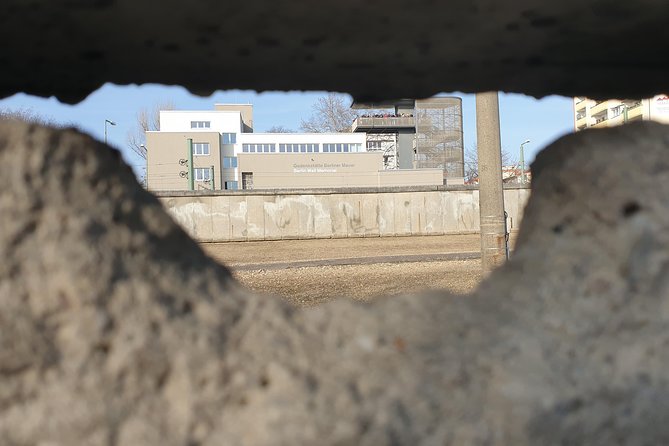
The Wall Memorial receives the longest scheduled visit, about 50 minutes, and it deserves that time. This is where the tour explains how the Wall was built, how the border system worked, and what happened to people who tried to escape.
You will hear about victims of the Wall and the methods used in escape attempts. That makes this section more personal than a simple account of dates and political speeches. The border was not one thin barrier. It involved a system designed to stop movement, and the memorial helps you understand that physical reality.
I consider this the most valuable stop for anyone who wants more than the familiar image of people celebrating on November 9, 1989. The East Side Gallery is visually striking, but the Wall Memorial gives the subject its weight.
Allow yourself to listen closely here. The material is serious, and the guide’s Italian explanations can be especially useful if you want to follow the details without worrying about a language gap.
A few more Berlin half-days to weigh up
- Berlin: Reichstag, Dome and Government District Guided Tour
★ 4.7 · 18,288 reviews - Berlin: 1-Hour City Tour by Boat with Guaranteed Seating
★ 4.3 · 16,993 reviews - Berlin: Boat Tour Along the River Spree
★ 4.4 · 11,252 reviews - Discover Berlin Half-Day Walking Tour
★ 5.0 · 9,624 reviews
Alexanderplatz and the public protest of 1989
The next major stop is Alexanderplatz, with about 15 minutes devoted to the German Democratic Republic and its typical architecture. The square is also tied to one of the key public demonstrations that helped lead to the Wall’s fall.
This is where the tour shifts from border controls to public resistance. You learn how a large gathering in East Berlin became part of the pressure that weakened the government and helped open the way to the events of 1989.
The stop is relatively short, so do not expect a long architectural tour of the square. Instead, use it as a quick reading of the political setting. The surrounding buildings help show the scale and style favored by East German planners, while the protest story explains why the square matters beyond its appearance.
The TV Tower, seen from outside
The Berlin TV Tower receives about 10 minutes, with the visit limited to the outside. It is the most recognizable structure from the GDR period and remains Berlin’s tallest building.
The tower is useful here as a symbol of East German confidence and state power. Its size and visibility made it a major statement in the city center. Seeing it during a Cold War route helps connect architecture with politics without requiring an interior visit.
Be clear about what is included: you will see the tower from outside, not go up to the viewing area. If you want a visit inside, that would need to be arranged separately, and the tour price does not cover it.
Karl-Marx-Allee and Stalinist Berlin
Karl-Marx-Allee is one of the most revealing architectural sections of the route. The stop lasts about 20 minutes and focuses on the boulevard’s grand buildings and the early years of the GDR.
The scale is the point. This was not modest residential planning. The boulevard was designed to project order, authority, and a particular vision of socialist urban life. The large facades and formal layout offer a sharp contrast to the improvised feel of many surviving Wall sections.
A guide makes a difference here because the buildings can otherwise look like a long row of imposing apartments. You will learn how the boulevard fits into the beginning of East Germany and why its architecture carries political meaning.
This is also a good stop for people interested in design, not only military borders and political events. The tour shows that the Cold War was built into streets, homes, public squares, and transport systems.
East Side Gallery and the Wall as a symbol of freedom
The tour ends at the East Side Gallery, where about 20 minutes are scheduled. This is the longest remaining section of the Berlin Wall and the best-known part because of its murals.
The paintings transformed a structure made for separation into a public symbol of freedom. That change is central to the modern memory of Berlin: the Wall is no longer only a barrier and crime scene, but also a place where artists expressed hope, anger, humor, and relief.
The East Side Gallery is more colorful and open than the Wall Memorial, but it should not replace the earlier stops. The murals are powerful because you already understand what the concrete once meant.
The ending location is practical as well as memorable. You finish in the East Side Gallery area, and the guide can advise you on public transport for the rest of your day. Since the tour does not include transportation to or from the attractions, ask for that advice before saying goodbye.
What the $27.87 price really covers
At $27.87 per person, this is a reasonably priced way to organize a substantial half-day of Cold War sightseeing. You are paying mainly for the Italian-speaking guide, the route planning, and the explanations that connect sites separated across the city.
There are no attraction admission fees listed because the stops are viewed from public areas or outside. That keeps the cost down, but it also means you should not expect interior visits to the TV Tower or paid museum access.
The route covers enough ground that doing it alone would require research, map work, and careful timing. If you already know Berlin well and enjoy building your own walking route, the value may be less obvious. If you want one morning devoted to the Cold War without sorting every stop yourself, the price is easier to justify.
The average booking point is 24 days before the tour. That suggests you should not leave an Italian-language departure until the last minute if your Berlin dates are fixed.
Timing, group size, and practical limits
The experience lasts approximately 3 hours and 30 minutes and begins at 10:00 am. That leaves much of the afternoon free for museums, food, or further exploring around Friedrichshain and central Berlin.
The maximum group size is 25 people. That is small enough for a guide to lead a focused city walk, but it is not a private tour. Stay close to the guide at crossings and transit points, especially as the route moves between major parts of Berlin.
Transportation to and from the sights is not included. The information provided does not specify exactly how every transfer is made, so plan for a mixture of walking and city transport and confirm the day’s arrangements with the guide. You are responsible for getting to Potsdamer Platz and for your journey onward from the East Side Gallery.
Food and drinks are also not included. A small drink and snack can be sensible for a 3.5-hour outing, though the tour does not list a meal stop.
Confirmation arrives at booking, and the mobile ticket is convenient for the meeting point. Service animals are allowed, the tour operates near public transportation, and most people can participate. Still, this is an active urban walk, so comfortable footwear matters more than dressy clothes.
Free cancellation is available up to 24 hours before the start time for a full refund. Changes or cancellations within 24 hours are not refunded, and the cut-off follows Berlin local time.
Who should choose this Italian-language walk
I would choose this tour if you want Berlin’s Cold War story explained in Italian and prefer a planned route over independent research. It is particularly useful for first-time visitors who want to see several important locations in one morning.
It also suits anyone who finds political history easier to understand when it is tied to real streets. The ghost stations, Wall Memorial, Alexanderplatz protest, Karl-Marx-Allee, and East Side Gallery each show a different part of the story.
You may want another option if you need a private experience, dislike walking, or expect long visits inside attractions. The TV Tower is exterior only, the group may reach 25 people, and transportation and refreshments are your responsibility.
The tour is also a good match for repeat visitors who have already seen Checkpoint Charlie or the Brandenburg Gate. Its route focuses on places that explain the system behind the Wall, not only the best-known photo stops.
Should you book the Cold War and Berlin Wall Tour in Italian?
Book it if Italian commentary will help you follow a difficult subject, and if you want a compact route with real historical range. The best parts are the Wall Memorial, the ghost-station explanation, and the connection between Alexanderplatz and the events of 1989.
At $27.87, the experience offers solid value for a 3.5-hour guided walk, provided you are comfortable arranging your own transport and spending much of the morning on foot. I would treat the East Side Gallery as the memorable finish, but the Wall Memorial as the reason to book.
FAQ
What language is the tour conducted in?
The tour is conducted in Italian by an Italian-speaking guide.
Where does the tour begin?
It begins at Potsdamer Platz 10, 10785 Berlin, near the Potsdamer Platz S-Bahn and U-Bahn station. Look for the blue bicycle and the VIVE BERLIN TOURS flag.
What time does the tour start?
The tour starts at 10:00 am.
How long does the tour last?
It lasts approximately 3 hours and 30 minutes.
Where does the tour end?
It ends at the East Side Gallery in Berlin. The guide can advise you about public transport afterward.
Is transportation included?
No. Transportation to and from the attractions is not included.
Is the Berlin TV Tower visited inside?
No. The TV Tower is visited from outside only.
Is food or drink included?
No. Food and drinks are not included.
How large can the group be?
The maximum group size is 25 people.
Can I cancel for a full refund?
Yes. You can cancel at least 24 hours before the start time for a full refund. Cancellations or changes made within 24 hours are not refunded.
Just added around Berlin
- eSIM for Germany and 34 European Countries★ 4.5 · 16 reviews
- Your ticket to The Wall Museum Berlin★ 3.0 · 60 reviews
- Walking on the Wall: 3-Hour Tour in Berlin★ 4.5 · 34 reviews
- Rickshaw Tours Berlin – Groups of up to 16 people with several rickshaws★ 4.0 · 97 reviews
- Warnemuende Shore Excursion: Private Berlin Tour★ 4.5 · 27 reviews
- Love and War in Berlin: Self-Guided Story Puzzle Walk★ 5.0 · 7 reviews
- Warnemuende Shore Excursion: Berlin Private Sightseeing Tour from Rostock★ 5.0 · 4 reviews
- Cold War Berlin – Private Live Virtual Experience★ 5.0 · 4 reviews
Berlin Tours, compared.

Reichstag, Dome and Government District Guided Tour
Read our review →
1-Hour City Tour by Boat with Guaranteed Seating
Read our review →




Reichstag, Plenary Chamber, Cupola & Government Tour
Read our review →
Browse the lists this tour appears in