Review · WALKING TOURS
Weimar Private Walking Tour With A Professional Guide
Weimar’s great strength is its compact center. In about two hours, you can walk from the Market Square to Goethe and Schiller’s memorial, a former ducal palace, the birthplace of the Weimar Republic, and the homes of two of Germany’s best-known writers. The city’s story changes from stop to stop, from court life to Lutheran reform, literary classicism, and modern democracy.
I like the private format, since your guide can respond to your questions instead of following a fixed script. I also like the chance to see Weimar through several figures at once: Goethe, Schiller, Anna Amalia, Herder, Liszt, and the dukes who shaped the city. The main consideration is pace. There is a lot to cover, and a two-hour walk gives you an introduction rather than time for long visits inside every building.
Key points about the Weimar walk
- Goethe and Schiller’s world: See the memorial at Theaterplatz, Goethe’s former home, and Schiller’s House.
- A private group of up to 15: You are not mixed with strangers, and the guide can adjust the walk on the spot.
- A compact, easy route: The sights are close together, and no transportation is needed.
- German democracy in the center: Learn how the National Assembly met in Weimar in 1919 and how the republic later fell.
- Palaces, churches, and parks: The route links ducal buildings, St. Peter and Paul Church, Park an der Ilm, and Anna Amalia’s Library.
- Good value for a larger party: At $244.41 per group, the price becomes more reasonable as your party approaches the maximum of 15 people.
Why Weimar works so well on foot
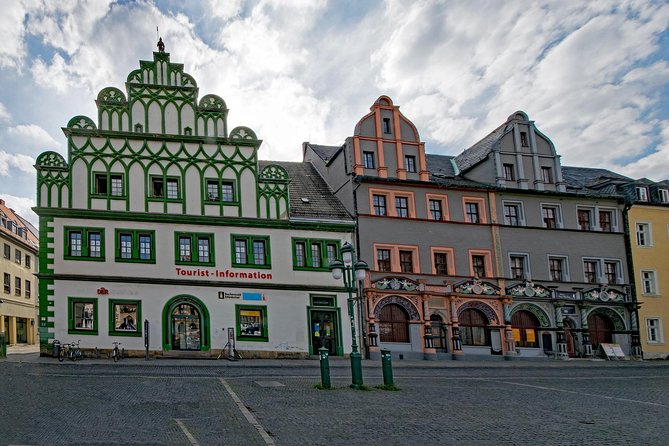
Weimar is unusually suited to a guided walk. The central sights sit close together, and the route begins and ends near the Market Square, at Markt 20. You do not need a bus, taxi, or complicated transport plan between stops.
That compact layout matters because Weimar’s appeal is not limited to one monument. The city’s importance comes from the links between people and places. A square leads to a theater, a palace, a church, a library, and private homes where writers and musicians lived and worked.
The architecture also reflects Weimar’s past as a ducal residence. You will see a city shaped by court life, but the walk does not stop there. It also explains Lutheran worship, the creation of the Weimar Republic, and the way the city became tied to German literature and music.
The route is listed as easy and suitable for any age. Still, this is a walking tour, so comfortable shoes will make the experience better. The walk is approximately two hours, though one account describes a three-hour walk with guide Alexander. If timing matters, confirm the expected length before you begin.
More walking tours in Germany:
- Discover Berlin Half-Day Walking Tour
★ 5.0 · 9,624 reviews - Berlin: Third Reich and Cold War 2 Hour Walking Tour
★ 4.9 · 6,830 reviews - Munich: Third Reich & WWII Walking Tour
★ 4.6 · 6,181 reviews
Market Square and Lucas Cranach’s Weimar
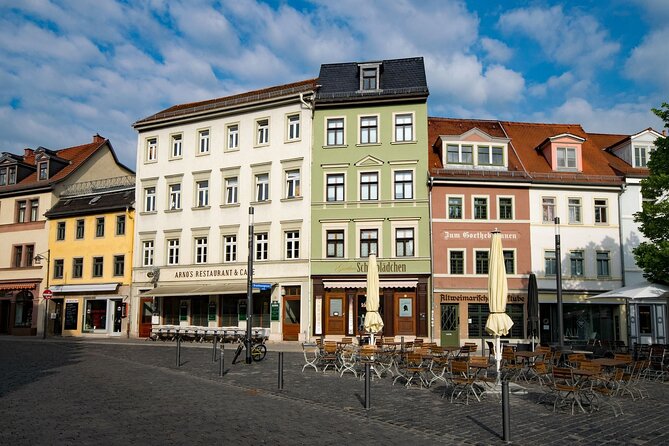
The Market Square is a practical starting point and a good place to get your bearings. It has long been a meeting place, and its buildings connect everyday city life with Weimar’s artistic past.
One detail worth watching for is the connection to Lucas Cranach, the Renaissance painter who lived in a building close to the square. The stop also opens the door to Weimar’s classicist period, which draws much of the city’s cultural attention today.
Your guide can help you read the square rather than simply photograph it. The buildings reflect the city’s former feudal order, when dukes, court officials, artists, and clergy all played a part in public life.
Because the tour returns here at the end, the Market Square is also convenient if you want to continue exploring on your own. You will not need to arrange a pickup at another part of town.
Theaterplatz and the partnership of Goethe and Schiller
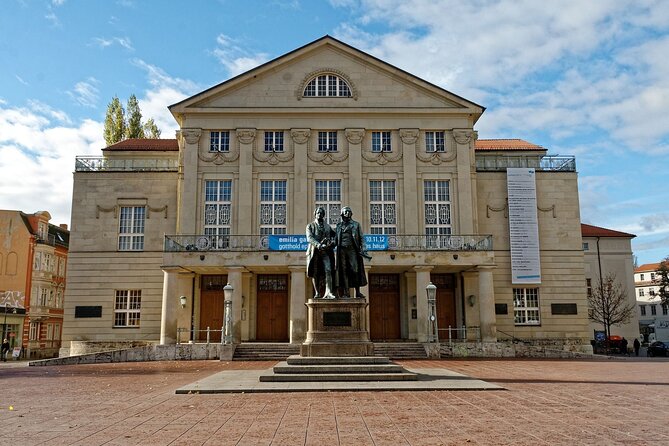
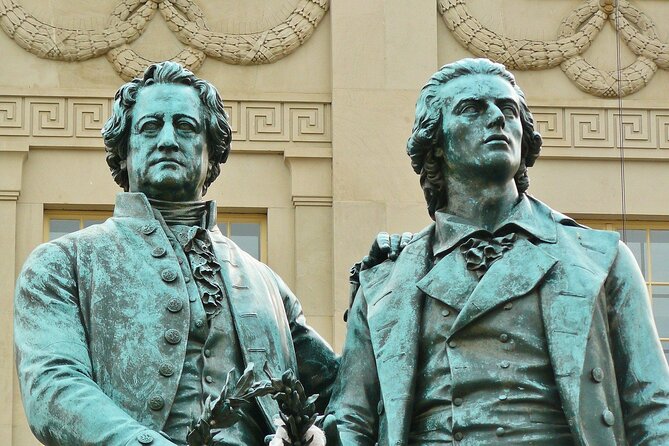
At Theaterplatz, the most familiar sight is the Goethe and Schiller memorial. The two writers are shown together in front of the National Theater, and their shared place in Weimar’s identity is hard to miss.
The story is not just about two statues. Weimar classicism grew from a circle that included the dowager duchess Anna Amalia, who hosted gatherings attended by Goethe, Schiller, and other important figures. The guide can give you the human connections behind the formal label of Weimar classicism.
This is one of the best stops for understanding why Weimar became so important to German culture. Goethe and Schiller did not simply live in the same city. Their creative association became one of the central stories attached to Weimar.
The square also introduces a very different chapter: the House of the Weimar Republic. On the opposite side of Theaterplatz, the building recalls the National Assembly of 1919, when representatives met to decide the future of Germany after the First World War and the fall of the German Empire.
The Weimar Republic was Germany’s first attempt to build a democracy. It ended with the rise of the Nazi party in 1933. The renovated building now presents that story and serves as a Forum for Democracy. This gives the walk a useful modern edge. You are not only hearing about famous writers and courtly life. You are also confronting a major turning point in German political history.
St. Peter and Paul Church and Martin Luther’s connection
The Church of St. Peter and Paul is described as the most important church in Weimar. Its foundations reach back to a 13th-century church, while the present building was first created in the 16th century in Gothic style.
The church became Lutheran during the Reformation, and Martin Luther preached there. That detail gives the building a direct place in the religious changes that reshaped Germany.
Inside, you can connect the church to two figures from Weimar’s cultural and political past. Johann Gottfried Herder is buried there, as is Duchess Anna Amalia. Herder served as the church’s superintendent, and a memorial to him has stood in front of the church since 1850.
This stop is especially useful if your picture of Weimar begins and ends with Goethe. The church shows how much older the city’s story is. It ties literary Weimar to religious reform, ducal power, and the long life of the city’s institutions.
The tour does not require transportation, but remember that a two-hour schedule may limit the time available inside. If the church is a priority for you, ask the guide how much time can be given to it.
A few more Germany half-days to weigh up
- Berlin: Private Reichstag and Glass Dome Tour
★ 4.8 · 2,226 reviews - Berlin Private Complete History All Day Walking Tour
★ 5.0 · 474 reviews - Munich Private Tour with a Local – Highlights & Hidden Gems
★ 5.0 · 469 reviews - Private Walking Tour Berlin Third Reich Hitler and World War II
★ 5.0 · 360 reviews
Weimar Palace and the former ducal city
The walk then passes Weimar Palace, once home to the dukes of Saxe-Weimar and Eisenach. The building began as a medieval castle, first mentioned in the 10th century, and changed over centuries after fires and rebuilding.
It took roughly 500 years to reach the palace’s present form. That long building story helps explain why Weimar can feel layered rather than uniform. What you see is not one clean period of architecture. It is a residence altered to meet the needs of different generations of rulers.
A guide is useful here because palace exteriors can look impressive without explaining who lived there or why the building changed. The palace gives context for the dukes’ role in supporting, hosting, or employing the artists and thinkers associated with Weimar.
This is also where the tour shifts from individual writers to the political structure around them. Goethe, Schiller, Liszt, and Anna Amalia were connected to a city governed by a ruling family with money, influence, and cultural ambitions.
Democracy Square, royal buildings, and Anna Amalia’s Library
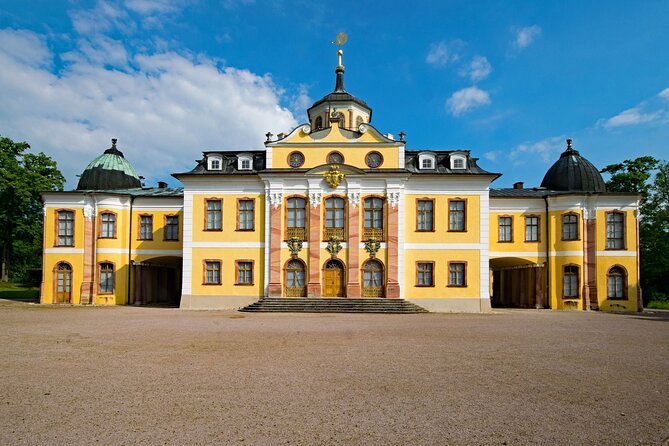
Democracy Square was formerly known as the Duke’s Square. The older name fits the buildings around it, including the red and yellow palaces and the house where Duke Charles Augustus lived.
The square makes a useful contrast with the House of the Weimar Republic. One space recalls royal rule, while another marks Germany’s first democratic experiment. Seeing both within the same walk helps you follow the transition from ducal Weimar to modern political history.
Next to the square is Anna Amalia’s Library, housed in a small palace. The dowager duchess supported the library, which holds important treasures and a document offering an early indication of Wolfgang von Goethe’s presence in Weimar.
Goethe later ran a library for decades. That fact adds another side to his public life. He was not only a poet and dramatist working on major texts. He also took part in the intellectual and administrative life of the city.
The library is one of the places where time may work against you. It is an important stop, but the walking experience is designed to cover many sites. The description does not promise a full interior visit, so you should treat it as a landmark and ask your guide what can be seen during your booking.
Park an der Ilm and Goethe’s first Weimar home
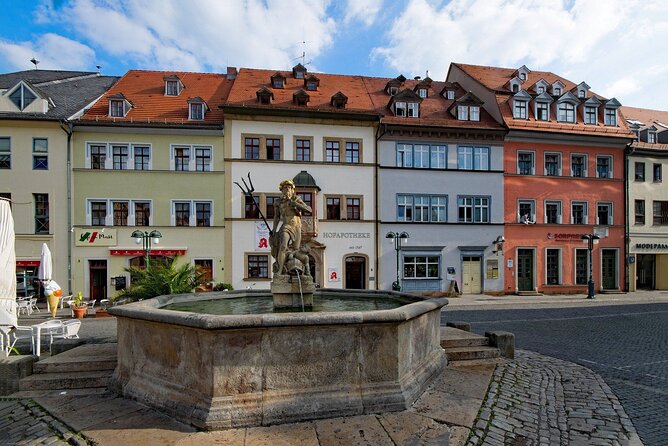
Next to Anna Amalia’s Library is Park an der Ilm, created in the 18th century. The park is known for valuable trees and architectural features, including the ruins of the Tempelherrenhaus.
The park also brings Goethe into the city’s physical design. He helped shape the park and spent his first years in Weimar in a house beside it. Charles Augustus gave him that home, a sign of the close connection between the writer and the ducal court.
I like this part of the walk because it gives you a break from formal squares and grand buildings. A park can show how people used the city, where they sought quiet, and how a ruler’s cultural interests affected ordinary urban space.
The stop is not presented as a long park stroll. You will likely see it as part of the larger route, so do not expect a leisurely tour of every path. Its value is the connection between the grounds, the duke, and Goethe’s early years in Weimar.
Goethe’s House on Frauenplan
Goethe’s House on Frauenplan became his more impressive residence after 1782. Several rooms remain arranged as they were during the final years of his life, giving the stop a more personal feel than a monument in a public square.
The study is particularly important. It is described as unchanged and is associated with works such as Faust. Goethe remained in Weimar until his death in 1832, so this home covers the mature period of his life in the city.
For many people, this will be the emotional center of the tour. You can connect the public figure from the Theaterplatz memorial with the rooms where he worked, lived, and received the city’s attention.
Do not expect a long museum visit within the walking tour’s short format. The route includes many locations, and the guide’s job is to place the house in context. If you want to study Goethe’s rooms in detail, plan separate time for a return visit.
Liszt Haus and Weimar’s musical life
The Liszt Haus adds music to a route otherwise dominated by writers and political figures. Franz Liszt spent many summers in Weimar in a house provided by the local duke.
In Weimar, Liszt taught young pianists from across Europe without charging them. That detail shows how the city’s cultural role continued beyond the era of Goethe and Schiller.
The house also illustrates the way Weimar attracted artists through personal support from the ducal court. A residence, a teaching opportunity, or an invitation could bring a major figure to the city for long periods.
This stop may appeal most to people who already know Liszt’s music, but it is useful even if you do not. It broadens the story of Weimar and shows that its artistic life was not limited to literature.
Schiller’s House and the friendship that shaped Weimar
The final major stop is Friedrich Schiller’s House. Goethe and Schiller were brought together through an assembly, and Goethe, impressed by Schiller, invited him to Weimar.
From then on, the two formed an intense creative partnership. The earlier memorial at Theaterplatz can feel symbolic. Here, the story becomes more concrete, with a home connected to Schiller’s working life.
This pairing of Goethe’s House and Schiller’s House is one of the tour’s strongest features. You see the writers not as isolated names in a textbook but as people whose lives and work were tied to specific streets and buildings.
The walk then returns to the Market Square. That simple ending is useful. You finish where you began, with no need to find a distant endpoint or arrange transport back to your hotel.
What $244.41 means for your group
The price is $244.41 per group, with up to 15 people included. For one or two people, that is a considerable cost for an approximately two-hour walk. For a larger family or group of friends, the calculation improves quickly because the price does not rise with each additional participant up to the stated limit.
The private format is the main reason to pay more than you would for a standard group walk. You have a guide assigned only to your party, and customization is possible during the tour. That can be valuable if your group has a strong interest in Goethe, church history, democracy, music, or architecture.
I would consider this a better buy for a group than for a solo visitor. It is also a practical choice if you have limited time in Weimar and want a clear introduction before choosing which interiors deserve a longer visit.
The five available ratings average 4.8, with praise focused on the guides’ command of Weimar’s history and their ability to answer questions beyond the basic route. Alexander is one named guide connected with the experience. A separate account describes a very friendly female guide with an unusually broad store of information. Those details suggest that guide quality is the central strength, but your assigned guide may vary.
Timing, group size, and practical planning
The tour is offered in English and includes a mobile ticket. You meet at Markt 20 in Weimar, and the walk ends in the Weimar area, with the route returning to the Market Square for convenience.
The activity is listed as approximately two hours. Since one account describes a three-hour walk, you should allow some flexibility if you have a train, museum reservation, or meal booking immediately afterward. Ask about the expected finish time when you meet your guide.
No transportation is needed, and the activity level is easy. Most people can participate, and the route is near public transportation. The private group limit of 15 is generous, though a group that large may move more slowly and may have a harder time hearing every explanation in busy public areas.
Free cancellation is available if you cancel at least 24 hours before the local start time. Changes or cancellations made inside that window are not accepted for a refund.
Who will get the most from this tour?
I would choose this walk if you want a broad introduction to Weimar rather than a single museum visit. It suits first-time visitors, families, older adults who prefer an easy route, and anyone who wants a guide to connect the city’s main names and buildings.
It is also a good fit for mixed-interest groups. One person can focus on Goethe and Schiller, another on the Weimar Republic, and another on churches, palaces, or music. Because the guide can adjust the walk on the spot, you can ask for more attention to the subjects that matter most to your group.
You may want something else if you prefer a slow, detailed visit inside every house and library. Two hours is enough to see the central framework, but not enough to linger at every stop. Think of this as a strong orientation walk, followed by independent visits to the places that catch your attention.
Should you book the Weimar private walking tour?
Book it if you want the city’s major cultural and political stories tied together by a private English-speaking guide. The route covers an impressive amount of ground without requiring transport, and the combination of Goethe, Schiller, Anna Amalia, Liszt, Lutheran history, ducal power, and the Weimar Republic gives you a fuller picture than a literature-only walk.
For a small party, the price is harder to justify unless personal attention and schedule flexibility matter a great deal. For a family or group of up to 15, the cost can be fair, especially if you use the guide to shape the discussion around your interests.
My practical advice is simple: book this early in your Weimar visit, ask about the actual walking time, and note which interiors you want to revisit afterward. That way, the tour gives you both a useful map of the city and a clear plan for the rest of your stay.
FAQ
Where does the Weimar walking tour begin?
The tour begins at Markt 20, 99423 Weimar, Germany, near the Market Square.
Where does the tour end?
The route returns to the Market Square for convenience. The stated end location is in Weimar.
How long does the tour last?
The tour lasts approximately two hours. One account describes a three-hour walk, so confirm the expected duration if you have plans afterward.
Is the tour private?
Yes. Only your group participates, and the private guide is assigned to your group alone.
How many people can join the tour?
The price covers a group of up to 15 people.
Is transportation included or needed?
No transportation is needed. The tour is conducted on foot, and the central sights are close together.
Is cancellation free?
You can cancel for a full refund at least 24 hours before the experience start time. Cancellations or changes made less than 24 hours before the start are not accepted for a refund.
Just added around Germany
- Konstanz Scavenger Hunt and Sights Self-Guided Tour★ 4.5 · 14 reviews
- e-Scavenger hunt Koblenz: Explore the city at your own pace★ 4.0 · 20 reviews
- Private city tour in Constance★ 4.0 · 5 reviews
- Koblenz Guided tour of the Ehrenbreitstein Fortress★ 4.5 · 7 reviews
- Koblenz – Old Town with the Ehrenbreitstein Fortress★ 4.0 · 7 reviews
- Koblenz – Old Town including the Deutsches Eck★ 4.5 · 16 reviews
- Kiel – Private Historic Walking Tour★ 5.0 · 4 reviews
- Lubeck Private Walking Tour With A Professional Guide★ 4.5 · 10 reviews
Walking Tours, compared.


Berlin’s Best: 2 Hour Walking Tour Third Reich and the Cold War
Read our review →