
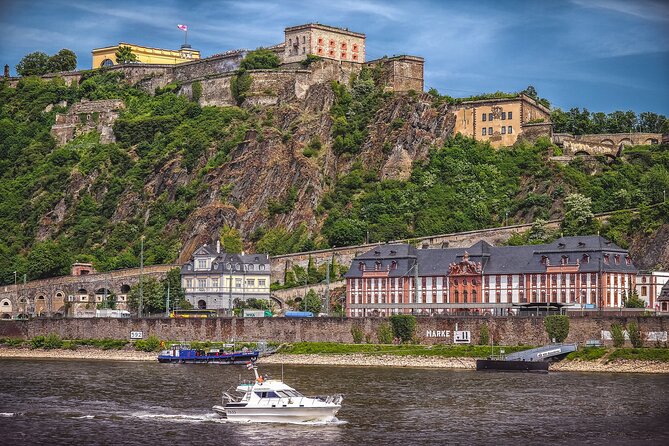
Review · KOBLENZ TOURS
e-Scavenger hunt Koblenz: Explore the city at your own pace
Koblenz turns sightseeing into a self-guided city game, with your phone leading you from old churches and grand squares to the Rhine and Moselle rivers. You solve challenges, answer questions, and look for objects rather than simply following a guide from one stop to the next.
I like the freedom to set your own pace, especially since the route takes about 2 to 4 hours and includes a pause feature. I also like the private pricing: $37.33 covers a group of up to six, which can be good value for friends or a family. The main caution is that the app and its translations may feel basic, and some users have had trouble with GPS, registration, and questions that were hard to interpret.
Key points at a glance

- Fifteen historic stops: See Deutsches Eck, the Basilica of St. Kastor, the Electoral Palace, old town squares, churches, and the Moselle Bridge.
- A private group activity: One booking covers up to six people, with no strangers added to your group.
- Flexible timing: Plan on roughly 2 to 4 hours, with the option to pause for photos, food, or extra sightseeing.
- A game rather than a guided lecture: You answer questions, complete challenges, and search for objects as you move through Koblenz.
- Useful for mixed-age groups: The simple format suits families, friends, and groups who prefer an active walk.
- Bring your own phone and data: The game is included, but smartphone use and mobile data are not.
A phone-led way to see Koblenz
This experience is best understood as a walking route with a game layered on top. You start at Münzplatz 15 in the old town, open the activity on your phone, and follow the sequence of challenges around central Koblenz. The route ends back at the starting point.
You are not tied to a guide’s timetable. The booking information lists availability from midnight to 11:59 p.m. every day during the operating period, so you have plenty of flexibility in choosing when to begin. The practical time estimate is 2 to 4 hours, though your actual visit depends on how long you stop at churches, squares, cafés, and river viewpoints.
The app supplies information about each attraction, then asks you to do something with it. You might answer a question, identify an object, or work out where to go next. That gives children and energetic groups a reason to pay attention, while adults can still treat the route as a compact introduction to Koblenz.
The content is offered in English. Keep your expectations in check: this is not a live tour with a local guide offering stories, questions, and conversation. It is a private digital walk, and the quality depends on how smoothly the app works on your phone.
A few more Koblenz half-days to weigh up
- Koblenz: Rhine Valley Castles and Palaces Boat Tour
★ 4.4 · 1,824 reviews - Koblenz: 2-Hour Sightseeing Cruise on the Rhine
★ 4.6 · 839 reviews - Koblenz: Old Town Sightseeing Cruise along the Rhine
★ 4.5 · 305 reviews
Starting at Münzplatz and entering the old town
Münzplatz is both the meeting point and the final stop. Its name recalls the former electoral mint, a useful detail because it connects the square to Koblenz’s time as an important seat of power.
From here, the route moves through the historic center, where the streets are compact enough for a walking game. The activity uses the city itself as its playing board. You should be ready to look up from the screen often, since the point is to match the clues with real buildings and details around you.
A practical advantage of starting and ending in the same place is simple: you do not need to arrange transport back from a distant neighborhood. It also makes the activity easier to fit around lunch or another planned visit. If you pause halfway through, you can take your time without holding up a guide or another group.
St. Florin, the Church of Our Lady, and Koblenz’s skyline
The route includes St. Florin’s Church, an evangelical church in central Koblenz. Built around the year 1100, it belonged to the former Florinusstift, or Florin collegiate foundation.
You also visit the Church of Our Lady, a Roman Catholic church at the highest point of the old city. Together with St. Kastor and St. Florin, it helps define the silhouette of central Koblenz. That makes this part of the walk useful for understanding how the old town is arranged, not just for ticking off another church.
The route also includes a major Romanesque church building described as being on the World Heritage List since 2002. The supplied route information does not clearly identify this stop separately from the other churches, so you should treat the game’s own description as your guide at the site.
The questions here are reported as fairly easy. That can work in your favor if you are playing with children or want a relaxed outing. If you already know medieval church architecture, the information may feel too brief. You will get an introduction, not a full architectural lesson.
Basilica of St. Kastor beside the two rivers
The Basilica of St. Kastor is one of the most important stops. This Roman Catholic church was built between 817 and 836 and sits near Deutsches Eck, the point where the Moselle meets the Rhine.
Its location gives the stop extra value. You are not only looking at an old church, but also seeing how closely Koblenz’s religious, political, and river trade stories are tied together. The church sits at a key point in the city, and the walk helps connect it to the riverfront sights that follow.
The app-led format is useful here because you can stop for photographs and look around without worrying about falling behind a group. On the other hand, the digital notes are described as fairly surface-level. If St. Kastor catches your interest, you will likely want to read more elsewhere after the game.
Same city, a completely different sort of afternoon:
- Koblenz: Panoramic Cruise on Moselle River to Winningen
★ 4.4 · 283 reviews - Koblenz: Rhine Valley Castle Sightseeing Cruise
★ 4.6 · 98 reviews - Koblenz: Sunset Boat Cruise
★ 4.6 · 80 reviews - Koblenz: City & Rhine Valley Sightseeing Cruise
★ 4.7 · 39 reviews
Deutsches Eck and the meeting of Rhine and Moselle
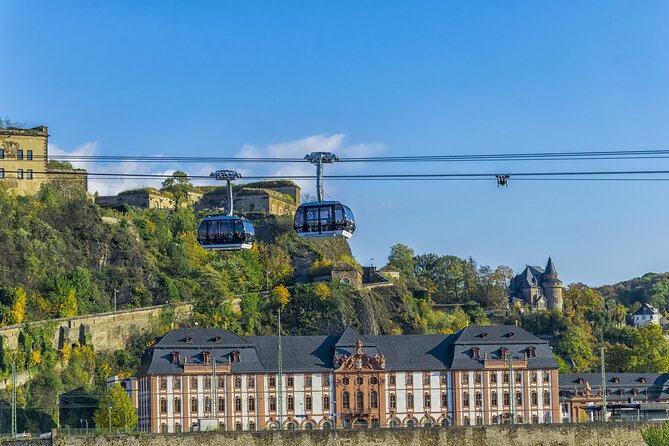
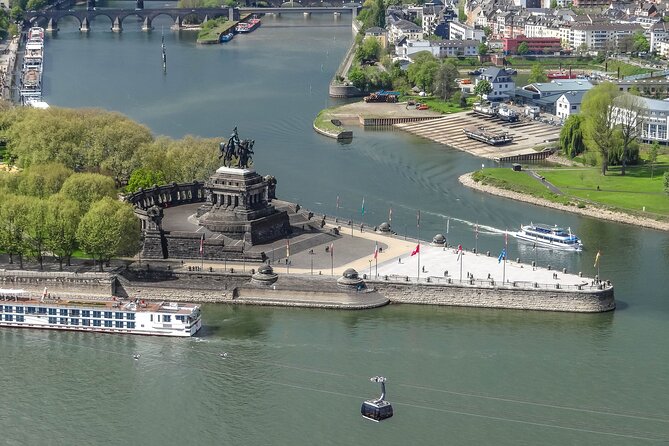
Deutsches Eck is Koblenz’s most famous memorial area. This artificial headland marks the meeting of the Moselle and Rhine and carries a national monument to German unity.
It is also one of the most open parts of the route, a change from the tighter old town streets. The river setting gives you a clear sense of why Koblenz developed where it did. The game asks you to notice the monument and its surroundings rather than simply passing through for a quick photograph.
Expect this stop to attract plenty of people, including visitors arriving from large sightseeing boats. That can make the area less quiet than the old town, but it also gives the monument a proper sense of scale. The route’s challenge format may help younger participants stay interested while adults take in the river views.
The Electoral Palace and Koblenz’s seat of power
The Electoral Palace was the residence of the last Archbishop and Elector of Trier. Its inclusion adds political context to the route, balancing the churches and public squares with a building linked to the city’s former rulers.
The palace is a good place to pay attention to the shift from religious authority to courtly and administrative power. The app gives you a short explanation and a question to answer, so you can learn the basic role of the building without committing to a lengthy indoor visit.
The stop is more about seeing the exterior and placing it in the city’s story than about receiving a detailed palace tour. The experience does not include a live guide or a stated interior visit, so do not book it expecting access to rooms or a formal palace presentation.
Small fountains and the details of public memory
Two fountain stops add smaller-scale details to the route. One fountain contains a large column that tells the story of 2,000 years of Koblenz. It is a popular point on the walking circuit, with tourists from river cruise boats often passing through.
Another fountain has a bronze statue of a boy. It was made by Carl Burger and dedicated to the poet Josef Cornelius. This is exactly the sort of object you might walk past on a normal city stroll. A scavenger hunt gives you a reason to stop, inspect it, and connect the artwork with a local name.
These stops also show the limits of the format. Questions about time and historical details have been described as difficult to answer in some cases, and the amount of background information can feel slight. Use the game to notice the object, then rely on a nearby plaque or another source if you want more depth.
The Level House and the Rhine waterfront
The Level House, built around 1609, first served as a Rhine crane. In 1839 it became a gauge house station, and the crane on the roof was removed around 1900. The building later gained another floor for the 2011 Federal Horticultural Show.
That is a lot of practical history in one compact building. It shows how the riverfront changed with trade, measurement, shipping, and later public events. The app’s challenge format should make this stop easier to remember than a bare date in a guidebook.
This is also a good place to notice the route’s range. You are not being taken only to grand monuments. You are also asked to look at working buildings and explain what they did. That gives the walk a more grounded feel, even if the digital text does not explore every detail.
Koblenz’s squares: atmosphere between the clues
At one point, you wander into a particularly photogenic square with attractive façades, terraces, and a comfortable atmosphere. The route does not treat the city as a chain of monuments only. It allows space for the everyday old town, where people sit outside and buildings form the setting.
The Vier Türme, or Four Towers, are an ensemble of four historic buildings at the crossing of Am Plan, Löhrstraße, and Altengraben. Their unusual grouping makes them a rewarding challenge stop. Rather than searching for one famous building, you are asked to look at how several façades fit together.
Münzplatz, the starting and ending square, brings the route back to its historical theme. Its connection with the electoral mint is a small but useful clue to Koblenz’s past. Because the route loops back here, you can finish near the same cafés and streets where you began.
The Old Castle and the city’s changing roles
The Old Castle was a substantial moated castle owned by the Elector. It was founded in the 13th century and has since been reduced to the later Burghaus, which now houses the city archive.
The stop is a reminder that old buildings rarely keep the same purpose forever. A medieval defensive and political structure became part of a modern civic institution. The app can point out that change in a few lines, while the challenge encourages you to find the surviving building within the surrounding old town.
Again, the experience is strongest as a visual introduction. If you want a full account of the castle’s construction, destruction, and later use, the route will not provide the depth of a specialist tour.
The 14th-century Moselle Bridge
The route includes a 14th-century stone bridge over the Moselle. It is the oldest surviving bridge in Koblenz and connects the old town with the Lützel district.
This is one of the more useful stops for understanding the city’s geography. You can see the river not as scenery but as a barrier that required an important crossing. The bridge also helps explain how the old center connects with the area beyond the Moselle.
The bridge is a natural place for a challenge because its age, stonework, and position offer visible clues. The walk does not promise an extended bridge history, but it does give you a reason to stop and look at a structure that many people might otherwise cross without much thought.
The Prussian government building and city hall
The Prussian government building in Rhine Park once served as the seat of the Prussian government for the Koblenz administrative district of the Rhine Province. It brings a later political period into the route after the medieval churches, castle, and electoral buildings.
The city hall occupies the former Jesuit college in the old town. Taken together, these stops show how political and religious buildings were reused as government offices and civic spaces. That continuity is one of the more interesting threads running through the walk.
You will get the most from this section if you take a moment to compare the buildings’ roles rather than treating each clue as a separate answer. The game provides the prompts, but you supply the larger connection.
Price, group size, and what you are really buying
At $37.33 per group of up to six, the price works out well for a full group. Six people would pay a little over $6 each, while a couple would pay about $18.67 per person. For a private city activity, that is reasonable if you enjoy solving clues together and want to avoid a fixed group tour.
The value drops if you want a detailed history lesson. The information is brief, some questions are simple, and the app does not replace a human guide who can explain a building in response to your interests. You are paying for a route, a game structure, and flexibility.
The activity is particularly suitable for families, friend groups, and people who find ordinary sightseeing walks too passive. It can also suit a group with different energy levels, since the pause feature lets you stop for food, photographs, or extra sights.
The booking includes the online game and city walk. It does not include your smartphone or mobile data, so check your battery and data access before beginning. Service animals are allowed, public transport is nearby, and the activity is described as suitable for most participants and user-friendly for people with hearing impairments.
App quality and the practical drawbacks
The largest risk is the technology. One poor experience described the GPS as unreliable, with the user needing to find each location through their own navigation. Another criticism focused on awkward registration, incorrect translations, shallow information, and questions that did not always seem to match the site.
That does not mean every booking will have the same trouble, but you should plan sensibly. Save the starting address, Münzpl. 15, 56068 Koblenz, and keep a map available as a backup. If the app offers a helpdesk, the provider states that support is available around the clock, so contact it promptly rather than spending the whole route guessing.
The pause function is a real advantage when it works. It lets you explore beyond the clues, which is important in a city with more to see than any fixed two-hour route can cover. The activity also has free cancellation up to 24 hours before the start time. Changes or cancellations inside that window are not refunded.
Who should book the Koblenz e-scavenger hunt?
I would recommend it to you if you want an independent walk with a little competition and structure. It is a good match for a family that needs children to stay involved, friends who enjoy challenges, or a small group that dislikes being tied to a guide’s schedule.
I would be more cautious if your priority is expert commentary, polished translations, or detailed historical context. In that case, the route may feel too basic, and app problems could become frustrating.
The experience has a rating of 3.9 from 20 reviews, which fits the mixed picture: the route and flexibility are strong, but the software and wording are not always dependable. Book it for the freedom, the loop through Koblenz’s main sights, and the group format. Skip it if you want a carefully narrated tour with guaranteed GPS guidance.
FAQ
How long does the e-scavenger hunt take?
The estimated duration is approximately 2 to 4 hours. You can also pause during the activity, which gives you time for food, photographs, or extra sightseeing.
Where does the activity start and finish?
It starts at Münzplatz 15, 56068 Koblenz, Germany, and ends back at the meeting point.
How many people can join one booking?
The activity is private, and one group can include up to six people.
Is the activity available in English?
Yes. English is the listed language for the mobile activity.
Do I need to bring a smartphone and mobile data?
Yes. The online game is included, but use of a smartphone and data is not included.
Can I cancel for a full refund?
You can cancel at least 24 hours before the experience start time for a full refund. Cancellations or changes made less than 24 hours before the start time are not refunded.
Just added around Koblenz
- Koblenz Guided tour of the Ehrenbreitstein Fortress★ 4.5 · 7 reviews
- Koblenz – Old Town with the Ehrenbreitstein Fortress★ 4.0 · 7 reviews
- Koblenz – Old Town including the Deutsches Eck★ 4.5 · 16 reviews
- Koblenz: Private pub crawl with insider guide & free shots★ 5.0 · 5 reviews
- Koblenz: The Living Vineyard, Nature & Wine Enjoyment★ 5.0 · 14 reviews
- Koblenz: Sunset Boat Cruise★ 4.6 · 80 reviews
- Koblenz: Rhine Valley Castle Sightseeing Cruise★ 4.6 · 98 reviews
- Koblenz: Christmas Boat Tour with Mulled Wine★ 4.3 · 35 reviews
Koblenz Tours, compared.



Browse the lists this tour appears in