
Review · BERLIN TOURS
Berlin: Karl-Marx-Allee 2-Hour Tour
Karl-Marx-Allee is Berlin’s great socialist boulevard, built on a scale meant to impress. In two hours, you’ll move from the twin towers of Frankfurter Tor through monumental apartment blocks, a former cinema, a damaged church, and Strausberger Platz, where the boulevard opens toward the old socialist city center.
I like this tour for two clear reasons: it makes post-war architecture easy to read, and it ties the buildings to Berlin’s political changes instead of treating them as pretty façades. The price is also fair at $23 for a live, expert-led walk. The main consideration is that two hours gives you a strong introduction, not a full study of every building or the wider Friedrichshain district.
Key points to know before you go
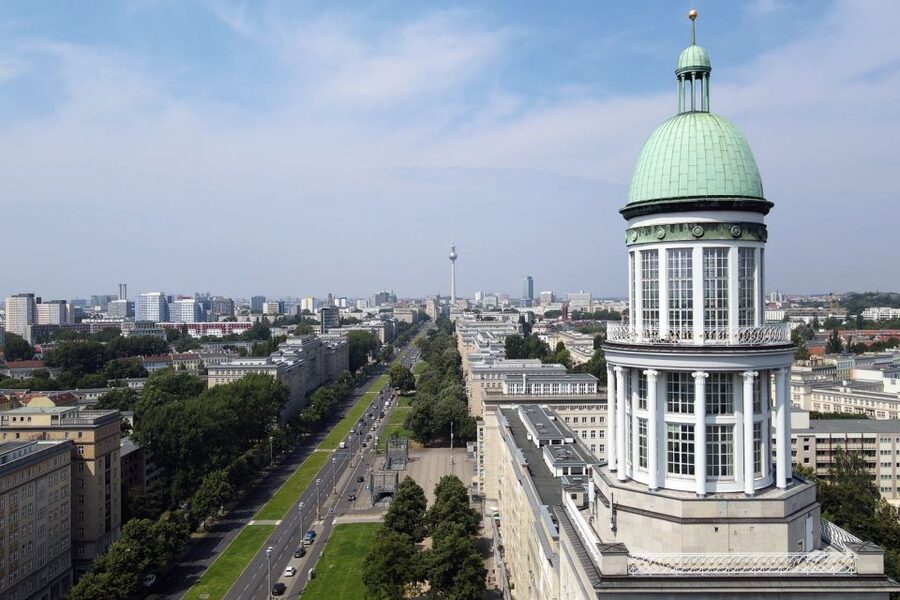
- Frankfurter Tor’s twin towers provide the tour’s most memorable architectural view and mark one of Berlin’s finest examples of socialist-era city planning.
- Karl-Marx-Allee changed names three times, moving from Frankfurter Allee to Stalinallee and finally to Karl-Marx-Allee.
- Arcaded apartment buildings show how everyday housing was given a grand, ceremonial appearance.
- The Kosmos cinema, designed by Josef Kaiser, adds culture and public entertainment to the boulevard’s story.
- Hochhaus an der Weberweise and the ruined Church of the Resurrection reveal two very different sides of post-war Berlin.
- Strausberger Platz functioned as a gateway to the socialist city center and gives the walk a strong sense of arrival.
Why Karl-Marx-Allee tells Berlin’s post-war story so well
You may come to Berlin expecting its best-known history to be found at the Berlin Wall, Museum Island, or Checkpoint Charlie. Karl-Marx-Allee offers a different lesson. Here, politics is written into the width of the road, the height of the buildings, the repeated arches, and the carefully planned views.
The boulevard runs for almost two kilometers and is described as the largest monument in Berlin. That size matters. This is not a single memorial or isolated building. It is a whole urban project, designed to express a new social order through architecture.
The street first carried the name Frankfurter Allee. It later became Stalinallee and was renamed Karl-Marx-Allee. Those changes are more than a naming footnote. They reflect shifting political priorities in East Germany and give your guide a useful way to explain how the boulevard changed meaning over time.
I find this kind of context far more useful than a list of dates. You can look at the same building as a grand promise of modern housing, a symbol of state power, or a surviving piece of East Berlin. The tour helps you hold all three ideas at once.
A few more Berlin half-days to weigh up
- Berlin: Third Reich and Cold War 2 Hour Walking Tour
★ 4.9 · 6,830 reviews - Berlin’s Best: 2 Hour Walking Tour Third Reich and the Cold War
★ 5.0 · 5,486 reviews - Berlin: 2-Hour Lake Oberhavel Cruise from Tegel
★ 4.4 · 577 reviews
Frankfurter Tor and the boulevard’s grand opening view
Frankfurter Tor is the architectural high point of the walk. Its distinctive towers create a strong visual gateway and are among the most recognizable features along Karl-Marx-Allee.
Take time here to look up and then back along the avenue. The towers do not work only as separate buildings. They frame the road and help establish the boulevard’s sense of scale. The planners wanted the approach to feel formal and impressive, not like an ordinary residential street.
This is a good place to ask your guide about the difference between a street designed for daily use and one designed to represent a government’s ideals. Karl-Marx-Allee had apartments, shops, cultural buildings, and public spaces, but it also had a ceremonial quality that made private life feel part of a much larger public statement.
The towers are especially useful for visitors who do not normally study architecture. You do not need to know technical terms to see the repeated shapes, the symmetry, and the deliberate framing of the road. A guide can point out details you might pass without a second thought.
Friedrichshain’s arcaded apartments and planned daily life
As you continue through Friedrichshain, the apartment buildings become the main subject. Their arcades give the blocks a formal, almost palace-like appearance, yet their original purpose was ordinary housing.
That contrast is one of the most interesting parts of Karl-Marx-Allee. The buildings were intended for residents, not just for official ceremonies or visiting dignitaries. Their grand design suggested that workers deserved impressive homes and that the new socialist city could provide a dignified setting for daily life.
The arcades also change the experience at street level. Instead of seeing a continuous wall of apartments, you see a repeated sequence of columns and sheltered walkways. This creates rhythm along the boulevard and helps connect the large buildings to pedestrians.
Your guide can make these details easier to understand by showing how the housing fits into the larger plan. Look for the relationship between the buildings, the broad roadway, and the open spaces. The point was not simply to construct apartments quickly. The street was meant to function as a complete urban setting.
One limitation is that the walk focuses on the exterior cityscape. You should not expect a general apartment tour or a visit inside private homes. The value comes from reading the façades, public spaces, and surviving design features with someone who knows what to point out.
The Kosmos cinema and culture on a socialist boulevard
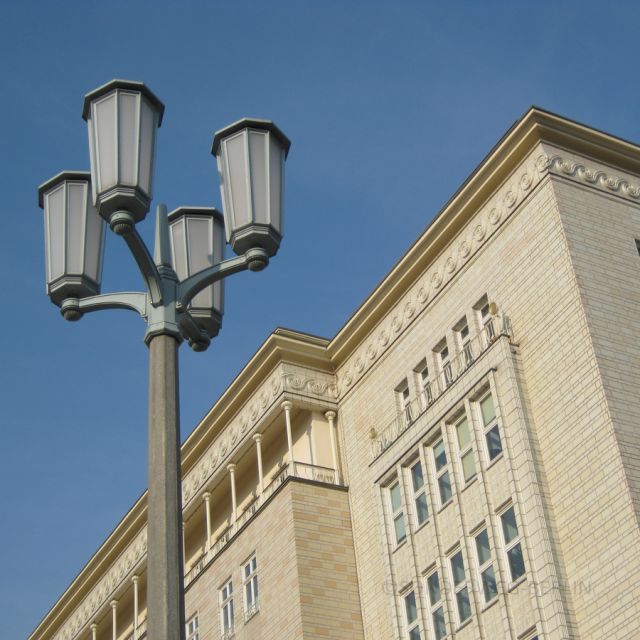
The Kosmos cinema, designed by Josef Kaiser, adds a welcome change of pace. Karl-Marx-Allee is often reduced to government architecture and monumental housing, but the cinema shows how entertainment and public culture were built into the plan.
A cinema is a useful stop because it makes the boulevard feel lived in. Housing alone can look severe. A cultural building suggests an attempt to create a full social center where people could live, meet, and spend their free time.
Josef Kaiser’s design gives the tour another architectural voice. You are not looking only at one repeated style across the whole avenue. The buildings work together, but individual structures also had their own roles and visual character.
This is where old photos or posters can make a real difference. Tobias, one of the guides associated with this experience, has used historical images, old posters, and lesser-seen details to bring the area into clearer focus. Those materials help you compare the street as it looks now with the public image it once projected.
If you are interested in film, design, or East German culture, the Kosmos stop may be one of the most useful parts of the walk. If your main interest is medieval Berlin or Prussian history, you may find the subject more specialized than expected.
Same city, a completely different sort of afternoon:
- Berlin: Reichstag, Dome and Government District Guided Tour
★ 4.7 · 18,288 reviews - Berlin: 1-Hour City Tour by Boat with Guaranteed Seating
★ 4.3 · 16,993 reviews - Berlin: Boat Tour Along the River Spree
★ 4.4 · 11,252 reviews - Discover Berlin Half-Day Walking Tour
★ 5.0 · 9,624 reviews
Hochhaus an der Weberweise and the changing face of housing
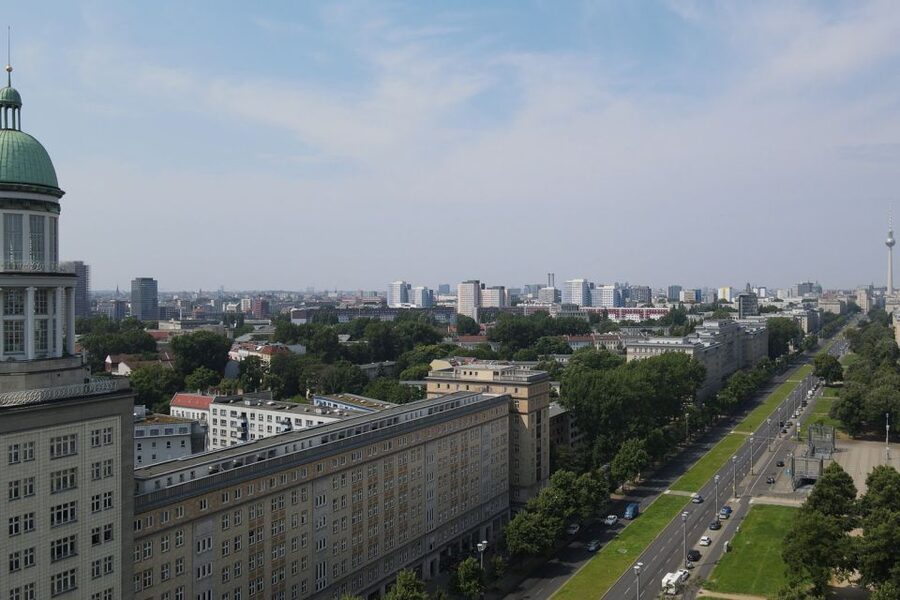
The high-rise building known as Hochhaus an der Weberweise gives you another angle on Berlin’s post-war building program. Its vertical form differs from the long arcaded blocks, so it helps show that Karl-Marx-Allee was not created in one single architectural gesture.
The building is worth considering in relation to the rest of the route. Large boulevard blocks offer a strong horizontal presence, while the high-rise reaches upward and acts as a visual marker. Together, these forms reveal how planners used height, repetition, and open space to shape movement through the district.
This stop also helps explain why the boulevard can feel both residential and monumental. A high-rise is practical in one sense, since it places more homes on a smaller footprint. Yet its position and visibility also give it a role in the public image of the area.
Your guide may use old photographs to show how much the surroundings have changed. Such comparisons are especially useful here because a building can survive while its political meaning shifts. You are looking at the same structure, but not necessarily the same city.
The Church of the Resurrection, where the past survives in fragments
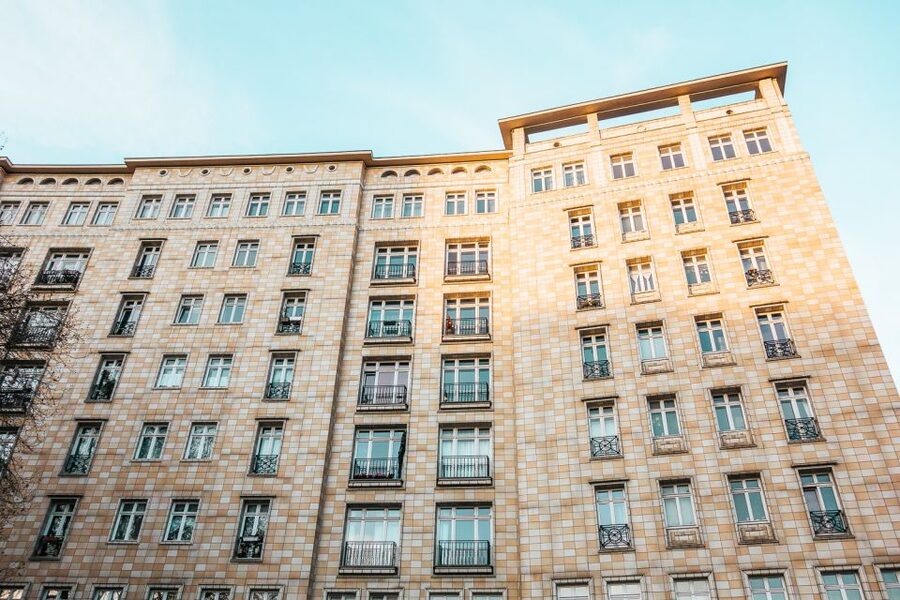
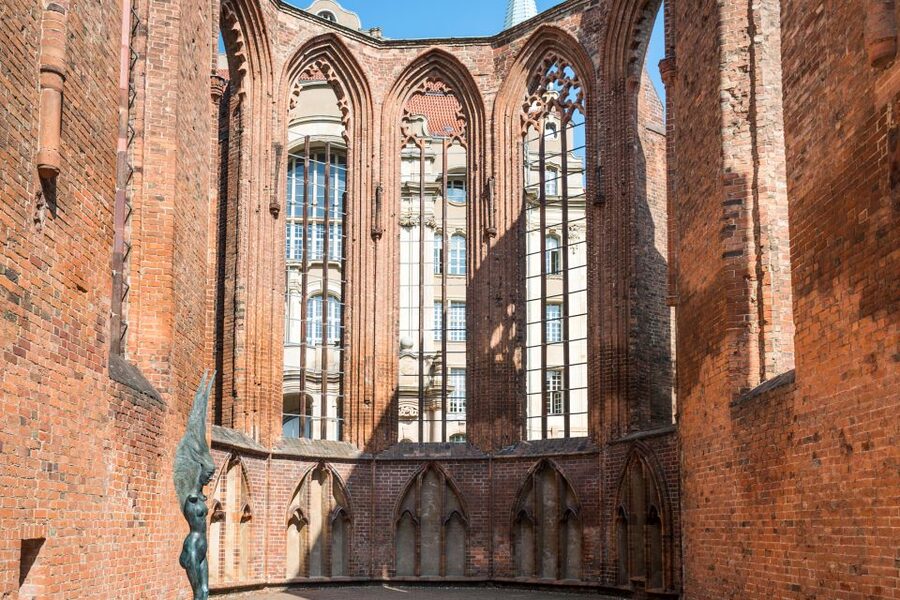
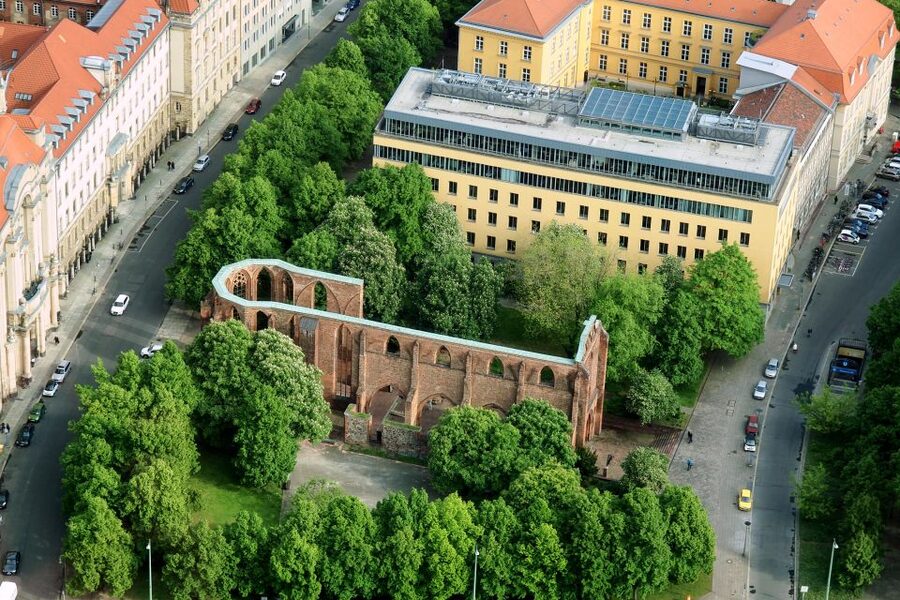
The partial ruins of the Church of the Resurrection bring a more complicated note to the tour. Unlike the carefully planned apartment blocks, the church represents damage and survival.
Its incomplete condition makes the history visible in a direct way. You do not need a museum label to understand that the city was broken and rebuilt in stages. The ruins interrupt the polished geometry of Karl-Marx-Allee and remind you that the boulevard was created in a city marked by war.
This is also a useful point for keeping the tour balanced. Karl-Marx-Allee can look like a confident display of a new political era, but the Church of the Resurrection shows what that new city was built around and over. The route is not only about socialist architecture. It is also about loss, rebuilding, and decisions about which parts of the past remain.
Do not expect a long stop inside a church complex. The information provided describes partial ruins, so think of this as a brief but meaningful visual counterpoint to the grand avenue. The guide’s explanation is important because the remains may not be self-explanatory.
Strausberger Platz and the gateway to the socialist city center
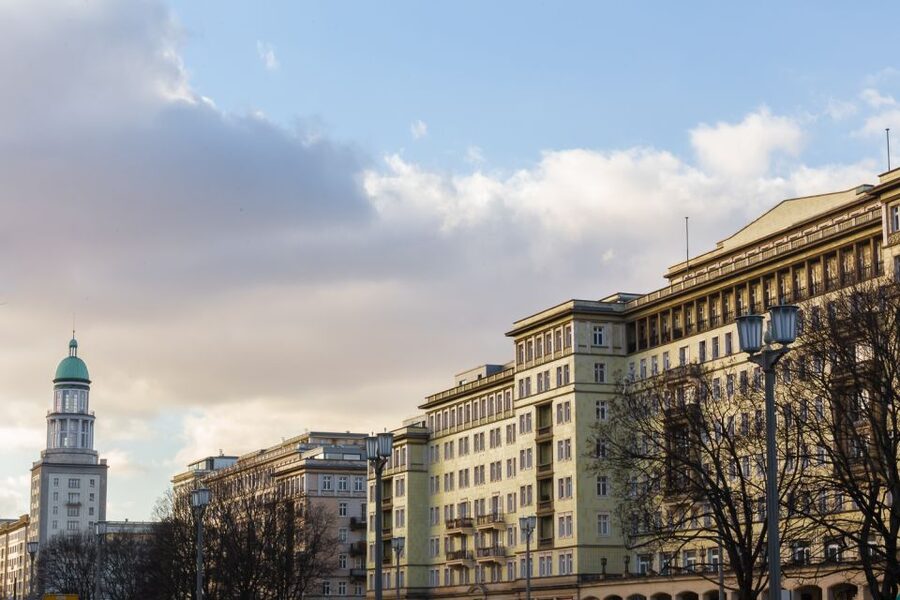
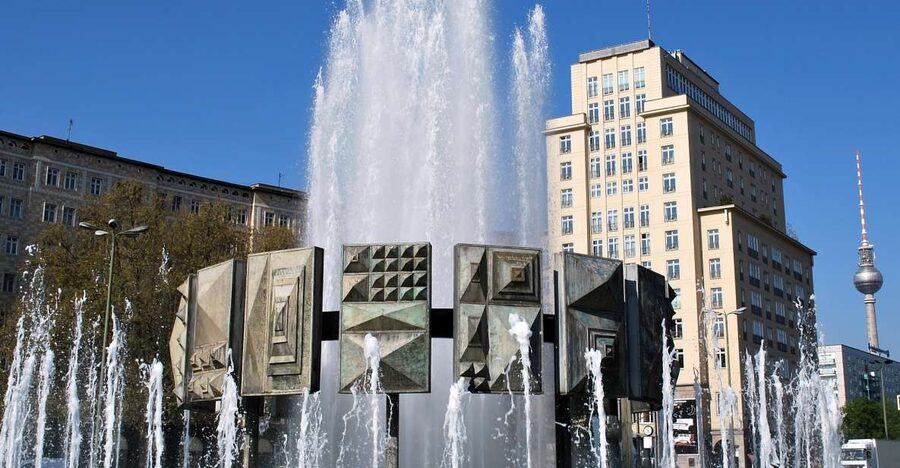
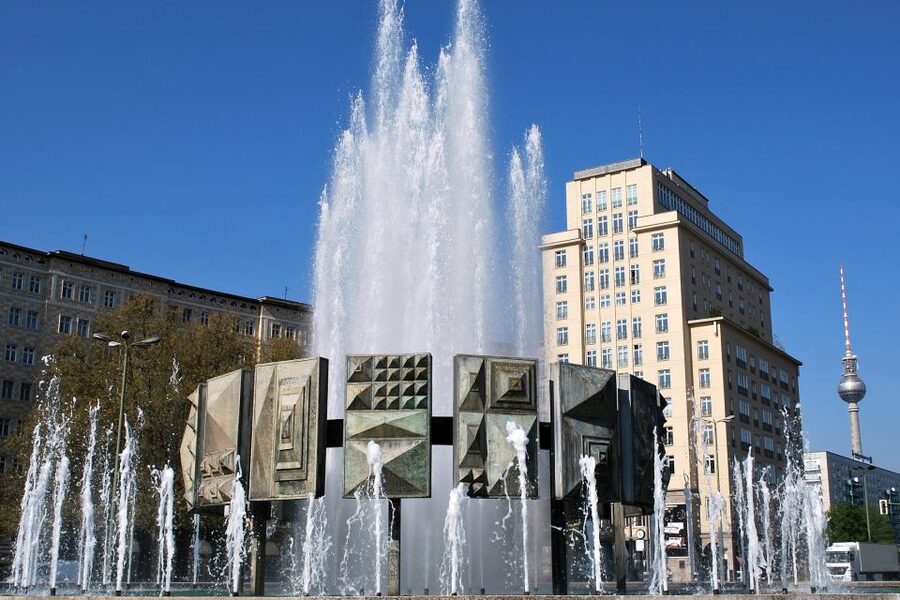
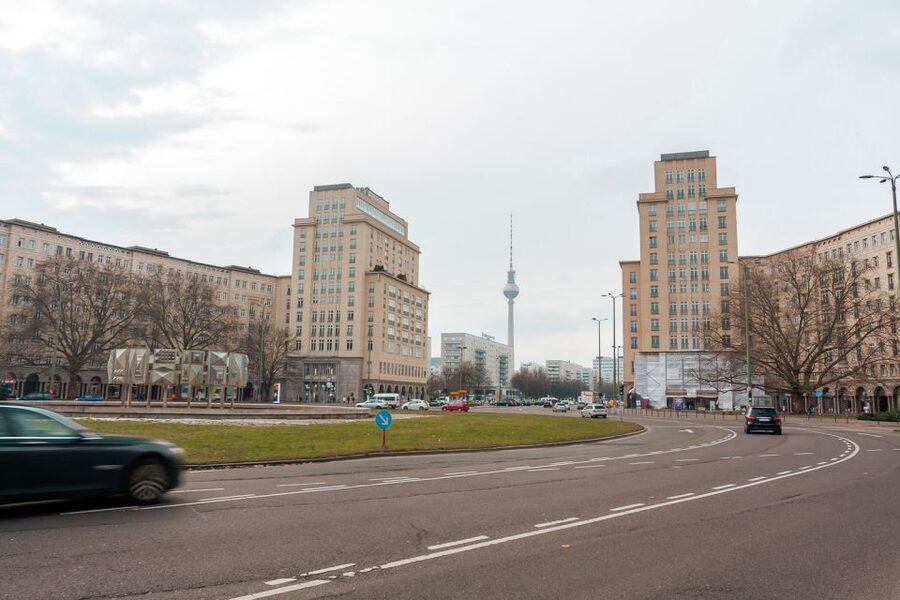
Strausberger Platz gives the walk a natural sense of movement and purpose. Its distinctive high-rise buildings served as a gateway to the socialist city center, making the square more than a wide intersection.
Look at how the buildings shape the space around the plaza. The square acts as a transition between parts of the boulevard, and its high-rises help create a formal approach. This is urban design used almost like stage scenery, with the buildings guiding your eye and giving the route a clear endpoint or turning point.
For me, this is where the separate stops begin to make sense as one project. Frankfurter Tor provides a dramatic entry, the apartment blocks create the long central stretch, the cinema adds public culture, and Strausberger Platz gives the route a ceremonial threshold.
The square is also a good place to think about the difference between a real neighborhood and an idealized city plan. The buildings were designed to express order and collective purpose. Modern Berlin, of course, is more layered and less controlled. That tension is part of what makes the walk interesting.
What the two-hour format does well
Two hours is a sensible length for this subject. Karl-Marx-Allee is long, and a walk covering its key buildings could easily become tiring if every architectural detail received equal attention.
The compact format gives you a clear route and enough time for explanation without turning the experience into a full-day architecture seminar. You will see the principal landmarks, hear the street’s name changes, and gain a basic understanding of post-war urban planning.
The guide is the reason this works better than simply following a map. The route includes details, old posters, historical photographs, and less obvious parts of the area that you might miss alone. A strong guide can also explain why a building matters rather than merely identifying it.
Tobias has been praised for being communicative, passionate, and engaging. That matters on a walk where the buildings can initially appear repetitive. The best version of this tour turns façades into evidence and keeps the story moving.
Still, the time limit requires choices. You may not get a detailed account of every side street, individual apartment block, or later change to the district. If you want an exhaustive architectural survey, look for a longer specialist program. If you want a focused introduction, two hours is enough.
Price, language, and practical planning
At $23 per person, this is good value if you care about history, architecture, or Berlin’s divided past. You are paying for a walking tour and a live expert guide, not for transportation or hotel pickup. That keeps the price modest, but it also means you must reach the meeting point yourself.
The meeting point can vary with the option booked, so check your confirmation carefully before setting out. Build in enough time to reach it, since a late arrival can be awkward when the group has already begun walking.
Tours are offered in German and English. Choose the language in which you can follow historical explanations comfortably, especially if architecture is new to you. The details are the point here, and missing a few explanations can make the large buildings feel less connected.
Wear comfortable shoes. This is a two-hour walking tour along a broad boulevard, with stops at several separate sites. Since hotel pickup and drop-off are not included, plan this as an independent part of your Berlin day.
You can cancel up to 24 hours before the activity for a full refund, and the reserve-now, pay-later option keeps your plans flexible. Those terms are useful if your Berlin schedule is still shifting.
Who should book the Karl-Marx-Allee walk
I would recommend this tour to anyone who wants Berlin beyond the standard wall and Cold War checkpoints. It suits visitors who enjoy architecture, urban planning, twentieth-century history, or the way politics shapes ordinary streets.
It is also a good choice if you prefer a clear story to an open-ended neighborhood stroll. The route has a strong structure, and each stop adds something different: monumental towers, housing, cinema, high-rise design, ruins, and a formal square.
Families with older children may find the changing street names and dramatic buildings easier to grasp than a long museum display. The walk also gives visual variety, which helps keep the subject from feeling like a lecture.
I would think twice if your main goal is to enter historic interiors, shop, or see Berlin’s oldest architecture. This is an exterior-focused tour about a specific period and district. Its appeal depends on your interest in the built environment and East Germany’s urban story.
Should you book it?
Book it if you want to understand why Karl-Marx-Allee looks the way it does, rather than simply photographing Frankfurter Tor and moving on. For $23, you get a focused two-hour walk, a live guide in German or English, and a practical introduction to one of Berlin’s largest planned monuments.
The strongest reasons to go are the well-shaped route, the mix of famous and less obvious sites, and the guide’s use of historical photos, posters, and local details. Tobias has led particularly engaging walks, though the guide may vary by departure.
Skip it only if socialist-era architecture is not your interest or if you need a tour with hotel transportation. For everyone else, this is a useful way to read Berlin’s post-war city plan with fresh eyes.
FAQ
How long is the Karl-Marx-Allee tour?
The walking tour lasts two hours.
What language is the tour offered in?
Live tours are available in German and English.
What does the tour include?
The price includes the walking tour and an expert guide.
Is hotel pickup and drop-off included?
No. Hotel pickup and drop-off are not included.
Where does the tour meet?
The meeting point may vary depending on the option you book. Check the details for your selected departure.
What places will I see?
The route includes Frankfurter Tor, the arcaded apartment buildings in Friedrichshain, the Kosmos cinema, Karl-Marx-Allee, Hochhaus an der Weberweise, the partial ruins of the Church of the Resurrection, and Strausberger Platz.
Can I cancel for a full refund?
Yes. You can cancel up to 24 hours in advance for a full refund.
Just added around Berlin
- Berlin: Battle for Seelow Heights WW2 tour -Clash of Titans★ 5.0 · 27 reviews
- From Berlin: Gardens & Palaces of Potsdam Bike Tour★ 5.0 · 61 reviews
- From Berlin: Historical Gems of Potsdam Private Day Trip★ 4.4 · 4 reviews
- Berlin: Französischer Dom 360° Panorama & Crémant to go★ 3.9 · 5 reviews
- Explore Berlin Tour: History and Highlights★ 4.7 · 5 reviews
- Berlin: Evening Yacht Cruise with Aperitif & Dinner Upgrade★ 4.6 · 178 reviews
- Berlin: Expats in Berlin Comedy Show Ticket★ 4.7 · 182 reviews
- Berlin: The Epic Comedy Club Friday Night Showcase★ 4.8 · 28 reviews
Berlin Tours, compared.
Reichstag, Dome and Government District Guided Tour
Read our review →
1-Hour City Tour by Boat with Guaranteed Seating
Read our review →
Reichstag, Plenary Chamber, Cupola & Government Tour
Read our review →
Browse the lists this tour appears in