
Review · BERLIN TOURS
Charité Hospital Walking Tour: Exploring Berlin’s Medical History
Charité’s story is not only about doctors and discoveries. It is also about power, ethics, war, dictatorship, and the ordinary people caught inside them. This two-hour walking tour links monuments, old academic buildings, and the hospital campus in a compact route through Berlin’s medical past.
I like the small group of up to 15 because the guide can give the sites proper attention, and I like the range of subjects, from Robert Koch’s laboratory breakthroughs to escape attempts across the canal during the socialist era. The main drawback is clear: you do not visit working clinical or university buildings, so this is an outdoor history walk rather than a hospital museum tour.
Key points to know before you book
- Robert Koch’s monument opens the story: Learn how Charité began in the 18th century and hear about Koch’s work on tuberculosis, anthrax, and cholera.
- The route covers more than medicine: Nazi-era abuses, social medicine, Cold War escape attempts, and hospital life after reunification are all part of the walk.
- Tieranatomisches Theater is a special stop: This surviving 18th-century academic building shows how animal diseases were studied before modern medical science.
- The tour stays short and focused: Six stops take about 20 minutes each, making it useful when you have limited time in Berlin.
- You see the Charité campus from outside: Clinical and university buildings are not open for touring during this experience.
- The price is moderate for a guided city walk: At $30.12 per person, the value depends on how much you want interpretation rather than entry to interiors.
Why Charité tells a bigger Berlin story
Charité is the oldest hospital in Berlin, and its history gives you a useful way to read the city. Medical progress did not happen in a quiet vacuum. It took place under monarchies, amid scientific rivalries, through two world wars, during Nazi rule, and on opposite sides of a divided Berlin.
That is what makes this walk more interesting than a simple parade of statues. You move from scientific breakthroughs to social medicine, then to the misuse of medicine under the Third Reich and the daily realities of a hospital in East Berlin.
I like this structure because each stop adds a different kind of context. The tour does not ask you to remember a long list of dates. Instead, it connects people and places to questions about how medicine works, who receives care, and what happens when science serves politics.
The format also suits Berlin’s large and sometimes scattered history. You remain on foot, but the route is compact enough to finish in about two hours. Each of the six main stops receives roughly 20 minutes, so you get a clear explanation without committing half a day.
More history-led days in Berlin:
- Berlin: Natural History Museum Entrance Ticket
★ 4.6 · 3,382 reviews - Berlin: World Heritage Cruise to Potsdam
★ 4.5 · 1,435 reviews - Berlin Historical Highlights Walking Tour
★ 4.9 · 657 reviews
Robert Koch Denkmal and the birth of Charité
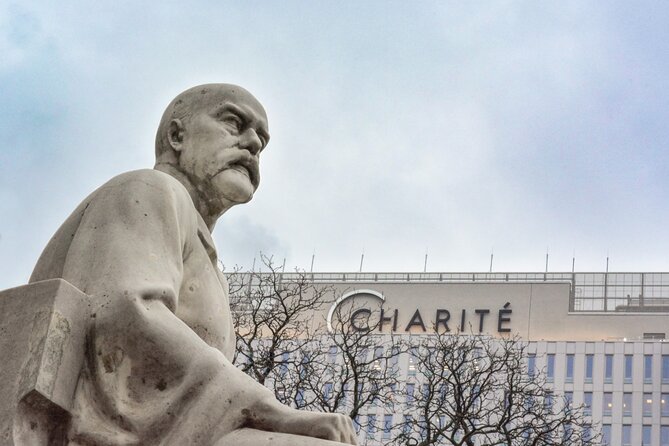
Begin at Robert-Koch-Platz, where the tour starts beside the monument to Robert Koch. This is a useful opening because it introduces both the hospital and one of the key figures in modern medical research.
You learn why Charité was established in the 18th century and how it became part of Berlin’s medical identity. The monument then brings the conversation forward to Koch, who won the Nobel Prize and identified the causes of tuberculosis, anthrax, and cholera.
That list alone gives you a sense of the stakes. These diseases caused serious illness and death before researchers could identify their sources and develop more effective ways to study them. The guide’s job here is to turn a formal monument into a human story about discovery, reputation, and consequences.
Koch’s career also includes what is described as the first pharmaceutical scandal in medical history. That detail keeps the stop from becoming a simple celebration of a famous scientist. You get both the breakthrough and the warning that medical progress can carry ethical problems.
The monument itself is free to view, as are all the outdoor stops on this tour. You are paying for the guide’s interpretation, not admission. If you already know a great deal about Koch, this first stop may feel familiar, but the scandal and Charité’s founding story add useful angles.
Tieranatomisches Theater, an 18th-century classroom
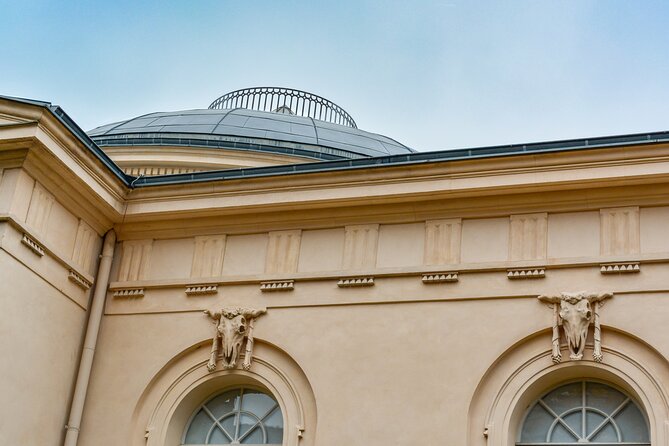
Next comes the Tieranatomisches Theater, the oldest surviving academic building in Berlin. Its neoclassical design gives the walk a change of mood after the monument.
This building was tied to veterinary study, and the guide explains how animal diseases were treated before medicine became a science based on systematic research. That makes the stop especially useful if you want to understand how medical education developed, rather than simply hear about famous doctors.
The building’s name may sound theatrical, and its academic setting helps you picture an earlier form of teaching. You can expect the emphasis to be on the stories connected to the building and on older methods of treating disease. The tour does not include entry into buildings where clinical or university work takes place, so confirm your expectations before booking.
I find this stop valuable because it supplies a before-and-after comparison. Koch’s work makes more sense once you have considered a period when doctors and veterinarians had fewer scientific tools. It also reminds you that medical history includes animal health and training, not only hospitals and human patients.
Rudolf Virchow and medicine for society
The monument to Rudolf Virchow shifts the focus from individual disease to the wider conditions that shape health. Virchow is presented as the father of modern pathology and the founder of social medicine.
Pathology examines disease through the body and its tissues. Social medicine asks a broader question: how do living conditions, poverty, public policy, and society affect health? That combination gives this stop a practical edge.
You will hear about Virchow as a scientist, but the subject also points toward a more public idea of medicine. A hospital does not exist apart from the city around it. Cleanliness, housing, access to care, and government decisions can matter as much as a doctor’s treatment.
This is one place where the guide’s storytelling matters. A monument can offer only a name and a face unless someone explains why the person still matters. The supplied feedback describes the guide as a good storyteller who connects medical history with current issues. Virchow is the clearest point on the route for that kind of link.
If you prefer famous buildings to ideas, this stop may feel less visual. Its value comes from the explanation and from seeing how Charité’s story reaches beyond laboratories and operating rooms.
More walking tours in Berlin:
- Discover Berlin Half-Day Walking Tour
★ 5.0 · 9,624 reviews - Berlin: Third Reich and Cold War 2 Hour Walking Tour
★ 4.9 · 6,830 reviews - Berlin: Discover Berlin Walking Tour
★ 4.9 · 5,998 reviews - Berlin’s Best: 2 Hour Walking Tour Third Reich and the Cold War
★ 5.0 · 5,486 reviews
Albrecht von Graefe and the progress of eye care
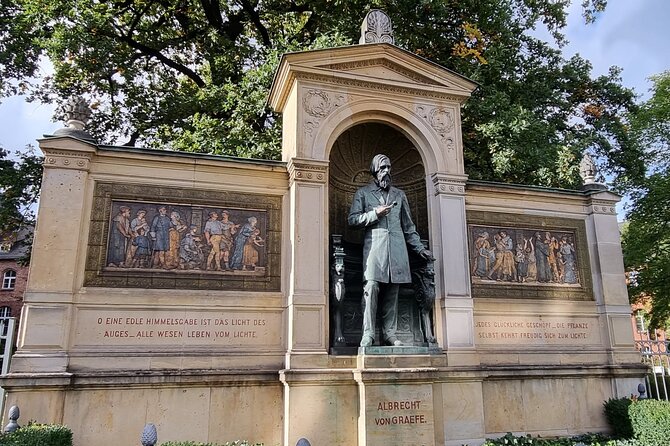
The next monument honors Albrecht von Graefe, a pioneering ophthalmologist. You also see the first monument in Berlin dedicated to a scientist.
That fact gives the stop a second subject. It is not only about von Graefe’s work with the eyes. It also shows how Berlin gradually began to publicly honor scientific figures, not just military leaders, rulers, or artists.
The tour gives you the basic story of von Graefe and his importance in ophthalmology. Since the stop lasts about 20 minutes, expect a focused explanation rather than a full account of eye medicine.
I like the way this monument broadens the route. Koch represents laboratory discovery, Virchow represents pathology and social medicine, and von Graefe represents a specialized medical field. Together, they show that modern medicine grew through many branches of work.
This stop is also easy to fit into a busy day. You are not spending hours inside a museum with a large collection. Instead, you get a short account tied to a specific place, then continue along the route.
Charité Campus Mitte and medicine under dictatorship
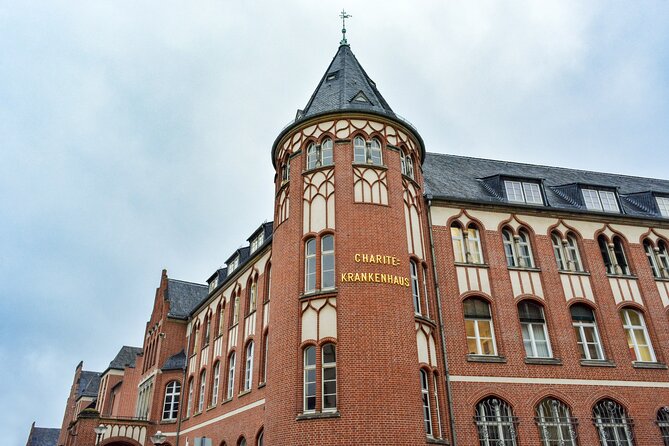
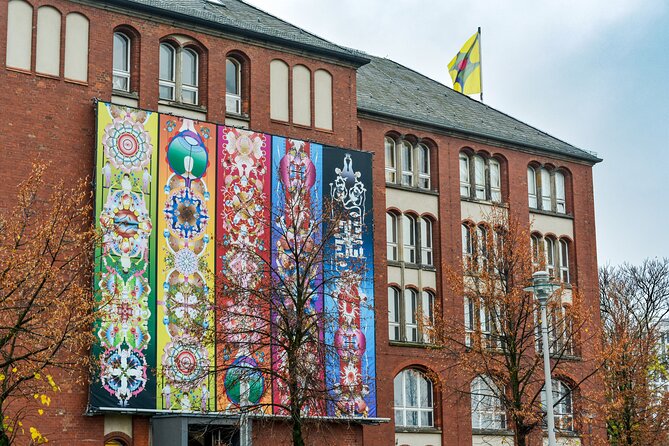
The Charité Campus Mitte is likely the most visually striking section of the walk. You see its neogothic red-brick buildings and learn how the hospital operated through one of the darkest periods in German history.
The guide addresses doctors who abused medicine during the Third Reich. You also hear about others who helped people without discrimination until the final days of the Second World War.
This is difficult material, but it is essential. A tour of medical history should not present science as automatically humane. Doctors can heal, but professional status and scientific authority can also be used to harm when ethical limits collapse.
The value here is the contrast between individual choices. Some medical workers took part in abuse. Others continued to help people despite the political system around them. The campus becomes more than an attractive collection of old brick buildings. It becomes a place where professional duty and personal courage had real consequences.
The tour does not claim that everyone at Charité behaved in the same way. That balance matters. You get a more honest account by hearing about both complicity and resistance.
Because the buildings remain tied to clinical and university operations, you view the campus from outside. The red-brick architecture gives you something concrete to look at, while the guide supplies the context that an independent walk would probably miss.
The canal, East Berlin, and escape attempts
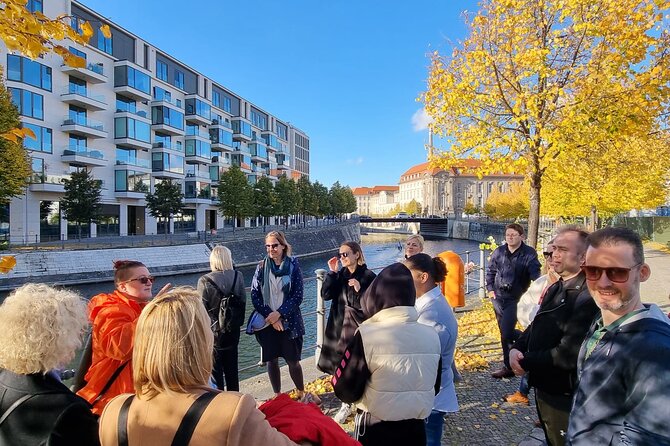
The final stop is near the Humboldthafen canal, ending at Alexanderufer. From here, you hear about East Berliners who tried to swim across the canal to reach the West.
That story changes the scale of the tour again. Earlier stops focus on scientific figures and institutional choices. Here, the focus is on people trying to change their lives under a divided political system, with Charité nearby as part of the setting.
You also hear about hospital life during the socialist period and after the Berlin Wall fell. This gives the closing section a useful time span. The story does not end with the war. It continues through East Germany, reunification, and the hospital’s later role in a changed Berlin.
The tour ends beside the canal, about a 10-minute walk from Berlin Central Station. That makes the finish practical if you are continuing to another part of the city or catching a train. The route starts at Robert-Koch-Platz and ends at Alexanderufer, so you should not expect to return to the starting point.
This last stop may be especially worthwhile for anyone interested in Berlin’s Cold War history. It also helps connect medical institutions to the city’s political divisions. Charité was not isolated from the wall, the border, or the lives of people living nearby.
What $30.12 buys you
The price is $30.12 per person. All fees and taxes are included, and the guide is included. There are no separate admission charges for the six listed outdoor stops.
At first glance, that is more than the cost of walking around the area on your own. The difference is that you receive a prepared route and a guide who can explain why each monument matters. If you would otherwise read about Koch, Virchow, von Graefe, the Nazi period, and East Berlin separately, the tour saves research time and puts the subjects in one clear sequence.
The value is strongest if you enjoy history but do not want a long museum visit. It is also useful if you have only a short window in Berlin. Two hours gives you a substantial subject without taking over your day.
The value is weaker if you expect to enter Charité’s buildings, see hospital collections, or visit active clinical areas. That is not included. You are buying interpretation and access to the outdoor route, not an interior hospital tour.
The maximum group size is 15. That is small enough to keep the walk more personal than a large city excursion, while still being a group experience rather than a private tour. The tour is offered in English and uses a mobile ticket.
Timing, weather, and who should book
The walk lasts about two hours and is offered in English. Since the route is outdoors, good weather is required. If poor weather forces cancellation, you are offered another date or a full refund.
You can cancel for a full refund up to 24 hours before the start time. That policy gives you some flexibility, but changes made less than 24 hours before the tour are not accepted and the payment is not refunded.
Most people can take part, and service animals are allowed. The route is near public transportation, with the start at Robert-Koch-Platz and the finish near the central station and Humboldthafen canal.
I would choose this for you if you like medical history, science, Berlin’s political past, or tours that examine difficult moral questions. It also suits you if you prefer a short guided walk to a full museum program.
I would not make it your first choice if your main goal is to tour hospital interiors or see medical instruments and displays. The experience is about places, monuments, and storytelling from outside.
Should you book the Charité Hospital Walking Tour?
Book it if you want a focused look at Berlin through medicine. The best parts are the unusual mix of subjects: Koch’s discoveries, Virchow’s social medicine, von Graefe’s eye care, Nazi-era medical abuse, and Cold War escape attempts.
At $30.12, the tour makes sense when you value a guide who can connect those subjects and bring current issues into the conversation. The strong rating and full recommendation fit the experience’s main strength: a well-told, serious walk that does not require a full day.
Skip it if you need indoor access or a conventional hospital museum. For everyone else, this is a compact way to see a less familiar side of Berlin, with enough history to keep the two hours moving and enough difficult questions to stay with you afterward.
FAQ
Where does the Charité Hospital Walking Tour start?
The tour starts at Robert-Koch-Platz, 10115 Berlin, Germany.
Where does the tour end?
It ends at Alexanderufer, 10117 Berlin, beside the Humboldthafen canal.
How far is the ending from Berlin Central Station?
The ending point is about a 10-minute walk from Berlin Central Station.
How long does the tour last?
The tour lasts approximately two hours.
Is the tour offered in English?
Yes. The tour is offered in English.
What is included in the price?
The price includes the guide, all fees, and all taxes.
Are building interiors included?
No. You do not visit buildings where clinical or university operations take place.
How many people can join the tour?
The maximum group size is 15 people.
Is a mobile ticket available?
Yes. The experience provides a mobile ticket.
Can I cancel for a full refund?
Yes. You can cancel at least 24 hours before the start time for a full refund. Changes or cancellations made less than 24 hours before the start time are not accepted for a refund.
Just added around Berlin
- eSIM for Germany and 34 European Countries★ 4.5 · 16 reviews
- Your ticket to The Wall Museum Berlin★ 3.0 · 60 reviews
- Walking on the Wall: 3-Hour Tour in Berlin★ 4.5 · 34 reviews
- Rickshaw Tours Berlin – Groups of up to 16 people with several rickshaws★ 4.0 · 97 reviews
- Warnemuende Shore Excursion: Private Berlin Tour★ 4.5 · 27 reviews
- Love and War in Berlin: Self-Guided Story Puzzle Walk★ 5.0 · 7 reviews
- Warnemuende Shore Excursion: Berlin Private Sightseeing Tour from Rostock★ 5.0 · 4 reviews
- Karl-Marx-Allee Tour: Life and Architecture in East Berlin★ 5.0 · 19 reviews
Berlin Tours, compared.

Reichstag, Dome and Government District Guided Tour
Read our review →
1-Hour City Tour by Boat with Guaranteed Seating
Read our review →




Reichstag, Plenary Chamber, Cupola & Government Tour
Read our review →
Browse the lists this tour appears in