
Review · BERLIN TOURS
Private Berlin: Iconic Sights and Hidden Gems Walking Tour
Berlin is easiest to understand when you connect the grand monuments with the painful places tucked between them. This private walk does exactly that, linking the Brandenburg Gate and Reichstag with Hitler’s bunker site, the Berlin Wall, Checkpoint Charlie, and the moving memorials that explain what happened here.
I like the one-to-one format, which lets you ask questions without holding up a large group. I also like the hotel pickup and drop-off, especially on a first day when Berlin’s wide streets and scattered sights can feel confusing. The main drawback is price: at $192.97 per person, this is a serious spend, and three or four hours is not enough to explore every stop in depth.
Key points to know before booking
- A private route shaped around you: Ask for WWII history, Cold War Berlin, architecture, art, or lesser-known courtyards.
- A strong first-day orientation: You can cover major sights spread across central Berlin without wasting time finding the meeting point.
- Serious historical subjects: Expect clear discussion of Hitler, the Nazi regime, the Holocaust, the Wall, and life under division.
- Guide quality matters: Past tours have been led by guides including Tina, Xavier, Daniel, Ariel, Will, Rebecca, and Rohan.
- The 4-hour option gives you breathing room: Choose it if you want more questions, more context, or a route tailored to a special interest.
- It is still a walking tour: Hotel transfers help with arrival and departure, but you should be ready to walk between sites.
Why a private Berlin walk can be worth the cost
Berlin’s sights are not arranged like a tidy museum exhibit. One important place may be a grand square, the next a bare patch of pavement, a preserved wall segment, or a glass panel set into the ground. Without context, you can easily take a picture and miss the point.
A private guide helps tie these places together. You can ask why the Brandenburg Gate mattered during the Cold War, how the Nazi regime used public spaces, or what the Wall meant to ordinary Berliners. That conversation is the real value of the tour.
The cost is easiest to justify for a small group. If two, three, or four people are sharing the experience, the price buys personal attention and a flexible route rather than a fixed group schedule. Solo visitors may find the per-person cost harder to defend, particularly if they already know Berlin or plan to visit museums independently.
You choose between roughly three and four hours. The shorter option is a good introduction for a first day in town. The longer version is better if you want to focus on a theme, accommodate a slower pace, or make time for questions.
The guides have different styles, so your booking request matters. Tina is described as animated and good at offering local suggestions. Xavier has been praised for explaining difficult subjects clearly to both children and adults. Daniel, Ariel, Will, Rebecca, Rohan, and others have also led tours with an emphasis on stories, visual aids, humor, or specialist interests.
More walking tours in Berlin:
- Discover Berlin Half-Day Walking Tour
★ 5.0 · 9,624 reviews - Berlin: Third Reich and Cold War 2 Hour Walking Tour
★ 4.9 · 6,830 reviews - Berlin: Discover Berlin Walking Tour
★ 4.9 · 5,998 reviews
Starting at your hotel and finding your Berlin bearings
The guide meets you in the lobby of your central Berlin hotel. That small convenience has real value. You do not need to decode a meeting-point map, find a particular train exit, or wonder if you are waiting on the correct side of a busy street.
Several departure times are offered, and the tour ends with a hotel drop-off. The experience is conducted in English, and only your group takes part. That makes it easier to pause, ask questions, or change the pace.
Tell the company what you care about when booking. A WWII enthusiast might want the tour built around the Third Reich and the final days of the war. Another group might prefer architecture, Jewish history, the Cold War, or Berlin’s changing neighborhoods. One guide, Ronja, adjusted the pace for a person with limited walking ability, so it is sensible to explain mobility needs in advance.
The itinerary includes many possible stops, but three or four hours will not allow a full visit to every site. Ask which places are planned for your chosen duration. This is especially important if you want both the Berlin Wall Memorial and East Side Gallery, since they are different experiences and are not next door to each other.
Brandenburg Gate and the political heart of Berlin
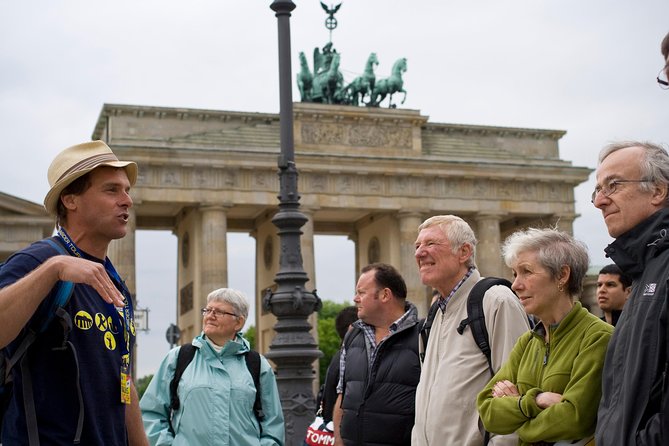
The Brandenburg Gate is the natural opening chapter. Set on Pariser Platz, this neoclassical arch is topped by the Quadriga, a chariot drawn by four horses. It began as a royal entrance, but its meaning changed sharply as Berlin passed through empire, dictatorship, war, division, and reunification.
Your guide can explain why the gate became a symbol of separation during the Cold War and why it now represents German unity. The surrounding square also helps you get your bearings. You are near several major government and memorial sites, including the Reichstag and the Memorial to the Murdered Jews of Europe.
The listed stop is about 10 minutes and has no admission charge. That means this is mainly an explanation and photo stop, not a long architectural visit. Go early in the tour with a few questions ready, since the gate provides useful context for nearly everything that follows.
Hitler’s bunker site and the difficult work of remembering
The Führerbunker site is deliberately understated. The bunker once lay beneath the grounds of the Reich Chancellery, where Hitler spent his final days as Soviet forces closed in on Berlin. Today, there is no dramatic entrance to explore. The location is largely unmarked, with a small plaque identifying its historical importance.
That plain setting is part of the point. You are not being offered a theatrical Nazi attraction. Instead, a guide can place the site within the final phase of the war and explain how Berlin confronted, or failed to confront, the physical remains of the Nazi regime.
The stop lasts around nine minutes. It is short, but the subject is heavy. If you want a detailed account of the bunker, the war’s final weeks, or Nazi government buildings, request that focus when you book. The value here comes from explanation rather than what you can see.
The Memorial to the Murdered Jews of Europe adds another layer. Its field of concrete stelae is designed for reflection, not a quick checklist stop. The tour can help you understand the memorial’s place in modern Berlin and the need to remember the victims without turning the visit into spectacle.
A few more Berlin half-days to weigh up
- Berlin: Reichstag, Dome and Government District Guided Tour
★ 4.7 · 18,288 reviews - Berlin: 1-Hour City Tour by Boat with Guaranteed Seating
★ 4.3 · 16,993 reviews - Berlin: Boat Tour Along the River Spree
★ 4.4 · 11,252 reviews - Berlin: Hop-on Hop-off Bus Tour with Live Commentary
★ 4.3 · 8,579 reviews
Reichstag, Bebelplatz, and the cost of political power
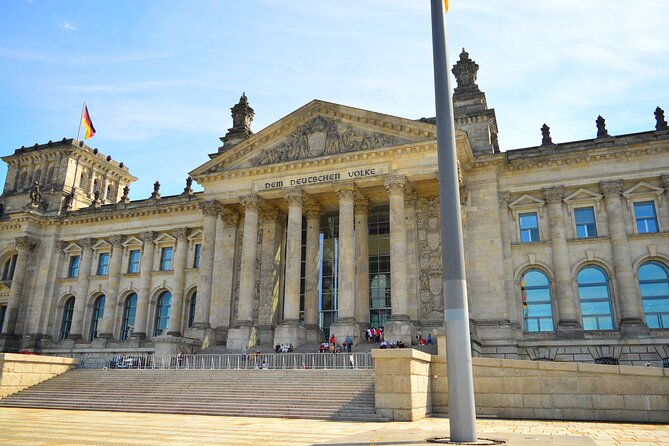
The Reichstag Building brings the story forward to Germany’s present government. Completed in 1894, it once housed the parliament of the German Empire. The 1933 fire became a major event in the Nazi seizure of power, and the damaged building later became a symbol of Germany’s broken political order.
The restored building is now home to the Bundestag. Its glass dome, designed by Norman Foster, represents openness and allows visitors to look down toward the parliamentary chamber while taking in views across Berlin.
The tour stop is listed at about 10 minutes and does not include an admission ticket. Treat it as an exterior visit unless your booking specifically confirms entry. The dome requires its own visitor arrangements, so do not assume that a walking tour stop includes access inside.
Bebelplatz offers a quieter but equally serious lesson. In May 1933, Nazi supporters and students burned more than 20,000 books here, including works by writers such as Einstein, Freud, and Marx. The Empty Library memorial, visible through a glass panel in the pavement, shows empty shelves below ground.
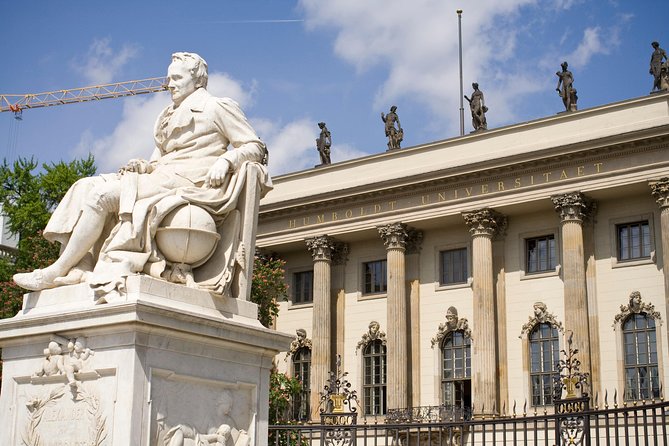
This is one of Berlin’s most effective memorials because it asks you to picture what has been destroyed. The stop takes about 12 minutes. It also sits among the State Opera House, St. Hedwig’s Cathedral, and Humboldt University, so your guide can connect censorship with the square’s cultural and academic identity.
Checkpoint Charlie and the everyday reality of a divided city
Checkpoint Charlie is famous, but the site can surprise you. It is a busy central location with a replica guardhouse and plenty of photo opportunities, yet the visible remains do not convey the full force of the former border.
That is where your guide earns the fee. You can learn how the crossing operated, why it became the best-known route between East and West Berlin, and what happened to people who tried to escape. The stop is around 15 minutes and free to visit from the outside.
I would not make Checkpoint Charlie your only Wall stop. Its symbolic importance is huge, but the preserved structures and exhibits at the Berlin Wall Memorial offer a more grounded sense of how the border cut through homes, streets, and families.
Bernauer Strasse and the Berlin Wall Memorial
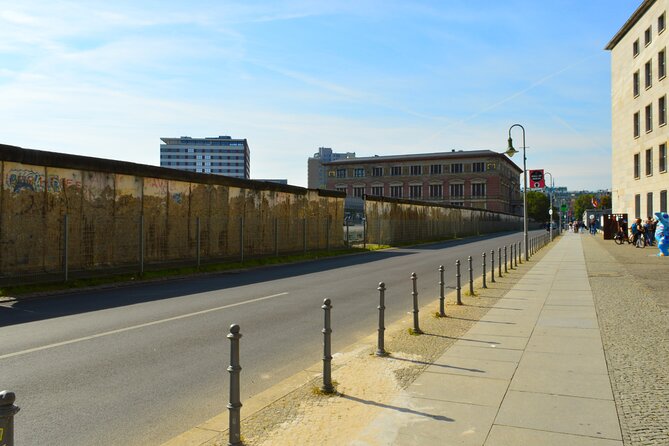
At Bernauer Strasse, the Berlin Wall Memorial gives you a clearer picture of the border system. You can see a preserved section of Wall, the former border strip, and displays that explain how the division affected daily life.
Personal accounts and photographs focus on escape attempts and the human cost of the Wall. The site is not simply a piece of concrete. It shows how a political boundary became a physical barrier, complete with surveillance and deadly consequences.
The planned visit is about 30 minutes. That is enough for an introduction, but not a full museum visit. If Cold War history is your priority, choose the four-hour tour and ask for extra time here. The site has more to explain than a quick photograph suggests.
The Wall Memorial is also one of the better places to ask questions about East and West Berlin. A guide can help you understand the difference between a border crossing, a memorial, and a surviving stretch of Wall. Those distinctions matter, especially if this is your first visit.
East Side Gallery turns division into public art
The East Side Gallery is a different kind of Wall experience. This 1.3-kilometer stretch of remaining Wall carries more than 100 murals painted after the Wall fell in 1989.
The best-known image is the Fraternal Kiss, showing Soviet leader Leonid Brezhnev and East German leader Erich Honecker in a famous embrace. Other murals express hope, freedom, and political change. Together, they show how artists transformed a structure built to divide people into a public canvas.
The planned stop is about 20 minutes, so you will see only a portion of the gallery. That is fine for a first look, but art lovers may want to return on their own. The murals are exposed to weather and repeated restoration, so the gallery is best understood as changing public art rather than a perfectly preserved monument.
If you want both Bernauer Strasse and East Side Gallery, tell your guide. They serve different purposes, and fitting both into a short walking route may require compromises.
Gendarmenmarkt and Unter den Linden show another Berlin
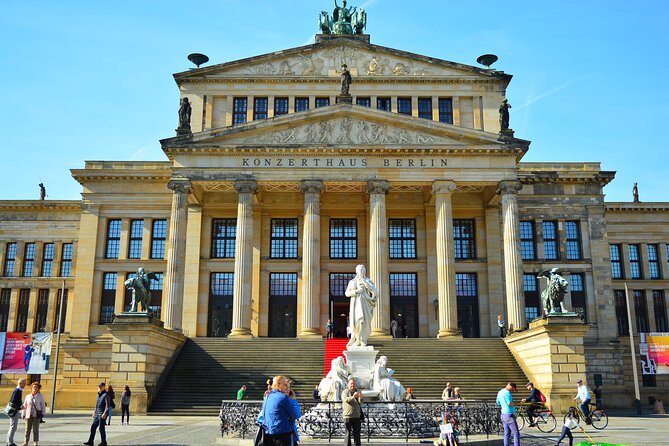
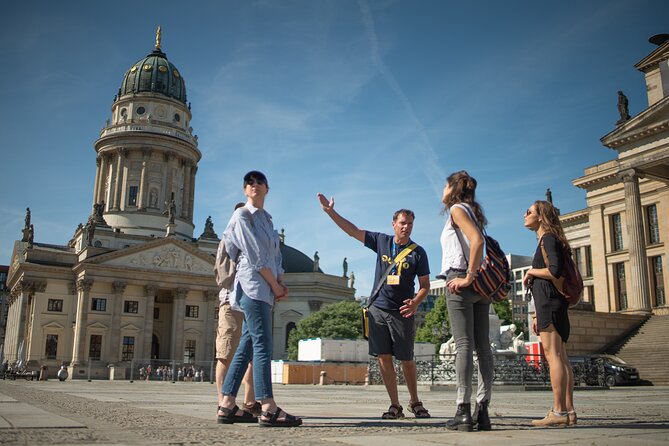
Gendarmenmarkt offers a welcome change of mood. The square is framed by the French Cathedral, German Cathedral, and Konzerthaus. Its neoclassical design and central location make it one of Berlin’s most elegant public spaces.
A 10-minute stop gives you time to take in the architecture and hear how the square developed as a cultural and civic center. Cafés and seasonal events add life, but the buildings are the main attraction.
Unter den Linden may also be included. This boulevard runs through Mitte and links several central landmarks. It is useful for seeing how Berlin’s imperial, academic, and political centers sit close together. The exact amount of time here depends on your chosen route.
These stops matter because Berlin is not only memorials and ruins. The city also has grand avenues, concert halls, churches, universities, and government buildings. A good guide shows how the attractive surface and the difficult past occupy the same few blocks.
Museum Island and the Berlin Cathedral
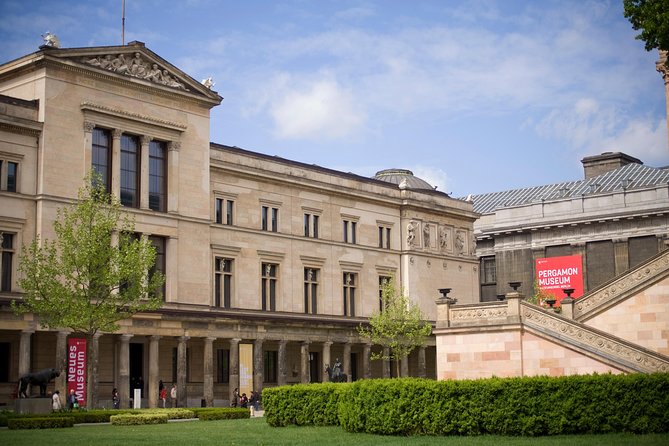
Museum Island sits in the Spree and forms one of Berlin’s major cultural centers. The tour includes about 15 minutes here, usually enough for exterior views, photographs, and an explanation of the island’s role in the city.
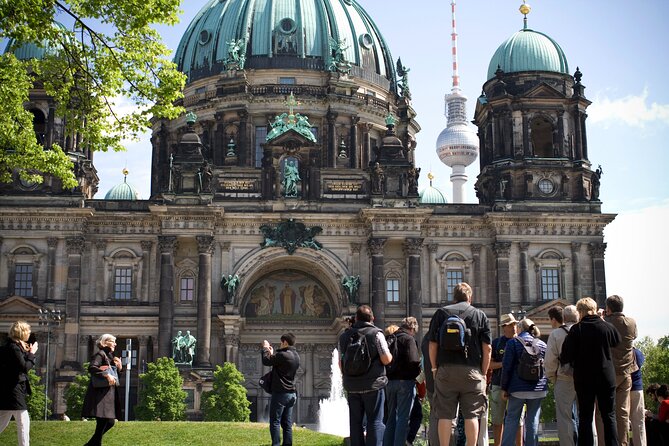
The Berlin Cathedral, or Berliner Dom, dominates the area with its large Baroque dome. Completed in 1905, it is a Protestant cathedral with a decorated interior, mosaics, an impressive organ, and a dome walkway offering broad views over Berlin.
The listed stop is about 10 minutes and has no admission included. If you want to enter the cathedral or climb the dome, ask whether that can fit your private route and plan for an additional ticket if required. A short exterior visit and a full cathedral visit are very different uses of time.
Museum Island is also a good place to request a museum-focused follow-up plan. The walking tour does not include food, drinks, or museum admissions, so you should treat it as an orientation rather than a substitute for a museum day.
Hackescher Höfe brings in Berlin’s creative side
Hackescher Höfe is the most obvious change of pace on this route. The complex contains eight connected courtyards with Art Nouveau details, tilework, wrought iron, shops, galleries, restaurants, theaters, and a cinema.
The courtyards were designed as a mixed-use development, combining homes, businesses, and creative spaces. Today, they provide a look at the social and architectural side of Mitte that major political monuments cannot offer.
The visit lasts about 20 minutes. That is enough to walk through several courtyards and get suggestions for returning later. If you want shopping or a meal, do not squeeze it into the tour. Use the guide’s recommendations, then come back when you have time.
This is also where the phrase hidden gems would be tempting, but the better description is simply lesser-known corners of central Berlin. You get a sense of how the city works between the headline monuments.
Pace, walking demands, and guide style
The walk is designed for most people, but it covers a lot of ground. Some stops are close together, while others are spread across central Berlin. Wear comfortable shoes, and tell the company about mobility limits before the day begins.
The private format gives you control over pauses and questions. Ronja adjusted a tour for limited walking ability, while other guides have used photographs and visual aids to clarify historical events. That flexibility is more useful than a fixed script.
The subject matter can be emotionally demanding. You will discuss Nazi persecution, the Holocaust, war, censorship, escape attempts, and political repression. Guides such as Rebecca have been praised for presenting WWII history in a way that makes specific places and moments easier to understand. A guide such as Will may add humor and personal warmth, but the tone should still respect the material.
Families can make this work, too. Xavier has been described as clear and patient with children and adults. Ask for age-appropriate explanations if younger members of your group are joining.
Price, timing, and cancellation details
At $192.97 per person, this is not a budget walk. I would compare it with the cost of separate group tours, taxi rides between distant sights, and the value of having a private historian for three or four hours.
It is strongest for a small group with limited time, a shared interest, or a need for a custom pace. It is less compelling if you want museum entry, long interior visits, food, or a low-cost overview.
The price includes a professional guide, private walking tour, and hotel pickup and drop-off. Food, drinks, and admissions are not included. Free cancellation is available up to 24 hours before the start time. Changes or cancellations inside that window are not refunded, so be careful with flight connections and tight schedules.
Should you book this Berlin walking tour?
Book it if you want Berlin’s major sights explained as part of one connected story, rather than visited as isolated photo stops. It is especially useful on your first day, for families, for small groups, and for anyone with a clear interest in WWII, the Cold War, architecture, or Berlin’s changing neighborhoods.
Choose four hours if you want a slower pace or several special requests. Choose three hours if you need a sharp orientation and plan to return to the places that interest you most.
I would book only after sending a focused request. Ask which stops will receive real time, whether the route includes the Wall Memorial or East Side Gallery, and whether any interior entry is planned. With the right guide and a clear theme, this can be an efficient and thoughtful introduction to Berlin. If you expect to see every site listed in detail, the short format and premium price may disappoint.
FAQ
How long is the private Berlin walking tour?
You can choose a tour lasting approximately three or four hours.
What language is the tour offered in?
The tour is offered in English.
Where does the tour begin?
The guide meets you in the lobby of your central Berlin hotel.
Does the tour include hotel transportation?
Yes. Hotel pickup and drop-off are included.
Is this a private tour?
Yes. Only your group participates in the activity.
What sights can the tour include?
Possible sights include the Brandenburg Gate, Berlin Wall Memorial, Checkpoint Charlie, Gendarmenmarkt, Führerbunker site, Reichstag, East Side Gallery, Museum Island, Berliner Dom, Bebelplatz, Hackescher Höfe, Kaiser Wilhelm Memorial Church, the East German Government Quarter, and Unter den Linden.
Can I request specific attractions?
Yes. You should include your preferred sights and interests when booking because the tour is customized.
Are food, drinks, and admission tickets included?
No. Food, drinks, and admission tickets are not included.
Can I cancel for a full refund?
Yes, if you cancel at least 24 hours before the experience starts. Cancellations or changes made less than 24 hours in advance are not refunded.
Just added around Berlin
- eSIM for Germany and 34 European Countries★ 4.5 · 16 reviews
- Your ticket to The Wall Museum Berlin★ 3.0 · 60 reviews
- Walking on the Wall: 3-Hour Tour in Berlin★ 4.5 · 34 reviews
- Rickshaw Tours Berlin – Groups of up to 16 people with several rickshaws★ 4.0 · 97 reviews
- Warnemuende Shore Excursion: Private Berlin Tour★ 4.5 · 27 reviews
- Love and War in Berlin: Self-Guided Story Puzzle Walk★ 5.0 · 7 reviews
- Warnemuende Shore Excursion: Berlin Private Sightseeing Tour from Rostock★ 5.0 · 4 reviews
- Cold War Berlin – Private Live Virtual Experience★ 5.0 · 4 reviews
Berlin Tours, compared.

Reichstag, Dome and Government District Guided Tour
Read our review →
1-Hour City Tour by Boat with Guaranteed Seating
Read our review →




Reichstag, Plenary Chamber, Cupola & Government Tour
Read our review →