
Review · NUREMBERG TOURS
Nuremberg: WWII Tour, Courtroom 600 and 3rd Reich Sites
Nuremberg’s Nazi rally grounds are so vast that seeing them on foot alone can leave you with more questions than answers. This four-hour tour connects the scattered sites by vehicle, then puts you inside Courtroom 600, where the International Military Tribunal tried leading Nazi war criminals.
I like the small group size, limited to eight people, and the way guides such as Rob, Sheba, and Robson bring old photographs into the present-day setting. I also like the hotel pickup and drop-off, which saves time in a city where the rally grounds and Palace of Justice are not next door to each other.
The main drawback is time at the Palace of Justice. You may reach Courtroom 600 with only about 45 minutes left, so this is a guided overview rather than a leisurely museum visit. The courthouse is also closed on Tuesdays.
Key points to know before booking
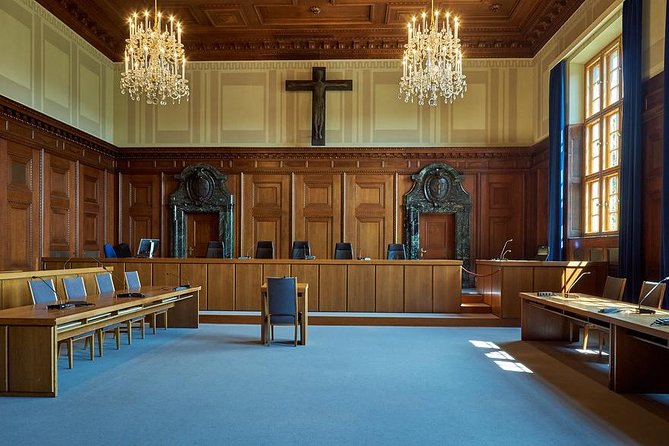
- Courtroom 600 is the emotional centerpiece: You purchase the €7.50 Palace of Justice ticket separately and explore the courtroom and exhibition on your own.
- The tour covers several large Nazi-era sites: Luitpoldhain, Große Straße, Congress Hall, and Zeppelin Field are spread across southeastern Nuremberg.
- Small groups make the history easier to follow: The van holds no more than eight participants, leaving room for questions and conversation.
- Period photographs add useful context: Guides compare the present-day sites with images from the Nazi era.
- Hotel pickup and return simplify the morning: Pickup is outside your accommodation in Nuremberg, with transport between locations.
- Avoid Tuesday: Both the Palace of Justice and Courtroom 600 are closed that day.
Why Nuremberg’s Nazi sites need a guided visit
Nuremberg is often introduced through its medieval old town, but southeast of the center lies a very different chapter. The Nazi Party selected the city for huge rallies and grand construction plans intended to project power, order, and permanence.
The surviving structures are impressive in size, but they do not always explain themselves. A broad parade road can look like an empty strip of pavement. A half-finished building can seem merely odd. Your guide gives these places their political purpose and shows how the architecture was designed to overwhelm ordinary people.
I find that especially useful at the rally grounds. The scale is hard to grasp from a single photograph. Once you are standing near the enormous Congress Hall or looking across Zeppelin Field, the physical ambition of the regime becomes clear. The point was not comfort or practical city planning. It was spectacle.
This tour also avoids treating the sites as simple curiosities. The subject is difficult, and the best parts are the moments when your guide connects the structures to propaganda, mass gatherings, and the later legal reckoning. Guides are reported as energetic and personable, but one practical note matters: Rob, who leads many departures, can speak quickly. If you need a slower pace, say so early.
More WWII History Tours in Nuremberg
- Nuremberg: Walking Tour of Former Nazi Party Rally Grounds
★ 4.7 · 1,665 reviews - Nuremberg: Historischer Kunstbunker WWII Art Bunker Tour
★ 4.8 · 921 reviews - Nuremberg Old Town and Nazi Party Rally Grounds Walking Tour in English
★ 4.5 · 504 reviews
The vehicle transfer makes the four-hour schedule work
The experience begins with pickup outside your Nuremberg accommodation. A comfortable vehicle takes you toward the first sites, and you continue between stops by vehicle rather than trying to cover the entire area on foot.
That matters. The rally grounds occupy a large area, and the tour includes several stops with guided explanations, photo pauses, and walking. A listed one hour of bus or coach transport gives you a break between sites and lets you see more in four hours than a purely walking tour could manage.
The group limit of eight is another practical advantage. You are not trying to hear a guide across a large crowd, and the format leaves room for questions. One departure had only a single participant because of an unexpected change, while another had four groups in the van. That flexibility can make the experience feel more like a private history lesson than a standard coach outing.
Transport is highly praised, with an emphasis on clean vehicles and careful driving. That is not the main reason to book a WWII tour, but it matters when the schedule includes several stops and a return to your accommodation.
Luitpoldhain: the first sense of Nazi scale
The first substantial stop is Luitpoldhain, also called the Luitpold Arena area. You have about 30 minutes with your guide here.
The site was used as a dramatic setting for Nazi Party gatherings. Today, the open space gives you a clear sense of how the regime used crowds, ceremony, and carefully arranged surroundings to create political theatre. The contrast between the quiet modern setting and the purpose it once served can be unsettling.
This is a place where period photographs are particularly helpful. Your guide can point out how the area looked during rallies and explain what the structures and open ground were meant to achieve. Without those comparisons, much of the original staging is difficult to picture.
You will walk here, so sensible shoes are useful. The tour is not described as strenuous, but the sites are open and expansive. In wet or cold weather, your comfort will depend more on clothing than on the vehicle.
Große Straße and the machinery of spectacle
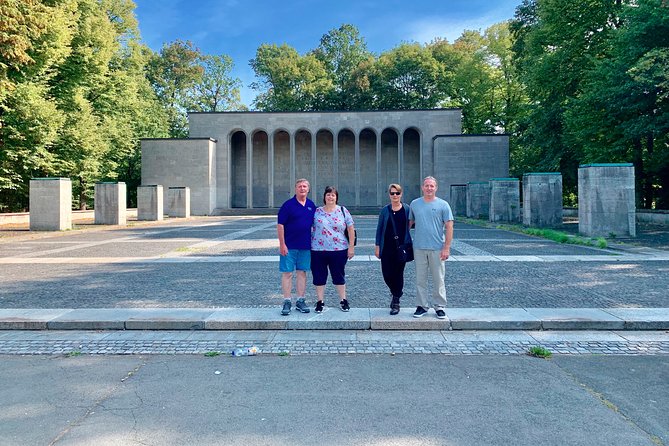
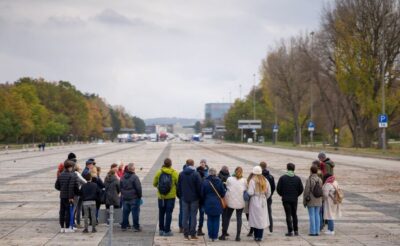
The next stop is Große Straße, with roughly 30 minutes of guided time. This long ceremonial road was planned for party events and mass formations.
I like this stop because it shows that Nazi architecture was not limited to monumental buildings. Roads, sightlines, open spaces, and the movement of people were all part of the design. The goal was to direct attention and turn political gatherings into carefully controlled displays.
Your guide’s explanation is important here. The road itself may not look dramatic in isolation, but its proportions and intended use become clearer when set beside historic images. The tour’s method is consistent: visit the modern site, then compare it with the past.
Do not expect a long independent walk at each location. The schedule gives you enough time to understand the site and take photographs, but not enough to wander without a clock in mind. If you want detailed architectural study, you may prefer to return independently after the tour.
More wartime history tours in Nuremberg:
- Nuremberg Old Town and Nazi Rally Grounds Walking Tour
★ 4.7 · 377 reviews - Nuremberg Third Reich Tour in Spanish
★ 5.0 · 355 reviews - Nuremberg: World War II Tour with Hotel Pickup
★ 4.4 · 51 reviews - Nuremberg: Tour of Former Nazi Party Rally Grounds
★ 5.0 · 43 reviews
Congress Hall: the largest surviving Nazi monumental building
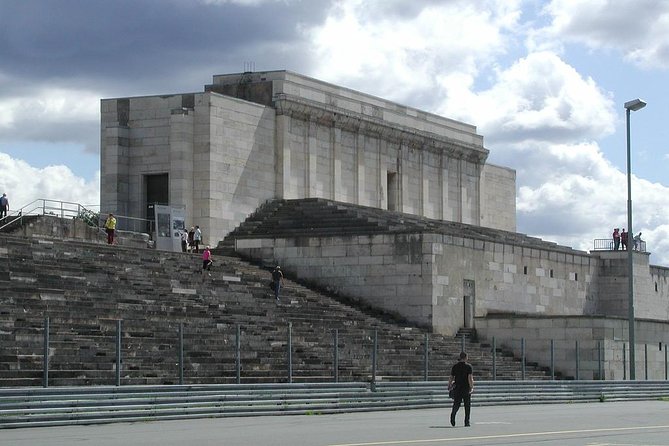
Congress Hall receives about 30 minutes and serves as both a guided visit and a photo stop. Its sheer size is the point. The building was designed as a vast party congress structure and remains the biggest preserved National Socialist monumental building in Nuremberg.
The unfinished condition is part of what makes it so powerful. You see an enormous structure that was meant to project permanence and authority, yet the project was never completed as planned. The result is an architectural warning about political ambition as much as a historic site.
The tour description refers to an architectural pun at the Documentation Center Nazi Party Rally Grounds. That refers to the modern museum’s design, which cuts into the old Congress Hall with a sharp glass-and-steel passage. The contrast is deliberate: a contemporary institution of research and education interrupts the old monument instead of simply presenting it as an impressive relic.
You pass the Documentation Center during the tour, but this experience does not provide a full museum visit. That distinction is important. I would not book this tour expecting several hours inside the museum. You get an explanation and a look at the building, while the main museum time is reserved for Courtroom 600 later.
One past participant wanted less time at the Documentation Center and more at Zeppelin Field. That is a fair preference, especially if you are more interested in outdoor rally architecture than museum design. The guide controls the timing, so this is not a self-paced route.
Zeppelin Field: where scale becomes personal
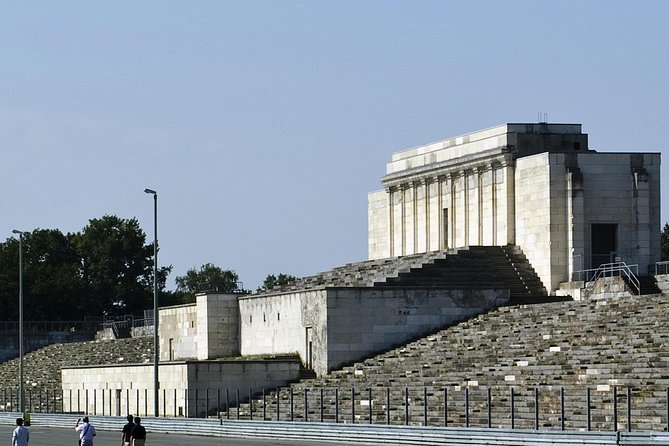
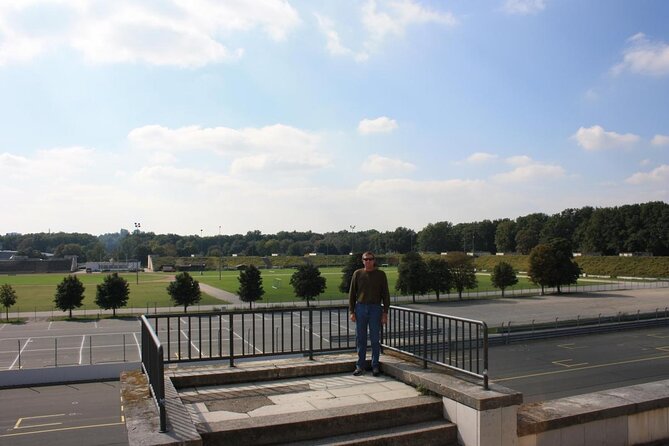
The tour allows about 40 minutes at Zeppelinfeld, including a photo stop and guided visit. Of the outdoor sites, this may be the most visually striking because the grandstand and field make the relationship between architecture and mass participation easy to see.
The empty field is not empty in historical terms. It was designed to frame rallies and place political authority at the center of a massive crowd. Your guide explains how the setting worked and uses photographs to show the ceremonies that once filled it.
You should expect a mix of standing, walking, listening, and taking photographs. Some people would gladly spend longer here, and the time can feel short if you want to study every angle. Still, 40 minutes gives the guide room to explain the site without turning the entire tour into a single-location visit.
This is also one of the clearest places to understand why a vehicle-based route has value. You see the field as part of a wider complex rather than as an isolated monument. The sequence from Luitpoldhain to Große Straße, Congress Hall, and Zeppelin Field helps you understand the planned relationship between the sites.
Courtroom 600 and the Palace of Justice
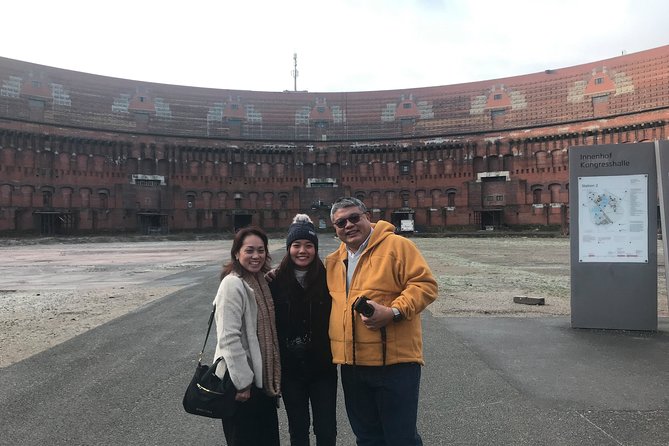
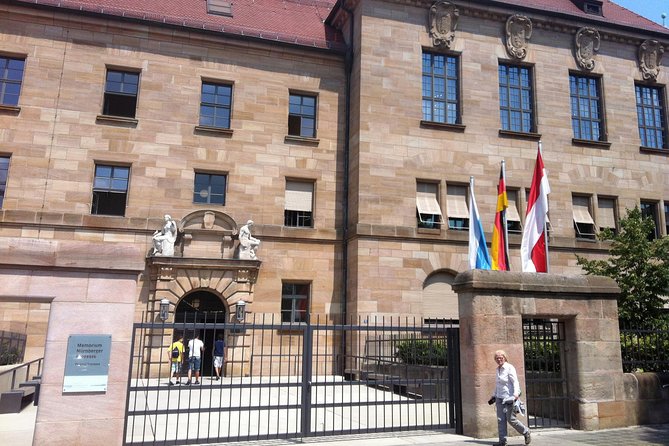
The final major stop is the Nuremberg Palace of Justice, with about 45 minutes for sightseeing and a self-guided visit. The building is where the International Military Tribunal tried major Nazi war criminals after the Second World War.
Courtroom 600 is the tour’s most important indoor stop. The courtroom itself carries a different weight from the rally grounds. Outside, you see the machinery of propaganda and mass politics. Inside, you confront the legal process that followed the crimes.
Admission is not included in the tour price. You pay €7.50 per person for the Palace of Justice and Courtroom 600. The tour information says you can skip the ticket line, but you should still allow time for entry and orientation.
Here is the main scheduling issue. Because Courtroom 600 comes at the end, the site may receive only the final 45 minutes of the four-hour experience. That is enough for a focused visit, but it may feel rushed if you want to read every exhibit carefully.
I would choose a day when the courtroom is open and treat this stop as the priority. The courthouse is closed on Tuesdays, and it may also be unavailable on certain holidays, as one Christmas departure showed. The closure is clearly stated, so check the operating day before you book.
The self-guided format gives you some freedom, but it also means the guide’s main historical explanation may finish before you have seen everything. If your main interest is the trial rather than the rally grounds, ask yourself if 45 minutes and a separate admission fee are enough. For many people, the answer will be yes because the tour also explains the sites that are harder to understand alone.
How the guides shape the experience
The strongest part of this tour is the guide-led interpretation. Rob is frequently named as the guide, while Sheba and Robson are also associated with departures. The most useful qualities are energy, clear storytelling, and the ability to connect present-day buildings with wartime photographs.
Rob is described as interactive, friendly, and passionate about the subject. He also drives between sites, so you receive both transport and commentary from the same person. That can give the tour a steady rhythm.
Language options are English, Portuguese, Spanish, and Italian. English delivery has been praised for its detail and enthusiasm, but some people found Rob’s speech fast or had difficulty with his accent. This is not a reason to reject the tour, but it is a reason to speak up. Ask for a slower pace or a repeated explanation when needed.
A good guide makes a major difference here because several locations are incomplete, altered, or visually plain. The story fills in what is no longer visible. You are not simply looking at old stone. You are learning how each space was used and why it mattered.
Is $147 a fair price?
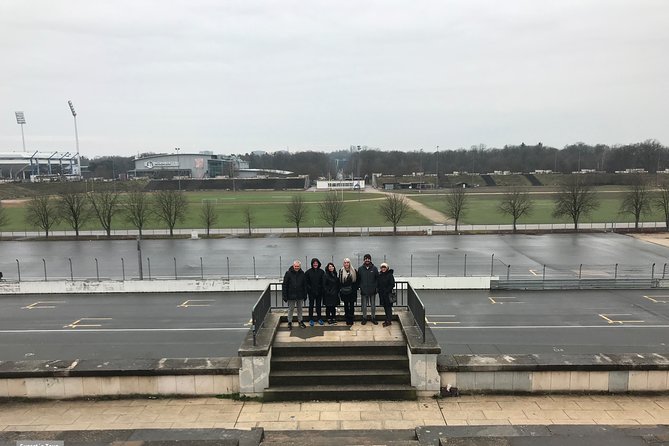
At $147 per person, this is not the cheapest way to see Nuremberg’s WWII sites. The price includes hotel pickup and drop-off, a guide, the small-group format, and vehicle transport between spread-out locations. The €7.50 Palace of Justice admission is extra.
I think the value depends on your priorities. If you want to cover the main rally grounds in one morning without navigating local transport, the cost is easier to justify. You save planning time, avoid getting lost among widely spaced sites, and receive historical context at each stop.
The price is harder to defend if you want long museum visits or extended time at one outdoor location. This is a broad introduction, not a full-day academic tour. You pay for efficient coverage and interpretation.
Free cancellation up to 24 hours ahead and the reserve-now, pay-later option reduce some booking risk. The tour is wheelchair accessible, though the open-air sites and walking portions still make it sensible to confirm any personal mobility needs before departure.
Who will get the most from this tour?
I would recommend it to anyone with a serious interest in WWII, the Nazi era, political architecture, or the Nuremberg Trials. It also suits you if you have only one morning in Nuremberg and want to see several sites without arranging transport yourself.
Families with older children may find the guided format useful, especially because the subject is heavy and needs careful explanation. The small group makes it easier to ask questions than on a large bus outing.
It is less suitable if you want a slow, quiet museum day. You move through several locations, and the timing is controlled. It may also disappoint you if Courtroom 600 is your only goal, since the final visit can feel brief.
Plan to book for a day other than Tuesday, wear comfortable shoes, and keep your schedule after the tour open if you want to return to the Documentation Center or spend more time at Zeppelin Field. The tour gives you orientation. You can then decide which site deserves a second visit.
Should you book the Nuremberg WWII tour?
Book it if you want an efficient, small-group introduction to Nuremberg’s Nazi rally grounds and Courtroom 600, especially if hotel pickup matters. The combination of Rob or another lively guide, period photographs, clean transport, and access to several large sites gives the morning real value.
Skip it if you need extensive time inside the Documentation Center or want to study Zeppelin Field at your own pace. Also avoid booking Tuesday, when the Palace of Justice and Courtroom 600 are closed.
For most history-focused visitors, I would choose a courtroom-open day and treat this as a strong first look at Nuremberg’s most difficult sites. It gives you the scale, the setting, and the legal aftermath in one tightly planned four-hour route.
FAQ
How long does the Nuremberg WWII tour last?
The tour lasts four hours, including vehicle transport, guided visits to the rally grounds, and the visit to the Palace of Justice.
What sites are included?
The route includes Luitpoldhain, Große Straße, Nuremberg Congress Hall, Zeppelin Field, the Documentation Center area, and the Nuremberg Palace of Justice with Courtroom 600 when open.
Is Courtroom 600 open every day?
No. The Palace of Justice and Courtroom 600 are closed on Tuesdays.
Is admission to Courtroom 600 included in the price?
No. The Palace of Justice entrance fee is €7.50 per person and must be paid separately.
Is hotel pickup included?
Yes. Pickup and drop-off are included from outside your accommodation in Nuremberg.
How large is the tour group?
The tour is limited to eight participants.
What languages are available?
Live guiding is available in English, Portuguese, Spanish, and Italian.
Is the tour wheelchair accessible?
Yes, the activity is listed as wheelchair accessible.
Can I cancel the booking?
You can cancel up to 24 hours in advance for a full refund. The reserve-now, pay-later option also lets you delay payment when booking.
Just added around Nuremberg
- Tour en español al Campo Zeppelin★ 5.0 · 8 reviews
- Stein: Public guided tour of the “Old Mine” museum★ 4.5 · 18 reviews
- “Rotes Bier” and “Blaue Zipfel”. A historical-culinary walk★ 4.4 · 190 reviews
- Nuremberg: Old Town Guided Tour By Bus★ 4.4 · 198 reviews
- Nürnberg kennenlernen: Highlights in der Altstadt★ 4.7 · 189 reviews
- Nürnberg Bachelor(ette) Party with Night PubCrawl★ 4.2 · 5 reviews
- Nuremberg: Bar and Club Tour with Free Shots and Free Entry★ 3.8 · 23 reviews
- Nuremberg: World War 2 History Tour with Beer Tasting★ 5.0 · 4 reviews
Nuremberg Tours, compared.
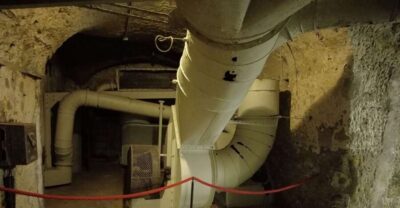
Tunnels and Secret Passages in the City Wall Tour
Read our review →
Walking Tour of Former Nazi Party Rally Grounds
Read our review →
Browse the lists this tour appears in