Review · BERLIN TOURS
Jewish Berlin Extended (private Walking tour – 5 Hours)
The most powerful part of this private walk is the way it links ordinary Berlin streets with the people who lived, worshiped, worked, protested, and suffered there. You move from the remains of an early synagogue to memorials for deportation, with guide Ariel explaining the events and people behind each place.
I like the private format, since your group can ask questions and set the pace. I also like the route’s range, especially the Otto Weidt workshop, Rosenstraße protest memorial, and Gleis 17, where the subject becomes personal rather than just a list of dates. The main drawback is time: five hours on foot, with a serious subject throughout, can feel demanding, and public transportation is not included.
Key points at a glance
- A five-hour private walk: Your group alone takes part, with space for questions and a slower explanation when a place calls for it.
- Guide Ariel’s visual storytelling: Ariel supports his explanations with illustrations and is prepared to discuss questions in detail.
- Sites rarely covered together: The route joins the Alte Synagoge remains, Hackesche Höfe, Otto Weidt’s workshop, and the Missing House.
- Rosenstraße’s protest story: You hear how non-Jewish women publicly pressed for the release of their Jewish husbands.
- Gleis 17 and deportation: Four memorials mark the railway site tied to Berlin’s deportation of Jews to camps.
- A group-value price: At $624.79 for up to 15 people, the cost makes more sense for a family or small group than for one or two people.
Why this five-hour walk matters
Jewish Berlin is not one single sight. It is spread through streets, courtyards, memorials, former workplaces, cemeteries, and railway yards. That makes a guide especially useful. Without context, you may pass a small plaque or an empty space and miss why it matters.
This tour follows a broad arc. It begins with the early Jewish community in Berlin, moves through places tied to daily life and resistance, and ends with deportation and German memory. You are not simply looking at buildings. You are asking what remains, what disappeared, and how Berlin marks both.
The private setup changes the feel of the day. You do not share the walk with a large mixed group, and the guide can spend more time on a question that matters to you. It is a good choice if you want conversation rather than a fixed speech.
At the same time, this is not a light sightseeing stroll. The subject includes persecution, deportation, and death camps. I would choose it for adults, older children who are ready for difficult material, and anyone who wants a serious look at Berlin’s Jewish past.
More walking tours in Berlin:
- Discover Berlin Half-Day Walking Tour
★ 5.0 · 9,624 reviews - Berlin: Third Reich and Cold War 2 Hour Walking Tour
★ 4.9 · 6,830 reviews - Berlin: Discover Berlin Walking Tour
★ 4.9 · 5,998 reviews
Starting at the Alte Synagoge in Berlin-Mitte
The first stop is the Denkmal Alte Synagoge Berlin-Mitte, where you see remains connected with one of Berlin’s oldest synagogues. The visit takes about 15 minutes and admission is free.
The value here is the starting point. You begin before the Nazi period, with the early development of Jewish life in Berlin. That matters because it places Jewish residents in the city’s story as citizens and community members, not only as victims of persecution.
The remains themselves are not presented as a grand intact building. You should expect a site that needs explanation, which is exactly where the guide helps. Ariel’s use of illustrations is useful at stops like this, where the present-day view may not show the full story.
Rosenstraße and the power of public protest
At Denkmal Rosenstraße, the tour spends about 15 minutes with the monument to the women’s protest. The story centers on non-Jewish women who demanded the release of their Jewish husbands from transports to the camps.
This is one of the route’s most striking stops because it shifts attention from official policy to individual courage. You hear about people who protested openly when silence might have seemed safer. The site also gives you a clear sense of how a memorial can focus on action, pressure, and family ties.
I would pay close attention here and ask questions. Fifteen minutes is enough for an introduction, but not for every detail of the event. The private format gives you a chance to ask Ariel to explain the sequence more fully if this becomes one of the parts you want to understand better.
Hackesche Höfe and Jewish Berlin as a lived place
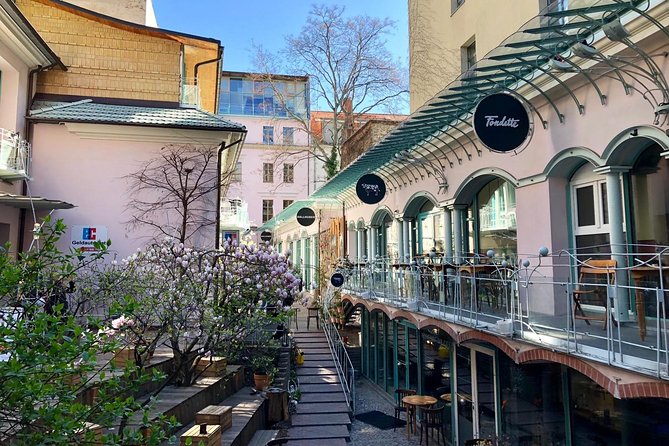
The stop at Hackesche Höfe lasts about 15 minutes. Here, the guide discusses the site and its history as part of the wider Jewish Berlin route.
This stop helps break up the memorial-heavy sections. You are looking at a place within the city rather than only at a monument or ruin. The point is to connect Jewish life with work, housing, commerce, and the everyday city.
You should not expect a long architectural tour based on the information provided. Instead, treat Hackesche Höfe as a setting where Ariel adds historical context. The stop is brief, so it works best as part of the larger story rather than as a destination that fills an afternoon by itself.
A few more Berlin half-days to weigh up
- Berlin: Reichstag, Dome and Government District Guided Tour
★ 4.7 · 18,288 reviews - Berlin: 1-Hour City Tour by Boat with Guaranteed Seating
★ 4.3 · 16,993 reviews - Berlin: Boat Tour Along the River Spree
★ 4.4 · 11,252 reviews - Berlin: Hop-on Hop-off Bus Tour with Live Commentary
★ 4.3 · 8,579 reviews
Otto Weidt’s workshop and quiet courage
The Museum Blindenwerkstatt Otto Weidt receives about 20 minutes. You see the site and hear how Otto Weidt risked his life to protect Jewish employees from the death camps.
This is one of the route’s strongest human stories. It brings the period down to the level of a workplace and the choices made by one employer. Rather than discussing persecution only through laws and government actions, the stop asks what one person did for people under his care.
The allotted time is short for a museum site, so you should think of this as a guided introduction rather than a full museum visit. The tour includes admission fees, but the provided details do not promise extended independent time inside. If this stop matters most to you, ask the guide how much of the site you will see during the scheduled visit.
The old Jewish cemetery and the Missing House
The Memorial Jewish Cemetery is another 15-minute stop. You see what remains of Berlin’s oldest Jewish cemetery and hear about some of the people buried there.
Like the synagogue remains, this place carries meaning through absence. The cemetery gives the early community a human scale. Names and burial ground replace broad statistics, helping you think about the generations who lived in Berlin before the destruction of Jewish life under the Nazis.
The Missing House follows, with about five minutes at the site. The monument’s meaning is discussed rather than presented as a conventional building visit. Its short time slot suggests a compact but important pause, one that asks you to notice what is no longer there.
I appreciate the pairing of these two stops. One points to a community’s early roots, while the other focuses on disappearance. You get a stronger sense of change by seeing both.
New Synagogue Berlin and the limits of appearances
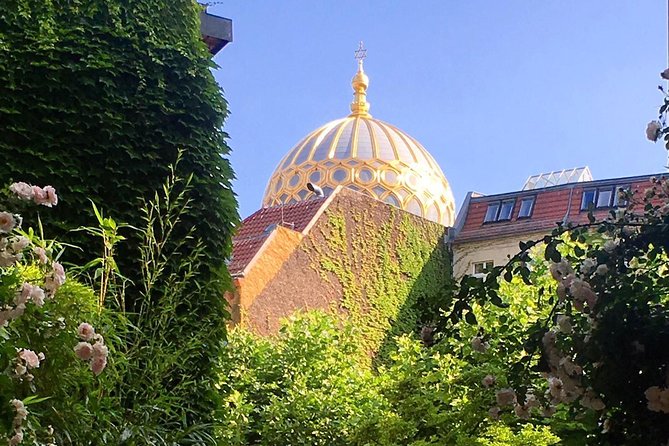
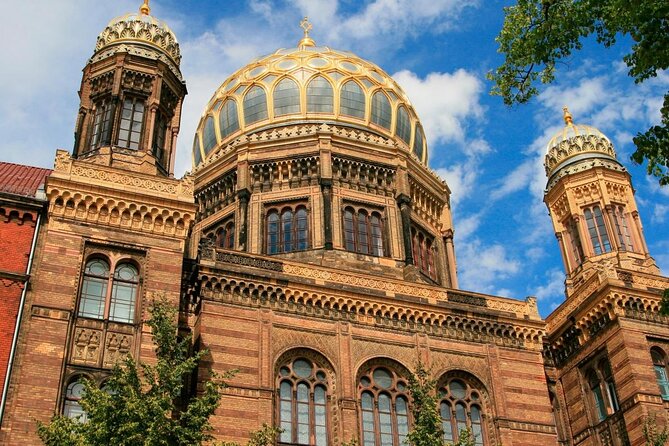
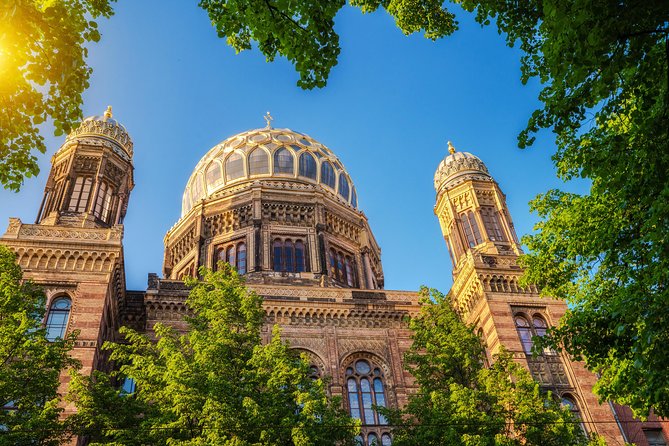
At Stiftung Neue Synagoge Berlin, also called Centrum Judaicum, the tour spends around 15 minutes discussing the site and its history. The building is visually impressive from the outside, but the experience is not simply a grand synagogue visit.
A particularly useful detail for your expectations is that the beautiful facade does not lead into a fully restored synagogue interior. As Ariel explains, the space beyond includes offices, a yard, and a small chapel on the third floor. That contrast can be startling. It shows how a building may survive in part while the institution and community around it have been badly damaged.
The tour information lists the New Synagogue as the end point, while the route also includes Gleis 17 as its final numbered stop. Because those details do not perfectly match, confirm the exact ending point when you book. The stated meeting point is Hackescher Markt, with hotel lobby pickup offered, and the stated end address is New Synagogue Berlin, Oranienburger Str. 28-30.
Gleis 17 and Berlin’s culture of memory
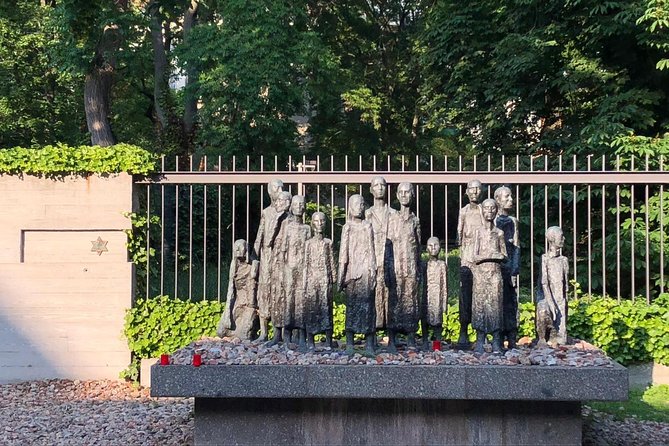
The longest stop is Gleis 17 Memorial, at about 45 minutes. You see four monuments at the site and discuss the deportation of Berlin’s Jews to the camps. The guide also explains how German memory has changed over time.
This is the tour’s heaviest section, and rightly so. A railway platform can look ordinary until you understand what happened there. The power of Gleis 17 comes from the meeting of place and record: the location ties the city’s transport system to the deportation process, while the memorials show later efforts to mark that crime.
The discussion of German memory adds an important layer. The tour does not stop with what happened during the Nazi period. It also considers how the country has remembered, represented, and confronted those events over the years.
Allow yourself mental space for this stop. Forty-five minutes gives the guide time to explain the monuments without rushing, and it gives you time to absorb the setting. If you are choosing between a short overview and this extended tour, Gleis 17 is one reason the five-hour option has value.
Ariel’s guiding style and the private advantage
Guide Ariel receives particular praise for detailed explanations, illustrations, patience, and answers to questions. Those details tell you what kind of guide this is likely to suit: someone who wants history explained carefully rather than delivered as a quick set of headlines.
The illustrations are a practical benefit. Several stops involve ruins, memorials, or altered buildings, so the past may not be obvious from what you see today. Visual material can help you picture the earlier synagogue, understand how a site changed, or follow a complicated story.
Ariel also does not appear to treat the walk as a race. That matters on a five-hour route. You have time to stop, ask, and connect one site with the next. Since this is a private activity, the experience can be more responsive than a large scheduled group walk.
Still, guide quality is personal. The tour’s strongest value depends on wanting a discussion-led experience. If you prefer to spend most of your time inside museums or move quickly between landmarks, this route may feel too slow and too focused on explanation.
Price, group size, and practical value
The price is $624.79 per group of up to 15 people. For one or two people, that is a major expense. For a family, school-style group, or party of several adults, the math improves because the price is shared.
At the full 15-person limit, the cost works out to roughly $42 per person. A smaller group pays more per person, but you receive the benefit of a private guide and a long, focused route. All fees and taxes are included.
Food, drinks, gratuities, and public transportation are not included. Plan for those separately. Hotel lobby pickup is offered, which can make the start easier, but the listed meeting point is Hackescher Markt. Confirm pickup arrangements and the ending location before the day begins.
The tour is offered in English, runs Monday through Sunday between 8:00 AM and 8:00 PM during the stated operating period, and confirmation is received at booking. Service animals are allowed, the route is near public transportation, and most people can participate.
Free cancellation is available if you cancel at least 24 hours before the start time. Within 24 hours, the payment is not refunded, and changes are not accepted. Keep the local-time cutoff in mind.
Who should book this private Berlin walk?
I would recommend it to you if you want:
- A focused introduction to Jewish Berlin rather than a general city tour
- A guide who can answer questions and use visual aids
- A private experience for your family or group
- Memorials and sites connected to real people and events
- A serious look at deportation and how Germany remembers it
- A route that includes places you might miss while exploring alone
I would think twice if you want a relaxed sightseeing day with lots of free time. The tour lasts about five hours, covers difficult material, and includes several short outdoor stops rather than long visits at one major museum.
It is also less cost-effective for a couple than for a larger group. If two people are paying the full group price, compare that cost with a shorter shared walking tour or individual museum visits. But if you are traveling with several relatives or friends, the private rate becomes easier to justify.
Should you book it?
Book this tour if you want Berlin’s Jewish story explained through places of worship, work, protest, burial, absence, and deportation. The combination of Ariel’s careful style, the private setting, and the 45-minute Gleis 17 discussion gives the experience more depth than a quick memorial walk.
Before paying, confirm two practical points: your hotel pickup and the final stop, since the stated route includes Gleis 17 while the listed end point is the New Synagogue. If the subject matters to you and your group can handle a long, serious day, this is a strong choice. If your main goal is grand architecture or a short city stroll, choose something lighter.
FAQ
How long does the Jewish Berlin Extended tour last?
The tour lasts approximately five hours.
Is this a private tour?
Yes. Only your group participates, with a maximum group size of 15 people.
What language is the tour offered in?
The tour is offered in English.
Where does the tour start?
The stated meeting point is Hackescher Markt, 10178 Berlin. Hotel lobby pickup is also offered.
Where does the tour end?
The stated end address is New Synagogue Berlin, Centrum Judaicum, Oranienburger Str. 28-30, 10117 Berlin. The route also lists Gleis 17 as a stop, so confirm the final meeting location when booking.
Is public transportation included?
No. A public transportation ticket is not included.
Are food and drinks included?
No. Food and drinks are not included.
What is the cancellation policy?
You can cancel for a full refund up to 24 hours before the experience start time. Cancellations or changes made less than 24 hours before the start time are not accepted, and no refund is provided.
Just added around Berlin
- eSIM for Germany and 34 European Countries★ 4.5 · 16 reviews
- Your ticket to The Wall Museum Berlin★ 3.0 · 60 reviews
- Walking on the Wall: 3-Hour Tour in Berlin★ 4.5 · 34 reviews
- Rickshaw Tours Berlin – Groups of up to 16 people with several rickshaws★ 4.0 · 97 reviews
- Warnemuende Shore Excursion: Private Berlin Tour★ 4.5 · 27 reviews
- Love and War in Berlin: Self-Guided Story Puzzle Walk★ 5.0 · 7 reviews
- Warnemuende Shore Excursion: Berlin Private Sightseeing Tour from Rostock★ 5.0 · 4 reviews
- Cold War Berlin – Private Live Virtual Experience★ 5.0 · 4 reviews
Berlin Tours, compared.

Reichstag, Dome and Government District Guided Tour
Read our review →
1-Hour City Tour by Boat with Guaranteed Seating
Read our review →
Reichstag, Plenary Chamber, Cupola & Government Tour
Read our review →