
Review · BERLIN TOURS
Berlin: Sightseeing Walking Tour of the Top 20 Attractions
Berlin’s past is laid out almost like an open-air history book, and this three-hour walking tour turns the pages quickly. You move from the government district to the Brandenburg Gate, across former Cold War borders, and through the grand squares and museums of central Berlin.
I like the route’s strong historical range. You do not see only the postcard sights, but also the Holocaust Memorial, Topography of Terror, longer stretches of Berlin Wall history, and Bebelplatz, where books were burned. I also like the personal style: guides such as Carlos, Carlo, Antonella, and Max have been praised for warm conversation, local stories, and the ability to adjust the pace.
The catch is simple: six kilometers in three hours is tiring. You will stop often, but this is still a brisk city walk, not a slow museum tour. At $94 per person, it makes the most sense if you want a private or small-group orientation and plan to explore the interiors later on your own.
Key points to know before you book
- See Berlin’s major landmarks in one route: The walk covers the government district, Brandenburg Gate, Checkpoint Charlie, Gendarmenmarkt, Bebelplatz, Museum Island, and the New City Palace area.
- History is the main event: Nazi persecution, wartime destruction, the divided city, the Berlin Wall, and reunification all form part of the story.
- Guides add personality: Carlos and Carlo have been especially praised for personal Berlin stories, while Antonella and Max are noted for friendly, engaging tours.
- Expect a brisk six-kilometer walk: Comfortable shoes and water are essential, even though the tour is listed as suitable for all ages.
- Good for first-time orientation: You finish near Friedrichsbrücke with a useful map in your head and ideas for where to return.
- Private and small-group formats are available: The experience can feel more tailored than a large coach or crowded public tour.
Why this three-hour route works for a first day in Berlin
Berlin is spread out. Its most important sights do not sit around one compact old town, and the city’s story is split between grand avenues, open memorials, former border crossings, and rebuilt districts.
That makes a guided walk useful. Instead of seeing the Reichstag, Checkpoint Charlie, and Museum Island as unrelated stops, you get the links between them. The guide explains how power moved through Berlin, how the city was divided after the Second World War, and how reunification changed its streets.
The route is advertised as a Top 20 tour, though the supplied stop list names the principal areas rather than twenty individually described attractions. You should think of it as a fast central Berlin overview with many landmark views, not twenty full visits.
The guides use storytelling, local observations, and a touch of dry Berlin humor. That matters here. Berlin’s history can be heavy, and a good guide helps you face difficult subjects without making the walk feel like a lecture.
More walking tours in Berlin:
- Discover Berlin Half-Day Walking Tour
★ 5.0 · 9,624 reviews - Berlin: Third Reich and Cold War 2 Hour Walking Tour
★ 4.9 · 6,830 reviews - Berlin: Discover Berlin Walking Tour
★ 4.9 · 5,998 reviews
Starting beside the Chancellery and Reichstag
The meeting point is in front of the main entrance of the Paul-Löbe-Haus on Konrad-Adenauer-Straße, opposite the Federal Chancellery. Look for the TourguideMe guide there.
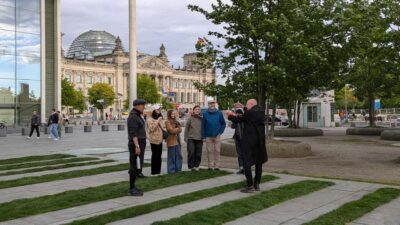
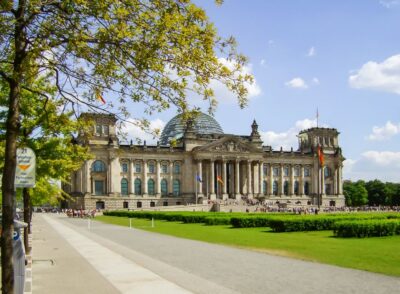
Starting in the government district gives the tour an immediate sense of modern Berlin. You see the German Chancellery and the Reichstag, two buildings tied to the country’s current political life, while the guide explains the role of Berlin as the capital of a reunited Germany.
The Reichstag is usually appreciated from outside on this walking route. That is important to understand before booking. You are not signing up for a full parliamentary building visit or an interior museum tour.
This first section can also help you get your bearings. The open spaces around the government quarter feel different from the dense streets farther south, and the guide begins connecting present-day Germany with the events that shaped the capital.
Brandenburg Gate and the weight of the Holocaust Memorial
Brandenburg Gate is the natural centerpiece of any first Berlin walk. Once a city gate, it became a symbol of division during the Cold War and then of unity after the Wall fell.
Your guide can give the monument more meaning than a quick photograph provides. Look at the gate as a political stage, not just a neoclassical landmark. Its location on the former border between East and West Berlin makes it one of the clearest places to discuss the city’s divided past.
The nearby Holocaust Memorial changes the mood. Its field of concrete blocks invites you to walk among them, and the experience is intentionally unsettling. The tour includes guided time here, along with some free time for you to look around.
This is one of the places where a short explanation helps. The memorial is not a conventional monument with a single statue or a simple message. Give yourself a moment to notice how the ground shifts and how the blocks alter your sense of direction.
Potsdamer Platz and the city rebuilt
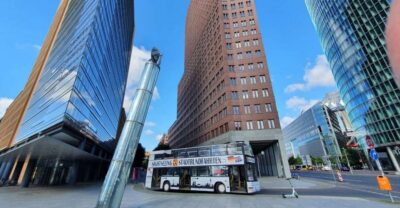
Potsdamer Platz offers a sharp contrast to the memorials and older monuments. It is a modern commercial district shaped by the rebuilding of Berlin after reunification.
The guide uses this stop to show how much of central Berlin changed in a short period. The area once sat near the Wall and became a large redevelopment project after the border disappeared.
You will not spend three hours at any single site, so expect an exterior overview rather than time inside shops, cinemas, or museums. The value is the comparison: from imperial Berlin to Nazi-era destruction, Cold War division, and modern reconstruction, the city’s layers appear within a few blocks.
A few more Berlin half-days to weigh up
- Berlin: Reichstag, Dome and Government District Guided Tour
★ 4.7 · 18,288 reviews - Berlin: 1-Hour City Tour by Boat with Guaranteed Seating
★ 4.3 · 16,993 reviews - Berlin: Boat Tour Along the River Spree
★ 4.4 · 11,252 reviews - Berlin: Hop-on Hop-off Bus Tour with Live Commentary
★ 4.3 · 8,579 reviews
Checkpoint Charlie and the Berlin Wall story
Checkpoint Charlie is one of Berlin’s most famous Cold War names. It was a crossing point between East and West Berlin, and today it is a busy city sight surrounded by reminders of the border era.
The guide places the checkpoint in its larger setting. You learn how the city was divided, what the Wall meant in daily life, and how Berliners experienced the border before its fall.
This stop can feel more staged than other parts of the walk. The checkpoint booth and nearby displays are designed for quick sightseeing, and the area can be crowded. The guide’s context is what gives it value.
The tour also includes longer sections of Wall history than a basic central sightseeing walk. That is helpful because the Wall was not one isolated structure. It cut through neighborhoods, roads, parks, and ordinary lives.
Martin-Gropius-Bau and the Topography of Terror
Martin-Gropius-Bau is an impressive historic exhibition building near the former border zone. You see it from the outside while the guide explains the surrounding district and its changing role.
The more serious stop is the Topography of Terror memorial. It sits on the grounds of the former Gestapo and SS headquarters, making it one of the most direct places in Berlin for confronting Nazi terror.
This part of the walk is particularly valuable for anyone who wants more than royal buildings and scenic squares. The guide discusses the Nazi period and the machinery of persecution, linking the site to the wider political history of Berlin.
The memorial has an exhibition area, but this three-hour experience is a walking tour rather than a full indoor visit. If the subject matters to you, return later with extra time. The guided introduction helps you know what you are looking at, but it cannot replace a careful visit inside.
Gendarmenmarkt, Bebelplatz, and Unter den Linden
Gendarmenmarkt is one of central Berlin’s grandest squares, framed by the French Cathedral, the German Cathedral, and the Konzerthaus. It provides a change of pace after the difficult history around the Topography of Terror.
The guide then takes you toward Bebelplatz, a handsome square with a painful history. It is remembered for the Nazi book burning of 1933. A glass panel set into the pavement points toward an underground room lined with empty bookshelves, a quiet reminder of censorship and destruction.
Bebelplatz is easy to pass without noticing its significance. That is exactly why a guide helps here. You see the architecture, then learn what happened in the same public space.
The route follows Unter den Linden, Berlin’s famous boulevard. Along the way, the guide places Prussian power, royal ambition, war, and the modern capital into one broad story. You will see important facades and public buildings, but the emphasis remains on orientation and explanation rather than interior visits.
Lustgarten, Berlin Cathedral, and Museum Island
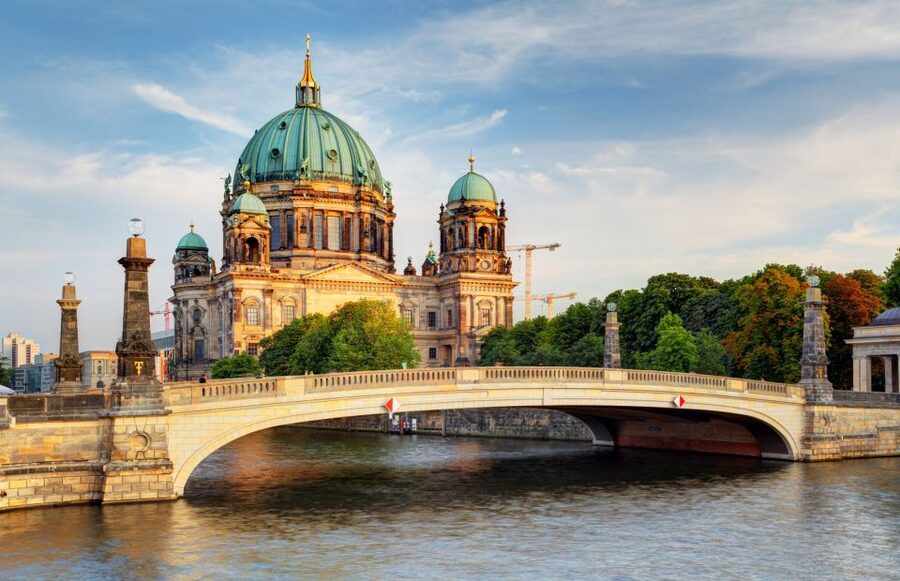
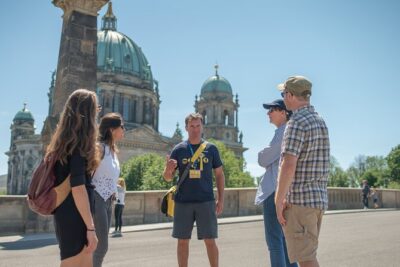
Lustgarten opens the view toward Berlin Cathedral and Museum Island. The setting is one of the city’s best places to appreciate Berlin’s monumental center.
Berlin Cathedral is a major landmark, but the tour treats it as part of the outdoor route. You can admire the dome, photograph the facade, and hear how the area developed without spending time inside the church.
Museum Island brings Berlin’s cultural heart into the picture. The island contains several major museums, including the Alte Nationalgalerie, which the guide points out during the walk.
This is a useful introduction if you plan to return for a museum day. You get a sense of the layout and can decide which buildings deserve your time. Do not expect admission to the museums as part of the $94 walking tour. The experience is built around exterior sights and live interpretation.
The New City Palace and the finish at Friedrichsbrücke
The rebuilt Berlin Palace, often called the New City Palace, adds another layer to the route. Its presence raises questions about Prussian architecture, wartime destruction, East German rebuilding, and the choices made by a reunited city.
The guide can explain how Berlin has repeatedly rebuilt, removed, and reinterpreted its landmarks. That makes the palace more interesting than a simple photo stop.
The tour finishes at Friedrichsbrücke, close to Museum Island. Ending here is practical. You are near museums, the cathedral, public transport connections, and the central sights you may want to revisit.
Because the route ends in the heart of Berlin, you can continue sightseeing rather than losing time getting back to a distant starting point. Ask your guide for ideas about food, nightlife, and neighborhoods before saying goodbye. Local recommendations are one of the most useful extras offered on this walk.
What the guides add to the experience
The guide can make or break a history-heavy walking tour. Here, the strongest feedback centers on friendly delivery, personal attention, and a real connection to Berlin.
Carlos and Carlo have been singled out for warm conversation and personal knowledge of the city. Carlo has guided groups of friends and has been praised for adapting his explanations in depth. Carlos has also shared what it was like to live through the fall of the Wall, which gives the Cold War section a personal dimension.
Antonella is described as a wonderful guide, while Max is noted for being warm and friendly. Names and assignments can change, so you should not book on the promise of a particular guide. Still, the pattern is clear: the experience aims for conversation rather than a rigid speech.
Some guides may let the walk run beyond three hours when the group has questions. That can be a pleasure, but do not count on extra time if you have a hard appointment afterward. The advertised duration remains 180 minutes.
Pace, access, and practical comfort
You will cover about six kilometers, mostly on foot. The route includes frequent sightseeing stops, but you should prepare for a sustained walk over several hours.
Wear shoes you can trust. Bring water, especially in warm weather, and carry a camera if you want photographs of the major landmarks. The tour runs in all weather, so rain and wind should not come as a surprise.
The activity is listed as wheelchair accessible and suitable for all ages and fitness levels. Since the route is long and outdoor, anyone with limited stamina should confirm that the pace and distance fit their needs before booking.
Tours begin daily at 10:00 AM and 2:00 PM. The morning departure gives you a useful introduction before an afternoon of independent sightseeing. The later start works well if you prefer a slower morning or arrive in Berlin around midday.
English, Spanish, and German tours are available. Private and small-group options are offered, which is especially useful if you want to ask many questions, travel with children, or shape the conversation around architecture, politics, or twentieth-century history.
Is $94 per person good value?
At $94, this is not Berlin’s cheapest way to see the center. You are paying for a guide, a private or small-group setting, and a route that covers a lot of ground in a short time.
The price is easier to justify if you are in Berlin for only a few days or want help understanding the city before exploring alone. A large group tour may cost less, but it can offer less room for questions and less flexibility at each stop.
You should also remember what the fee does not provide. This is not a museum admission package, and the tour does not give you long indoor visits. Its value comes from the route, the historical connections, and the guide’s local perspective.
One useful detail is the flexible booking policy. You can cancel up to 24 hours ahead for a full refund, and reserve now while paying later. That helps if your Berlin schedule is still shifting.
Who should book this Berlin walk?
I would choose this tour for a first visit, especially if you want to understand the city before spending time in its museums. It suits couples, families, friends, small teams, and curious locals who prefer conversation to a headset.
It is also a good fit if Nazi and Cold War history are central to your plans. The route does not treat those subjects as side notes. The Holocaust Memorial, Topography of Terror, Checkpoint Charlie, Bebelplatz, and the Wall story all receive attention.
I would hesitate if you dislike brisk walking, want extensive free time at each monument, or hope to enter several buildings during the tour. You may prefer a shorter neighborhood walk followed by self-guided museum visits.
Should you book it?
Book this tour if you want a fast but meaningful introduction to central Berlin, with a guide who can connect grand architecture to the city’s difficult modern past. The strongest reason to choose it is the blend of landmark coverage and human storytelling.
Skip it if six kilometers sounds demanding or if you already know Berlin well and want a slow, specialist tour of one district. For most first-time visitors with limited time, the route offers a useful start, and the guide’s tips can shape the rest of your stay.
FAQ
How long is the Berlin sightseeing walking tour?
The tour lasts three hours, or 180 minutes, and covers approximately six kilometers on foot.
Where does the tour begin?
It begins in front of the main entrance of the Paul-Löbe-Haus, opposite the Federal Chancellery, at Konrad-Adenauer-Straße 1 in Berlin.
Where does the tour finish?
The walk finishes at Friedrichsbrücke near Museum Island.
What languages are available?
Live guides are available in English, Spanish, and German.
Is the tour private or shared?
Private and small-group options are available.
What happens if I need to cancel?
You can cancel up to 24 hours before the tour for a full refund. You can also reserve now and pay later.
Just added around Berlin
- From Berlin: Gardens & Palaces of Potsdam Bike Tour★ 5.0 · 61 reviews
- Berlin: Battle for Seelow Heights WW2 tour -Clash of Titans★ 5.0 · 27 reviews
- From Berlin: Historical Gems of Potsdam Private Day Trip★ 4.4 · 4 reviews
- Berlin: Französischer Dom 360° Panorama & Crémant to go★ 3.9 · 5 reviews
- Explore Berlin Tour: History and Highlights★ 4.7 · 5 reviews
- Berlin: Evening Yacht Cruise with Aperitif & Dinner Upgrade★ 4.6 · 178 reviews
- Berlin: Expats in Berlin Comedy Show Ticket★ 4.7 · 182 reviews
- Berlin: The Epic Comedy Club Friday Night Showcase★ 4.8 · 28 reviews
Berlin Tours, compared.

Reichstag, Dome and Government District Guided Tour
Read our review →
1-Hour City Tour by Boat with Guaranteed Seating
Read our review →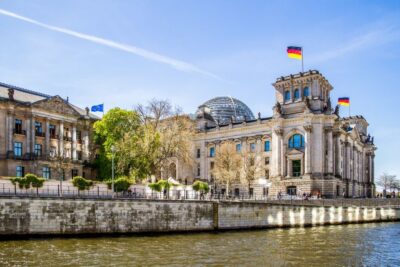
Reichstag, Plenary Chamber, Cupola & Government Tour
Read our review →
Browse the lists this tour appears in