
Review · BERLIN TOURS
Warnemuende Shore Excursion: Berlin Private Sightseeing Tour from Rostock
Berlin is a long way from your ship, but this private shore excursion makes the trip worthwhile by giving you one full day in Germany’s capital. You ride through Mecklenburg-Vorpommern, the land of 1,000 lakes, then meet your Berlin guide at Charlottenburg Palace before touring the city’s key sights. I like the private minivan and the chance to shape the day around your interests.
I also like the way this tour packs Berlin’s divided past, royal history, and modern city life into one route. Guides such as Luca have managed to show guests the main sights even within a tight port schedule. The catch is simple: the drive takes about two hours each way, so this is a long day with limited time for museums or unplanned wandering.
Key points to know before booking
- About four hours are spent on the road: The transfer from Rostock to Berlin takes about two hours each way.
- You get a private group of up to six: Your own vehicle and guide make it easier to adjust the day.
- The route covers Berlin’s essential sights: Checkpoint Charlie, the Berlin Wall, the Holocaust Memorial, Reichstag, Brandenburg Gate, and more are included.
- Guide Luca has led this itinerary: Your Berlin guide joins you after the drive, rather than riding with you from the port.
- The Reichstag roof needs advance planning: You must provide your full name and date of birth and bring identification.
- Lunch is optional and costs extra: A rooftop restaurant at the Reichstag can be arranged if you request it ahead of time.
The real value of making the long trip to Berlin
The main question is not if Berlin is worth seeing. It is. The question is if Berlin is worth seeing during a port day in Warnemünde, with roughly four hours of driving added to the schedule.
For many people, the answer will be yes. A private day trip gives you a useful first look at the capital without asking you to organize trains, taxis, museum tickets, and a return journey on your own. You also have a guide to explain the city as you move between sights, which matters in Berlin. The memorials and former border points are more meaningful when you understand what happened there.
The price is $1,967.92 per group of up to six. At full capacity, that works out to about $328 per person. For a couple or small family, the per-person cost rises sharply, but the private vehicle, port pickup and drop-off, local guide, and flexible touring style still offer a level of ease that a large group excursion cannot match.
This is not a cheap outing, and it is not designed for a slow, museum-heavy day. It is best viewed as a private orientation to Berlin. You see a great deal, learn how the city fits together, and decide what deserves a longer return visit.
More shore excursions from Berlin:
- All-in-One Berlin Shore Excursion from Warnemunde
★ 4.5 · 293 reviews - Explore Berlin Shore Excursion: Top Attractions Private Tour from Warnemuende
★ 5.0 · 41 reviews - Private All-in-One Berlin Shore Excursion from Warnemünde Port
★ 5.0 · 35 reviews
Crossing Mecklenburg-Vorpommern by private minivan
Your day begins with pickup at the cruise port in Warnemünde or Rostock. The transfer to Berlin takes around two hours, depending on traffic and the exact pickup point. The vehicle is an air-conditioned private minivan, and only your group participates.
The drive itself has a pleasant regional character. You pass many lakes in Mecklenburg-Vorpommern, with bright yellow rape fields adding color in May and June. This is not a sightseeing stop, but it gives you a look at northern Germany beyond the major cities.
One detail matters here: the Berlin guide joins you at Charlottenburg Palace. The port transfer and the Berlin sightseeing portion are therefore distinct parts of the day. A driver gets you to the city, then your local guide takes over for the main tour.
A past pickup was described as perfectly on time, which is especially important on a cruise day. Still, you should keep your ship’s all-aboard time in mind and make sure the planned return leaves a sensible margin. The tour lasts about 12 hours, so expect a full day from early pickup to evening return.
Charlottenburg Palace and the western side of Berlin
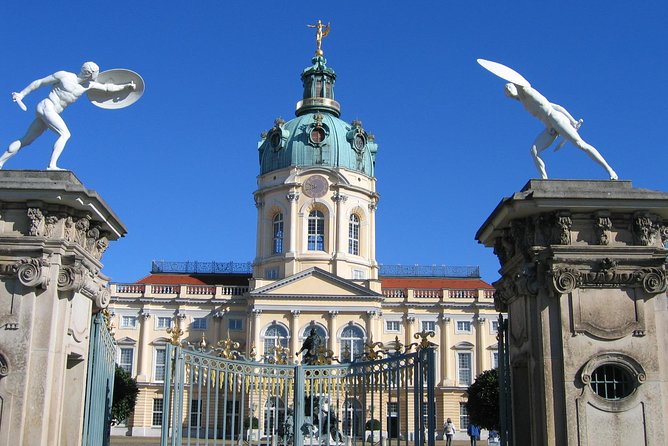
Charlottenburg Palace is the first Berlin stop. It was built by the Hohenzollerns and named for Sophie Charlotte, the wife of Frederick I, who became king in Prussia. The palace gives you a quick introduction to Berlin before the route turns toward the city’s 20th-century story.
The scheduled stop is about 10 minutes, with admission listed as included at no extra cost. That means you should expect an exterior look and an explanation from your guide, not a long palace visit. If royal interiors are high on your list, this brief stop may feel too short.
From here, you pass along Kurfürstendamm, often shortened to Ku’damm. This broad boulevard was central to Berlin’s nightlife in the 1920s and later became the main shopping street of West Berlin. Today it remains a place for shopping, cafés, restaurants, theaters, and a general look at the western part of the city.
You can choose a longer stop at KaDeWe, the Kaufhaus des Westens. It is the largest department store in continental Europe and is known for its polished food and shopping floors. The planned stop is about 30 minutes, free to enter, and best for a quick look rather than a serious shopping session.
I see KaDeWe as an optional personality stop. If you want Berlin design, food, and department-store culture, it adds variety. If you care more about political history and memorials, use the time elsewhere.
Topography of Terror and the Berlin Wall
The Topography of Terror is one of the most important stops on the route. The site occupies the former headquarters of the SS and Gestapo, now a documentation center and memorial. It also includes an original section of the Berlin Wall.
The planned stop is 20 minutes. That is enough for your guide to explain the site and for you to see the main outdoor material, but not enough for a careful visit to every exhibit. You will need to choose between listening, reading, and taking photographs.
This stop is valuable because it connects Nazi terror with Berlin’s later division. The city’s history is not arranged in neat chapters. At Topography of Terror, the remains of one dictatorship sit beside evidence of another political conflict. Even a short visit helps you understand why Berlin can feel like an open-air history lesson.
A few more Berlin half-days to weigh up
- Berlin: Reichstag, Dome and Government District Guided Tour
★ 4.7 · 18,288 reviews - Berlin: 1-Hour City Tour by Boat with Guaranteed Seating
★ 4.3 · 16,993 reviews - Berlin: Boat Tour Along the River Spree
★ 4.4 · 11,252 reviews - Discover Berlin Half-Day Walking Tour
★ 5.0 · 9,624 reviews
Checkpoint Charlie and the city’s divided past
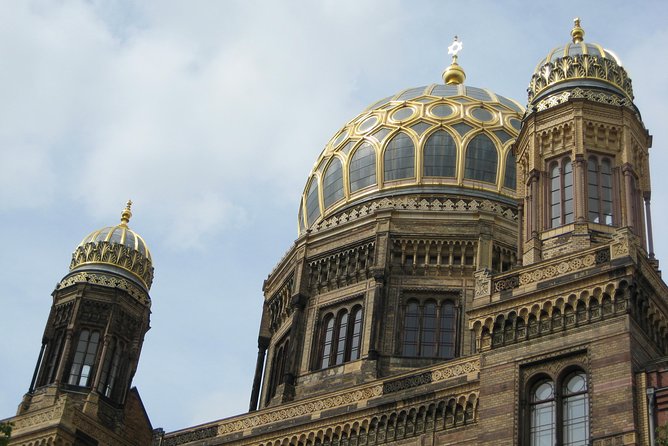
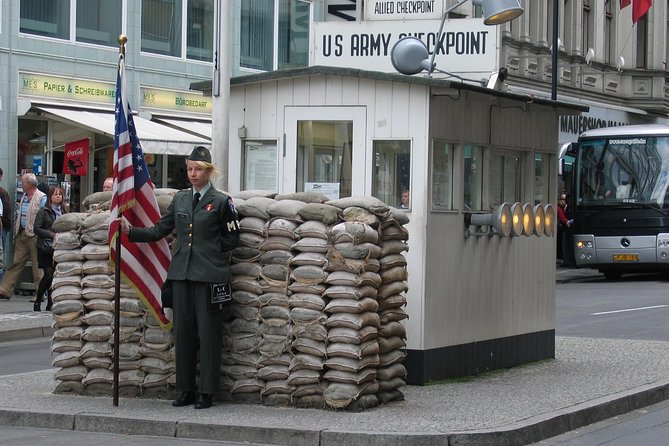
Checkpoint Charlie is a quick stop, usually about 10 minutes. It was the crossing point where Allied personnel could move between West and East Berlin. During the Cold War, American and Soviet tanks faced each other here in a tense confrontation.
Today, the guardhouse is a replica, along with the familiar sign marking the former American sector. That detail is worth knowing before you arrive. The site has major historical importance, but what you see on the street is largely a reconstructed symbol rather than an untouched border crossing.
Your guide’s explanation is the main value. Without context, Checkpoint Charlie can feel like a photo stop around a small guard booth. With context, it becomes a reminder of how sharply the city was divided and how risky crossing the border could be.
Holocaust Memorial and Brandenburg Gate
The Memorial to the Murdered Jews of Europe is made up of large concrete blocks arranged in a field near the Brandenburg Gate and the US Embassy. Designed by Peter Eisenman, it is intended to create an uneasy, disorienting experience rather than a simple monument.
The stop lasts about 10 minutes. You can walk between some of the blocks, but you should not expect time for the underground information center. The brief visit still works because the memorial is powerful from the outside, and your guide can explain its place in modern Berlin.
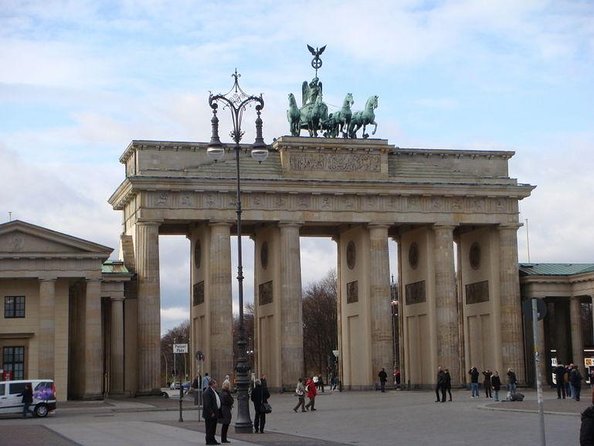
Brandenburg Gate follows, with another 10-minute stop. This is Germany’s most famous landmark and one of the best places to connect several periods of history. The gate saw Nazi torchlight marches, sat near the former Berlin Wall death strip, and became linked to Ronald Reagan’s call to tear down the Wall.
The gate is especially useful as a geographic marker. From here, you can understand how the old border, government quarter, memorials, and central avenues fit together. Bring your camera, but give yourself a moment to look beyond the columns and think about what took place here.
Potsdamer Platz and Gendarmenmarkt
Potsdamer Platz offers a sharp contrast to the memorials. Once a lively center, it became a barren area cut by the Berlin Wall. After reunification, it was rebuilt with high-rise hotels, cinemas, and shops.
The scheduled stop is about 10 minutes, so this is mainly a view and orientation point. You will not have time to explore the shopping and entertainment district in depth. Its value is visual: Berlin’s modern skyline rose on a site that had been divided and largely empty.
Gendarmenmarkt is one of the city’s most attractive squares. The French and German domes face each other, with a 19th-century theater designed by Schinkel between them. The stop is listed at about five minutes, making it another quick photo and explanation point.
That short timing is typical of the tour. You see the city’s main pieces, but many stops are introductions rather than full visits. If you want to sit in a square, enter a church, or browse an exhibit, you may need to give up another stop.
Reichstag, rooftop views, and a practical booking tip
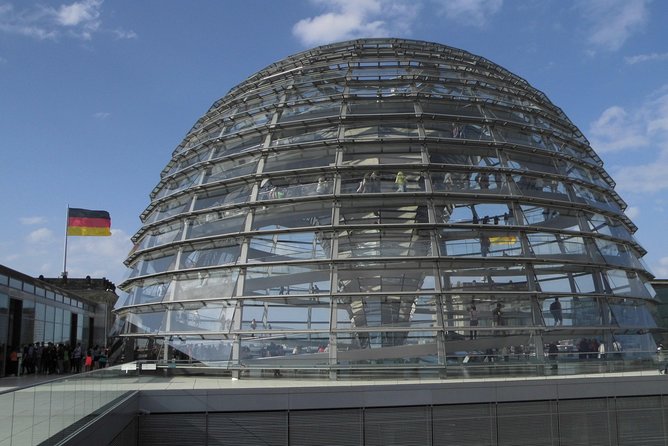
The Reichstag is one of the most meaningful buildings on the route. It was the seat of Germany’s parliament before Hitler’s rise to power. A fire damaged the building soon afterward, and it was not used as the center of Nazi government during the Third Reich. After German reunification, it became the home of the national parliament again.
The standard stop is about 30 minutes. You can see the exterior and hear how the building’s changing role mirrors Berlin’s political story.
A rooftop visit can be arranged, but you must request it in advance. The operator needs your full name and date of birth, and you must bring identification. This is not something to leave until the morning of the tour.
Lunch can also be arranged at the rooftop restaurant. It is at your own expense, and the timing must fit the day’s schedule. I like this option because it combines a meal with a view, but you should not assume it is automatically included. Ask for the reservation when booking.
The Reichstag roof is one of the few parts of the day that requires extra planning. If it matters to you, make it a priority and confirm the details early.
Unter den Linden and Alexanderplatz
After the central sights, the route continues along Unter den Linden. You pass the Opera, the New Guard House, and the new Humboldt Forum, a reconstruction of the former Hohenzollern Palace.
This drive helps you see Berlin as a connected city rather than a collection of isolated stops. Unter den Linden leads toward Alexanderplatz, a broad square marked by the TV Tower, Germany’s tallest building. The route does not promise a visit to the tower, but you get a look at this unmistakable symbol of East Berlin.
Alexanderplatz also gives the tour a useful final note. The day begins with a Prussian palace, moves through Nazi and Cold War sites, and ends among the modern and socialist-era parts of the capital. You leave with a basic map in your head, which is often the most useful result of a first city visit.
What the private format changes
The private setup is more than a label. Your group can choose among optional longer stops, including KaDeWe, lunch, and other available time choices in Berlin. You are not waiting for a large coach group to board or gathering strangers at every corner.
The guide also has room to respond to your interests. If you want more explanation at Checkpoint Charlie, the Wall, or the Reichstag, you can ask. If shopping is not your thing, you can favor the historical stops instead.
The tradeoff is that flexibility cannot defeat the clock. Berlin is large, and the transfer from Rostock consumes a major part of the day. You will see more by vehicle than on foot, but you will not experience Berlin at the relaxed pace of a stay in the city.
The tour suits you best if you are visiting Berlin for the first time, want the major sights explained, and value private transport. It is less suitable if you want several hours inside museums, a long restaurant meal, or time to explore neighborhoods without a schedule.
Booking, cancellation, and who should choose it
The tour includes a local guide, port pickup and drop-off, private transport, and an air-conditioned minivan. Confirmation is provided at booking, no special dress code is required, and most people can participate. The experience is near public transportation, though the main appeal is the included private vehicle.
Free cancellation is available up to 24 hours before the start time. Cancellations or changes made less than 24 hours ahead are not accepted for a refund.
I would book this tour if Berlin is a high priority on your cruise and you want to see the city without handling the long transfer yourself. I would also book it if your group has four to six people, since the group price becomes easier to justify.
I would think twice if you are sensitive to long road days or prefer slow travel. In that case, a closer shore excursion around Rostock or Warnemünde may give you more time on foot. But if your goal is a strong first look at Berlin, this private outing gives you the right mix of transport, history, and choice.
FAQ
Where does the tour begin?
Pickup is offered from the cruise port in Warnemünde or Rostock.
How long does the tour last?
The full experience lasts about 12 hours.
How long is the drive from Rostock to Berlin?
The transfer takes about two hours each way.
Is the tour private?
Yes. Only your group participates, with up to six people per booking.
What type of vehicle is used?
Transport is provided in a private, air-conditioned minivan.
Does the tour include a guide?
Yes. A local Berlin guide is included. The guide joins you at Charlottenburg Palace after the transfer from Rostock.
Can I visit the Reichstag roof?
A rooftop visit can be arranged if you request it in advance. You must provide your full name and date of birth and bring identification.
Is lunch at the Reichstag included?
No. Lunch at the rooftop restaurant can be arranged, but it is at your own expense.
Is admission charged at the listed stops?
The listed stops have no separate admission charge shown. The tour focuses mainly on exterior views, short visits, and explanations along the route.
What is the cancellation policy?
You can cancel for a full refund up to 24 hours before the experience begins. Changes or cancellations made less than 24 hours before the start time are not accepted for a refund.
Just added around Berlin
- eSIM for Germany and 34 European Countries★ 4.5 · 16 reviews
- Your ticket to The Wall Museum Berlin★ 3.0 · 60 reviews
- Walking on the Wall: 3-Hour Tour in Berlin★ 4.5 · 34 reviews
- Rickshaw Tours Berlin – Groups of up to 16 people with several rickshaws★ 4.0 · 97 reviews
- Warnemuende Shore Excursion: Private Berlin Tour★ 4.5 · 27 reviews
- Love and War in Berlin: Self-Guided Story Puzzle Walk★ 5.0 · 7 reviews
- Cold War Berlin – Private Live Virtual Experience★ 5.0 · 4 reviews
- Berlin’s Gay, Lesbian, and Queer Scene Small-Group Walking Tour★ 4.5 · 66 reviews
Berlin Tours, compared.

Reichstag, Dome and Government District Guided Tour
Read our review →
1-Hour City Tour by Boat with Guaranteed Seating
Read our review →




Reichstag, Plenary Chamber, Cupola & Government Tour
Read our review →
Browse the lists this tour appears in