
Review · BERLIN TOURS
Explore Berlin Shore Excursion: Top Attractions Private Tour from Warnemuende
Berlin’s story is packed into this long day: imperial grandeur, Nazi crimes, Cold War tension, and the hopeful pieces left after reunification. From Warnemünde, you ride into the capital with a private driver, then meet your guide for a fast-moving tour of its key sights.
I like the private format, which lets your own group set the pace and ask questions. I also like the separate driver and guide, since nobody in your party has to navigate Berlin traffic while listening to the history. Guides such as Phil and Brian Bell have brought extra material, including iPad images, to help explain places that no longer look as they did.
The main drawback is time. Twelve hours sounds generous, but the journey from the port and the number of stops leave only short visits at each site. The listed price of $1,075.31 per person also makes the most sense for families or small groups that value convenience and private attention.
Key points at a glance
- A full Berlin day from Warnemünde: Port pickup, private transport, a city guide, and return to the ship are built into one plan.
- Berlin’s major eras in one route: The tour links Prussian monuments, Nazi history, World War II, the Berlin Wall, and reunification.
- Mostly exterior sightseeing: Most stops last 12 to 35 minutes, so this is a city overview rather than a museum-heavy day.
- Strong Cold War focus: Checkpoint Charlie, Bernauer Strasse, the East Side Gallery, and the Soviet Memorial give the day a clear historical thread.
- Private questions matter: You can ask for more detail on World War II, government, economics, or modern Germany, depending on your group’s interests.
- Ship timing is central: You must provide docking, disembarkation, and re-boarding times when booking so the excursion can be planned around your sailing.
Why this private Berlin shore trip works
Berlin is too large to see properly in a quick port stop unless you accept a lot of driving or choose a tightly organized private tour. This experience gives you a driver for the road and a separate guide for the city. That division is useful. You can concentrate on Berlin instead of worrying about directions, parking, or finding your way back to the port.
The tour also gives you a broad historical frame. It does not focus only on Hitler or the Berlin Wall. You hear about Germany from the Middle Ages to the present, including changing forms of government and economic life. That wider view helps connect the grand buildings of central Berlin with the darker events that followed.
This is a private activity, so only your group participates. That can be a major advantage if your family has a particular interest in World War II, Cold War politics, architecture, or German reunification. One guide, Phil, was praised for explaining Germany’s role in World War II with the help of images on an iPad. Brian Bell was also singled out for giving a broad account of Germany’s political and economic changes. Guide assignments can vary, but the format allows for this kind of personal exchange.
The tradeoff is the schedule. The stops add up to roughly three hours of sightseeing time, before allowing for transfers between them. The rest of the 12-hour day is spent traveling between Warnemünde and Berlin and moving around the city. You see a great deal, but you do not linger.
More shore excursions from Berlin:
- All-in-One Berlin Shore Excursion from Warnemunde
★ 4.5 · 293 reviews - Private All-in-One Berlin Shore Excursion from Warnemünde Port
★ 5.0 · 35 reviews - Warnemuende Shore Excursion: Private Berlin Tour
★ 4.5 · 27 reviews
From Warnemünde to Berlin by private minibus
Your driver waits dockside in a modern air-conditioned vehicle or minibus. The tour includes pickup and drop-off at the port, round-trip private transport, and a return designed around your ship’s schedule.
That arrangement removes one of the biggest worries on a shore excursion: getting back to the vessel on time. You still need to provide the ship name, docking time, disembarkation time, and re-boarding time when you book. Give these details carefully. A private vehicle is helpful, but it cannot erase the distance between Warnemünde and Berlin or unexpected traffic.
The vehicle is a practical base for a long day. You can leave your belongings inside during sightseeing, though normal care is sensible. Food and drinks are not included, so plan to buy refreshments during the day or ask the provider how breaks are handled. The supplied details do not promise a dedicated meal stop.
Reichstag Building and Germany’s political past
The Reichstag is an excellent first major stop because its story touches nearly every period covered by the tour. Completed in 1894, it served the German parliament during the imperial and Weimar years. The building later became tied to the Nazi rise to power and the 1933 fire that helped Hitler consolidate control.
World War II left the Reichstag badly damaged. During the Cold War, its location near the dividing line between East and West added another layer of meaning. Today, the restored building represents a democratic Germany rather than the authoritarian systems that once controlled the country.
The modern glass dome, designed by Norman Foster, is the visual draw. It provides panoramic views across Berlin and offers a sharp contrast to the building’s troubled past. With only about 15 minutes listed here, your visit may be more of a guided look and explanation than a long architectural exploration. The details provided do not guarantee entry into the dome, so treat the Reichstag as a major context stop rather than a full interior visit.
East Side Gallery: art on the former Wall
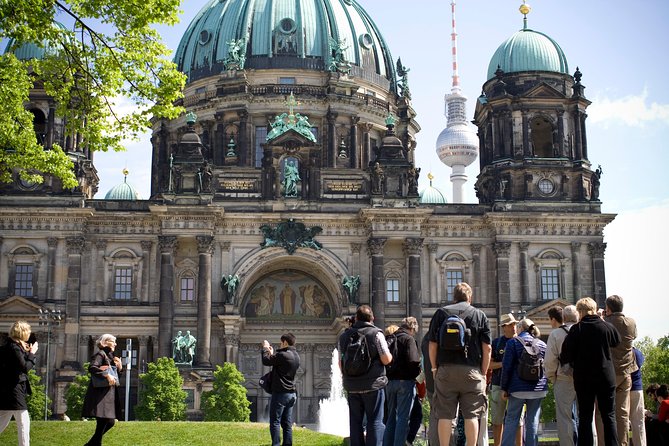
The East Side Gallery gives the Berlin Wall a more open and colorful face. This 1.3-kilometer stretch along the Spree River carries more than 100 murals by artists from around the world. Many works express the optimism of reunification, while others address freedom, political power, and human rights.
You have about 20 minutes here. That is enough to see several well-known paintings and take photographs, but not enough to walk the full length of the gallery at a relaxed pace. If one mural matters especially to you, tell your guide early so you can use the short stop wisely.
The gallery is valuable because it shows how Berlin turned a symbol of repression into a public space for art and memory. It is not a preserved Wall section in the same sense as Bernauer Strasse, but it helps explain how Berlin remembers the division and the joy of its end.
A few more Berlin half-days to weigh up
- Berlin: Reichstag, Dome and Government District Guided Tour
★ 4.7 · 18,288 reviews - Berlin: 1-Hour City Tour by Boat with Guaranteed Seating
★ 4.3 · 16,993 reviews - Berlin: Boat Tour Along the River Spree
★ 4.4 · 11,252 reviews - Discover Berlin Half-Day Walking Tour
★ 5.0 · 9,624 reviews
Soviet Memorial in Tiergarten
The Soviet War Memorial in Tiergarten is quieter and more solemn. A large statue of a Soviet soldier holding a raised sword dominates the site, which also serves as a cemetery for thousands of Soviet soldiers who died during the Battle of Berlin in 1945.
The memorial raises an important point that can be lost in simplified accounts of the war. The Soviet Union played the central military role in capturing Berlin, but the victory came at enormous human cost. After the war, the memorial also represented Soviet power in a city that would soon be divided between competing political systems.
The stop lasts about 15 minutes. Use that time for reflection and for your guide’s explanation of the site. This is not a casual photo stop, and respectful behavior is important.
Museum Island in a 20-minute look
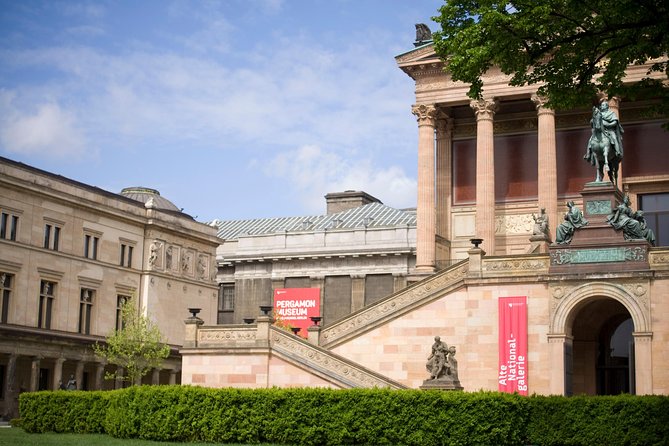
Museum Island is one of Berlin’s great cultural districts, located in the Spree and designated a UNESCO World Heritage site. Its museums include the Pergamon Museum, the Neues Museum, the Altes Museum, the Bode Museum, and the Alte Nationalgalerie.
The collections range from ancient Greek and Roman objects to Byzantine art and 19th-century painting. The bust of Nefertiti in the Neues Museum and the reconstructed Ishtar Gate associated with the Pergamon Museum are especially famous.
Do not mistake this stop for a museum visit. Twenty minutes is enough to admire the buildings, river views, and setting, but not enough to tour even one major collection. Admission is listed as free for the stop, but the tour does not describe an included museum admission or extended interior time. If art and archaeology are your main interests, you may find this portion too brief. If your goal is to understand Berlin’s layout and see its cultural center, it works well.
The Führerbunker site and the limits of historical places
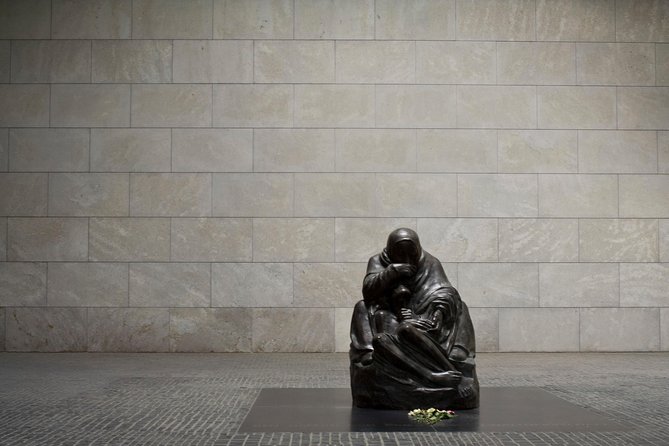
The former Führerbunker is one of the most difficult sites in Berlin because almost nothing remains to see. Hitler spent his final days in the underground complex beneath the Reich Chancellery. He married Eva Braun there on April 29, 1945, and they died by suicide the following day as Soviet forces closed in.
The bunker was built as a heavily protected air-raid refuge, with thick concrete walls and a network of rooms. After the war, much of it was destroyed or filled in. Today, the location offers little physical evidence beyond its historical setting and an information marker.
That absence is part of the point. The site does not glorify Hitler with a preserved room or dramatic monument. Instead, your guide supplies the context, explaining what happened and why the place is largely unmarked. The listed stop is only 15 minutes, which is appropriate for a location that requires explanation more than sightseeing.
Checkpoint Charlie and the Cold War city
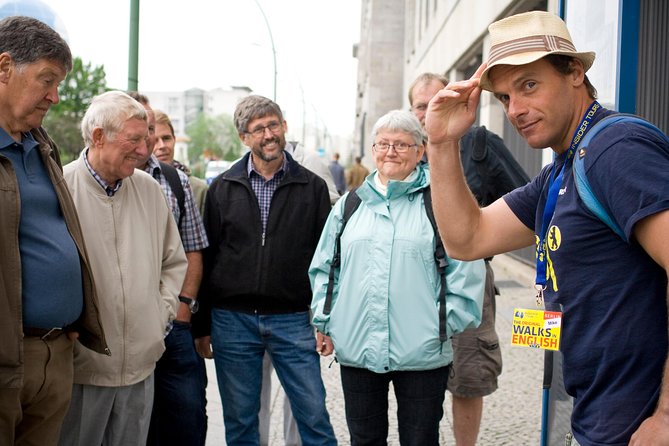
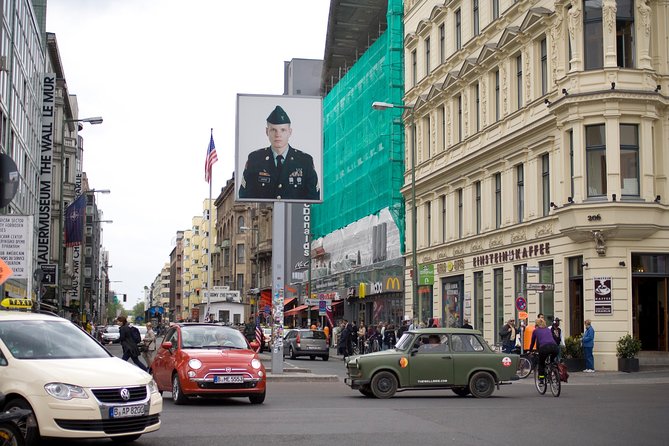
Checkpoint Charlie was once the best-known crossing between East and West Berlin. The name came from the Allied checkpoint system, and the location became a symbol of the political confrontation dividing Europe.
Your guide explains the 1961 tank standoff between American and Soviet forces, along with escape attempts across the Berlin Wall. The surrounding area also has material on espionage, border controls, and the risks faced by people trying to leave East Berlin.
The stop lasts about 15 minutes. That is enough to understand the location and take photographs, but it leaves little time for the nearby museum. The checkpoint booth and signs are also reconstructions rather than untouched Cold War equipment, so the value lies in the explanation and the larger story, not in expecting an unchanged border post.
Checkpoint Charlie is busy with people and traffic, and it can feel more commercial than reflective. Bernauer Strasse, visited later, offers a more powerful sense of the Wall’s physical reality.
Bernauer Strasse and the human cost of division
The Berlin Wall Memorial at Bernauer Strasse is one of the strongest stops of the day. Here, the Wall divided streets, buildings, families, and daily life. The preserved sections and original watchtowers help you understand that the barrier was not simply a painted strip or a line on a map.
The site is also linked to escape stories, including tunnels 29 and 57. These efforts required careful planning, secrecy, and great personal risk. Your guide can put names and human choices behind the concrete, helping you understand why escape attempts became symbols of resistance and hope.
With about 35 minutes, this is the longest stop in the schedule. Even so, you will not see every part of the memorial. Use the time to focus on the preserved Wall sections and listen closely to the personal stories. If you want the most meaningful Berlin Wall experience on this tour, this is probably it.
Brandenburg Gate and the meaning of reunification
The Brandenburg Gate is Berlin’s most recognizable monument. Built in the late 18th century for King Frederick William II of Prussia, it has 12 Doric columns and a Quadriga, the four-horse chariot sculpture on top.
The gate later took on a very different role. During the Cold War, it sat beside the Berlin Wall, closed off and surrounded by barriers. After the Wall fell in 1989, the reopened gate became a public symbol of German reunification.
The stop lasts about 12 minutes. You can photograph the gate, look along Unter den Linden, and view the nearby Reichstag area. The short visit is enough for orientation, but not for a slow architectural study. Try to connect the monument’s formal Prussian design with the modern political meaning your guide explains.
Bebelplatz and the empty library
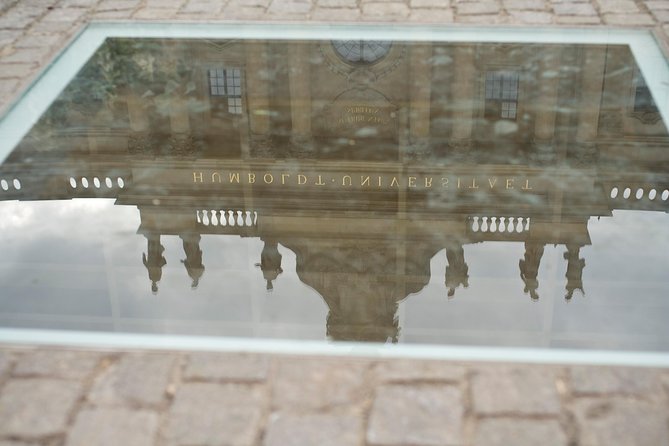
Bebelplatz carries a quieter but deeply disturbing story. On May 10, 1933, Nazi students burned thousands of books that they considered unacceptable or un-German. The event showed how censorship and political control can begin by attacking ideas, writers, and public debate.
A glass panel set into the pavement allows you to look down into an empty library. The bare shelves symbolize the books lost to the burnings. It is a small memorial, but its simplicity gives it force.
The square also includes the State Opera House and Humboldt University, reminders of Berlin’s intellectual and cultural life. You have about 15 minutes here, enough to see the memorial and hear the explanation before moving on.
Gendarmenmarkt and Berlin’s grand center
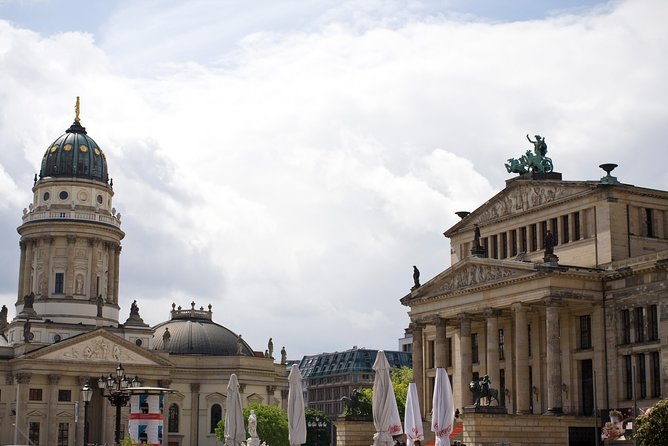
Gendarmenmarkt offers a change of mood after the war memorials and Wall sites. It is one of Berlin’s grandest squares, framed by the French Cathedral, the German Cathedral, and the Konzerthaus. The architecture combines Baroque and neoclassical elements in a carefully planned civic setting.
The square dates back to the 17th century and became an important center for music and public life. In winter, it hosts a Christmas market, according to the seasonal schedule provided for the experience.
You have about 16 minutes here. That is enough for photographs and a brief walk, but not a concert or building visit. The square works best as a short architectural pause before the long return to Warnemünde.
What the $1,075.31 price buys you
At $1,075.31 per person, this is not a budget excursion. The value depends heavily on the size of your group. A family or group of friends can spread the cost across a private vehicle, private guide, port transfers, and a full day of service. For one or two people, the per-person price is harder to justify unless private attention and ship-safe transport are your top priorities.
You are paying for convenience as much as sightseeing. The driver meets you at the ship, takes you into Berlin, remains with the vehicle, and brings you back to the port. A separate guide handles the historical commentary. That setup is especially useful when your ship gives you only one day and you do not want to combine trains, taxis, and timed connections.
Food and drinks are not included. Admission is listed as free for the individual stops, but the schedule is primarily exterior sightseeing, so you should not expect a series of included museum entries. The best value comes from the breadth of the route and the private format, not from paid attractions.
The tour has a 4.9 rating from 41 reviews, with 98 percent recommending it. More important than the numbers is the pattern in the comments: strong praise goes to the guides, the combination of driver and guide, the historical explanations, and the return to the ship with time to spare. One family found the guide especially effective with a child interested in World War II. Another group appreciated that the tour covered centuries of German history rather than stopping at 1933 or 1989.
Who should book this tour
I would choose this excursion if you want to see Berlin’s main historical sights in one day and prefer not to manage a long independent journey from Warnemünde. It suits families, first-time Berlin visitors, cruise passengers with limited time, and groups with mixed interests.
It is also a good fit if you want to ask questions. A private guide can spend more time on the topics that matter to you, whether that means Nazi Germany, the Cold War, architecture, government, or modern Germany.
I would hesitate if you want long museum visits, unhurried meals, or several hours in one neighborhood. The route is packed, and most stops are short. You should also think carefully about the price if your group is very small.
Practical details before you book
Confirmation is normally sent at booking. If you book within five days of travel, confirmation may arrive within 48 hours and remains subject to availability.
The experience is offered in English. Most people can participate, and the activity is private for your group. Pickup is dockside, and the vehicle is air-conditioned.
Free cancellation is available until 24 hours before the start time for a full refund. Cancellations or changes made within 24 hours are not accepted for a refund. The cutoff uses local time.
Should you book this Berlin shore excursion?
Book it if your priority is a wide-ranging Berlin introduction with private transport and a guide who can explain the connections between the city’s major events. The route covers the Reichstag, the Wall, Checkpoint Charlie, Brandenburg Gate, Nazi-era memorials, Soviet history, Museum Island, and Berlin’s grand civic squares in one demanding day.
Skip it if you want to enter several museums or explore each site at length. The price is substantial, and the schedule favors coverage over leisure. For a small group that values comfort, historical explanation, and a dependable return to the ship, it can be a sensible splurge. For a couple seeking the cheapest way into Berlin, public transport or a less costly group excursion may offer better value.
FAQ
How long is the Berlin shore excursion?
The tour lasts approximately 12 hours, including transportation between Warnemünde and Berlin and sightseeing in the city.
Where does pickup take place?
Your driver waits dockside at the cruise port in Warnemünde and takes you to Berlin in an air-conditioned vehicle or minibus.
Is transportation included?
Yes. The tour includes port pickup and drop-off, round-trip private transfer, and transport by air-conditioned minibus.
Is the tour private?
Yes. Only your group participates in the private activity.
Is a guide included?
Yes. The package includes a separate driver and guide. The guide meets you in Berlin after the port transfer.
Which language is offered?
The tour is offered in English.
Are meals and drinks included?
No. Food and drinks are not included in the tour price.
Do cruise passengers need to provide ship information?
Yes. At booking, cruise passengers must provide the ship name, docking time, disembarkation time, and re-boarding time.
Are museum admissions included?
The listed stops show free admission, but the schedule provides only about 20 minutes at Museum Island. The tour does not specify extended museum entry or a dedicated museum visit.
Can I cancel for a full refund?
Yes. You can cancel at least 24 hours before the experience starts for a full refund. Cancellations or changes made less than 24 hours before the start are not accepted for a refund.
Just added around Berlin
- eSIM for Germany and 34 European Countries★ 4.5 · 16 reviews
- Your ticket to The Wall Museum Berlin★ 3.0 · 60 reviews
- Rickshaw Tours Berlin – Groups of up to 16 people with several rickshaws★ 4.0 · 97 reviews
- Warnemuende Shore Excursion: Private Berlin Tour★ 4.5 · 27 reviews
- Walking on the Wall: 3-Hour Tour in Berlin★ 4.5 · 34 reviews
- Love and War in Berlin: Self-Guided Story Puzzle Walk★ 5.0 · 7 reviews
- Warnemuende Shore Excursion: Berlin Private Sightseeing Tour from Rostock★ 5.0 · 4 reviews
- Cold War Berlin – Private Live Virtual Experience★ 5.0 · 4 reviews
Berlin Tours, compared.

Reichstag, Dome and Government District Guided Tour
Read our review →
1-Hour City Tour by Boat with Guaranteed Seating
Read our review →




Reichstag, Plenary Chamber, Cupola & Government Tour
Read our review →
Browse the lists this tour appears in