
Review · BERLIN TOURS
Private walking Tour: Berlin Architecture Tour
Berlin’s architecture tells its political story in concrete, stone, glass, and brick. On this private four-hour tour, you move from Prussian grandeur and restored museums to communist-era housing, Cold War scars, and bold post-reunification buildings. The route can be done on foot or by bike, and your guide can shape it around the subjects you care about most.
I like the one-to-one format, which lets you ask why a building looks the way it does instead of simply collecting names and dates. I also like the range of the route, from Schinkel’s classical Konzerthaus to the tent-like Philharmonie and the glass structures of Potsdamer Platz. The main drawback is pace: ten stops across Berlin in four hours means some places receive a quick look rather than a full visit, and the $191.87 per-person price is a serious spend for a walking tour.
Key points at a glance
- Compare East and West Berlin: See how political ideas shaped apartment blocks, civic buildings, cultural centers, and public spaces.
- Choose walking or biking: The private format gives you a choice of pace and transport style.
- Meet guides with different strengths: Previous tours have been led by Sara, Thomas, Tom, Daniel, Heiko, Tarek Ibrahim, Ariel, and others, with architecture, history, and design knowledge.
- Cover ten major areas: The route includes Museum Island, Gendarmenmarkt, the Philharmonie, Reichstag, Potsdamer Platz, Kreuzberg, Friedrichshain, Pariser Platz, Berliner Dom, and Hackescher Höfe.
- Use the tour as a first-day orientation: The mix of politics, architecture, and geography can help you decide where to spend the rest of your Berlin stay.
- Expect a private hotel pickup and return: Food, drinks, and interior admissions are not included.
Berlin’s political story in stone and concrete
This tour works best when you see Berlin not as a collection of pretty façades, but as a city rebuilt several times. War damage, the Cold War division, reunification, and ambitious redevelopment all left visible marks.
Your guide explains the contrast between East and West Berlin. In the former East, large socialist housing blocks and broad planning schemes reflect a state that favored order, scale, and collective life. In the former West, postwar cultural buildings and modern commercial architecture show a different political message, often focused on openness, renewal, and international connection.
The private format matters here. A guide can pause when you spot an architectural detail or shift the conversation toward urban planning, design, history, or photography. The company has supplied guides with different specialties. Sara, for example, is an architect, while Thomas was praised for explaining what designers were trying to achieve. Tom was described as both a historian and an engaging companion, and Heiko used the route as a geographic, political, and artistic introduction to the city.
You meet at your central Berlin hotel lobby, and the tour concludes with a return to your hotel. That setup is convenient, especially if you are still learning Berlin’s layout. It also means the exact walking route may vary. Speak up early if you want more time for a certain neighborhood or building.
More walking tours in Berlin:
- Discover Berlin Half-Day Walking Tour
★ 5.0 · 9,624 reviews - Berlin: Third Reich and Cold War 2 Hour Walking Tour
★ 4.9 · 6,830 reviews - Berlin: Discover Berlin Walking Tour
★ 4.9 · 5,998 reviews
Museum Island: five buildings, several eras
Museum Island is an excellent place to begin because the architecture changes from one museum to the next. The Altes Museum gives you a formal neoclassical opening, with its grand columns and wide portico facing the city.
The Pergamon Museum has monumental classical façades and large sculptural forms. The Bode Museum shifts the mood with its rounded shape and dome, which add a baroque note to the Spree-side view.
The Neues Museum is especially useful for understanding Berlin’s approach to restoration. Wartime damage remains part of the building’s story, while modern work has been added beside historic fabric. You get a direct lesson in how a city can preserve scars rather than pretend the past never happened.
The Berliner Dom completes the Museum Island section with a much heavier dose of ceremony. Its huge dome, columns, stone decoration, mosaics, and ornate interior reflect Baroque and Renaissance Revival ideas. The exterior is made for photographs, though the listed visit is a short 15 minutes and does not include an interior admission.
A practical point: the itinerary gives Museum Island only 20 minutes at one stop and the Berliner Dom another 15 minutes. That is enough for an architectural introduction and photographs, not enough for the museums themselves. If you want to enter any museum or cathedral, ask your guide whether the route can be adjusted, and check admission arrangements separately.
Gendarmenmarkt and the classical center
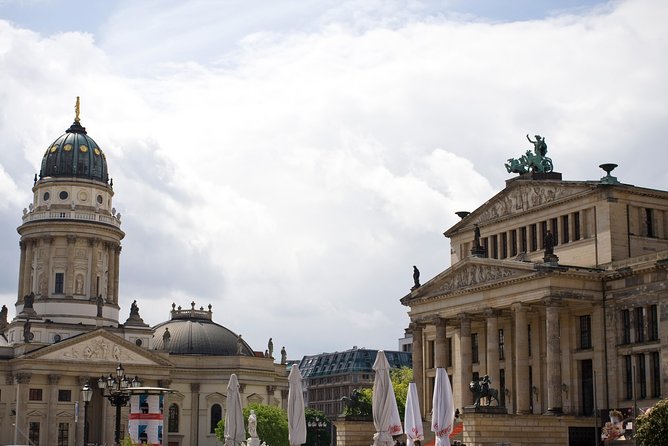
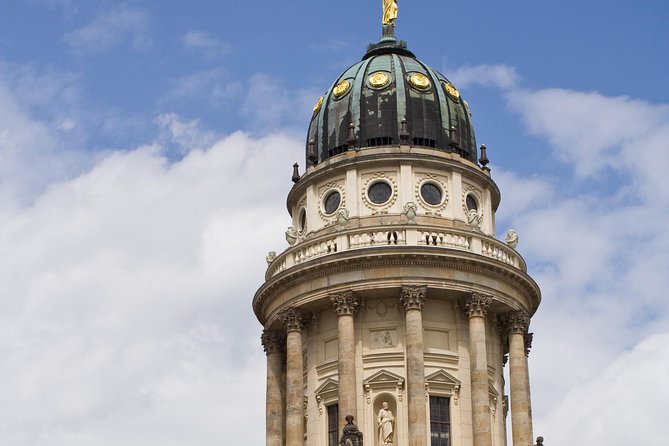
Gendarmenmarkt is one of Berlin’s most impressive urban rooms. The French Cathedral and German Cathedral face each other across the square, while Schinkel’s Konzerthaus occupies the center with its classical columns and concert-hall form.
The square is valuable because the buildings work as an ensemble. Instead of studying one structure in isolation, you can see how domes, façades, symmetry, and open space create a carefully composed civic setting. Friedrich Schiller’s statue sits at the center, adding a literary figure to the architectural scene.
You have about 15 minutes here, so your guide will likely focus on the square’s design, the three principal buildings, and a few lesser-known details. At sunset, the stone can take on warm light, making this one of the better photo stops. If photography matters to you, mention it at the start so the guide can allow a little breathing room.
The Philharmonie and Kulturforum
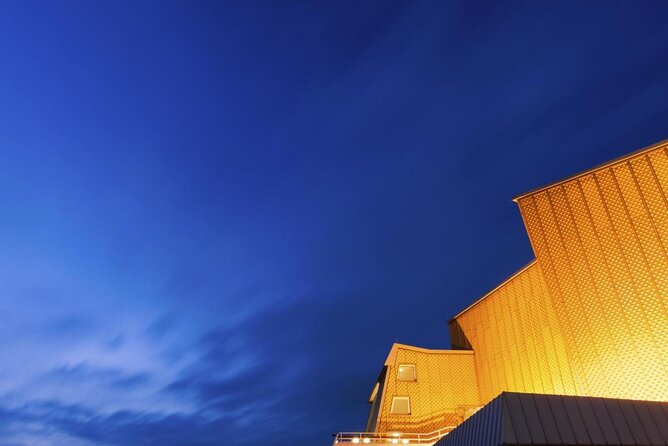
The Berliner Philharmonie is one of the tour’s strongest modern architecture stops. Its asymmetrical, tent-like exterior looks nothing like the classical buildings around Museum Island or Gendarmenmarkt. Inside, the concert hall is arranged around the performers, creating a more intimate relationship between musicians and audience.
You receive roughly 15 minutes here, free of admission. That makes the stop an exterior architecture visit rather than a concert experience or a full study of the hall’s acoustics.
The Philharmonie belongs to the Kulturforum, a group of museums, concert halls, libraries, and research institutions built during the 1950s and 1960s in West Berlin. Many cultural collections and institutions had been left on the other side of the Berlin Wall, so West Berlin built a new cultural center of its own.
That political context gives the Kulturforum more weight than its modern shapes alone might suggest. It was not merely a building project. It was also a statement about culture, identity, and the rivalry between two halves of a divided city.
A few more Berlin half-days to weigh up
- Berlin: Reichstag, Dome and Government District Guided Tour
★ 4.7 · 18,288 reviews - Berlin: 1-Hour City Tour by Boat with Guaranteed Seating
★ 4.3 · 16,993 reviews - Berlin: Boat Tour Along the River Spree
★ 4.4 · 11,252 reviews - Berlin: Hop-on Hop-off Bus Tour with Live Commentary
★ 4.3 · 8,579 reviews
Reichstag and the meaning of a glass dome
The Reichstag combines an older shell with a modern symbol. Its 1894 classical façade has a grand portico and formal decoration, while Norman Foster’s glass dome was added during renovation after German reunification.
The dome’s transparent design is meant to suggest openness and democracy. It also gives you wide views over Berlin, though this tour lists only a ten-minute stop and no included admission. Do not assume that the tour includes entry to the dome. Ask your guide about the possibility of visiting it separately if that is a priority.
Even from outside, the Reichstag helps explain how Berlin handles its past. The building retains its imperial-era appearance but has been given a new public meaning. That old-and-new contrast is one of the clearest themes running through the tour.
Potsdamer Platz: a city rebuilt from almost nothing
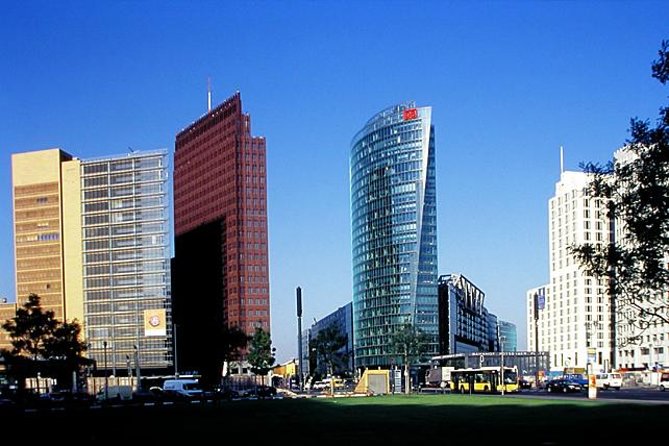
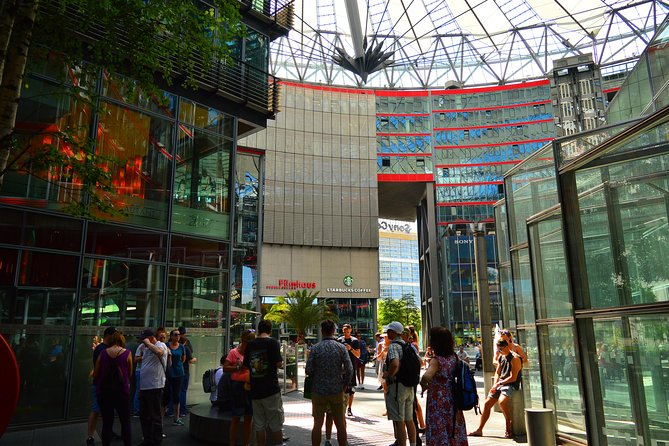
Potsdamer Platz is where Berlin’s modern redevelopment becomes easiest to see. Once a major prewar center, it suffered wartime destruction and later sat near the Berlin Wall. After reunification, it became a large-scale project filled with office towers, public spaces, cinemas, shops, and glass structures.
The Sony Center is the visual star, with a sweeping glass roof and a dramatic open space below. The DB Tower adds a sleek, glass-clad vertical form. The Panoramapunkt offers city views, although the tour stop itself is listed as free and does not include an observation admission.
This is a good place to ask your guide about urban planning rather than just architecture. Potsdamer Platz raises practical questions: How much of a historic city should be rebuilt? How should empty land be used after political change? When does new construction create a real public place, and when does it simply create a polished commercial zone?
You get about 20 minutes, enough to understand the area and take photographs. If you prefer older streets and intimate buildings, this may be less appealing than Hackescher Höfe or Kreuzberg. If you want to see Berlin’s post-Cold War ambitions, it is essential.
Friedrichstrasse and the idea of New Berlin
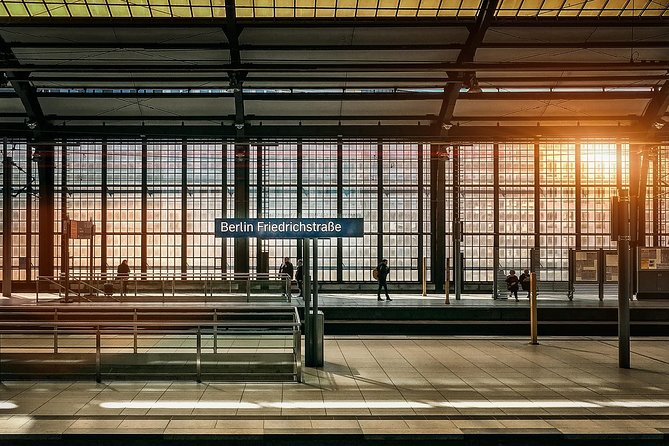
Friedrichstrasse links several parts of central Berlin and mixes the memory of the Golden Twenties with newer offices, cafés, shops, restaurants, boutiques, and department stores. Galeries Lafayette is one of the best-known modern additions.
The street is useful because it shows urban renewal at street level. Here, architecture is not only about museums and monuments. It is also about shopping corridors, commercial façades, coffee shops, and the way a city tries to make a central avenue feel prosperous again.
The tour description gives Friedrichstrasse a prominent role, though the detailed stop list does not assign it a separate time block. That means the guide may fold it into the central Berlin route rather than treat it as a long standalone visit. If this street matters to you, request it specifically when you book or during the hotel meeting.
Kreuzberg and Friedrichshain: old apartments and living neighborhoods
Kreuzberg offers a different kind of architectural lesson. Its streets combine 19th-century Altbau apartment houses, industrial conversions, modern additions, and the traces of alternative culture. The old buildings often have ornate façades, tall ceilings, and large windows, while newer work has adapted former industrial spaces for present-day use.
The Oberbaum Bridge is the key landmark in this part of the route. Its red-brick towers and Gothic-inspired arches cross the Spree and connect Kreuzberg with Friedrichshain. You receive about 30 minutes in Kreuzberg, which gives you enough time for a neighborhood introduction and photographs without turning the tour into a full district walk.
Across the river, Friedrichshain adds prewar apartment blocks, socialist-era buildings, and newer development. The East Side Gallery, painted on a surviving section of the Berlin Wall, brings politics and public art into the architectural story.
This pair of neighborhoods is valuable because you see Berlin as a lived-in city rather than a museum of grand buildings. The buildings here serve apartments, cafés, shops, studios, and ordinary daily life. The drawback is that a 30-minute stop cannot cover the full social or architectural story of either district.
Pariser Platz: neoclassical symbols beside modern experiments
Pariser Platz gathers some of Berlin’s most recognizable architecture. The Brandenburg Gate dominates the square with its neoclassical columns and formal proportions. Around it are the Hotel Adlon, French Embassy, American Embassy, Academy of Arts, and DZ Bank building.
The DZ Bank building, designed by Frank Gehry, brings a sculptural modern interior and glass-and-steel forms into a square better known for classical architecture. That contrast is exactly what makes Pariser Platz worth studying. Berlin did not simply rebuild the square in one style. It allowed modern architecture to sit beside historic symbols, within rules intended to preserve the overall character.
The stop lasts about 20 minutes. You can expect a clear explanation of the square’s changing role and time for photographs, but not a detailed inspection of each building. The Brandenburg Gate is often crowded, so your guide’s architectural explanation can help you look beyond the obvious postcard view.
Hackescher Höfe and Berlin’s decorative side
Hackescher Höfe is the tour’s most decorative stop. Built in 1906 by August Endell, the complex contains eight connected courtyards with Art Nouveau façades, colored ceramic tiles, ironwork, curved lines, and geometric patterns.
The courtyards show how early 20th-century design tried to make practical urban buildings beautiful. They were not isolated monuments. They were working spaces and residential courtyards, designed around the daily needs of a growing city.
You have about 20 minutes here. The first courtyard is especially striking for its strong color and flowing decoration, while later courtyards bring different brickwork and patterns. The complex now includes shops and cafés, so it is a pleasant place to end a central Berlin architecture route, though the tour itself does not include food or drinks.
Four hours, private pacing, and the price
The listed price is $191.87 per person. That is expensive if you are comparing this with a large group walking tour, especially because food, drinks, and interior admissions are not included.
The value improves when you are traveling with people who care about architecture, design, politics, or photography. You are paying for a private guide, hotel pickup and drop-off, an English-language conversation, and the ability to change the focus. A small group can also ask detailed questions without waiting for a large crowd to catch up.
Previous guide experiences have included Ariel adjusting the timing to suit the group, Sara walking from a hotel near Checkpoint Charlie toward Museum Island, and Heiko using the tour as a first-day orientation. One group of American interior designers received a three-hour version, which suggests that the exact duration and route may sometimes be adjusted.
Still, clarify the practical details. The published duration is approximately four hours, and the tour can be taken by foot or bike. Ten stops spread across central, western, and eastern parts of Berlin can feel brisk, particularly on foot. If your priority is depth at two or three buildings, tell the guide. If your priority is seeing a broad cross-section of Berlin, the full route makes more sense.
Most people can participate, the tour is near public transportation, and service animals are allowed. Confirmation is normally issued at booking, although reservations made within three days of departure may take up to 48 hours to confirm, subject to availability. Free cancellation is available up to 24 hours before the start time.
Who will get the most from this tour
I would choose this tour for an architecture student, designer, photographer, history-minded couple, or first-time visitor who wants a fast but thoughtful introduction to Berlin. It also suits families with older children. A 15-year-old can follow the story because the tour connects buildings to war, division, politics, and everyday life rather than relying only on technical design terms.
It is less suitable if you want long museum visits, a concert at the Philharmonie, or a relaxed neighborhood stroll. It is also not the best value for a solo visitor on a tight budget.
Ask for a guide whose interests match yours if possible. Sara’s architecture background may appeal to design professionals. Thomas, Tom, Daniel, Heiko, Tarek Ibrahim, and Ariel have all been associated with strong experiences in architecture, history, communication, or flexibility. Guide availability is not guaranteed, but requesting a preferred guide is sensible.
Should you book the Berlin Architecture Tour?
Book it if you want Berlin’s buildings explained as evidence of political change, not just photographed as landmarks. The best part is the range: Museum Island, Gendarmenmarkt, the Philharmonie, Reichstag, Potsdamer Platz, the Wall, Kreuzberg, Friedrichshain, and Hackescher Höfe each show a different chapter.
Skip it if $191.87 per person feels too high for a four-hour outing or if you would rather spend that time inside museums. For the right small group, though, the private format can make the difference between seeing Berlin’s architecture and actually understanding why the city looks this way.
FAQ
How long is the Berlin Architecture Tour?
The tour lasts approximately four hours.
Is the tour private?
Yes. Only your group participates in the activity.
Is hotel pickup included?
Yes. The guide meets you in the lobby of a central Berlin hotel, and hotel drop-off is included at the end.
Is the tour offered in English?
Yes. English is the listed tour language.
Can I take the tour by bike instead of walking?
Yes. You can choose to do the tour on foot or by bike.
Which Berlin sights are included?
The route includes Museum Island, Gendarmenmarkt, the Berliner Philharmonie, Reichstag, Potsdamer Platz, Berliner Dom, Kreuzberg, Friedrichshain, Pariser Platz, and Hackescher Höfe. Friedrichstrasse is also part of the architectural discussion.
Are food and drinks included?
No. Food and drinks are not included.
Can I cancel for a full refund?
Yes, if you cancel at least 24 hours before the experience start time. Cancellations made less than 24 hours in advance are not refunded.
Just added around Berlin
- eSIM for Germany and 34 European Countries★ 4.5 · 16 reviews
- Your ticket to The Wall Museum Berlin★ 3.0 · 60 reviews
- Rickshaw Tours Berlin – Groups of up to 16 people with several rickshaws★ 4.0 · 97 reviews
- Warnemuende Shore Excursion: Private Berlin Tour★ 4.5 · 27 reviews
- Walking on the Wall: 3-Hour Tour in Berlin★ 4.5 · 34 reviews
- Love and War in Berlin: Self-Guided Story Puzzle Walk★ 5.0 · 7 reviews
- Warnemuende Shore Excursion: Berlin Private Sightseeing Tour from Rostock★ 5.0 · 4 reviews
- Cold War Berlin – Private Live Virtual Experience★ 5.0 · 4 reviews
Berlin Tours, compared.

Reichstag, Dome and Government District Guided Tour
Read our review →
1-Hour City Tour by Boat with Guaranteed Seating
Read our review →




Reichstag, Plenary Chamber, Cupola & Government Tour
Read our review →