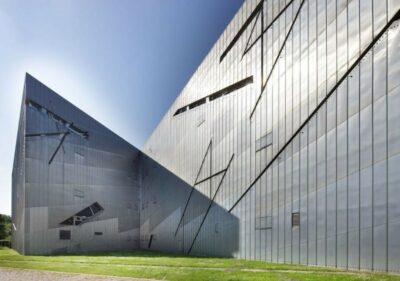
Review · BERLIN TOURS
Private Berlin Walking Tour
Berlin’s most important sights are packed into a walk that moves from Brandenburg Gate to Bebelplatz, taking in Nazi history, the Holocaust, the Berlin Wall, and the Cold War along the way. The route is not just a parade of grand buildings. It also pauses at a parking lot, an empty bookshelf beneath the pavement, and stark concrete slabs.
I like the private format, since your group can ask questions and spend more time on the subjects that matter most to you. I also like the guides’ practical approach: Marc has explained postwar Germany with a hand-drawn map, and he and Jenny have been praised for clear storytelling and useful suggestions for restaurants, clubs, and other places to visit.
The main drawback is the price, $285.09 per person, which is a serious outlay for a 2-hour-30-minute walk with no hotel pickup and no paid admissions included. You are paying for a private guide and focused historical context, not for tickets or transportation.
Key points to know before you book
- Eight central stops in 150 minutes: The route covers Brandenburg Gate, the Holocaust Memorial, Berlin Wall history, Hitler’s bunker site, the former Aviation Ministry, Checkpoint Charlie, Gendarmenmarkt, and Bebelplatz.
- A private tour for your group only: You do not join a large public crowd, and a certified expert guide leads the walk in English.
- History takes center stage: The tour connects the Nazi era, the Holocaust, World War II, the Cold War, German division, and reunification.
- The route ends at Bebelplatz: You finish beside major cultural buildings and can continue exploring central Berlin on your own.
- No admission fees are needed for the listed stops: The experience is an outdoor walking tour, with the historical value coming from the sites and the guide’s explanation.
Why this route gives you Berlin’s modern story quickly
I like this tour because it puts Berlin’s 20th-century story into a clear sequence. You begin with the old royal city and the symbol of reunification, then move through the crimes of the Nazi regime, the destruction of war, the division of Germany, and the remains of the Cold War.
That sequence matters. Berlin can feel scattered if you visit its monuments one by one. Here, the guide can connect each place to the next, helping you understand how a capital known for Prussian ceremony became the center of dictatorship, war, division, and reunification.
The tour is scheduled for about 2 hours and 30 minutes. The listed stops add up to that full period, so the pace is likely purposeful. You will spend about 20 minutes at several major sites and 15 minutes at the shorter stops. That is enough time for explanation and questions, but not enough for long museum visits or extended personal wandering.
Because this is a private walk, the experience should suit you best if you want a focused introduction rather than a broad sightseeing bus ride. It is also a useful first-day option if you want to get your bearings fast before exploring more of Berlin independently.
More walking tours in Berlin:
- Discover Berlin Half-Day Walking Tour
★ 5.0 · 9,624 reviews - Berlin: Third Reich and Cold War 2 Hour Walking Tour
★ 4.9 · 6,830 reviews - Berlin: Discover Berlin Walking Tour
★ 4.9 · 5,998 reviews
Brandenburg Gate begins with a symbol of unity
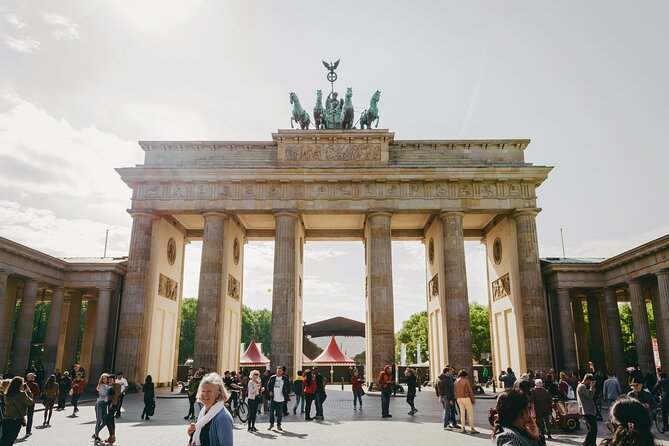
The tour starts at the Hotel Adlon Kempinski Berlin on Unter den Linden, close to Brandenburg Gate. From there, the guide introduces one of Berlin’s best-known landmarks, a neoclassical triumphal arch built in the 18th century.
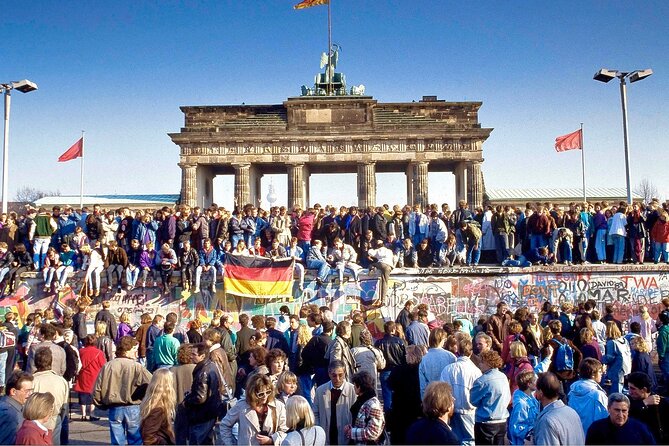
Brandenburg Gate has carried several meanings over time. It was built as a sign of peace, became linked with power and political ceremony, and later sat beside the Berlin Wall during the Cold War. Its image is now strongly tied to the fall of the Wall and German reunification.
You have about 20 minutes here. That is a sensible amount of time for a guide to explain the monument and place it within Berlin’s larger story. The stop is outdoors, and admission is free, so the value comes from the explanation rather than from access to an interior.
This is also a good meeting point because the gate is easy to recognize. Still, confirm the exact meeting instructions when you book, since the official starting point is the Hotel Adlon rather than the gate itself.
The Holocaust Memorial asks you to slow down
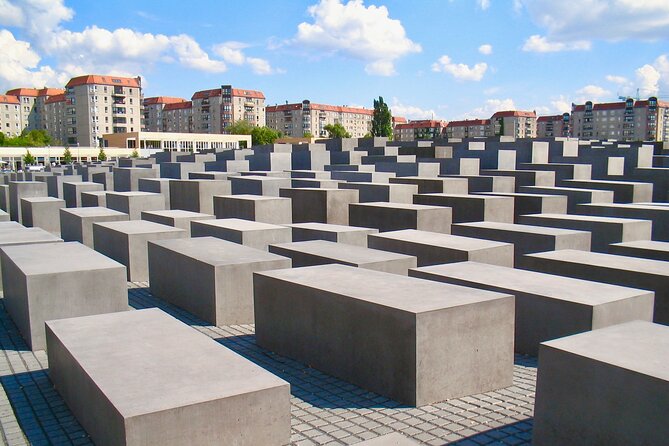
A short visit to the Memorial to the Murdered Jews of Europe offers one of the tour’s most serious moments. The memorial consists of 2,711 concrete slabs arranged in a grid over sloping ground.
The design is abstract. There are no individual names or long explanatory panels within the field itself. As you walk among the slabs, the ground changes beneath you and the blocks appear to rise and fall. The effect is intentionally unsettling, leaving room for thought rather than giving you a simple message to absorb.
The guide’s role is important here. A good explanation can provide historical facts without turning the memorial into a quick photo stop. You receive about 20 minutes, which allows time to walk through part of the site and listen.
Please treat this as a place for quiet attention. It is not a light sightseeing stop, and the subject may be difficult. That is part of its purpose.
The Berlin Wall section connects division to daily life
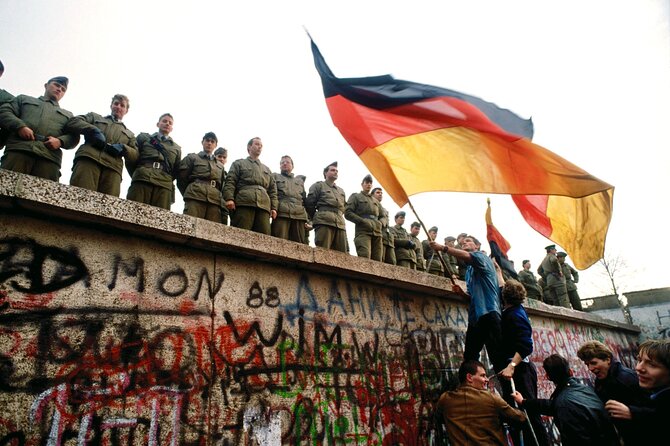
The Berlin Wall stop shifts the story from Nazi persecution and wartime defeat to the Cold War. The Wall became the most visible sign that Germany and Berlin had been split between rival political systems.
The description of this stop refers to preserved sections throughout the city and identifies the East Side Gallery as the best-known area for murals. The tour itself does not state that it visits the East Side Gallery, so do not assume you will see that particular stretch. Instead, expect a guide-led explanation of the Wall’s meaning and the way its remains are treated today.
You have about 20 minutes here. That is enough for a concise account of the division of Berlin, especially in a private setting where you can ask how the split affected movement, families, and everyday life.
Marc has been especially effective at explaining this period with a simple map drawn during the tour. That detail is useful because Berlin’s postwar geography can be confusing. A quick sketch showing East Berlin, West Berlin, the Wall, and the surrounding divisions may make the whole subject click.
A few more Berlin half-days to weigh up
- Berlin: Reichstag, Dome and Government District Guided Tour
★ 4.7 · 18,288 reviews - Berlin: 1-Hour City Tour by Boat with Guaranteed Seating
★ 4.3 · 16,993 reviews - Berlin: Boat Tour Along the River Spree
★ 4.4 · 11,252 reviews - Berlin: Hop-on Hop-off Bus Tour with Live Commentary
★ 4.3 · 8,579 reviews
Hitler’s bunker site is deliberately ordinary
The stop at the Führerbunker is one of the most striking because there is almost nothing to see. Hitler spent his final days in the bunker, but the site is now an unremarkable parking lot.
Information boards explain the bunker’s role in the final days of World War II. The plain setting is part of the lesson. You do not get a dramatic ruin or a preserved underground chamber. Instead, you see how a place tied to one of the darkest chapters in modern history has been left without a grand monument.
The tour allows about 20 minutes here. That should give the guide time to describe what happened without turning the location into a shrine. This is a site where context matters more than appearance, so listen closely and expect a sober tone.
The lack of a visible bunker may disappoint anyone hoping to enter a historic structure. For many people, though, the ordinary parking lot makes the point that dictatorship should not be given a theatrical setting.
The former Aviation Ministry shows power in stone
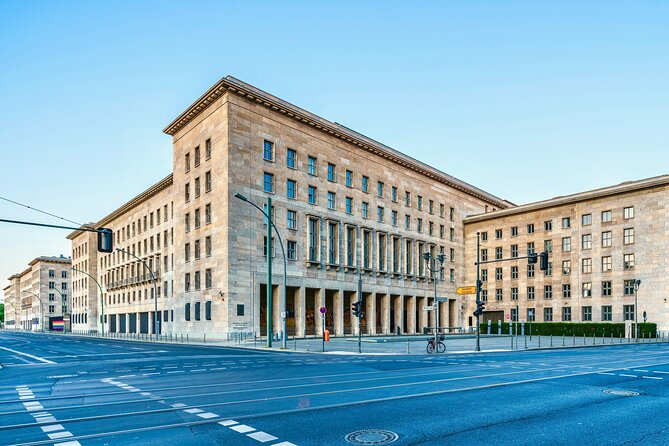
The former Luftwaffe building, now home to the German Finance Ministry, gives you a look at Nazi-era government architecture. It is a massive structure, and its scale reflects the regime’s taste for imposing institutions.
You will spend about 15 minutes here. The stop is brief, but it helps show how political power was expressed through buildings as well as speeches, laws, and military force. The architecture is not being presented as decoration alone. It formed part of the visual language of the regime.
The building now serves a modern government role, creating a clear contrast between its original purpose and its current use. You may not enter, since this is listed as an outdoor stop with free admission, but the guide can point out the building’s significance from outside.
This is a good example of why a walking tour can add value even when you are not going inside. A photograph may show the scale, but it will not explain why the building was made so imposing or how its use changed.
Checkpoint Charlie explains the Cold War in one place
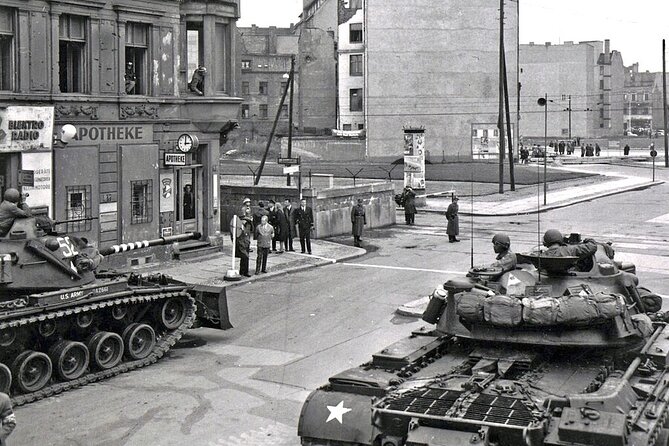
Checkpoint Charlie was the best-known crossing point between East and West Berlin. Today, the site includes a replica guardhouse and tourist facilities, while a nearby museum documents escape attempts and Cold War history.
The tour gives you about 15 minutes here. That is enough for an overview and a look at the setting, but not enough for a full museum visit. If the museum interests you, plan a separate visit after the walk rather than expecting admission to be part of this experience.
The site can feel more commercial than the Holocaust Memorial or the bunker location. That contrast is worth recognizing. Checkpoint Charlie is an important historical place, but it is also one of Berlin’s busiest tourist attractions, with a replica rather than the original guardhouse.
I would use this stop to ask questions about how the crossing worked and why it became so famous. The guide can help separate the historical checkpoint from the modern display built around it.
Gendarmenmarkt brings architecture into the story
Gendarmenmarkt provides a welcome change of mood. The square is framed by the French Cathedral, the German Cathedral, and the Concert House, making it one of central Berlin’s most handsome urban spaces.
You have about 20 minutes here. The stop lets the tour move beyond war and political division to Berlin’s architectural and cultural identity. The square also helps you see how the city’s grand public spaces were designed to express order, ceremony, and civic life.
Cultural events and markets take place here during the year, though no specific event is promised for your visit. The square is worth seeing even if you are not focused on history, and the guide can explain how its buildings fit together.
This stop also gives you a visual pause after several heavy subjects. Berlin’s past is not only memorials and ruins. It is also concert halls, cathedrals, public squares, and the continuing life of the city.
Bebelplatz ends with books and an empty room
The walk ends at Bebelplatz, a fitting place for the final stop. The square is surrounded by important cultural buildings and is home to the Book Burning Memorial, which remembers the Nazi book burning of 1933.
Look down into the transparent panel set in the cobblestones. Beneath it, empty bookshelves represent the books and ideas that were destroyed. The memorial is small and easy to miss if you do not know where to look, which makes a guide particularly useful.
The tour allows about 20 minutes here, and this is where the experience ends. You are not rushed into transport, and you can remain in the square afterward. The location has services and amenities nearby, making it a practical finishing point for lunch, coffee, or more sightseeing.
Ending at Bebelplatz gives the tour a strong final image. The concrete slabs at the Holocaust Memorial and the empty shelves here both use absence to communicate loss, but they do so in different ways.
What the private format is worth at $285.09
At $285.09 per person, this is not a budget walk. The price needs to make sense because the tour does not include hotel pickup, hotel drop-off, museum admissions, or paid attractions.
What you are buying is a private 2-hour-30-minute service with a certified expert guide, conducted in English for your group alone. That can be worthwhile if you want to ask many questions, need history explained clearly, or prefer not to spend time waiting for a large group.
The value is stronger for couples, families, or small groups who would otherwise book separate guided visits. Group discounts are available, but the exact saving is not stated, so check the total price for your party before booking.
The value is weaker if you mainly want quick photographs of famous places. Every listed stop has free admission, and you can see many of these locations independently. The difference is the guide’s ability to connect them and explain details you might miss.
Marc’s map-based explanation of postwar Germany is a useful example of that added value. So are the practical recommendations for restaurants, clubs, and places to visit. If you want local suggestions as well as history, ask about them during the walk.
Pace, meeting point, and practical details
The tour begins at Hotel Adlon Kempinski Berlin, Unter den Linden 77, 10117 Berlin. It ends at Bebelplatz, also in central Berlin. There is no hotel pickup or drop-off, so you must make your own way to the start and continue independently from the finish.
The experience is offered in English and uses a mobile ticket. Confirmation is provided when you book. It is near public transportation, and most people can participate. Service animals are allowed.
The itinerary is tightly timed. Wear comfortable shoes, since the experience is on foot, and allow yourself enough time to reach the hotel meeting point. The supplied details do not state the walking distance, restroom arrangements, or weather policy, so ask the provider if any of those points matter to you.
StellarTours operates the experience. The guide’s actual name may vary, although Marc and Jenny are the guides associated with the praise for this tour. If having a particular guide matters to you, request that information before booking rather than assuming one is guaranteed.
Free cancellation is available if you cancel at least 24 hours before the local start time. Cancellations or changes made inside that window are not refunded or accepted.
Who should book this Berlin walk
I would recommend this tour to you if you want Berlin’s difficult history explained in a compact, personal format. It suits first-time visitors, couples, families with older children, and anyone who finds the city’s Nazi and Cold War sites hard to connect without a guide.
It is also a good choice if you prefer conversation over a headset and want to ask about restaurants, nightlife, or what to see next. The private setting gives you room to shape the discussion.
I would hesitate if your budget is tight or if you want to enter museums. You will need to pay separately for any museum you choose to visit, and the tour’s free outdoor stops can all be seen without a ticket.
Should you book the Private Berlin Walking Tour?
Book it if you want a clear, serious introduction to central Berlin and value a private guide more than included attractions. The route handles major sites in a logical order, and the best moments come from the explanations: the hand-drawn map of divided Germany, the meaning behind an ordinary parking lot, and the empty shelves beneath Bebelplatz.
Skip it if $285.09 per person feels too high for a short walk or if you prefer to explore at your own pace. For the right visitor, though, this is a useful way to understand Berlin quickly, with enough personal attention to turn a collection of monuments into a connected story.
FAQ
How long does the Private Berlin Walking Tour last?
The tour lasts approximately 2 hours and 30 minutes.
What language is the tour offered in?
The tour is offered in English.
Is this a private tour?
Yes. Only your group participates in the private walking tour.
Where does the tour begin?
The tour begins at Hotel Adlon Kempinski Berlin, Unter den Linden 77, 10117 Berlin, Germany.
Where does the tour end?
The tour ends at Bebelplatz in Berlin.
Does the tour include hotel pickup or drop-off?
No. Hotel pickup and drop-off are not included.
Are admission tickets included?
The listed stops have free admission, and the tour includes access to those outdoor locations. Any separate museum visit or paid attraction is not included.
Are service animals allowed?
Yes. Service animals are allowed.
Can most people participate?
Yes. The available information states that most people can participate, and the tour is near public transportation.
What is the cancellation policy?
You can cancel for a full refund up to 24 hours before the experience start time. Cancellations or changes made less than 24 hours before the start time are not accepted or refunded.
Just added around Berlin
- eSIM for Germany and 34 European Countries★ 4.5 · 16 reviews
- Your ticket to The Wall Museum Berlin★ 3.0 · 60 reviews
- Walking on the Wall: 3-Hour Tour in Berlin★ 4.5 · 34 reviews
- Rickshaw Tours Berlin – Groups of up to 16 people with several rickshaws★ 4.0 · 97 reviews
- Warnemuende Shore Excursion: Private Berlin Tour★ 4.5 · 27 reviews
- Love and War in Berlin: Self-Guided Story Puzzle Walk★ 5.0 · 7 reviews
- Warnemuende Shore Excursion: Berlin Private Sightseeing Tour from Rostock★ 5.0 · 4 reviews
- Cold War Berlin – Private Live Virtual Experience★ 5.0 · 4 reviews
Berlin Tours, compared.
Reichstag, Dome and Government District Guided Tour
Read our review →
1-Hour City Tour by Boat with Guaranteed Seating
Read our review →
Reichstag, Plenary Chamber, Cupola & Government Tour
Read our review →