Review · BERLIN TOURS
Berlin during Nazism – Tour in Italian
Berlin’s Nazi past is easiest to understand when you connect the names in a history book with actual streets, buildings, stations, and memorials. This Italian-language tour does that well, moving from the German Resistance Memorial Center to the Jewish Quarter and the ruins of Anhalter Bahnhof, where deportation trains once departed.
I like two things here. First, the route covers both Nazi persecution and German resistance, rather than treating the period as a story with only one side. Second, the Italian guide can explain difficult subjects in your own language, with guides such as Lorenzo, Fabio, Vita, Silvio, Paolo, and Federica praised for clear, engaging presentations. The main drawback is practical: you walk and use public transportation for about three hours, and the transport ticket is your responsibility.
Key points at a glance
- An Italian route through Nazi Berlin: Hear the story in Italian from 1933 through the war and its aftermath.
- Resistance and persecution together: The tour pairs the German Resistance Memorial with sites linked to Jewish life, deportation, and Nazi murder.
- A small group of up to 20: The size gives you a better chance to ask questions than a large coach tour.
- Several sites are modest or partly outdoors: The T4 memorial and Anhalter Bahnhof ruins are brief stops, not full museum visits.
- Public transport is part of the day: Buy a Berlin public transport day ticket for zones AB before you start.
- The route ends near Hackescher Markt: You finish in central Berlin, a useful place for lunch or further sightseeing.
Why this Italian tour gives Nazi Berlin a human scale
A city tour about Nazism can easily become a parade of grim facts. This one works best when you treat it as a connected walk through decisions, victims, resistance, and memory.
The tour begins with Hitler’s rise to power in 1933 and the events that led to World War II. From there, it brings you to places tied to the German opposition, the Nazi euthanasia program, Jewish Berlin, deportation, and the city’s later effort to remember what happened.
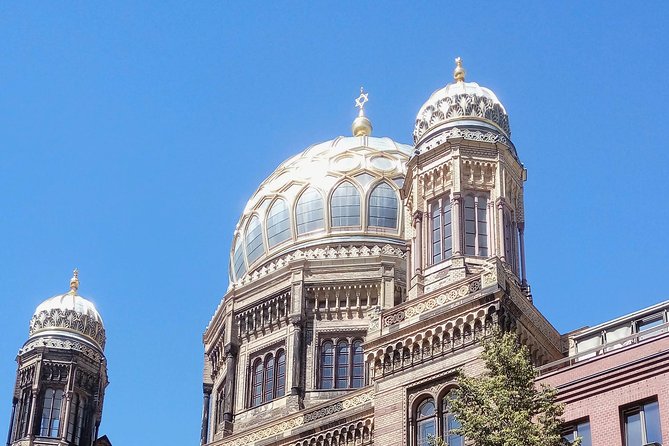
I especially value the balance between famous landmarks and quieter sites. The New Synagogue is visually striking and easy to recognize. The old Jewish cemetery and Otto Weidt’s workshop are less obvious, but they help you see Jewish life and individual courage beyond the usual headline sites.
The route also avoids presenting Berlin as frozen in the 1940s. Your guide explains how the city changed after the war and how modern Berlin deals with its Nazi past. That makes the tour useful even if you already plan to visit the Memorial to the Murdered Jews of Europe or the Topography of Terror.
This is not a light sightseeing outing. Several stops involve deportation, murder, disability persecution, and the destruction of Jewish communities. A serious tone is appropriate, and the strongest guides appear to handle the subject without sensationalism. Lorenzo is repeatedly praised for keeping the group focused and making a difficult subject understandable, while Silvio is praised for passion and preparation.
A few more Berlin half-days to weigh up
- Berlin: Reichstag, Dome and Government District Guided Tour
★ 4.7 · 18,288 reviews - Berlin: 1-Hour City Tour by Boat with Guaranteed Seating
★ 4.3 · 16,993 reviews - Berlin: Boat Tour Along the River Spree
★ 4.4 · 11,252 reviews
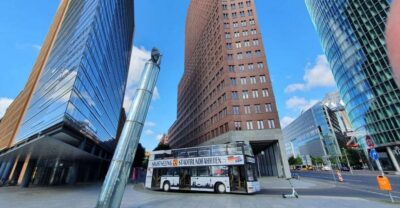
Starting at Potsdamer Platz with Berlin’s modern center around you
Meet at Potsdamer Platz 10 at 10 a.m. Look for the blue Vive Berlin Tours bicycle and the flag with the company logo. Potsdamer Platz is easy to reach by S-Bahn, U-Bahn, and other local connections, but give yourself extra time if you are unfamiliar with Berlin’s transport system.
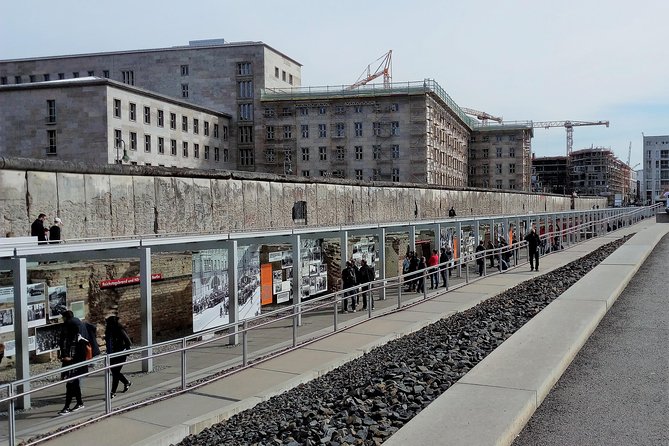
The meeting point is a useful reminder that Berlin is a city rebuilt and reshaped many times. Potsdamer Platz, now filled with modern buildings, was heavily damaged during World War II and later divided by the Berlin Wall. The tour’s main focus is the Nazi era, but this setting prepares you for the larger story of destruction and reconstruction.
The route ends at Hackescher Markt, not back at Potsdamer Platz. That is convenient because you finish in central Berlin, close to restaurants, shops, and transport links. Since the tour does not include rides between stops, purchase a Berlin public transport day ticket for zones AB. You should also wear comfortable shoes and bring weather protection. The experience operates in all weather.
German Resistance Memorial Center and Operation Valkyrie
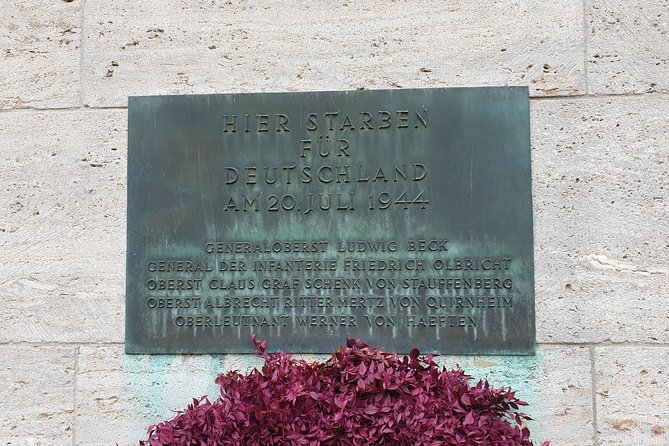
The first major stop is the German Resistance Memorial Center, located at the former Bendlerblock. This is where Operation Valkyrie was directed, the failed 1944 attempt to overthrow Hitler and the Nazi government.
The memorial is important because it widens the story beyond the idea that everyone in Germany supported the regime. The center presents individuals and groups who resisted National Socialism from 1933 to 1945. Their actions took many forms, and the site helps explain the risks involved in opposing a dictatorship.
You spend about 25 minutes here. That is enough for a guided introduction, but not enough for a full museum visit. If resistance history is your main interest, you may want to return independently with more time. During the tour, listen for the guide’s explanation of how resistance developed and why it was so difficult to organize.
This is also one of the more structured stops on the route. The memorial has a clear purpose and substantial material, so it gives the tour a firm historical base before the itinerary moves into more scattered city sites.
The T4 memorial and the Nazi murder of disabled people
The next stop is the Memorial for the Victims of the Nazi Euthanasia Program, usually called the T4 memorial. The name comes from Tiergartenstrasse 4, the address of the office that directed the program.
The Nazis murdered around 300,000 people because of mental or physical disabilities, chronic illness, or other conditions they labeled undesirable. The program used bureaucracy, medical language, and state institutions to organize mass murder. It is often described as a precursor to the Holocaust because methods and personnel later used in the extermination camps were developed during this campaign.
The stop lasts about 15 minutes. Expect a memorial site rather than a long indoor museum visit. The short time works if your guide provides context and points out why the location matters, but you may want to read more afterward if this part of Nazi history is unfamiliar.
I consider this one of the most valuable stops because it prevents a narrow understanding of Nazi persecution. The regime’s violence did not begin with the death camps. It also targeted people inside Germany, including those whose lives were controlled by hospitals and state agencies.
Same city, a completely different sort of afternoon:
- Discover Berlin Half-Day Walking Tour
★ 5.0 · 9,624 reviews - Berlin: Hop-on Hop-off Bus Tour with Live Commentary
★ 4.3 · 8,579 reviews - Berlin: Government District around the Reichstag Guided Tour
★ 4.7 · 8,447 reviews - Berlin: Reichstag, Plenary Chamber, Cupola & Government Tour
★ 4.6 · 8,422 reviews
Anhalter Bahnhof, from grand station to wartime ruin
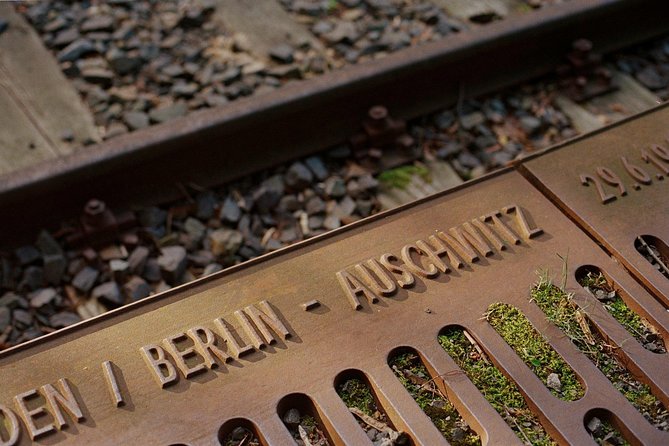
Anhalter Bahnhof was once one of Europe’s largest railway stations. Today, only part of the ruined facade remains, surrounded by modern Berlin.
The station’s size helps you picture the importance of rail travel in nineteenth and early twentieth-century Berlin. During the Nazi period, trains departed from here carrying people toward concentration and extermination camps, especially from 1942 to 1945.
You spend about 10 minutes at the site. It is a brief outdoor stop, and the remaining structure is not a complete station or conventional museum. Its value comes from the contrast between the impressive ruin and the knowledge of what the railway system was used to do.
This is a good example of why a guide matters. On your own, you might see a dramatic old facade and move on. With historical explanation, the site becomes part of the machinery of deportation and a reminder that mass murder depended on ordinary infrastructure, schedules, paperwork, and transport.
Scheunenviertel and Jewish Berlin before the catastrophe
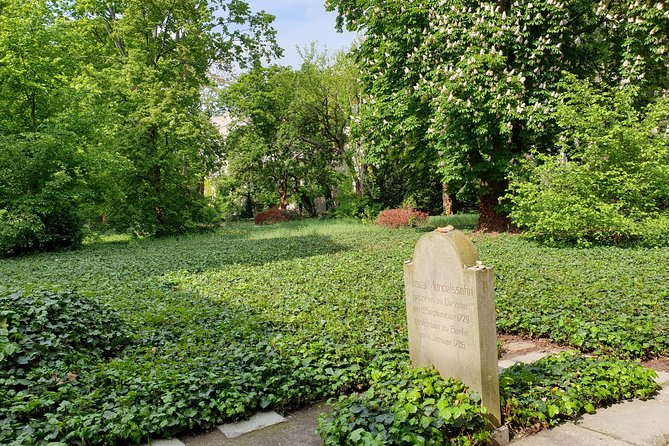
The route then moves into the Scheunenviertel, a part of Mitte often called Berlin’s Jewish Quarter. This section lasts around 45 minutes, making it the longest stop on the tour.
Do not expect a preserved Jewish neighborhood untouched by time. Modern Berlin surrounds the historic sites, and much of the original community has been destroyed or altered. The point is to understand that Jewish Berlin was a living community with schools, religious institutions, intellectual traditions, businesses, and families before Nazi persecution shattered it.
The guide introduces important institutions, including the New Synagogue and the school founded by Moses Mendelssohn. Mendelssohn was an Enlightenment philosopher and a major figure in the modernization of Judaism. That background matters because it shows Jewish life as part of Berlin’s cultural and intellectual development, not simply as a prelude to tragedy.
This portion is likely to appeal most to people who want social history. You hear about the people and institutions affected by Nazi rule, rather than only visiting government buildings and military sites. The longer time allocation also gives your guide room to answer questions.
Otto Weidt’s workshop and one man’s practical resistance
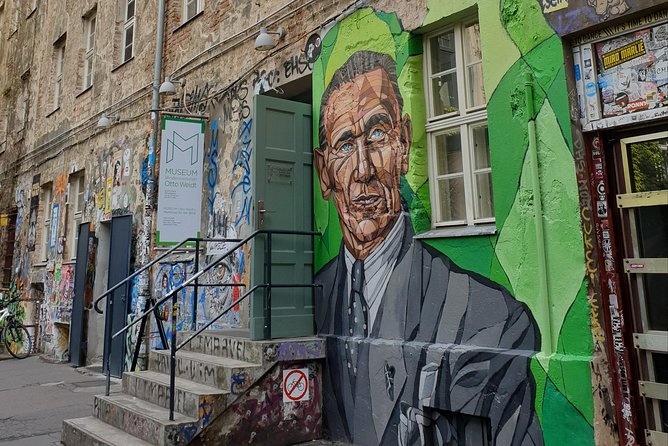
The Museum Blindenwerkstatt Otto Weidt occupies the original location of Otto Weidt’s workshop. Weidt employed Jewish workers, including blind and disabled people, and tried to protect them from deportation to Nazi extermination camps.
He is sometimes called the Schindler of Berlin, though it is better to focus on his own story rather than compare every rescuer to another famous figure. His workshop shows how protection could take place in an ordinary workplace, through personal decisions and persistent effort.
The stop lasts about 15 minutes. The compact visit is useful because the original setting gives the story a physical anchor. You are not hearing only about an abstract rescuer. You are seeing the place where Weidt worked and where his employees were part of the daily life of the business.
For me, this is one of the route’s strongest human stories. It gives the tour a change of scale after the T4 memorial and Anhalter Bahnhof. The Nazi state appears as a system of enormous power, but individual choices still mattered. The guide’s job is to explain both the courage and the danger without turning the story into a simple tale of heroism.
The New Synagogue and the lost Jewish community
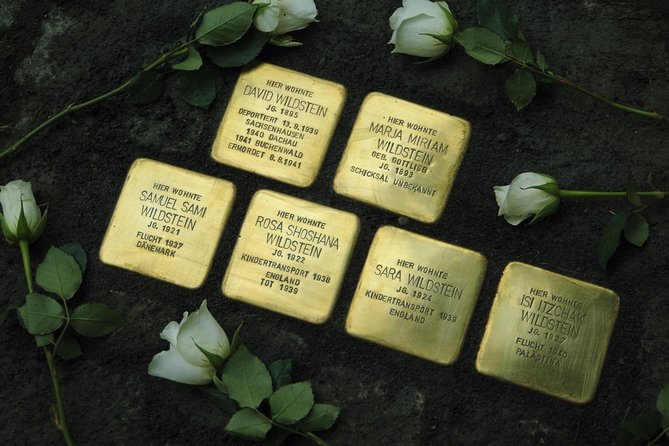
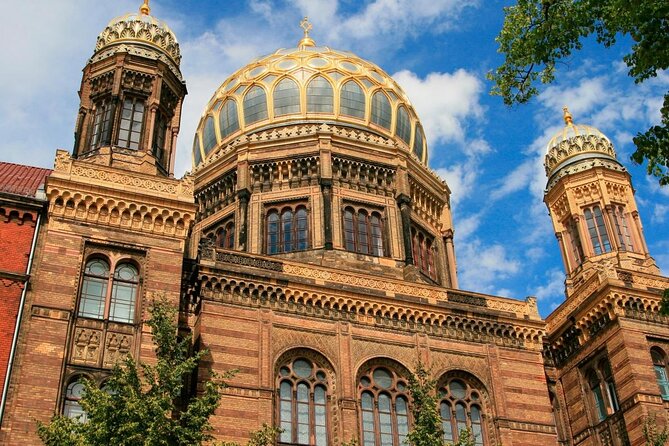
The New Synagogue, or Neue Synagoge, is one of Berlin’s most recognizable Jewish landmarks. Built in 1866, it could seat about 3,200 people and was the largest Jewish place of worship in Germany at the time.
Its size and elaborate design reflected the strength and confidence of Berlin’s Jewish community in the nineteenth century. The building was a major religious and civic landmark, not a small neighborhood prayer room.
The tour allows about 10 minutes here. That short visit should be understood as an introduction to the exterior and the synagogue’s place in Berlin’s Jewish history. The provided tour details do not promise an extended interior visit, so do not plan on a full museum experience within this schedule.
The building is especially useful after the Scheunenviertel stop. You can connect the institution to the larger community that once supported it. The contrast between the synagogue’s former scale and the later destruction of Jewish life gives the guide a clear way to explain what was lost.
The old Jewish cemetery on Hamburger Strasse
The route closes its historical stops at the Old Jewish Cemetery on Hamburger Strasse. It was once the burial place of prominent members of Berlin’s Jewish community and is now the oldest recognizable cemetery in the inner city.
Very little remains of the original cemetery. The Gestapo destroyed it during the Nazi period, so this is not a site where you will see a complete historic burial ground. That absence is the point. The missing stones and damaged place reflect the destruction of memory as well as the destruction of lives.
The stop lasts about 10 minutes. It may feel quieter and less visually dramatic than the New Synagogue, but it carries a different kind of weight. The synagogue shows a community’s public presence. The cemetery shows how even private remembrance was attacked.
Your guide also uses the final section to discuss how Berlin has changed since the war. The city’s memorials do not restore what was destroyed, but they influence how residents and visitors understand the past. Ending near Hackescher Markt places you back in present-day Berlin, where ordinary city life continues around these marked and unmarked sites.
What the three-hour format means for you
The advertised duration is about three hours, but the listed stops add up to roughly 140 minutes. The remaining time is needed for public transport, walking, transitions, and explanations between locations.
That pacing is sensible for a city tour with eight stops. You get a broad view of Nazi Berlin without spending an entire day on one museum. The tradeoff is that most sites receive a short introduction. If you want long museum visits, extensive archival material, or time for private reflection at each memorial, this route may feel rushed.
The group can include up to 20 people. That is still a real group, but it is small enough for the guide to keep people together and respond to questions. Several guides are praised for being clear, warm, and engaging, including Fabio, Paolo, Vita, Federica, Silvio, and Lorenzo. The exact guide is not specified in advance, so the experience may differ in style from one departure to another.
The tour is offered in Italian, which is its main advantage for Italian-speaking visitors. Historical terms, moral questions, and personal stories are easier to follow when explained naturally in your strongest language. Families with older children may also find the format useful. One account specifically describes the tour as meaningful for children aged 10 and 17, though the subject remains serious.
Price, transport, and practical value
At $27.87 per person, the tour is reasonably priced for a three-hour guided history route in central Berlin. You are paying mainly for the guide’s interpretation and the route design, not for paid admissions. All listed stops are free, and local taxes and professional guiding are included.
The public transport cost is extra. You should buy a day card for zones AB before starting, since transport between the sites is not included. Food, drinks, and an optional tip are also separate.
The value depends on how you like to see a city. If you are comfortable researching Nazi Berlin yourself, you can reach many of these places independently for less. But you would need to plan the connections, understand the historical links, and decide how to approach sites that are easy to overlook. The tour saves that preparation and puts the locations into one coherent morning.
The strongest value comes from the Italian explanation and the human stories. A ruin such as Anhalter Bahnhof or a damaged cemetery can be easy to miss without context. A good guide turns each brief stop into part of a larger story.
Who should book this Italian history tour
I would choose this tour if you want a structured introduction to Nazi Berlin, prefer Italian, and have only one morning available. It is also a smart first step before visiting other major memorials because it gives you a framework for understanding them.
It suits adults, history-minded families, and anyone interested in the relationship between Jewish Berlin, Nazi policy, resistance, and postwar memory. The small-group limit is useful if you want to ask questions.
You may want another option if you dislike walking, prefer indoor attractions, or want a narrow focus on military history. This experience is mainly about places, people, and the consequences of dictatorship. It is not a battlefield tour, and it does not include admission to a large museum.
Dress for rain or cold, even in summer, since the tour operates in all weather. Wear practical shoes, allow time to find the blue bicycle at Potsdamer Platz, and remember that the endpoint is Hackescher Markt.
Final call: a strong choice for context, not a casual city walk
I recommend booking this tour if you want to understand how Nazi Berlin affected Jewish life, disabled people, political opponents, and the city itself. Its best features are the Italian language, the range of sites, and the guide-led links between places that can otherwise seem unrelated.
The short stops and extra transport cost are fair tradeoffs for a $27.87 tour, but you should set your expectations correctly. This is a serious, moderately paced introduction, not a full museum day. Free cancellation is available up to 24 hours before the 10 a.m. start, giving you some flexibility if your plans change.
FAQ
What language is the tour conducted in?
The tour is conducted in Italian by an Italian-speaking professional guide.
How long does the tour last?
The tour lasts approximately three hours.
Where does the tour begin?
It begins at Potsdamer Platz 10 in Berlin. Look for the blue Vive Berlin Tours bicycle and the company flag.
What time does the tour start?
The start time is 10 a.m.
Where does the tour end?
The tour ends at Hackescher Markt in central Berlin.
Is public transportation included?
No. Transportation to and from the attractions is not included. You should buy a Berlin public transport day card for zones AB.
What places are visited?
The route includes the German Resistance Memorial Center, the T4 Memorial, Anhalter Bahnhof, the Scheunenviertel, the Museum Blindenwerkstatt Otto Weidt, the New Synagogue, and the Old Jewish Cemetery.
What is the maximum group size?
The tour can have a maximum of 20 participants.
Can I cancel for a full refund?
Yes. You can cancel for a full refund if you cancel at least 24 hours before the experience start time. Cancellations or changes made less than 24 hours before the start are not accepted for a refund.
Just added around Berlin
- eSIM for Germany and 34 European Countries★ 4.5 · 16 reviews
- Your ticket to The Wall Museum Berlin★ 3.0 · 60 reviews
- Walking on the Wall: 3-Hour Tour in Berlin★ 4.5 · 34 reviews
- Rickshaw Tours Berlin – Groups of up to 16 people with several rickshaws★ 4.0 · 97 reviews
- Warnemuende Shore Excursion: Private Berlin Tour★ 4.5 · 27 reviews
- Love and War in Berlin: Self-Guided Story Puzzle Walk★ 5.0 · 7 reviews
- Warnemuende Shore Excursion: Berlin Private Sightseeing Tour from Rostock★ 5.0 · 4 reviews
- Cold War Berlin – Private Live Virtual Experience★ 5.0 · 4 reviews
Berlin Tours, compared.
Reichstag, Dome and Government District Guided Tour
Read our review →
1-Hour City Tour by Boat with Guaranteed Seating
Read our review →
Reichstag, Plenary Chamber, Cupola & Government Tour
Read our review →