
Review · BERLIN TOURS
Berlin and National Socialism: Berlin under Nazism
Berlin’s Nazi-era story is written across the city, not confined to one museum. This four-hour tour connects government buildings, war memorials, former Nazi sites, and places of remembrance so you can understand how power, propaganda, war, and genocide shaped Berlin.
I like the clear historical focus and the chance to cover several major sites in one morning. I also like the Spanish-speaking format, with guides such as Julia, Helena, and Celia praised for detailed explanations, warmth, photographs, videos, and useful Berlin tips.
The main consideration is the pace. You spend only a few minutes at some stops, and the tour uses public transport, with your AB transport ticket not included. Cold or rainy weather can also make the outdoor portions less comfortable.
Key points at a glance
- Four hours across central Berlin: The route links the Bundestag, Soviet War Memorial, Topography of Terror, Führerbunker site, and other important locations.
- Spanish-speaking guidance: Julia, Helena, and Celia have led this experience, with a style focused on context, detail, and respectful treatment of tragic events.
- A useful introduction to the Third Reich: You get the broad story of Nazi Germany rather than visiting one isolated memorial.
- A meaningful look at overlooked victims: The Sinti and Roma memorial adds an essential part of the Nazi genocide that is often missed on a first visit.
- Good value at $25.54: For a roughly four-hour guided route, the price is modest, though you must pay separately for public transport.
- Small enough to remain manageable: The group is limited to 25 people, which is more workable than a large coach excursion.
Why this tour helps you understand Berlin
Berlin can be confusing if you approach its Nazi past as a list of disconnected sights. One memorial recalls Jewish victims. Another honors Soviet soldiers. A former airport points to the city’s role before and during the war. A modern museum documents the machinery of Nazi terror.
This route gives those places a shared frame. You are not simply checking off famous addresses. You are following the political center of Nazi Germany, the war that destroyed much of Berlin, and the effort to remember those crimes in the rebuilt city.
I especially value the focus on explanation. The guides are not there only to point at buildings. Julia, Helena, and Celia are described as using detailed storytelling, photographs, videos, anecdotes, and historical context. That matters at sites where little physical evidence remains.
The subject is serious, and the best guides handle it with care. The feedback associated with this tour repeatedly points to respectful explanations, strong preparation, and a personal style that makes a long morning easier to follow. You can also ask questions and, according to the experience details, receive suggestions for other places to see in Berlin.
A few more Berlin half-days to weigh up
- Berlin: Reichstag, Dome and Government District Guided Tour
★ 4.7 · 18,288 reviews - Berlin: 1-Hour City Tour by Boat with Guaranteed Seating
★ 4.3 · 16,993 reviews - Berlin: Boat Tour Along the River Spree
★ 4.4 · 11,252 reviews
Starting beneath the Berlin TV Tower
The tour begins at Berlin TV Tower, at Panoramastraße 1A, at 10:00 a.m. This is a practical meeting point in the center, near public transportation and easy to recognize.
Starting here places you in the heart of former East Berlin, though the tour itself is concerned mainly with the Nazi period. That contrast is useful. Berlin’s political identity changed more than once during the 20th century, and the city you see today carries traces of the empire, the Nazis, the divided Cold War capital, and reunified Germany.
The opening section should help you get your bearings before the route moves among memorials and historic sites. If you arrive early, allow enough time to find the exact meeting point around the tower and confirm your transport plan. The AB ticket is not included, so you should have the required public transport fare ready before the tour begins.
The Bundestag and the return of parliament
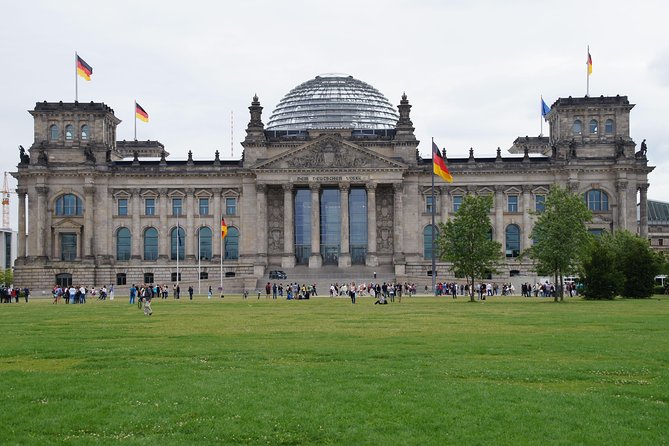
The first stop is the Bundestag, Germany’s modern parliament. You get about 20 minutes here, with no admission charge listed for this part of the visit.
The building’s story is a useful entry point because it connects Nazi Germany with the divided and reunified nation that followed. The Reichstag was damaged during the war and then protected from the elements. It received partial renovation in the 1960s, but a full reconstruction did not begin until after German reunification on October 3, 1990.
Architect Norman Foster led the rebuilding, completed in 1999. The building once again became the meeting place of the German parliament, now called the Bundestag.
Do not expect this stop to be a long interior visit based on the information provided. The value is in seeing the building and learning how its political meaning changed over time. The short stop also gives the guide a chance to explain the collapse of democracy, the Nazi seizure of power, wartime destruction, and Germany’s later return to parliamentary government.
Remembering Sinti and Roma victims
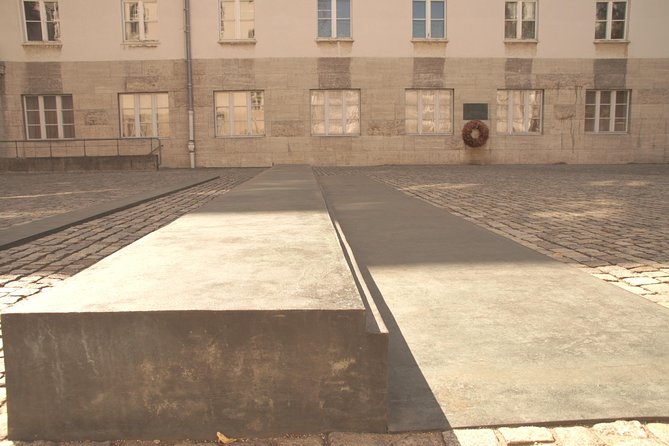
The next stop is the Memorial to the Sinti and Roma Victims of National Socialism. You have about five minutes here, and admission is included.
This is a brief stop, but it carries great weight. The monument remembers the estimated 220,000 to 500,000 Sinti and Roma murdered in Porajmos, the Nazi genocide of European Sinti and Roma people.
You should listen closely here because the short time does not reflect the importance of the subject. Many first-time visitors know the Holocaust mainly through the persecution of Europe’s Jews. Nazi persecution also targeted Sinti and Roma communities, and this memorial makes that part of the story visible.
The stop is best understood as a moment of remembrance rather than a full museum visit. If you want extensive information about the genocide of Sinti and Roma people, you may need to set aside extra time elsewhere in Berlin. On the tour, the guide’s role is to place the memorial within the wider Nazi system of racial persecution.
Same city, a completely different sort of afternoon:
- Discover Berlin Half-Day Walking Tour
★ 5.0 · 9,624 reviews - Berlin: Hop-on Hop-off Bus Tour with Live Commentary
★ 4.3 · 8,579 reviews - Berlin: Government District around the Reichstag Guided Tour
★ 4.7 · 8,447 reviews - Berlin: Reichstag, Plenary Chamber, Cupola & Government Tour
★ 4.6 · 8,422 reviews
The Soviet War Memorial in Tiergarten
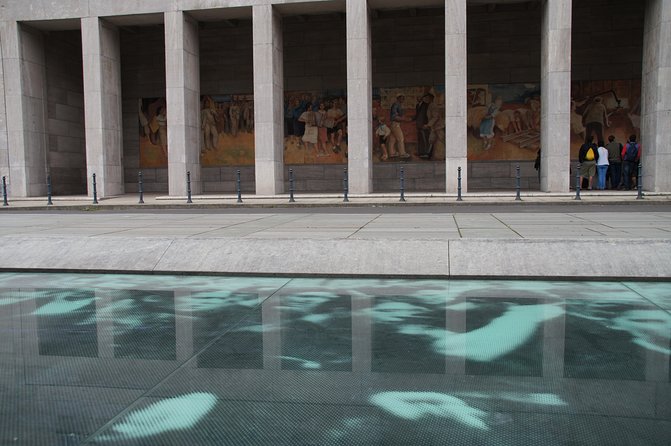
The route then reaches the Soviet Memorial in Tiergarten, with roughly 15 minutes here. There is no separate admission charge.
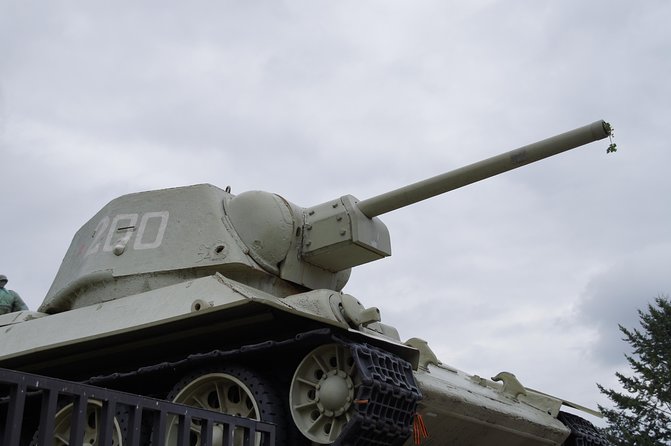
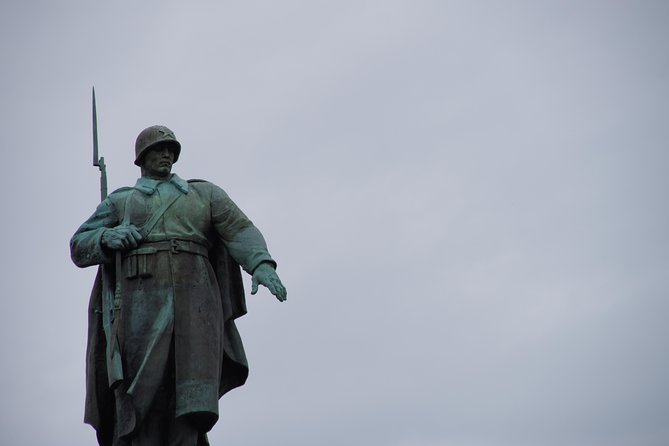
The memorial honors Soviet war dead, especially the roughly 80,000 Soviet soldiers who died during the Battle of Berlin in April and May 1945. Its location and scale help explain the final military phase of the war, when Berlin became a battlefield.
This stop broadens the tour beyond Nazi leadership and German institutions. The story also includes the armies that defeated Nazi Germany and the enormous human cost of the final fighting. The memorial is one of several Soviet war monuments in Berlin, and it remains a reminder that the city’s liberation came through a battle that caused massive destruction.
Fifteen minutes is enough for an explanation and a look around, but not for a detailed study of every feature. You may also find that the open setting leaves you exposed to wind, rain, or cold. Wear shoes suited to walking and dress for the forecast, since much of the morning takes place outdoors.
Tempelhof and Berlin’s aviation story
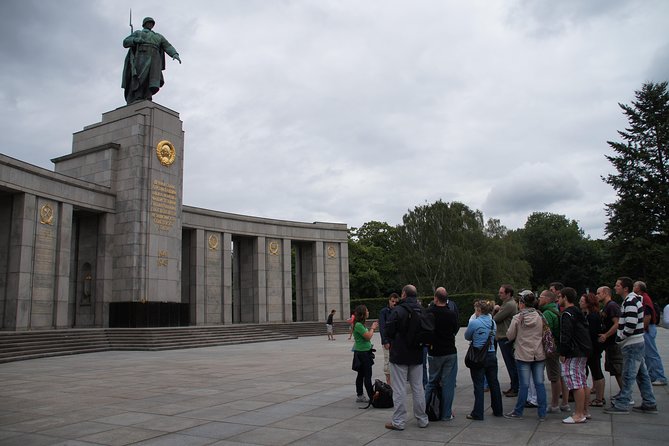
The Tempelhof stop lasts about 25 minutes. The airport was one of the most important in the early 20th century and, in 1926, handled ten flights a day, making it the largest airport in Europe at the time.
This portion adds a different angle to the city’s past. Tempelhof was not simply a wartime site. Its aviation history began before the Nazi era, and its importance shows how modern transport, technology, national ambition, and politics overlapped in 20th-century Berlin.
The tour summary does not promise entry into airport buildings or a dedicated interior tour, so expect an outside explanation and orientation rather than a full architectural visit. That is worth knowing if Tempelhof is your main reason for booking.
Still, the stop helps break up the memorial-heavy route. It gives you a sense of Berlin as a modern capital and lets the guide explain how infrastructure and grand projects fit into the ambitions of the era.
The Topography of Terror
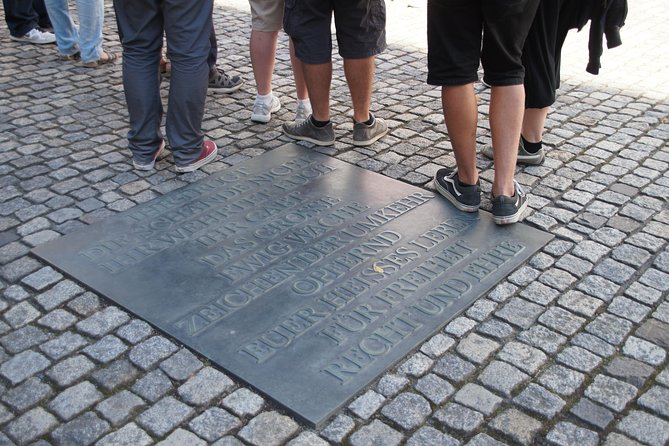
The Topography of Terror is the tour’s main museum stop. You receive admission, and the listed visit lasts about 15 minutes.
The museum has indoor and outdoor sections and is located at a site connected with the Nazi security apparatus. This is where the tour’s broad story becomes more concrete. Instead of focusing only on Hitler and famous military events, the museum helps show the institutions and methods used to enforce Nazi rule.
Fifteen minutes is a short visit for any serious museum, especially one with indoor and outdoor displays. Think of it as a guided introduction, not enough time to read every panel or explore the full exhibition at your own pace.
I would treat this as a useful orientation and plan a separate return visit if you want to study the displays carefully. The included admission adds value, but the schedule limits how much you can absorb. The advantage is that the guide can direct your attention to the parts that matter most for the route’s central story.
The Führerbunker site and the end of the dictatorship
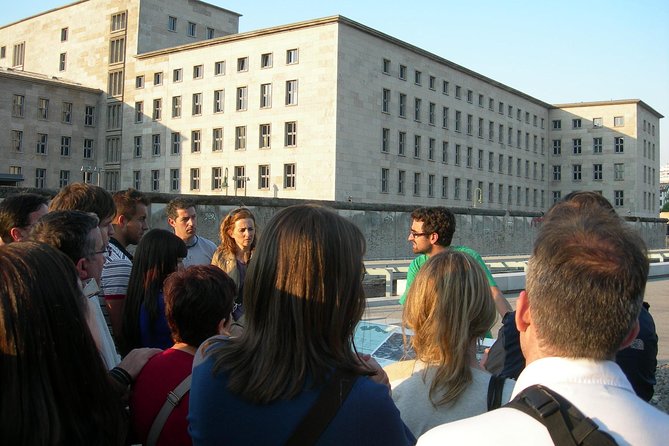
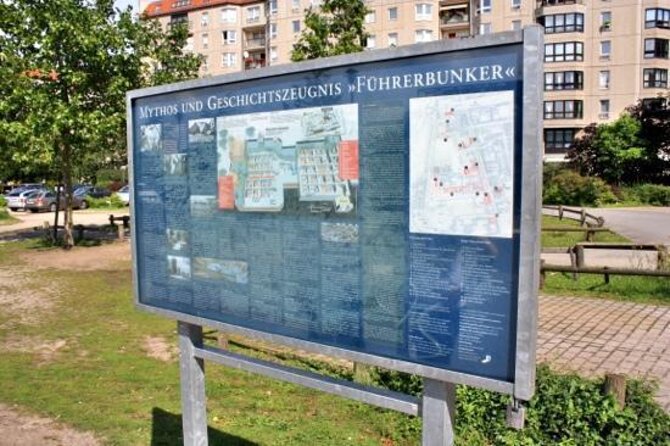
The tour then visits the area of the Führerbunker, where Hitler spent his final hours alive. About 15 minutes are allotted here, and there is no admission charge.
This is one of the most misunderstood places in Berlin. The physical site does not offer a dramatic underground attraction or a preserved room to tour. The point is the location and the historical explanation: the collapse of the Nazi regime, the final days of the war, and the death of Hitler as Soviet forces closed in on Berlin.
A good guide keeps the focus on events and consequences rather than turning the site into a shrine. The available information suggests that this tour treats the subject as part of a wider account of Nazi Germany, rather than as a spectacle centered on one dictator.
The short stop is appropriate because there is little to see on site. You are there to understand what happened and why the location matters. Keep your expectations realistic, and you will find the explanation more valuable than the physical setting.
Ending at the Memorial to the Murdered Jews of Europe
The tour ends at the Memorial to the Murdered Jews of Europe on Cora-Berliner-Straße, close to many central Berlin sights.
Ending here gives the morning a solemn final focus. The memorial is one of Berlin’s best-known places of remembrance, and its location near the former centers of Nazi power makes it a fitting place to pause after the route.
The tour information does not specify a guided interior visit to the memorial’s underground Information Centre, so you should not assume that this is included. If you want to visit that part, check its opening details separately and allow extra time after the tour.
The end point is practical as well as meaningful. From here, you can continue exploring central Berlin, visit nearby museums, or return to another site for a longer look. Since the guide may offer additional suggestions, keep a note on your phone for places you want to add later.
What the $25.54 price really gives you
At $25.54 per person, this is a low-cost way to organize a four-hour introduction to Nazi-era Berlin. You receive a Spanish-speaking guide, admission to the included sites, and a planned route linking places that would be harder to connect on your own.
The value comes mainly from the guide. Several of the stops are free, and some are short, so you are not paying for a series of expensive entry tickets. You are paying for historical structure, transport between locations, and explanations that help the sites make sense.
You should budget extra for the AB public transport ticket. That cost is not included, and the route depends on getting around Berlin rather than remaining in one compact walking zone.
The modest price also makes this a good choice early in a Berlin visit. You can use the morning to learn the basic story, then decide which museums or memorials deserve a longer return visit. At an average booking lead time of 36 days, planning ahead is sensible if your dates are fixed.
Pace, group size, and weather
The group can include up to 25 people. That is not a private tour, but it is more manageable than a large bus group. You should still expect to stand close to the guide and move between stops at a steady pace.
The itinerary includes six listed stops and lasts about four hours. The time is spread unevenly: 25 minutes at Tempelhof and 20 minutes at the Bundestag, but only five minutes at the Sinti and Roma memorial and 15 minutes at several other locations.
That pattern favors breadth over long reflection. I would choose this tour if you want a strong first framework for the period. I would not choose it as your only experience if you prefer to spend an hour at each museum, read every display, or take long quiet pauses at memorials.
Most people can participate, and the tour is near public transportation. Still, you should expect outdoor walking and changing conditions. One account describes a tour continuing through cold rain and even a brief snowfall, so a warm waterproof layer is a sensible addition.
The guide makes the difference
The guide is the most important variable in this experience. Julia is described as using photographs and videos to place you in the period, while Helena is praised for making a four-hour route feel engaging and for explaining difficult material in a clear, friendly way.
Celia is noted for warmth, historical depth, practical Berlin advice, and a respectful approach to tragic events. The guides may vary by departure, so you should not assume that you will receive a specific person. Still, the repeated appearance of Julia, Helena, and Celia gives you a useful idea of the team’s approach.
I like that the experience is offered in Spanish. Berlin’s 20th-century story includes many dates, political changes, organizations, and place names. Hearing the explanation in a language you understand well can make the difference between collecting facts and truly following the chain of events.
The strongest benefit is the combination of preparation and human delivery. Expect explanations, questions, anecdotes, and suggestions for continuing your visit. Do not expect a silent sightseeing ride or a purely academic lecture.
Who should book it
I would recommend this tour to you if you are visiting Berlin for the first time and want a structured introduction to the Third Reich. It is also a good fit if Spanish is your preferred language, if you enjoy history but do not know where to begin, or if you want to connect several central sites in one morning.
It suits curious adults, history students, and anyone trying to understand how Berlin remembers Nazi crimes. The route also works well for people who want practical advice from a local guide while learning the city’s historical layout.
You may want a different plan if you dislike public transportation, need long periods indoors, or prefer a slower visit with extensive museum time. The route is serious, sometimes emotionally difficult, and partly outdoors. It is not a light sightseeing loop dressed up as history.
The free cancellation policy is helpful if your schedule is uncertain: you can cancel for a full refund up to 24 hours before the start time. Changes or cancellations inside that window are not accepted for a refund.
Should you book Berlin under Nazism?
Book it if you want context, coverage, and a Spanish-speaking guide at a modest price. The tour connects major places that otherwise can feel scattered, and its guides are praised for detail, empathy, visual aids, and useful advice for the rest of your stay.
Just keep the limits in mind. Some stops are brief, admission is not included everywhere because several locations are outdoor sites, public transport costs extra, and a four-hour route cannot replace a full museum day.
For most first visits, I see this as a strong starting point. Use it to understand the city’s Nazi-era geography, then return on your own to the Topography of Terror or other memorials where you want more time.
FAQ
How long does the tour last?
The experience lasts approximately four hours.
What time does the tour start?
The tour starts at 10:00 a.m.
Where does the tour begin?
It begins at the Berlin TV Tower, Panoramastraße 1A, 10178 Berlin, Germany.
Where does the tour end?
It ends at the Memorial to the Murdered Jews of Europe, Cora-Berliner-Straße 1, 10117 Berlin, Germany.
Is the tour conducted in Spanish?
Yes. A Spanish-speaking guide is included.
Which places are visited?
The route includes the Bundestag, the Memorial to the Sinti and Roma Victims of National Socialism, the Soviet Memorial in Tiergarten, Tempelhof, the Topography of Terror, and the area of the Führerbunker.
Is public transportation included?
No. Your AB public transport ticket is not included in the tour price.
How many people can join the tour?
The maximum group size is 25 people.
Can I cancel for a full refund?
Yes. You can cancel at least 24 hours before the experience start time for a full refund. Cancellations or changes made less than 24 hours in advance are not accepted for a refund.
Just added around Berlin
- eSIM for Germany and 34 European Countries★ 4.5 · 16 reviews
- Your ticket to The Wall Museum Berlin★ 3.0 · 60 reviews
- Walking on the Wall: 3-Hour Tour in Berlin★ 4.5 · 34 reviews
- Rickshaw Tours Berlin – Groups of up to 16 people with several rickshaws★ 4.0 · 97 reviews
- Warnemuende Shore Excursion: Private Berlin Tour★ 4.5 · 27 reviews
- Love and War in Berlin: Self-Guided Story Puzzle Walk★ 5.0 · 7 reviews
- Warnemuende Shore Excursion: Berlin Private Sightseeing Tour from Rostock★ 5.0 · 4 reviews
- Cold War Berlin – Private Live Virtual Experience★ 5.0 · 4 reviews
Berlin Tours, compared.

Reichstag, Dome and Government District Guided Tour
Read our review →
1-Hour City Tour by Boat with Guaranteed Seating
Read our review →




Reichstag, Plenary Chamber, Cupola & Government Tour
Read our review →