
Review · BERLIN TOURS
Berlin: 4-Hour Guided Highlights Tour in Spanish
Berlin’s story makes the most sense when you walk it in sequence, from medieval beginnings to Nazi rule, the Berlin Wall, and reunification. This four-hour Spanish-language tour links the city’s major sights with the human stories behind them, including how East Berliners lived with a concrete border running through their neighborhoods.
I like the route for two reasons: it covers a useful first-day sweep of central Berlin, and guides such as Evelyn, Celia, and Constantino bring a clear, personal tone to difficult subjects. I also like the practical pause of about half an hour for coffee, a bathroom break, and rest. The main consideration is simple: this is a walking tour in Spanish only, and four hours on foot can feel long in cold, wet, or snowy weather.
Key points at a glance
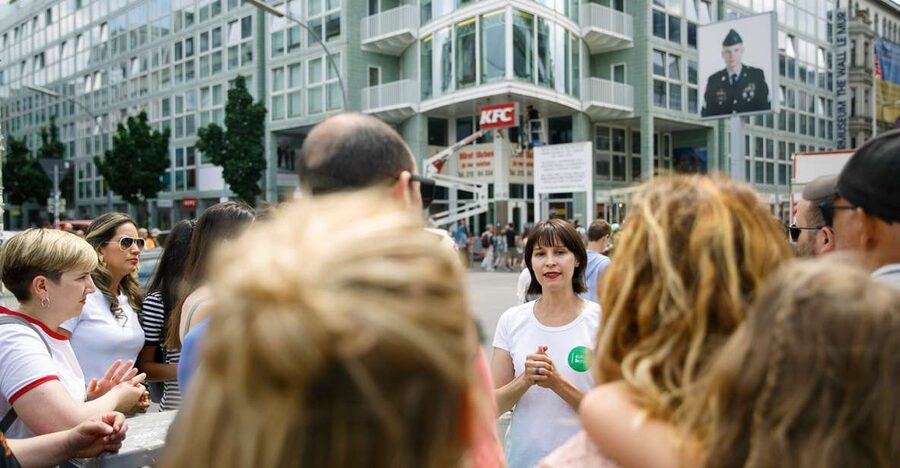
- Start at Alexanderplatz: Meet beside the TV Tower, near Espresso House and the green Spanish tours flag.
- Follow Berlin’s story in order: Begin in the San Nicolas neighborhood, then move through Prussian, Nazi, Cold War, and modern Berlin.
- See top central sights from outside: The route includes Museum Island, Berlin Cathedral, Gendarmenmarkt, Potsdamer Platz, and the Brandenburg Gate.
- Take on serious history: Hear why Hitler rose to power, what happened at the Gestapo headquarters, and why the Wall was built.
- Expect a Spanish-speaking guide: Evelyn, Celia, and Constantino are among the named guides connected with this experience.
- Plan for four hours outdoors: Wear comfortable clothing, and remember that tours run rain or shine.
Starting at Alexanderplatz beneath the TV Tower
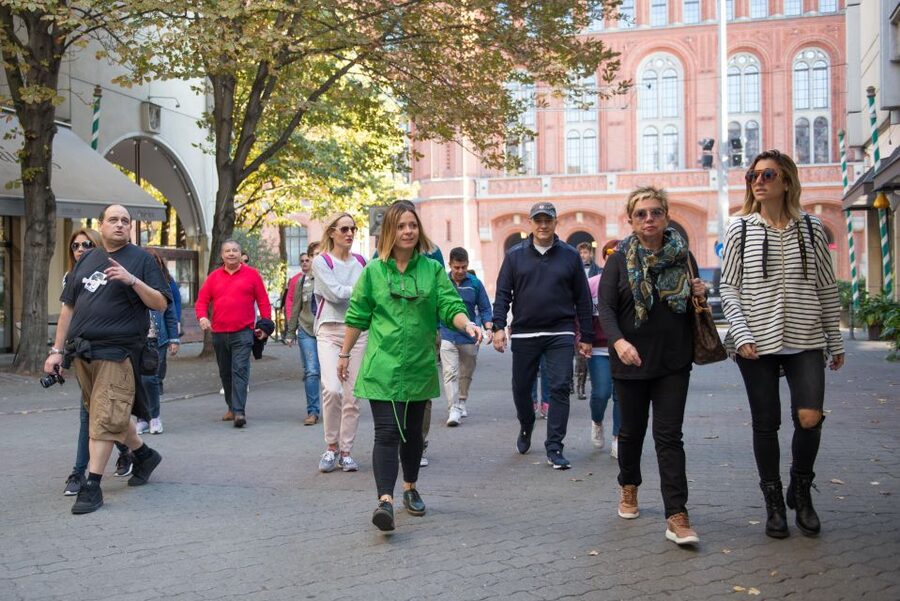
The meeting point is easy to recognize once you know what to look for. You’ll meet beside the only entrance to the TV Tower, called the Fernsehturm, between the tower and Alexanderplatz railway station. Look for the green flag marked tours en español, next to Espresso House.
Alexanderplatz is a fitting place to begin. It feels broad, modern, and shaped by East German planning, yet it also sits near some of Berlin’s oldest roots. Your guide uses this contrast to set up the city’s larger story: Berlin is not one polished historic center, but a place repeatedly rebuilt, divided, and reshaped.
The tour starts every day at 10:00. Arrive early enough to find the flag without rushing, especially if you are unfamiliar with the station. Alexanderplatz has several exits and a steady flow of people, so the details of the meeting point matter.
A few more Berlin half-days to weigh up
- Berlin: Reichstag, Dome and Government District Guided Tour
★ 4.7 · 18,288 reviews - Berlin: 1-Hour City Tour by Boat with Guaranteed Seating
★ 4.3 · 16,993 reviews - Berlin: Boat Tour Along the River Spree
★ 4.4 · 11,252 reviews
San Nicolas and the beginnings of Berlin
The first walk leads toward the San Nicolas neighborhood, where the guide introduces Berlin’s early origins. This gives you a useful counterweight to the familiar images of the Wall and the Brandenburg Gate. Before Berlin became the capital of a powerful kingdom, a Nazi dictatorship, and a divided nation, it began as a much smaller settlement along the River Spree.
I like starting here because it prevents the tour from treating Berlin as only a 20th-century city. The early part is also a gentle way to settle into the walking pace before the itinerary reaches its heaviest subjects.
The tour does not advertise interior visits to museums or monuments, so you should think of this as an outdoor introduction. You’ll see the urban setting and hear the story in place, but you should not expect time for a museum collection or a full visit inside Berlin Cathedral.
Museum Island and the Berlin Cathedral
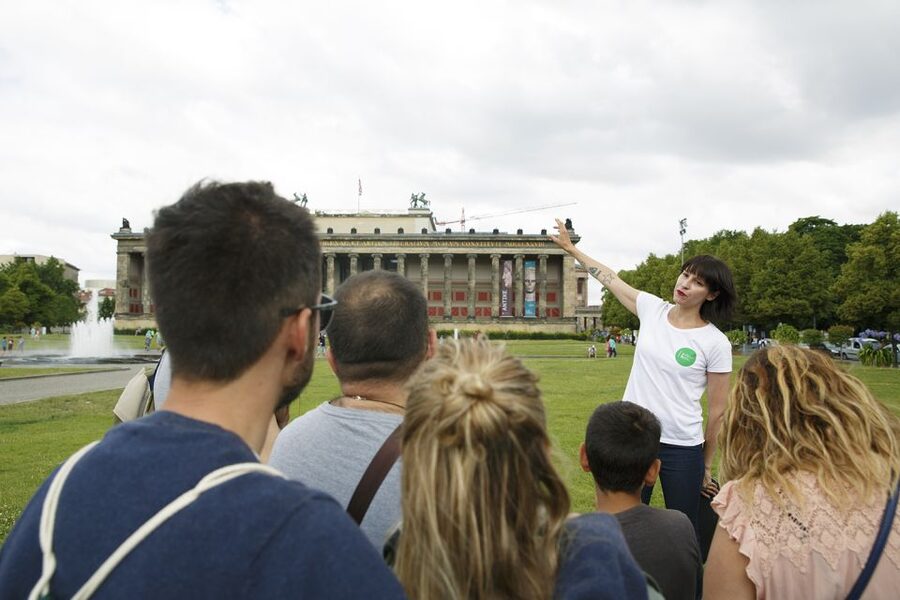
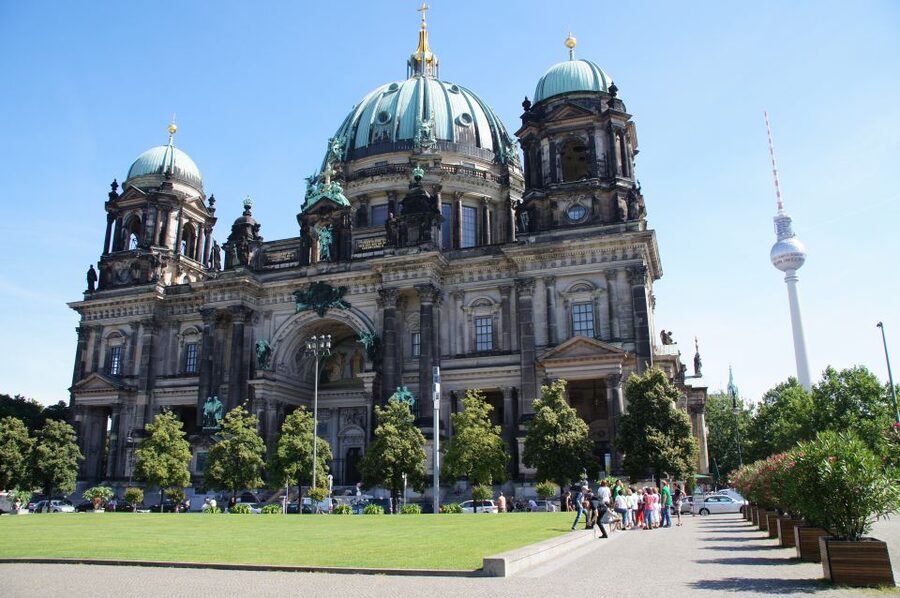
From San Nicolas, the route continues toward Museum Island, a UNESCO World Heritage Site. The island gathers several major museums in one compact area and offers one of Berlin’s grandest views of the River Spree and the Berliner Dom.
The cathedral’s dome and elaborate façade make an obvious photo stop, but the guide’s historical explanation is the real value here. You’ll learn how this part of Berlin became a center of royal, religious, and cultural power. If you want to visit the cathedral or museums inside, plan a separate block of time on another day. Four hours is enough for the outside story, not for a full museum visit.
This is one place where comfortable shoes help. The tour moves through a central district with many sights close together, but the total route continues for several hours. I would not choose dress shoes simply because you want a good photo at the cathedral.
Unter den Linden and Berlin’s Prussian showpiece
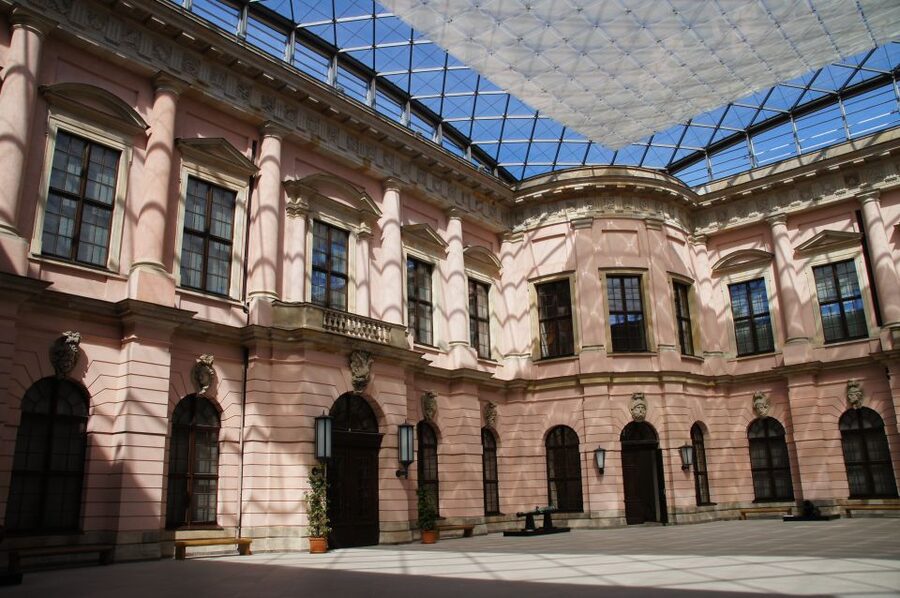
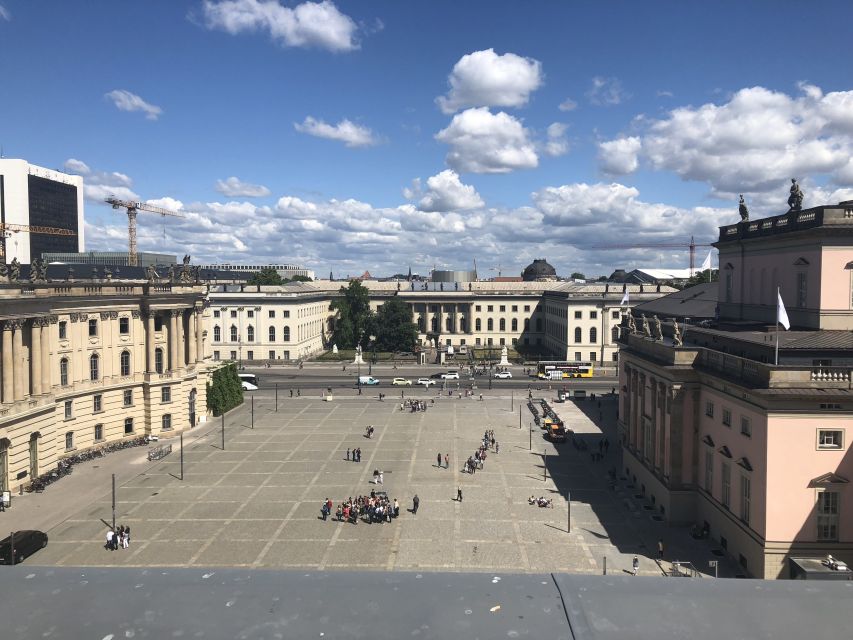
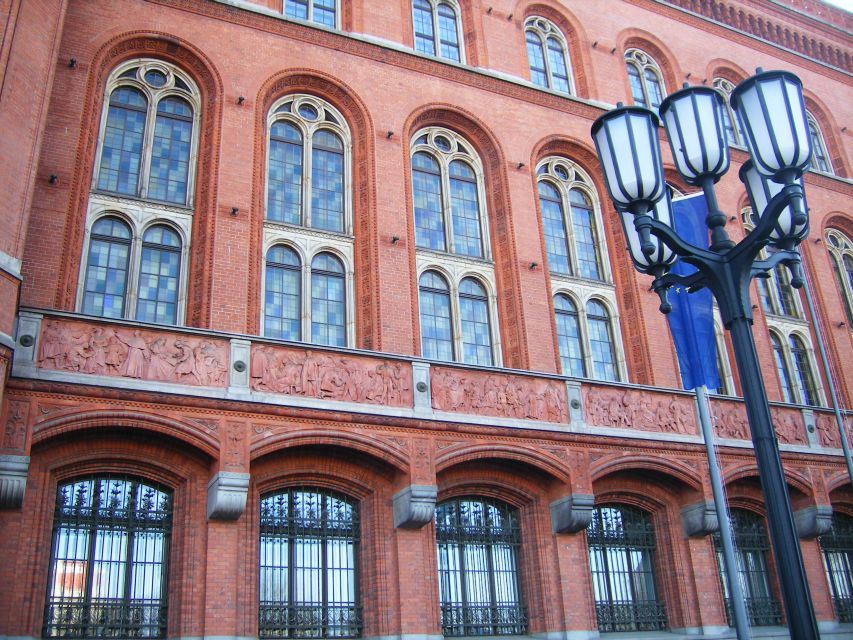
The walk then follows Unter den Linden, Berlin’s grand boulevard. Along the way, you pass Humboldt University, the former Royal Library, and the State Opera. This stretch explains how Berlin presented itself as a capital of learning, monarchy, administration, and ceremony.
The avenue also helps you read the city’s architecture. Some buildings are original, some were rebuilt, and others reflect later political eras. Your guide can connect these layers in a way that a quick self-guided walk might miss.
The itinerary describes this portion as Kaisers Avenue, an old reference to the boulevard’s imperial character. Keep your attention on the changing façades and public spaces rather than expecting one single monument to carry the section. It works best as a guided walk through Berlin’s political center.
Same city, a completely different sort of afternoon:
- Discover Berlin Half-Day Walking Tour
★ 5.0 · 9,624 reviews - Berlin: Hop-on Hop-off Bus Tour with Live Commentary
★ 4.3 · 8,579 reviews - Berlin: Government District around the Reichstag Guided Tour
★ 4.7 · 8,447 reviews - Berlin: Reichstag, Plenary Chamber, Cupola & Government Tour
★ 4.6 · 8,422 reviews
Gendarmenmarkt and the half-hour pause
Gendarmenmarkt is one of central Berlin’s most handsome squares, framed by the French Cathedral, the German Cathedral, and the Konzerthaus. The tour includes time for photographs here, and it is a natural place to pause and take in the scale of the square.
A break of about half an hour is also part of the experience according to the tour details supplied by recent participants. You can use it for coffee, a bathroom stop, or simply a rest from the pavement. That pause matters more than it might sound. Four hours is a serious walk, and a short reset helps you stay focused when the tour turns to Nazi Germany and the Cold War.
The exact rhythm can vary by guide and group. You should still bring water and dress for the weather rather than relying entirely on the break. The tour operates rain or shine, and winter conditions can be demanding. One February outing continued through cold and snow, so warm layers are not optional if you visit in that season.
Hitler’s rise and the former Gestapo headquarters
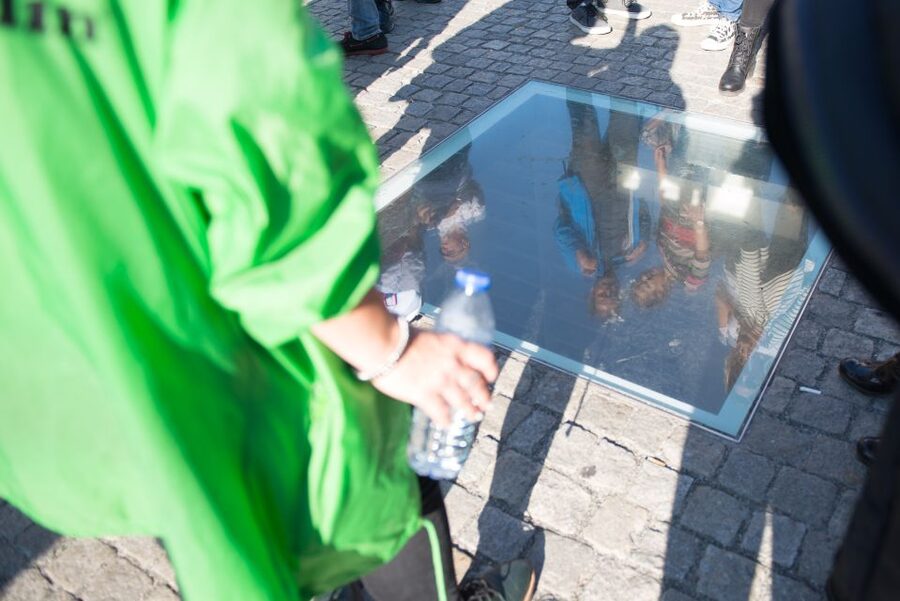
The route next moves into the Nazi period. You’ll hear how Hitler rose to power and see the remains of the Gestapo headquarters. This part is not treated as a parade of famous buildings. Much of the physical evidence has disappeared, which makes the guide’s explanation especially important.
The site helps show how terror operated through offices, police structures, and government power, not only through battlefields. You’ll hear about the machinery behind Nazi rule while standing in the city center where political decisions affected all of Germany.
This section can feel compressed because the tour covers a large amount of history. A good guide needs to explain the sequence clearly without turning the walk into a lecture. Celia, one of the named guides, is specifically associated with encouraging debate and reflection, which suits this part of the route. You’ll get more from the stop if you are willing to ask questions rather than simply collect dates.
The Memorial to the Murdered Jews of Europe
The Holocaust Memorial is one of Berlin’s most powerful modern sites. Its field of concrete slabs creates a changing sense of height, direction, and confinement as you move through it. The tour uses the memorial to remember the Jewish victims of the Holocaust and to place Nazi crimes in the city’s present-day setting.
Your guide can provide the historical frame, but allow yourself a quiet moment here. The memorial is not just another photo stop. The experience changes as you walk among the blocks, and the meaning is personal as well as historical.
This stop also shows why a walking tour can be more useful than a simple bus circuit. You reach the memorial on foot, after hearing about the Nazi government and its institutions, then continue directly into the story of postwar division. The sequence connects events that can otherwise seem like separate chapters.
Understanding the Berlin Wall from both sides
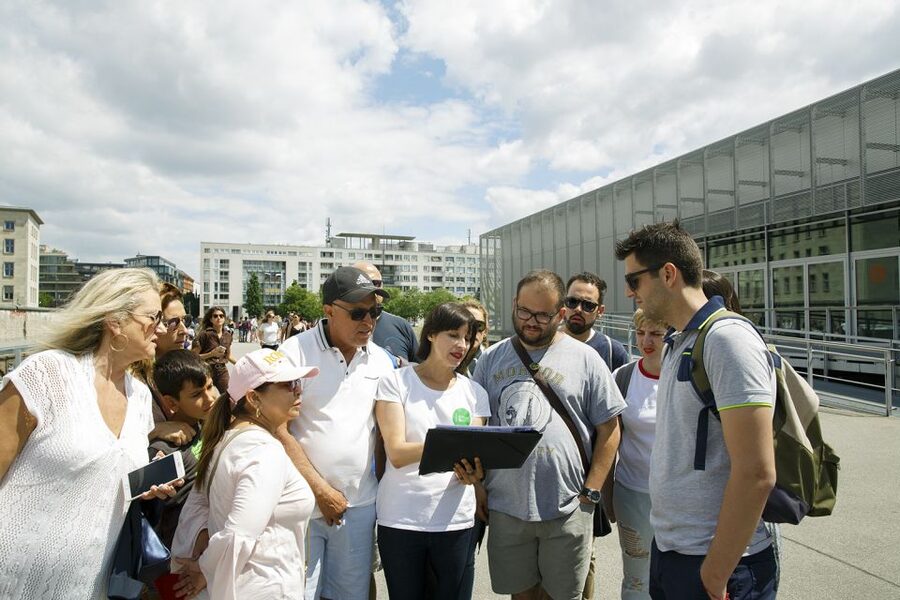
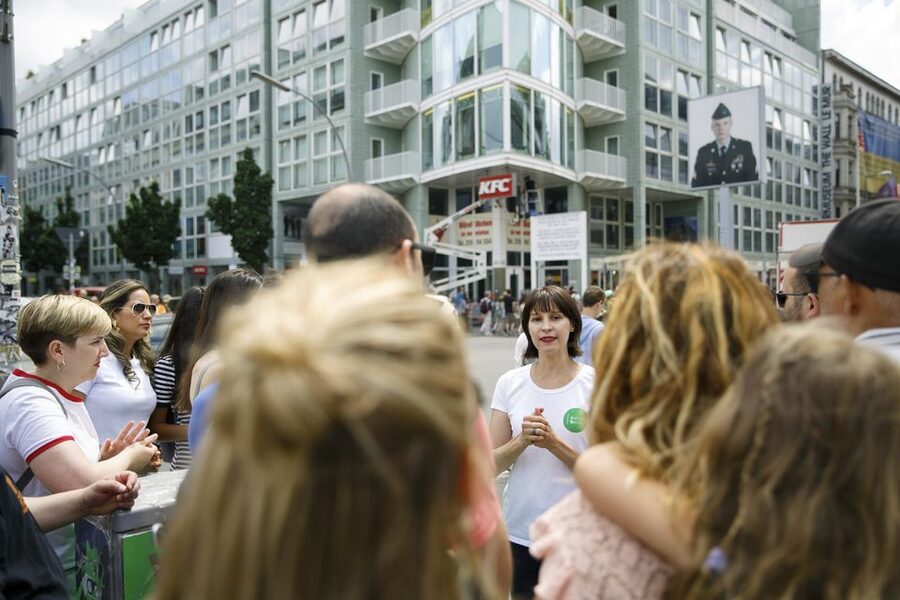
The Cold War section is the heart of the tour. You’ll learn why the Berlin Wall was constructed, how it divided East and West Berlin, and why it eventually fell. The guide also explains everyday life on both sides, which is often more revealing than a list of dates.
The most useful part is the human scale. You’ll hear about East Germans who risked their lives to reach West Berlin and about the daily reality of families, streets, workplaces, and neighborhoods split by the border. The Wall was not simply a line on a map. It interrupted routines and separated people who could sometimes see one another but could not freely meet.
I like that the route includes both the birth and collapse of the Wall. You are not left with the vague idea that it appeared because of a general East-West argument. The guide explains the political reasons for its construction, then shows how pressure, protest, and changing conditions led to its fall.
The tour’s bilingual limitation is also a strength here if Spanish is your comfortable language. Complex political history is easier to follow when you can ask questions and catch the small distinctions between East Germany, West Berlin, the Federal Republic, and the Soviet-backed state.
Potsdamer Platz and the modern city
Potsdamer Platz provides a sharp change of mood. Once divided by the Wall and badly damaged by war, it became a showcase for modern Berlin. The large contemporary buildings and open public spaces give you a sense of how the reunited city wanted to present itself.
The stop is valuable because it makes reunification visible. You move from border stories and Cold War tension into a district shaped by redevelopment and new construction. At the same time, do not expect Potsdamer Platz to feel like old Berlin. Its appeal is its modern character and its place in the city’s recent story, not traditional architecture.
This is also a good point for photos. The tour has already taken you through royal avenues, memorial spaces, and political sites, so the modern skyline adds variety before the final landmark.
Ending at the Brandenburg Gate
The tour finishes at the Brandenburg Gate, Berlin’s best-known symbol. Once tied to Prussian power, later used in Nazi imagery, and then isolated near the Berlin Wall, the gate now represents a reunited city.
Ending here gives the route a clear shape. You begin near Alexanderplatz, with its East Berlin associations, and finish at a landmark that has witnessed several versions of Germany. By this point, the Brandenburg Gate should mean more than a famous arch. You’ll have heard how Berlin’s political meaning changed around it.
The ending is practical, too. You are left in one of central Berlin’s main sightseeing areas, close to other important attractions. The tour does not include a return transfer, so arrange your next stop from the Brandenburg Gate or use public transport afterward.
What the $29 price gets you
At $29 per person, this is a strong value if you want a broad introduction to Berlin with a live Spanish-speaking guide. Four hours of guiding across central Berlin would cost more if booked as a private experience, and the route includes many of the places you would otherwise need to organize yourself.
The value is not in admission tickets. There are no listed entries into the museums, cathedral, or memorial buildings. You are paying for the route, the explanations, and the connections between sites. That is a good trade if you have limited time or find Berlin’s 20th-century history hard to organize on your own.
A private group is available, and hotel-lobby pickup can be requested as an optional service. Those choices may change the price, so compare the final booking details if you want a more personal setup. The standard experience is a guided walking tour beginning at Alexanderplatz.
The tour has a rating of 4.8 from 164 reviews, and the strongest praise centers on clear explanations, warm communication, and patience with slower walkers. Evelyn is described as especially clear and attentive, while Celia is noted for making difficult history open to discussion. Constantino also receives praise, and the coffee break is a useful feature for a long route.
Who should book this Spanish walking tour?
I would recommend it to you if:
- You want your first look at Berlin explained in Spanish.
- You have about four hours and want the major central sights in one route.
- You care about the reasons behind the Berlin Wall, not only the surviving fragments.
- You are traveling with family members who know little about Berlin.
- You prefer walking and outdoor sightseeing to a bus-only overview.
- You want a low-cost orientation before choosing museums and longer visits.
It may not suit you if you want extensive time inside museums, a short tour with minimal walking, or a guide in English or another language. The itinerary is full, and the serious historical sections require attention.
Families can benefit from the clear sequence, especially if different generations are trying to understand Berlin together. The tour has also worked well for people walking at a slower pace, but you should still wear comfortable clothes and prepare for four hours outside.
Practical details before you reserve
The tour runs every day at 10:00 and operates in all weather. Bring comfortable clothing, and add warm layers, waterproof gear, and suitable shoes if the forecast is poor. A cold, snowy day will not automatically cancel the walk.
The experience is offered only in Spanish. Confirm that every person in your group can follow a Spanish-language explanation before booking. If Spanish is your first or strongest language, that restriction becomes an advantage because the guide can handle sensitive topics with more detail and nuance.
Wheelchair access is available, and a private group option can be arranged. Hotel pickup at your lobby is optional. Free cancellation is available up to 24 hours before the start time, and you can reserve now and pay later, which helps if your Berlin schedule is still changing.
Should you book it?
Book this tour if you want a well-priced Spanish introduction to Berlin’s major sights and difficult history in one morning or afternoon-length outing. Its best feature is the way it links places that are often visited separately: medieval Berlin, Prussian power, Nazi terror, the Holocaust Memorial, the Wall, Potsdamer Platz, and the Brandenburg Gate.
I would skip it only if your priority is indoor sightseeing or a very relaxed pace. For everyone else, the combination of strong route coverage, Spanish-speaking guides such as Evelyn, Celia, and Constantino, and a useful rest break makes $29 a sensible first step into Berlin.
FAQ
Where does the Berlin walking tour begin?
It begins at the TV Tower, or Fernsehturm, in Alexanderplatz. Meet beside the only entrance to the tower, between the tower and Alexanderplatz railway station, next to Espresso House and a green flag marked tours en español.
What time does the tour start?
Tours begin at 10:00 every day. You should check availability for the exact starting time when reserving.
Is the tour offered in English?
No. This experience is offered only in Spanish and includes a live Spanish-speaking guide.
How long does the tour last?
The walking tour lasts four hours. An approximate half-hour pause may be included for coffee, a bathroom stop, and rest.
Which Berlin sights are included?
The route includes Alexanderplatz, the San Nicolas neighborhood, Museum Island, Berlin Cathedral, Unter den Linden, Humboldt University, the former Royal Library, State Opera, Gendarmenmarkt, the former Gestapo headquarters, the Memorial to the Murdered Jews of Europe, Potsdamer Platz, and the Brandenburg Gate.
Does the tour explain the Berlin Wall?
Yes. You’ll hear why the Wall was built, how it divided Berlin, why it fell, and how people lived on both sides. The tour also covers East Germans who risked their lives trying to reach West Berlin.
Is the tour wheelchair accessible?
Yes, the activity is listed as wheelchair accessible. Private groups and optional hotel-lobby pickup are also available.
Just added around Berlin
- eSIM for Germany and 34 European Countries★ 4.5 · 16 reviews
- Your ticket to The Wall Museum Berlin★ 3.0 · 60 reviews
- Walking on the Wall: 3-Hour Tour in Berlin★ 4.5 · 34 reviews
- Rickshaw Tours Berlin – Groups of up to 16 people with several rickshaws★ 4.0 · 97 reviews
- Warnemuende Shore Excursion: Private Berlin Tour★ 4.5 · 27 reviews
- Love and War in Berlin: Self-Guided Story Puzzle Walk★ 5.0 · 7 reviews
- Warnemuende Shore Excursion: Berlin Private Sightseeing Tour from Rostock★ 5.0 · 4 reviews
- Cold War Berlin – Private Live Virtual Experience★ 5.0 · 4 reviews
Berlin Tours, compared.

Reichstag, Dome and Government District Guided Tour
Read our review →
1-Hour City Tour by Boat with Guaranteed Seating
Read our review →




Reichstag, Plenary Chamber, Cupola & Government Tour
Read our review →