
Review · BERLIN TOURS
Alternative Berlin Bike Tour – Off the Beaten Tracks in Small Groups
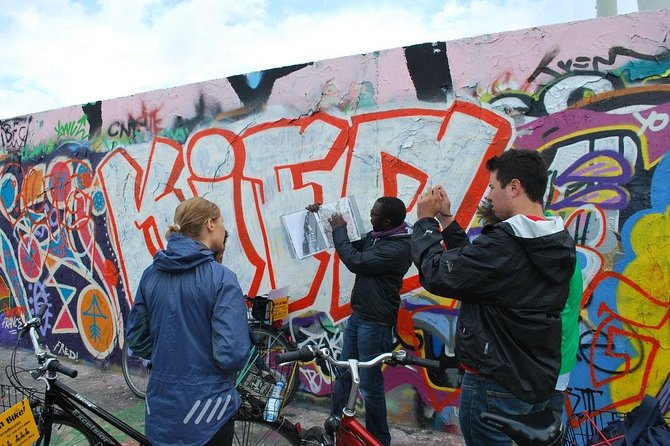
Berlin’s alternative side is best understood from a bicycle seat. This 3.5-hour ride moves beyond the postcard center into Friedrichshain and Kreuzberg, where former industrial sites, Soviet apartment blocks, political graffiti, artist spaces, parks, and everyday neighborhoods sit close together.
I like the small maximum group of 14, which means less time waiting for a long line of cyclists to gather. I also like the guides’ personal connection to Berlin’s creative scene. Anna, Marcus, Paul, George W., Lauren, Maria, and others have brought local stories and personal experience to the route. The main caution is traffic: Berlin is fairly flat and bike-friendly in many places, but city streets can still feel stressful, especially for a younger child or a rider who is not comfortable cycling in traffic.
Key points at a glance
- Ride through Friedrichshain and Kreuzberg: See neighborhoods most classic city tours skip.
- Mix old East Berlin with today’s creative culture: Karl-Marx-Allee, the Berlin Wall, RAW Tempel, and street art all fit into one route.
- Hear personal stories from local guides: Guides such as Anna and Marcus add lived experience to the history and art.
- Use a bike and helmet at no extra charge: You do not need to arrange a rental before arriving.
- Expect a steady, moderately active ride: Berlin is flat, but the tour lasts about three and a half hours.
- Return to the Kulturbrauerei: The tour begins and ends at the Berlin on Bike depot in Prenzlauer Berg.
Why this route shows a more useful Berlin
Many first-time Berlin tours focus on major landmarks and the broad outline of 20th-century history. This ride takes a different approach. It uses the spaces between the headline sights to explain how Berlin became a city associated with experimentation, political debate, street art, nightlife, and alternative living.
You pedal through Friedrichshain, a former East Berlin district with an unconventional feel, then cross toward Kreuzberg. Along the way, you see grand Socialist-era architecture, former railway and industrial sites, open-air art, parks, clubs, and ordinary residential streets. The route is not simply a collection of photo stops. Its value comes from seeing how these very different parts of Berlin fit together.
I especially like the balance of riding and short pauses. The listed stops are brief, often around five minutes, but the ride itself gives you time to absorb the neighborhoods at street level. You are not sealed inside a bus or hurried from monument to monument. You notice courtyards, painted walls, changing storefronts, and the shift from one district to another.
The English-speaking guides are an important part of the experience. Anna is praised for her knowledge of the alternative scene and for connecting well with adults and children. Marcus is noted for using personal stories to bring places to life. Other guides, including Paul, Lauren, George W., Maria, and Edgar, have also led the route. The exact guide depends on the departure date, but the format favors a personal, conversational style.
More bike days around Berlin:
- Berlin: Sights and Highlights Bike Tour with a Local Guide
★ 4.8 · 2,698 reviews - Berlin Highlights 3-Hour Bike Tour
★ 5.0 · 948 reviews - Berlin City Bike Tour with Beer Garden Stop
★ 5.0 · 917 reviews
Starting among brick courtyards at Kulturbrauerei
The ride begins at Berlin on Bike, at Knaackstraße 97 in the Kulturbrauerei complex. This is a practical meeting point in Prenzlauer Berg, close to public transportation and easy to reach without a hotel transfer.
Kulturbrauerei is more than a bike depot. The large 25,000-square-meter complex is a preserved late-19th-century industrial ensemble, with brick buildings and interior courtyards. It has been protected since 1974 and is one of Berlin’s better-preserved industrial monuments from that period.
That makes it a fitting place to begin. Before you even start pedaling, you are in a part of Berlin where old industrial buildings have found new uses. The contrast between the historic brick complex and the alternative districts later in the route helps set the tone.
The scheduled start is 3:00 p.m. Plan to arrive with enough time to check in, get fitted with a bicycle, and listen to the guide’s opening instructions. Bikes and helmets are included, which saves you the trouble of finding a rental shop and gives you one less piece of equipment to arrange.
Volkspark Friedrichshain and the feel of everyday Berlin
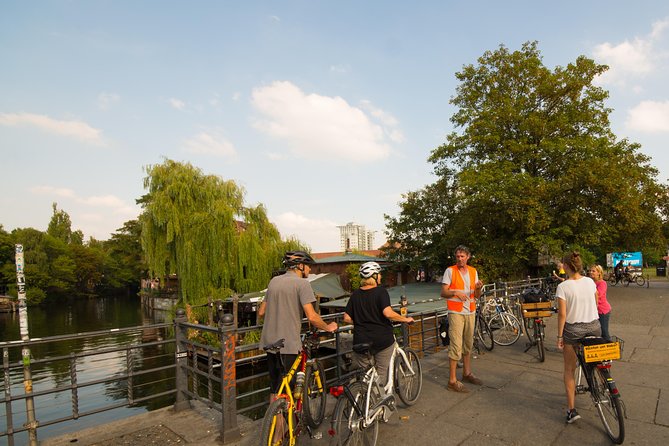
One early section takes you through Volkspark Friedrichshain, Berlin’s first municipal green area, created in 1846. This is not treated as a grand sightseeing monument. Its appeal is that it shows how Berlin residents use public space away from the famous central sights.
A park stop also gives your legs a short change of pace. You are still on an active tour, but the route is not three and a half hours of nonstop pedaling. The guide can use places such as this to explain how the city’s districts developed and how residents spend time outside the main tourist zones.
The route’s neighborhood focus is one of its strongest features. You might see a mix of residential streets, local gathering places, and public art rather than a neatly arranged series of attractions. If you want only famous landmarks, this may feel indirect. If you want to understand how Berlin works beyond Museum Island and the Brandenburg Gate, it is a useful detour.
Karl-Marx-Allee and the architecture of East Berlin
Karl-Marx-Allee provides one of the clearest history lessons on the ride. Its broad avenue is lined with apartment blocks and towers shaped by Socialist Classicism, with touches of the Prussian Schinkel tradition.
The scale matters. This is not just a street with a few old buildings. Its architecture reflects the ambitions of East Berlin and the former German Democratic Republic. The avenue was designed to project order, confidence, and state power, yet today it is part of a living city with cyclists, shops, residents, and changing uses.
A bicycle is a good way to see this kind of urban setting. You can take in the long perspective and the repeated building forms without being rushed through a vehicle window. The guide’s explanation gives the architecture a political and social context, which is more useful than simply being told that the buildings are from the Soviet era.
Several people have praised the tour for showing both DDR-era Berlin and present-day Germany in the same afternoon. That contrast is central to the route. You are not given a polished, single-version story of Berlin. You see monumental housing, contested public art, creative spaces, and neighborhoods still changing around them.
A few more Berlin half-days to weigh up
- Berlin: Reichstag, Dome and Government District Guided Tour
★ 4.7 · 18,288 reviews - Berlin: 1-Hour City Tour by Boat with Guaranteed Seating
★ 4.3 · 16,993 reviews - Berlin: Boat Tour Along the River Spree
★ 4.4 · 11,252 reviews - Discover Berlin Half-Day Walking Tour
★ 5.0 · 9,624 reviews
RAW Tempel, industrial ruins, and creative Berlin
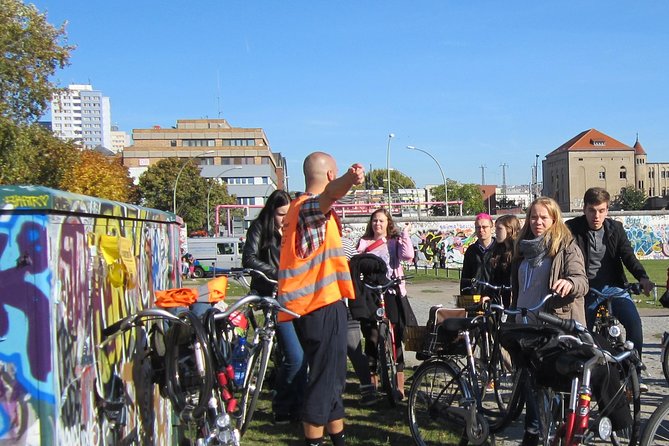
RAW Tempel is one of the route’s most distinctive stops. The former industrial setting now provides room for intercultural projects, exhibitions, markets, clubs, and bars. It represents the kind of flexible, rough-edged urban space that has become closely linked with Berlin’s alternative identity.
You should expect a place with a more informal character than a traditional cultural institution. The interest is in the setting and the activities that have grown around it. Art, nightlife, markets, and community projects share the same broad territory, giving you a direct look at how old industrial land can be reused.
RAW is also a good example of why this tour is different from a standard highlights ride. You might not find it on your own route between Berlin’s major monuments, yet it helps explain the city’s reputation for clubs, street art, and independent culture. One person who took the tour planned to return to RAW later, which is sensible if you want more time to explore the area beyond the short guided stop.
The route can include discussion of quirky neighborhood bars, clubs, squatter encampments, culture clashes, and the city’s alternative art scene. The guide does not present Berlin as tidy or finished. That honesty is part of the appeal, though some visitors may find the subjects less comfortable than a conventional sightseeing program.
East Side Gallery and the changing meaning of the Wall
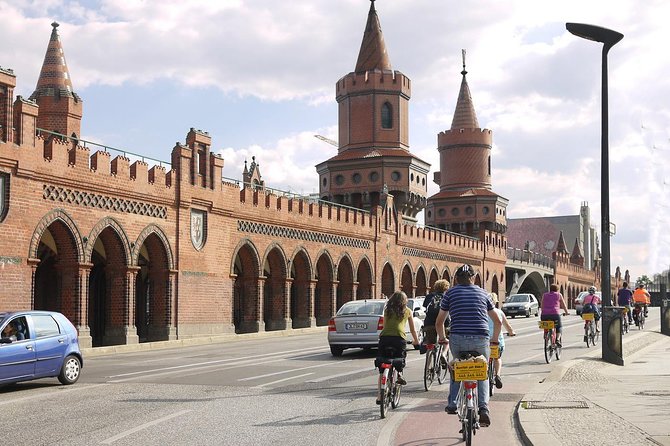
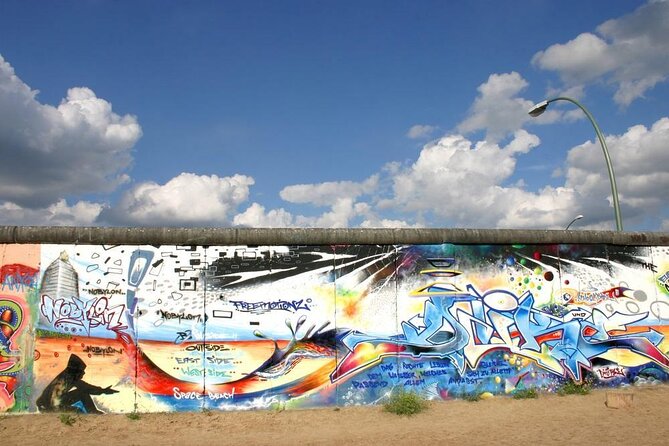
The ride continues toward the East Side Gallery, a permanent open-air gallery on the longest remaining section of the Berlin Wall. The section follows Mühlenstraße along the Spree between Ostbahnhof and Oberbaum Bridge.
This is one of Berlin’s best-known Wall sites, but the bicycle approach still adds something. You connect the painted Wall to the surrounding districts instead of treating it as an isolated memorial. The art sits beside a city shaped by reunification, redevelopment, tourism, nightlife, and ongoing arguments about how historic spaces should be used.
A short stop is enough to orient you, but it will not allow a close look at every mural. If the East Side Gallery is a major priority, you may want to return independently with more time. The tour’s purpose is broader: it places the Wall within the route from Friedrichshain to Kreuzberg and links political history with current street culture.
The guide may also discuss less familiar stories about the Wall. That can be especially valuable because Berlin’s Wall history is often reduced to a few famous dates and images. Here, the subject is connected to actual neighborhoods and the people who live and work around them.
Oberbaum Bridge and the crossing into Kreuzberg
Oberbaum Bridge is one of Berlin’s most recognizable bridges and the landmark of the Friedrichshain-Kreuzberg district. It crosses the Spree and links the two neighborhoods, making it a natural point in the tour.
The bridge is visually memorable, but its greater value on this route is symbolic and practical. You move from Friedrichshain into Kreuzberg, crossing not only a river but also a district boundary shaped by Berlin’s divided past and post-reunification changes.
This is the sort of transition that is easy to miss on public transportation. On a bike, the shift happens gradually. The buildings, street life, and cultural references change as you ride. The guide can explain the area’s past while pointing out how it functions now.
The bridge and the Wall section are also among the more familiar parts of the route, so they provide a useful anchor. After visiting less obvious places such as RAW Tempel and artist spaces, you get a clear connection to landmarks many people recognize from photographs.
Street art, galleries, and Berlin’s less polished side
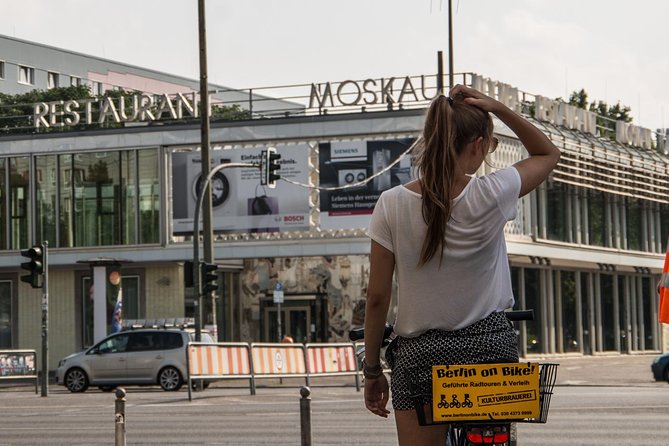
The route includes a center for modern visual arts with exhibitions, workshops, and an artist-in-residence program. The specific stop is presented as part of Berlin’s working art scene rather than as a major museum visit.
That distinction is important. You are not signing up for a formal gallery tour with a long indoor visit. Instead, you get a glimpse of the networks that support artists, exhibitions, workshops, and creative projects. The guide’s role is to explain the setting and its place in Berlin’s wider cultural life.
Street art is another major thread. The route can include political graffiti and stories about local crews, along with personal accounts of how the alternative scene has changed. You might see work that is temporary, layered, or difficult to interpret without context. That is precisely why the guide matters.
I like that the tour does not treat street art as mere decoration. The strongest descriptions of the experience point to art, culture, hope, conflict, and the city’s changing identity. If you enjoy learning why a neighborhood looks the way it does, rather than simply photographing it, this part of the ride should be rewarding.
Görlitzer Park and a final look at Kreuzberg
Görlitzer Park was created in the late 1980s and early 1990s after the old Görlitzer Bahnhof railway facilities were demolished. Today it is one of Kreuzberg’s large public parks and recreation areas.
The stop gives you another example of Berlin’s habit of turning former transport and industrial land into public space. It also brings the ride back to daily neighborhood life. After the monumental avenue, Wall art, bridge, and creative compounds, a park helps show how residents experience the district in a more ordinary way.
You should not expect a manicured palace garden. The appeal is urban and local. The park is part of Kreuzberg’s real social setting, with all the complications that come with a busy public space. The guide may use it to discuss the district’s shifting culture and the tension between long-term residents, new arrivals, visitors, and redevelopment.
The tour ends back at the Berlin on Bike depot. That makes the logistics easy: you do not need to arrange a separate return transfer or navigate back from an unfamiliar part of the city.
How hard is the ride?
The tour requires a moderate level of physical fitness. Berlin is fairly flat, so you will not be dealing with major hills, but the ride is longer than a quick two-hour city spin. Expect about three and a half hours of cycling, stopping, listening, and regrouping.
Traffic is the main practical concern. One family found the streets somewhat harrowing for an 11-year-old, even though the guide handled the situation well. That is useful advice. A confident young cyclist may be fine, but a child who is new to urban riding could find the traffic tiring or intimidating.
The group limit of 14 helps. A smaller group generally makes it easier to hear the guide and reduces the time spent waiting for everyone to catch up. It also allows the guide to remember names, answer questions, and adjust the pace more easily than on a large city tour.
The experience operates in all weather conditions, so dress for the forecast. Rain or cold can change the feel of a bicycle tour quickly. If poor weather forces a cancellation, you are offered another date or a full refund. You should also know that the activity requires a minimum number of participants.
Is $43.54 a fair price?
At $43.54 per person, the price is reasonable for a guided ride lasting roughly three and a half hours, especially since the bicycle and helmet are included. You are paying for more than a rental. The guide provides orientation, local context, route planning, and access to neighborhoods that can be hard to interpret on your own.
The value is strongest if you want a broad introduction to Friedrichshain and Kreuzberg. In one afternoon, you cover parks, East Berlin architecture, the Wall, a major bridge, former industrial sites, street art, and a modern art center. Reaching all of these places independently would take more planning and probably more time.
The value is weaker if you prefer long visits at individual attractions. The stops are short, often about five minutes, and the route keeps moving. Think of this as a guided neighborhood survey with historical and cultural commentary, not as a series of museum admissions.
Food and drinks are not included, and there is no hotel pickup or drop-off. That is normal for a bike tour and easy to manage, but plan accordingly. The 3:00 p.m. departure also means the ride occupies much of the afternoon.
Who should book this bike tour?
I would choose this tour if you have already seen Berlin’s major landmarks or if you want your first Berlin ride to focus on neighborhoods rather than monuments. It suits adults, older children, and teenagers who are comfortable on a bicycle and curious about street art, social history, nightlife culture, and urban change.
It is a particularly good match for you if:
- You want to see Friedrichshain and Kreuzberg with local context.
- You enjoy street art, former industrial spaces, and alternative culture.
- You prefer personal stories to a formal lecture.
- You want a small-group tour rather than a large cycling convoy.
- You are comfortable riding in city traffic for several hours.
I would think twice if you dislike cycling near cars, need a leisurely pace with long indoor visits, or want a tour centered on Berlin’s classic landmarks. The route is active, the subjects can be political or socially complex, and the weather can affect your comfort.
Final verdict: a strong choice for curious cyclists
I recommend the Alternative Berlin Bike Tour if you want to understand the city through its neighborhoods. Its best moments come from the contrasts: grand Karl-Marx-Allee beside informal creative spaces, Wall murals beside new development, and public parks beside former railway land.
The guides are the real key. Anna’s personal connection to Berlin’s alternative scene, Marcus’s storytelling, and the warm responses to guides such as Paul, Lauren, Maria, George W., and Edgar suggest a tour built around people rather than a fixed script. The route itself is strong, but a good guide turns the buildings and graffiti into a story.
Book it if you want a useful overview of Berlin’s less polished, more inventive side and you are ready for a moderately active afternoon. Skip it only if traffic, weather, or short stops would make a bicycle tour uncomfortable. At this price, with equipment included and a maximum of 14 people, it offers a practical and memorable way to see parts of Berlin you might otherwise miss.
FAQ
How long does the Alternative Berlin Bike Tour last?
The tour lasts approximately 3 hours and 30 minutes, with some descriptions placing the total time between 3.5 and 4 hours.
What time does the tour start?
The scheduled start time is 3:00 p.m.
Where does the tour begin?
It begins at Berlin on Bike, Knaackstraße 97, at the Kulturbrauerei in Berlin, Germany.
Where does the tour end?
The activity ends back at the same meeting point where it starts.
Are bicycles and helmets included?
Yes. The use of a bicycle and helmet is included in the tour price.
What places does the tour visit?
The route includes Kulturbrauerei, Volkspark Friedrichshain, Karl-Marx-Allee, RAW Tempel, the East Side Gallery, Oberbaum Bridge, a modern visual arts center, and Görlitzer Park.
Is cancellation free?
Yes. You can cancel at least 24 hours before the local start time for a full refund. If the tour is canceled because of poor weather or because the minimum number of participants is not reached, you are offered another date or a full refund.
Just added around Berlin
- eSIM for Germany and 34 European Countries★ 4.5 · 16 reviews
- Your ticket to The Wall Museum Berlin★ 3.0 · 60 reviews
- Walking on the Wall: 3-Hour Tour in Berlin★ 4.5 · 34 reviews
- Rickshaw Tours Berlin – Groups of up to 16 people with several rickshaws★ 4.0 · 97 reviews
- Warnemuende Shore Excursion: Private Berlin Tour★ 4.5 · 27 reviews
- Love and War in Berlin: Self-Guided Story Puzzle Walk★ 5.0 · 7 reviews
- Warnemuende Shore Excursion: Berlin Private Sightseeing Tour from Rostock★ 5.0 · 4 reviews
- Cold War Berlin – Private Live Virtual Experience★ 5.0 · 4 reviews
Berlin Tours, compared.

Reichstag, Dome and Government District Guided Tour
Read our review →
1-Hour City Tour by Boat with Guaranteed Seating
Read our review →




Reichstag, Plenary Chamber, Cupola & Government Tour
Read our review →
Browse the lists this tour appears in