Review · BERLIN TOURS
Rickshaw Tours Berlin – Groups of up to 16 people with several rickshaws
Berlin is a wide, spread-out city, and a rickshaw is a clever way to cover ground without committing to hours of walking. This private ride links the Brandenburg Gate, Reichstag, former Wall sites, Museum Island, Gendarmenmarkt, and Alexanderplatz in one moving tour. You get fresh air, city views, and a guide close enough to talk with.
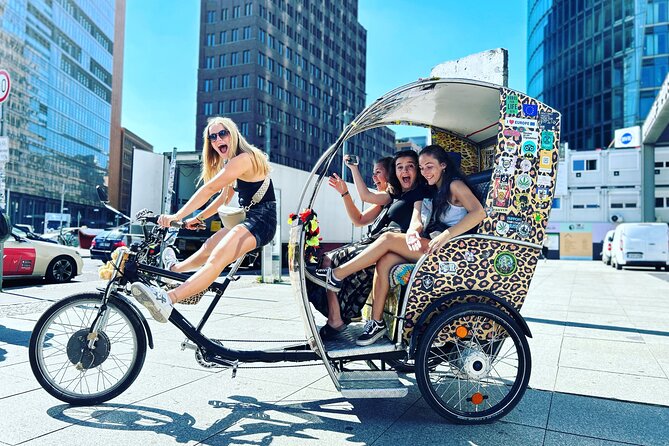
I like two things here: the personal scale and the flexibility. A good guide such as Leo or Hugo can stop for photos, adjust the route to your interests, and add stories that a bus guide might skip. The ride also suits people recovering from an injury or anyone who wants Berlin sightseeing without a long march.
The main concern is reliability. Several bookings ended in no-shows or last-minute cancellations, sometimes linked to illness, lost equipment, cold-weather battery problems, or poor communication. The sightseeing idea is strong, but I would confirm the appointment and keep a backup plan.
Key points to know before you book
- A citywide route in a small vehicle: See central Berlin’s major sights without walking between far-flung districts.
- Private groups of up to 16: Larger parties travel in several rickshaws, though your group may be split between vehicles.
- Leo and Hugo earn the strongest praise: Both are described as entertaining, friendly, and good at explaining Berlin’s past.
- Music and photos are part of the experience: Music can play on request, and a photographer is included.
- Good for limited mobility: The ride can replace a demanding walking tour, but confirm your needs before booking.
- Service reliability needs attention: Past no-shows and cancellations make reconfirming especially important.
Why a Berlin rickshaw works so well
The tour begins and ends at Brandenburg Gate, with pickup included within 2 kilometers of the gate. Pickup farther away costs 10 euros per kilometer, so central hotel pickup can be convenient, while a hotel outside the area may not be worth the added charge.
The listed duration ranges from one to four hours. That is a big spread, so you should settle the length and planned route before the ride begins. A one-hour trip can give you a quick orientation. A two-hour outing can cover the central sights at a useful pace. Four hours allows more stops, photographs, and conversation.
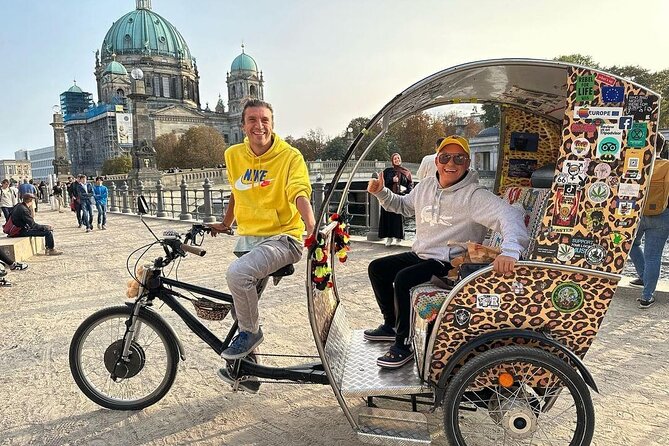
You sit close to the driver rather than behind glass. That matters in Berlin, where the best sightseeing often comes from noticing how one era meets another. You can ask about a building as you pass it, request a photo stop, or shift the focus toward the Cold War, Nazi Germany, architecture, or modern Berlin.
The rickshaw also handles spaces that feel awkward on a coach. Tiergarten, the streets around the government district, and central squares are easier to appreciate from a small vehicle. You are still on the road, so traffic and weather affect the experience. This is sightseeing, not a quiet carriage ride.
WiFi, private transportation, music on request, a tour guide, and a photographer are included. Alcoholic drinks are not included. The photographer is a useful touch, especially if you want pictures of the whole group rather than a collection of hurried phone selfies.
A few more Berlin half-days to weigh up
- Berlin: Reichstag, Dome and Government District Guided Tour
★ 4.7 · 18,288 reviews - Berlin: 1-Hour City Tour by Boat with Guaranteed Seating
★ 4.3 · 16,993 reviews - Berlin: Boat Tour Along the River Spree
★ 4.4 · 11,252 reviews
Brandenburg Gate and the government quarter
Brandenburg Gate is the natural opening point. Built from 1788 to 1791 under Carl Gotthard Langhans the Elder, it was modeled in part on the entrance structures of the Athenian Acropolis. Friedrich Wilhelm II wanted a grand architectural ending for Unter den Linden, and the gate still works as a powerful starting image of Berlin.
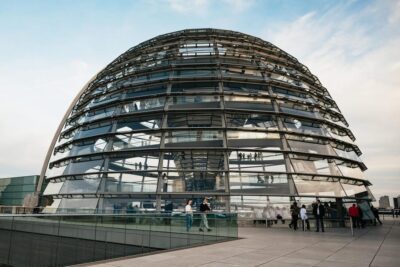
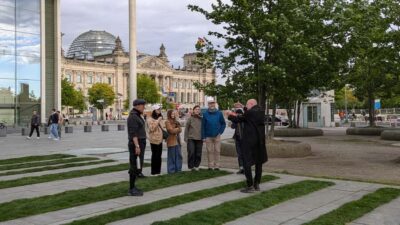
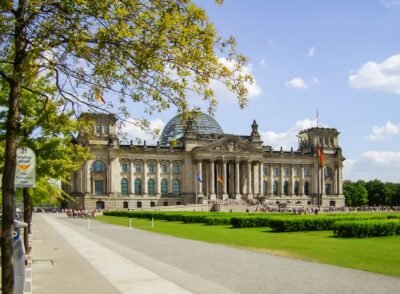
Your first short stop is the Reichstag, home of the German parliament. The building carries several major chapters of German history. Philipp Scheidemann proclaimed the republic from its west portal balcony in 1918. The fire of February 1933 badly damaged the plenary hall and dome, and a Soviet flag raised in 1945 became a symbol of the defeat of Nazi Germany.
The stop is brief, around five minutes, and admission to the building is not included. That means you should think of the ride as an exterior tour. If you want to visit the dome or parliamentary interior, arrange that separately.
Next comes the Federal Chancellery. Its design is strikingly modern, with a 36-meter central structure, broad glass surfaces, concrete pillars, and two lower administrative wings arranged around glazed courtyards. The building feels open from some angles and stern from others. A guide can help you read those contrasts instead of treating it as simply another government office.
Tiergarten and the Soviet memorial
The route then reaches Tiergarten, Berlin’s great central park. Its origins go back to an electoral hunting ground that Friedrich III ordered turned into a public pleasure park in the late seventeenth century. Peter Joseph Lenné reshaped it between 1833 and 1838 as an English-style public park.
This is one of the ride’s best sections. A rickshaw can move through the greenery while you stay seated, and the change from formal government buildings to broad paths and trees gives the tour a welcome pause. Tiergarten covers about 200 hectares and contains monuments, bridges, the Victory Column, the Federal President’s Office, the House of World Cultures, and the English Garden.
The Soviet War Memorial Tiergarten is a solemn stop. Two T-34 tanks flank a bronze Red Army soldier, while inscriptions and the graves of around 2,500 Soviet soldiers occupy the rear part of the memorial. Admission is free, and the listed stop is about three minutes.
This is not a place for a rushed joke or loud music. A thoughtful guide can explain how the memorial reflects the Soviet victory over Nazi Germany and why its location in former West Berlin is historically unusual. The short visit is enough for an introduction, though you may want more time if military history interests you.
Potsdamer Platz and the Topography of Terror
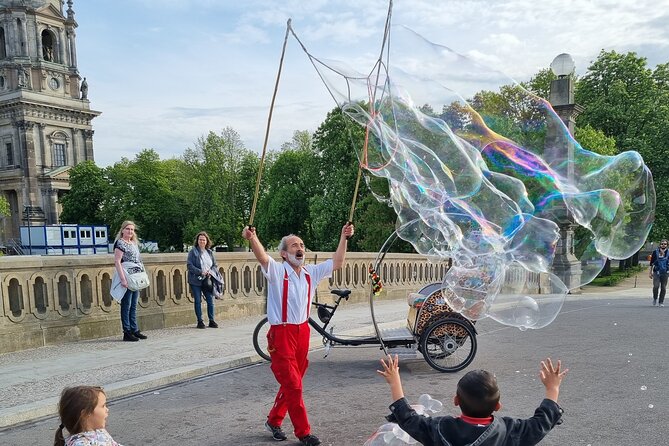
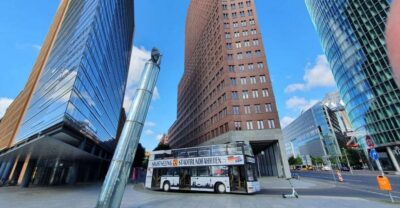
Potsdamer Platz shows Berlin’s modern side. After reunification, architects planned a new district on 6.8 hectares between Potsdamer Platz and Reichpietschufer. Cafes, cinemas, shops, and large modern buildings now fill an area once divided by the Wall.
The stop is listed at only two minutes, so expect a quick look rather than a full architectural walk. I find the contrast useful: Berlin’s story is not only monuments and ruins. It is also about how a divided city rebuilt its center and tried to create an ordinary urban neighborhood again.
The Topography of Terror is a more serious stop. The site housed the Secret State Police Office, the SS leadership, and the Reich Security Main Office from 1933 to 1945. It was one of the main places where Nazi persecution and mass crimes were planned and directed.
Admission is free, and the listed visit is about five minutes. That is enough to orient you to the site, but not enough for the full documentation center. If you want detailed exhibits, photographs, and original documents, return later on foot.
Nearby, the Gropius Bau offers exhibitions devoted to cultural history, contemporary art, and photography. The stop is about two minutes, and admission is not included. The building makes a good visual pause, but the rickshaw schedule will not allow a full museum visit.
Same city, a completely different sort of afternoon:
- Discover Berlin Half-Day Walking Tour
★ 5.0 · 9,624 reviews - Berlin: Hop-on Hop-off Bus Tour with Live Commentary
★ 4.3 · 8,579 reviews - Berlin: Government District around the Reichstag Guided Tour
★ 4.7 · 8,447 reviews - Berlin: Reichstag, Plenary Chamber, Cupola & Government Tour
★ 4.6 · 8,422 reviews
Bernauer Straße and Checkpoint Charlie
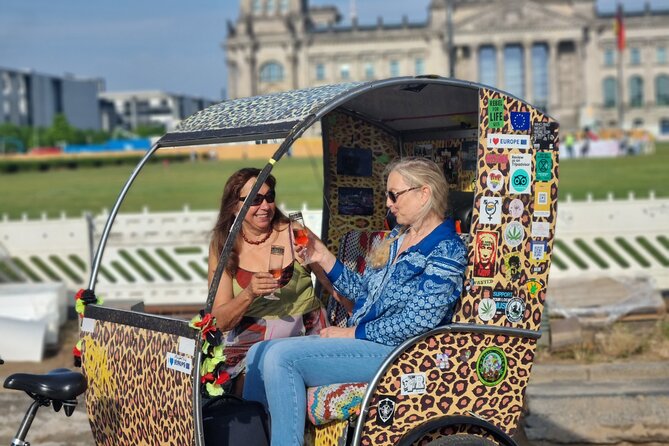
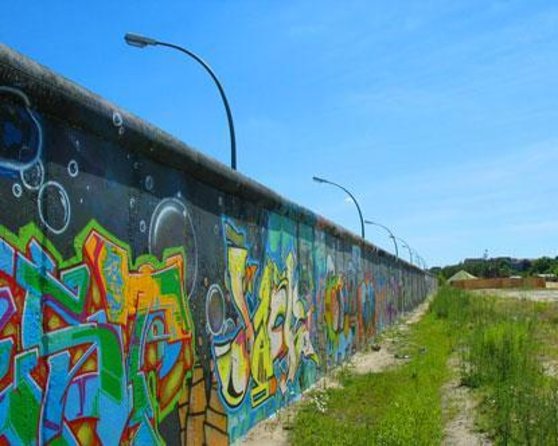
The Berlin Wall Memorial on Bernauer Straße presents one of the clearest reminders of how the Wall affected ordinary life. The street divided Wedding in the West from Mitte in the East, and residents faced sudden separation when the border closed.
The memorial recalls desperate escape attempts, including people who jumped from apartment windows to reach the West. It was formally opened in 1998, 37 years after construction of the Wall began. The listed stop is only one minute, and admission is not included, so treat this as an introduction rather than a complete visit.
Checkpoint Charlie is more compact. It was the best-known American-controlled border crossing in divided Berlin and could be used by foreigners, West German officials connected with the permanent mission, and East German officials. The three main American checkpoints included Checkpoint Alpha at Helmstedt-Marienborn and Checkpoint Bravo at Dreilinden-Drewitz.
The stop lasts about two minutes and is free. You will see a famous symbol of the Cold War, but the immediate area can feel commercial and crowded. I would not judge Berlin’s Wall story from Checkpoint Charlie alone. The memorial at Bernauer Straße offers stronger historical context, while Checkpoint Charlie shows how a border post became a global image.
Friedrichstraße follows as a quick look at Berlin’s north-south axis. The section between Checkpoint Charlie and Friedrichstraße station developed into a shopping street after the Wall fell. It is a useful reminder that the former border is now part of everyday city life.
Gendarmenmarkt, Bebelplatz, and Schinkel’s Berlin
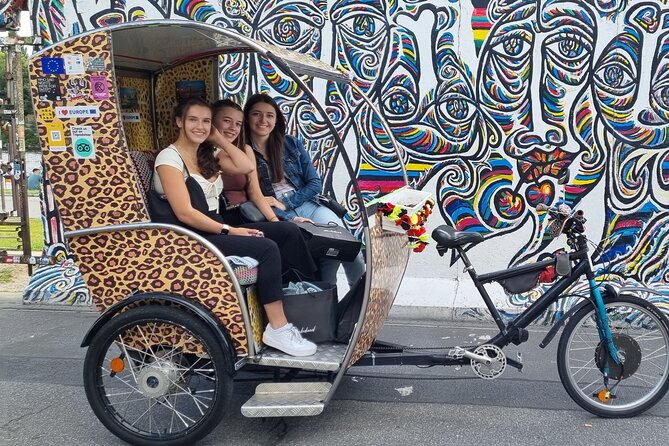
Gendarmenmarkt is one of central Berlin’s most elegant squares. It began in the late seventeenth century as a planned area for French Protestant immigrants and passed through several names before becoming Gendarmenmarkt in 1799. The name refers to the Gens d’armes regiment, whose guardhouse and stables were located here from 1736 to 1782.
The square is a good place to slow down for five minutes. The German Cathedral, French Cathedral, and Konzerthaus create a formal ensemble, though each building has its own story.
The German Cathedral contains the permanent exhibition Ways, wrong paths, detours, which traces the development of liberal parliamentary democracy in Germany across five floors. Admission is not included, and the short stop will only give you an exterior view unless you arrange a separate visit.
The Konzerthaus is one of Karl Friedrich Schinkel’s major classical buildings. A small comedy theater opened on this site in 1776 at Frederick the Great’s request, and it became the Royal National Theater in 1787. The rickshaw stop lasts around two minutes, with interior admission not included.
Bebelplatz presents a darker chapter. On May 10, 1933, the Nazis burned more than 20,000 books there, targeting works they labeled hostile to German thought. Authors included Erich Kästner, the Mann family, Magnus Hirschfeld, Lion Feuchtwanger, Karl Marx, Else Lasker-Schüler, and Heinrich Heine.
The memorial is easy to miss because it lies beneath the square. Look for the underground room of empty bookshelves, visible through glass in the pavement. The stop is free and lasts about two minutes. I would ask the guide to point out the memorial clearly, since the meaning is more important than the view from the street.
Museum Island, Berlin Cathedral, and Alexanderplatz
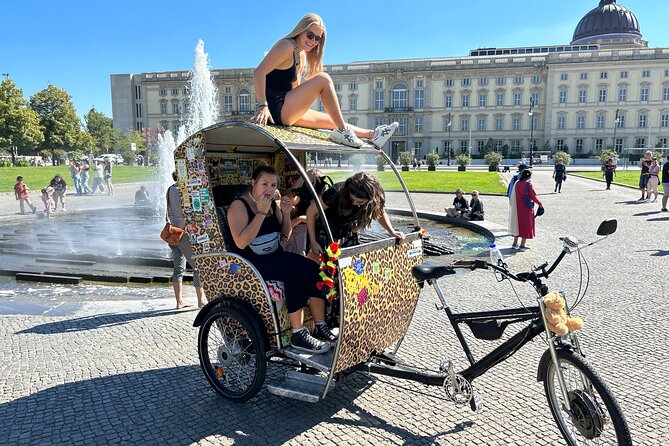
Museum Island occupies the Spree area between the river and the Kupfergraben. Its museums hold archaeological collections and nineteenth-century art, and the ensemble began with Schinkel’s Old Museum, completed in 1830.
The ride gives you a broad view of the island, but museum admission is not included. Five minutes is enough to identify the buildings and understand the setting. It is not enough to visit the collections, so plan a separate half-day if museums are a major reason for your Berlin trip.
Berlin Cathedral dominates the area with its large dome. The interior is richly decorated, and climbing to the dome provides views over the Spree, Lustgarten, and Museum Island. The listed stop is only one minute, and admission is not included, so the rickshaw ride serves as a preview.
Lustgarten sits between the cathedral, Old Museum, Kupfergraben, and Karl-Liebknecht-Straße. Linden trees, lawns, a large red granite bowl, and a fountain make it a pleasant urban pause. The stop is free but lasts only one minute.
The final sight is Alexanderplatz, known locally as Alex. It has been a major public square since the 1920s, through the East German period and into modern Berlin. The television tower, World Clock, Fountain of International Friendship, shops, and transport links make it one of the city’s liveliest meeting points.
Again, the listed stop is only one minute. You will get the orientation, not time to visit the tower or explore the square. The route ends back at the Brandenburg Gate meeting point, so you can return to Alexanderplatz later by public transport if you want more time there.
Guides, music, photos, and the human side of the ride

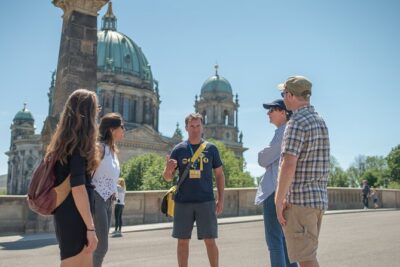
The guide can make or break this experience. Leo receives especially strong praise for combining Berlin stories with humor and music. He is also described as good with families, including teenagers, and as someone who can adapt the ride to what you want to see.
Hugo is another name worth noting. He is praised for explaining Berlin’s past, stopping for photos, and asking what interested the group. Ufuk Ayik is also noted for being accommodating in difficult weather. These details suggest that the best version of this tour is interactive rather than scripted.
Music can add energy, especially on a fun city ride, but it should not drown out the guide. One poor experience involved music being played too loudly, making the historical commentary hard to hear. Ask the driver to lower or stop the music whenever you want to focus on the sites.
The photographer is a real advantage for couples and groups. You can ask for pictures at major landmarks, and you do not have to choose between being in the image and taking it. The service may vary by driver, so confirm how photographs will be provided.
The ride can also be useful after a marathon, a bike accident, or another injury. One account describes it as a practical alternative to a walking tour for people using crutches. Still, you should state your mobility needs clearly before booking, since rickshaw design and boarding arrangements are not described in detail.
Price, group size, and value
At $53.10 per person, the tour is fairly priced when you use it as a private orientation ride that covers a large section of central Berlin. For a couple, the total cost is higher than a public bus or self-guided walk, but you receive a private vehicle, an English-speaking guide, music on request, WiFi, and photography.
The value improves for a family or group that wants to stay together. Groups can reach 16 people using several rickshaws. The tradeoff is that a party of four or more may be divided between vehicles, with a separate guide in each rickshaw. That can produce uneven commentary, so ask how the group will be coordinated.
The ride is not the best value if you want long interior visits. Admission to the Reichstag, Gropius Bau, German Cathedral, Konzerthaus, Museum Island museums, and Berlin Cathedral is not included. Think of this as a guided street tour with short stops, not a museum package.
The rating of 4.2 from 97 reviews reflects that split. Many rides are praised as fun, personal, informative, and efficient. The recurring weakness is not the concept or the route. It is inconsistent guide quality and, more seriously, missed appointments.
Reliability, weather, and sensible precautions
I would take the cancellation policy seriously. You can cancel for a full refund up to 24 hours before the start time. Changes made within 24 hours are not accepted, and a cancellation caused by poor weather should result in a different date or a full refund.
Past explanations for canceled rides have included cold-weather battery failures, illness, and lost access to a phone or computer. Several bookings involved long waits and unanswered calls. Those problems may have been isolated or corrected, but the pattern is important enough to affect your planning.
Confirm the meeting time and pickup location shortly before the ride. Save the operator’s contact details, arrive with enough time to identify the correct vehicle, and avoid booking this as the only activity on a day when you have a flight, train, or timed museum entry.
If your booking does fail, contact the booking platform promptly and keep records of calls and messages. The supplied information indicates that full refunds have sometimes been processed after a failed service, but you should not assume that a refund removes the lost time from your day.
Who should book Rickshaw Tours Berlin
I would choose this for a first day in Berlin, a short visit, a family group, or anyone who wants to see the main central sights without walking several miles. It is also a good fit if you enjoy conversation, quick photo stops, and a guide who can shape the ride around your interests.
It works particularly well for people who find a standard walking tour too tiring. The open vehicle gives you a broad view while keeping the pace easy. Ask about boarding and seating if you have a serious mobility concern.
I would hesitate if your priority is detailed museum time, long visits at memorials, or guaranteed operational reliability. In those cases, use the rickshaw as a broad introduction and arrange museums separately, or choose a tour with a more established transport system.
Should you book it?
Book it if you want a lively, personal overview of Berlin and can tolerate short stops. Leo and Hugo appear to offer the kind of warm, story-filled guiding that makes the format work, while the photo service and music give it more personality than a standard vehicle tour.
Before paying, confirm the duration, pickup point, number of rickshaws, guide, and weather plan. Most important, reconfirm shortly before departure and keep a backup plan. The route is excellent for seeing how Prussian grandeur, Nazi crimes, Cold War division, reunification, and modern Berlin fit into one city. The service record means you should book with care, not blind confidence.
FAQ
Where does the tour start and finish?
The tour starts at Brandenburg Gate in Berlin and ends back at the same meeting point.
Is hotel pickup included?
Pickup is included within a 2-kilometer radius of Brandenburg Gate. Pickup farther away costs 10 euros per kilometer.
How many people can join the tour?
A private group can include up to 16 people using several rickshaws. Larger groups may be divided among the vehicles.
Is the tour offered in English?
Yes. The experience is offered in English.
Are admission fees included?
No. Admission is not included for paid attractions such as the Reichstag, Gropius Bau, German Cathedral, Konzerthaus, Museum Island museums, and Berlin Cathedral. The Soviet War Memorial, Potsdamer Platz, Topography of Terror, Checkpoint Charlie, Friedrichstraße, Gendarmenmarkt, Bebelplatz, Lustgarten, and Alexanderplatz are listed as free stops.
What happens if the weather is poor?
The experience requires good weather. If the operator cancels because of poor weather, you should be offered another date or a full refund.
Just added around Berlin
- eSIM for Germany and 34 European Countries★ 4.5 · 16 reviews
- Your ticket to The Wall Museum Berlin★ 3.0 · 60 reviews
- Walking on the Wall: 3-Hour Tour in Berlin★ 4.5 · 34 reviews
- Warnemuende Shore Excursion: Private Berlin Tour★ 4.5 · 27 reviews
- Love and War in Berlin: Self-Guided Story Puzzle Walk★ 5.0 · 7 reviews
- Warnemuende Shore Excursion: Berlin Private Sightseeing Tour from Rostock★ 5.0 · 4 reviews
- Cold War Berlin – Private Live Virtual Experience★ 5.0 · 4 reviews
- Berlin’s Gay, Lesbian, and Queer Scene Small-Group Walking Tour★ 4.5 · 66 reviews
Berlin Tours, compared.
Reichstag, Dome and Government District Guided Tour
Read our review →
1-Hour City Tour by Boat with Guaranteed Seating
Read our review →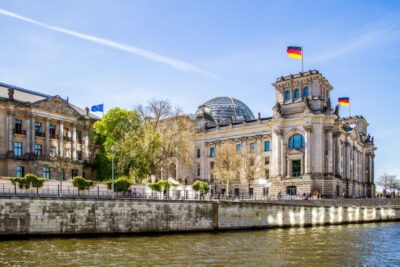
Reichstag, Plenary Chamber, Cupola & Government Tour
Read our review →