Review · BERLIN TOURS
Karl-Marx-Allee Tour: Life and Architecture in East Berlin
Karl-Marx-Allee tells East Berlin’s story in enormous buildings, broad avenues, and carefully planned views. On this two-hour walk, you move from the grand towers of Frankfurter Tor to the worker uprising memorial and the café once tied to Stalin’s nearby statue. The architecture is impressive, but the human stories give it weight.
I like the small group of no more than 15, which makes it easier to hear and ask questions. I also like the way the walk sets competing postwar visions beside each other: Hans Scharoun’s modernist ideas, Hermann Henselmann’s socialist boulevard, and the political reality of life in East Germany. The main drawback is that this is an outdoor walking tour, so poor weather can cancel it and there is no museum visit built into the route.
Key points
- Frankfurter Tor opens with East Berlin’s grandest socialist vista, including Hermann Henselmann’s matching towers.
- The Laubenganghäuser reveal a different postwar future, one based on modernist planning rather than Soviet-inspired monumentality.
- The Hochhaus an der Weberwiese was a prototype and propaganda tool, promising workers a level of comfort that was unusual at the time.
- The 17 June 1953 memorial connects architecture with political protest, showing how quickly official ideals could meet public anger.
- Café Sibylle and the Karl Marx bust bring ideology down to daily life, from fashionable coffee rooms to public monuments.
- The $30.01 price is fair for a focused two-hour tour, especially if you want context that is hard to pick up by walking the avenue alone.
Why Karl-Marx-Allee is worth two hours
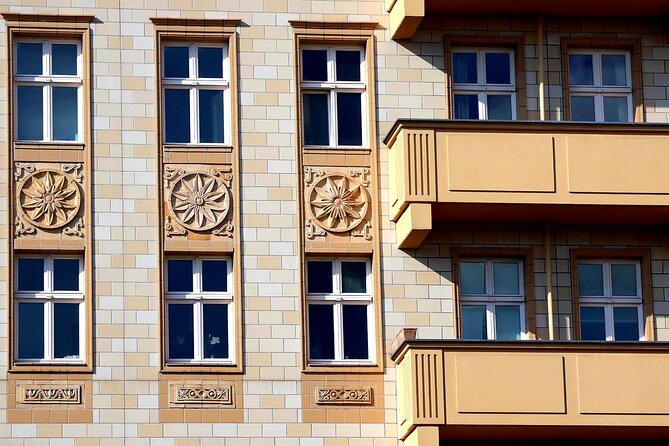
Karl-Marx-Allee is easy to see and hard to understand without context. You can walk its broad pavement, photograph the towers, and admire the repeated façades in less than an hour. The harder part is understanding why the avenue changed names, why its buildings look so different from nearby postwar housing, and how architecture served the East German state.
This tour gives you that framework while keeping the pace manageable. It focuses on life and architecture in East Berlin, not just dates and building names. You learn how destroyed Berlin became a testing ground for rival ideas about reconstruction, housing, politics, and public space.
The route is also useful because it begins at one strong visual point and ends at another. You start at U Frankfurter Tor and finish at Strausberger Platz, on the eastern side of the roundabout. That makes the walk feel like a connected story rather than a set of unrelated monuments.
The guides bring personality to a subject that can become dry in less capable hands. Martina is singled out for her preparation, humor, memory, and ability to explain difficult political subjects clearly. One account also names Marina, likely a variation in spelling, while Luis is praised for a separate Berlin architecture walk. If Martina is leading your Karl-Marx-Allee tour, you can expect a personal, story-led presentation rather than a simple recitation of facts.
A few more Berlin half-days to weigh up
- Berlin: Reichstag, Dome and Government District Guided Tour
★ 4.7 · 18,288 reviews - Berlin: 1-Hour City Tour by Boat with Guaranteed Seating
★ 4.3 · 16,993 reviews - Berlin: Boat Tour Along the River Spree
★ 4.4 · 11,252 reviews
Frankfurter Tor and the making of a socialist boulevard
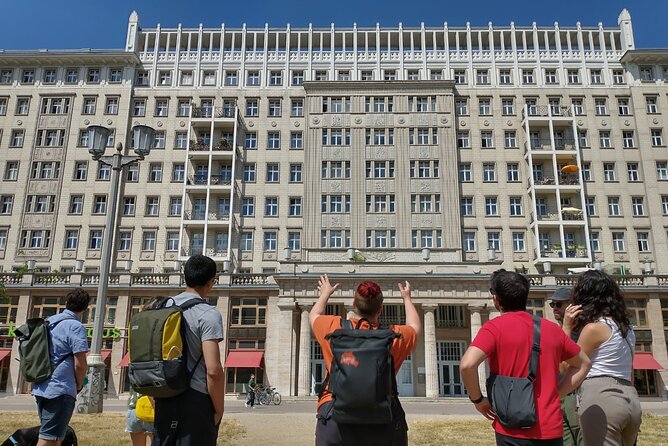
Begin at Frankfurter Tor, where the paired towers create one of the most recognizable views in former East Berlin. Designed by Hermann Henselmann, the towers frame the street with strong symmetry and an imposing sense of order.
Your guide explains how plans for Germany’s first socialist street took shape in the early 1950s. This was not just a housing project. It was a public statement about the new East German state and its links to the Soviet model.
The rebuilding effort drew thousands of volunteers. That detail helps explain the political power of the avenue. Construction was presented as a shared national task, a way for citizens to help rebuild a destroyed country while also helping create a new social order.
Allow about 20 minutes here. It is enough time to take in the scale of the towers and understand why the location mattered. You will also want to look beyond the obvious central view. The repeated façades and wide roadway were meant to create a sense of unity, discipline, and state confidence.
The grand scale can feel cold, especially if you prefer intimate old-city streets. That is part of the point, though. The avenue was designed to make an impression. The guide’s job is to explain what that impression was intended to do.
The Laubenganghäuser and a rejected modernist future
The next stop shifts the mood. At the Laubenganghäuser, you see modernist architecture from the years immediately after World War II. These buildings are linked to Hans Scharoun, whose urban ideas grew from the ruins of Berlin.
Scharoun imagined a more open and humane city. His plans were utopian in the broad sense: they tried to rethink how people might live after the destruction of war. Soon, the new East German regime rejected that direction.
This contrast is one of the best reasons to take the walk. Instead of treating East Berlin as one uniform architectural style, the tour shows that several futures were possible. The regime selected one path, while other architects imagined something less rigid and less tied to political display.
Spend about 15 minutes here. You may find the buildings less immediately dramatic than Frankfurter Tor, but they are important precisely because they show what did not become the official model. The stop also prevents the tour from turning into a simple celebration of socialist monumental design.
If architecture is your main interest, listen closely to the explanations of planning ideas. The value here is less about a single spectacular façade and more about the argument between different ways of rebuilding a city.
Hochhaus an der Weberwiese, the prototype with a political job
At the Hochhaus an der Weberwiese, the story becomes more personal. This building served as a prototype for the later Karl-Marx-Allee and gave its first residents a level of comfort that was unusual in the early postwar years.
The idea of modern housing mattered greatly after Berlin’s destruction. A new apartment could represent security, progress, and a clean break with the old city. Yet the building was also used as a propaganda tool, so its promise was political as well as practical.
Your guide explains how the project attracted architects from the West. That detail shows the building’s wider importance. It was not simply another block of flats. It became a showcase for what East Germany wanted to say about housing, planning, and the future.
Plan for about 20 minutes. This is a good point to ask questions about the gap between official presentation and ordinary life. The walk does not reduce the building to either success or failure. It shows why the project could be admired as a real improvement and still serve a tightly controlled political system.
For me, this is where the tour makes architecture feel useful. A building is not only a style or a façade. It affects who gets a home, what that home represents, and how the government uses it to tell its story.
Same city, a completely different sort of afternoon:
- Discover Berlin Half-Day Walking Tour
★ 5.0 · 9,624 reviews - Berlin: Hop-on Hop-off Bus Tour with Live Commentary
★ 4.3 · 8,579 reviews - Berlin: Government District around the Reichstag Guided Tour
★ 4.7 · 8,447 reviews - Berlin: Reichstag, Plenary Chamber, Cupola & Government Tour
★ 4.6 · 8,422 reviews
The 17 June 1953 memorial and the limits of state control
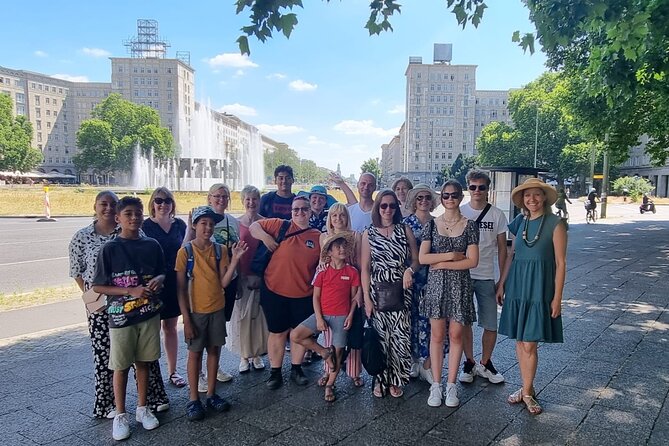
The memorial to the 17 June 1953 workers’ uprising adds a sharp political turn. This was the place where dissatisfied workers began a mass revolt that nearly brought down East Germany’s socialist government.
The event complicates the image of a united population rebuilding the country together. The same workers celebrated in official speeches could also challenge the government when working conditions, demands, and political control became too much.
The stop lasts about 20 minutes, giving the guide time to explain both the uprising and the controversy around its monument. That controversy matters. Memorials are never only objects in public space. They reflect which version of an event a government or community wants to preserve.
This is a useful place to pause and look back along the avenue. The monumental architecture was built to project confidence and order. The uprising reminds you that public loyalty cannot be designed into a street.
The subject is serious, but the tour’s reported style is not grim or humorless. Martina is praised for bringing wit and energy to difficult material without making light of it. That balance helps you keep track of a complicated period.
Café Sibylle, Stalin, and everyday life
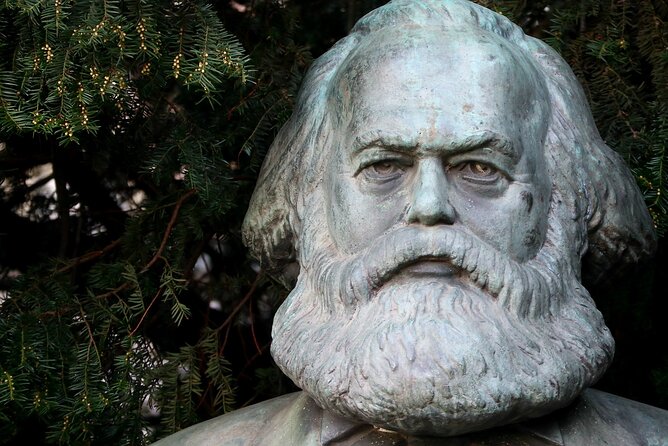
Café Sibylle offers a smaller, more social view of Karl-Marx-Allee. In East Berlin’s earlier years, it was one of the avenue’s most exclusive cafés. Its story is tied to the statue of Joseph Stalin that once stood nearby until 1961.
This stop helps move the discussion from official monuments to daily habits. A café can reveal who had access to fashionable places, how people used the boulevard, and how public symbols changed over time.
The connection with Stalin also shows how quickly political images could be revised. A statue that once dominated the avenue disappeared, while the surrounding buildings remained. The street therefore contains layers of official memory, including things that were removed or renamed.
You spend about 15 minutes here. That is long enough for the guide to connect the café, the statue, and the wider culture of East Berlin. If you are mainly interested in architecture, you may find this stop less visually dramatic. Its value is social and political rather than monumental.
I like this part of the walk because it prevents East Berlin from becoming a collection of government buildings. People still met friends, drank coffee, pursued status, and built routines inside a system that controlled much of public life.
The Karl Marx bust and ideology in ordinary life
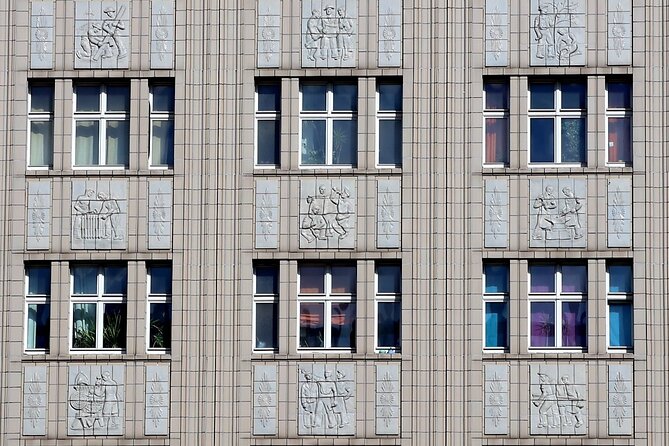
The Karl Marx bust puts the tour’s political ideas into direct view. Marx, author of The Communist Manifesto, is not presented only as a famous thinker. The guide uses the monument to explain how socialist ideology shaped everyday life in East Berlin.
That means looking beyond slogans. Ideology affected housing, work, public art, education, and the way the city presented itself. The bust becomes a prompt for understanding how political theory was turned into buildings, ceremonies, and daily rules.
The stop takes around 15 minutes. It is short, but it gives the preceding buildings a clearer frame. Frankfurter Tor, the workers’ housing, the café, and the memorial were all part of a society trying to show that its political system could create a better life.
The useful point is not to accept that claim at face value or dismiss it too quickly. The tour makes room for both the real improvements promised by postwar housing and the restrictions of a one-party state.
Strausberger Platz and the boulevard after 1989
The final stop is Strausberger Platz, another major example of Hermann Henselmann’s style. Its broad roundabout and monumental buildings give you a second view of the design language introduced at Frankfurter Tor.
Ending here works well. You have seen the avenue’s beginnings, its prototype housing, its competing modernist ideas, its political conflict, and its social spaces. At Strausberger Platz, the guide turns to what happened after the Berlin Wall fell and what the area is like today.
That final section matters because Karl-Marx-Allee did not freeze in 1989. The buildings survived political change, but their meaning shifted. What once represented the future of socialism is now part of Berlin’s complex architectural and historical record.
The tour ends on the eastern side of the Strausberger Platz roundabout, about a 10-minute walk from Alexanderplatz. That makes it easy to continue into central Berlin after the walk, though the experience itself does not include a return transfer.
How much value do you get for $30.01?
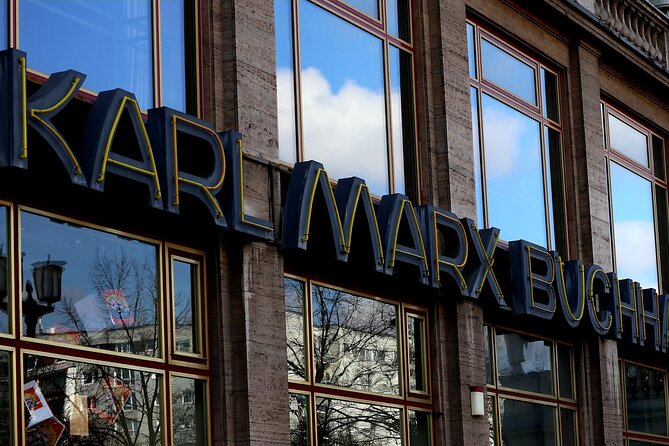
At $30.01 per person, this is reasonably priced for a two-hour small-group walk with a local expert. Every stop is free to enter, so you are paying for interpretation, route planning, and the guide’s ability to connect buildings that you could otherwise pass without understanding.
That distinction matters on Karl-Marx-Allee. You can visit the avenue at no cost on your own, but the central question is what you would miss. Without a guide, you might see the towers and broad street while overlooking the rejected plans, the 1953 uprising, the propaganda role of the Hochhaus an der Weberwiese, and the social story behind Café Sibylle.
The group limit of 15 is another part of the value. This is not a private tour, but it is small enough to avoid the worst problems of a large walking group. You should have a better chance of hearing the guide and asking a question.
The two-hour length suits a short Berlin stay. It is long enough to build a clear picture without taking an entire morning or afternoon. If you want a full architectural survey of East Berlin, it will not be enough. If you want a focused introduction to one important boulevard, the timing is right.
Practical details before you book
The tour is offered in English and includes a mobile ticket. It begins at U Frankfurter Tor, at 10243 Berlin, and ends at Strausberger Platz, also in 10243 Berlin. Both points are near public transportation.
Wear shoes suited to city walking and check the weather forecast. The experience requires good weather, and if conditions force a cancellation, you are offered another date or a full refund.
Most people can take part, and service animals are allowed. The supplied information does not describe the exact walking surface, seating, or restroom access, so ask the provider directly if those details are important to you.
You can cancel for a full refund up to 24 hours before the start time. Changes or cancellations made inside that 24-hour window are not accepted for a refund.
The tour is often reserved about 18 days ahead. That does not mean every departure sells out, but it is a sensible reason to book ahead if your Berlin dates are fixed.
Who will enjoy this walk most?
I would choose this tour if you like architecture, twentieth-century politics, or stories about how governments shape cities. It is especially useful if you have already seen the Wall memorials and want to understand another side of East Berlin.
The route also suits parents with older children. A 17-year-old was described as becoming absorbed in Martina’s storytelling, which suggests that the material can work well for teenagers who prefer real stories to a long museum visit.
This is less suitable if you want a relaxed stroll with little historical explanation. The subject includes state power, propaganda, political protest, and the failures of competing social ideals. You will get more from it if you are ready to listen and think while walking.
It is also not the best choice for someone seeking indoor shelter or a purely visual architecture tour. The buildings are the setting, but the guide’s explanations are the main attraction.
Should you book the Karl-Marx-Allee Tour?
Book it if you want Berlin history told through buildings rather than only through famous walls and checkpoints. The strongest parts are the contrast between Scharoun’s rejected modernism and Henselmann’s official boulevard, plus the way the 1953 uprising and Café Sibylle bring politics into ordinary life.
The price is fair, the route fits neatly into a two-hour schedule, and the 15-person limit supports a more personal experience. Just plan for weather and remember that the walk ends at Strausberger Platz rather than returning to the starting point.
If Martina is guiding your departure, you can expect a prepared, engaging presentation with humor and clear storytelling. For an authentic look at how East Berlin was planned, lived in, and remembered, I would put this walk high on your Berlin list.
FAQ
Where does the Karl-Marx-Allee Tour begin?
The tour begins at U Frankfurter Tor, 10243 Berlin, Germany.
Where does the tour end?
It ends at Strausberger Platz, on the eastern side of the roundabout. The endpoint is about a 10-minute walk from Alexanderplatz.
How long does the tour last?
The walking tour lasts approximately two hours.
What language is the tour offered in?
The tour is offered in English.
How many people can join the tour?
The group is limited to a maximum of 15 people.
What happens if the weather is poor?
The experience requires good weather. If it is canceled because of poor conditions, you will be offered a different date or a full refund.
Just added around Berlin
- eSIM for Germany and 34 European Countries★ 4.5 · 16 reviews
- Your ticket to The Wall Museum Berlin★ 3.0 · 60 reviews
- Walking on the Wall: 3-Hour Tour in Berlin★ 4.5 · 34 reviews
- Rickshaw Tours Berlin – Groups of up to 16 people with several rickshaws★ 4.0 · 97 reviews
- Warnemuende Shore Excursion: Private Berlin Tour★ 4.5 · 27 reviews
- Love and War in Berlin: Self-Guided Story Puzzle Walk★ 5.0 · 7 reviews
- Warnemuende Shore Excursion: Berlin Private Sightseeing Tour from Rostock★ 5.0 · 4 reviews
- Cold War Berlin – Private Live Virtual Experience★ 5.0 · 4 reviews
Berlin Tours, compared.
Reichstag, Dome and Government District Guided Tour
Read our review →
1-Hour City Tour by Boat with Guaranteed Seating
Read our review →
Reichstag, Plenary Chamber, Cupola & Government Tour
Read our review →