
Review · BERLIN TOURS
Private Taxi Tour of Berlin East and West and Neighbourhood approx. 4-6h
Berlin’s story is written in its streets, and this private taxi tour gives you a fast, useful introduction to that complicated story. In four to six hours, Gunter Bauer connects the Reichstag, Brandenburg Gate, Checkpoint Charlie, East Side Gallery, Cold War sites, grand boulevards, museums, embassies, and everyday neighborhoods.
I like the door-to-door pickup and the chance to cover both sides of the once-divided city without wrestling with public transportation. I also like Gunter’s habit of asking what interests you before the tour, then stopping for walks and photographs at major sites such as the Brandenburg Gate, Hackesche Höfe, Humboldt Forum, and the Berlin Wall.
The main caution is that this is still a driving tour. You will see far more than on foot, but you will not study every museum or monument in detail. Some past participants also found the vehicle tight for four people, and Gunter’s planned route may require a firm reminder if you want to skip a stop or add a personal priority.
Key points to know before booking
- A citywide introduction: See central Berlin, the former Wall line, East and West Berlin neighborhoods, Kreuzberg, Friedrichshain, Tiergarten, and the City West.
- A guide with personal knowledge: Gunter Bauer supplies long, continuous explanations about Berlin’s buildings, politics, war, division, and reunification.
- Several chances to get out: Typical walking and photo stops include the Brandenburg Gate, Topography of Terror, Checkpoint Charlie, Hackesche Höfe, East Side Gallery, and Humboldt Forum.
- Useful for limited mobility: The taxi reduces long walks and keeps much of the tour seated in an air-conditioned vehicle.
- Pickup inside the S-Bahn ring: Hotel or apartment pickup is included within central Berlin. Airport and out-of-center pickup cost extra.
- Best for a first look: Take it early in your stay if you want help choosing which museums, monuments, and neighborhoods to revisit on foot.
Why a private taxi works well in Berlin
Berlin is spread out. The Brandenburg Gate, Museum Island, East Side Gallery, Charlottenburg, the Kulturforum, and Kreuzberg are not lined up for a neat walking route. A taxi lets you connect these places while Gunter explains what you are passing.
That matters most when you want context. You may roll past the former Wall, a Soviet-era boulevard, a Nazi government building, and a modern embassy complex within a few minutes. On foot, you might understand each place separately. In the taxi, you get a sense of how the city’s political borders and rebuilding projects fit together.
The vehicle is air-conditioned, private, and equipped with WiFi. Parking fees and both the taxi ride and city tour are included in the advertised price. Pickup inside Berlin’s S-Bahn ring is included, roughly the central area around the Brandenburg Gate.
The private format is a real advantage. You are not waiting for a large group, and Gunter can ask what you want to see before the day begins. He has also taken photographs at stops for some groups, a thoughtful touch if you are usually the person left behind the camera.
Still, private does not mean unlimited. Berlin traffic, road closures, weather, and time at each stop affect the route. The published price is listed at $179.82 per person, so the value improves with a small group that wants a private guide and driver. For four people, ask about vehicle size in advance, since one experience found the car too small.
A few more Berlin half-days to weigh up
- Berlin: Reichstag, Dome and Government District Guided Tour
★ 4.7 · 18,288 reviews - Berlin: 1-Hour City Tour by Boat with Guaranteed Seating
★ 4.3 · 16,993 reviews - Berlin: Boat Tour Along the River Spree
★ 4.4 · 11,252 reviews
The Reichstag and Brandenburg Gate: Berlin’s symbolic center
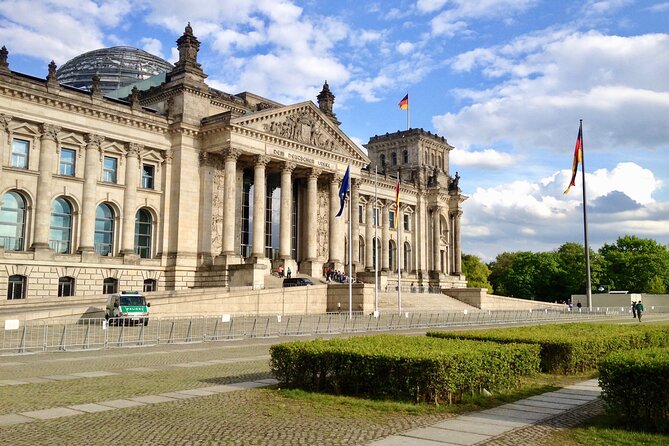
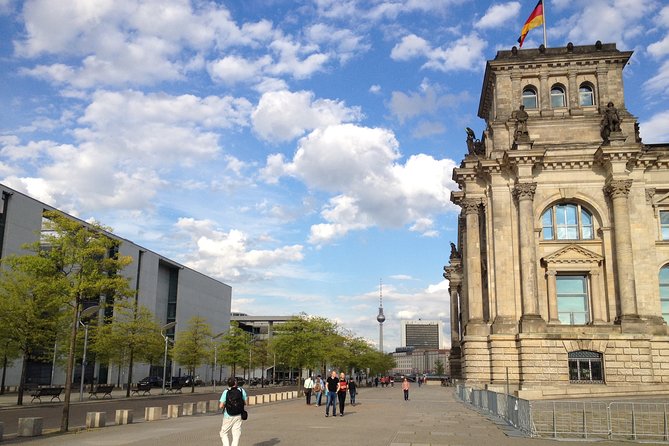
The tour begins or passes through the government quarter, where the Reichstag tells a compact story of Germany’s political upheavals. This grand Wilhelminian building was criticized in its own day, but it later became a powerful symbol of victory when Soviet soldiers raised a flag there at the end of the Second World War.
The famous flag photograph was staged and reproduced, but the event still shaped the building’s meaning. During the Cold War, the Reichstag sat just a few meters from the Wall on the West Berlin side. It was not permitted for regular Bundestag sessions, and even a federal presidential election there could bring an immediate protest from East Berlin.
After reunification, the interior was gutted and rebuilt for the modern parliament. The glass dome, added after architect Norman Foster replaced an earlier roof concept, now gives the building its most recognizable feature. The tour may not include a full interior visit, so plan a separate reservation if you want to explore the dome at length.
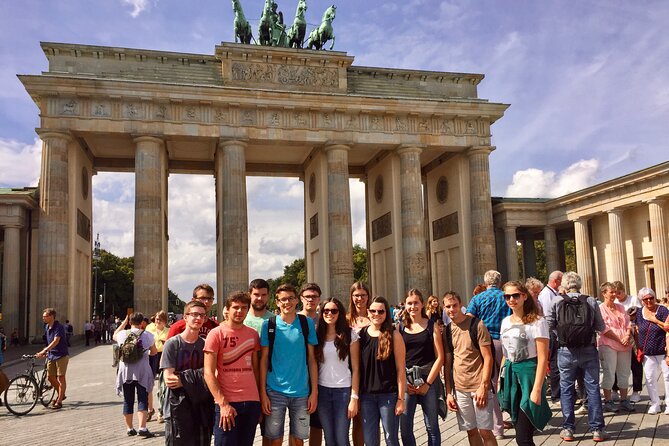
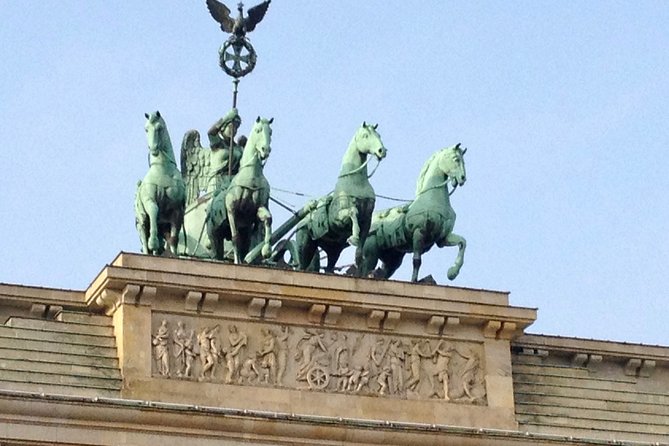
Nearby, the Brandenburg Gate sits at Pariser Platz, Berlin’s ceremonial front room. War and postwar demolition left the gate isolated, much like Paris’s Arc de Triomphe, but not by original design. The Wall blocked access from the west, while a fence separated East Berliners from the east.
Today the square has been rebuilt with the Liebermann House, the Academy of Arts, and the French and American embassies. The Hotel Adlon has returned, too, though the rebuilt district follows old dimensions with modern buildings. You get about five minutes here according to the usual schedule, enough for photographs and a short look around, not a long architectural inspection.
Potsdamer Platz and the working machinery of government
Potsdamer Platz is one of Berlin’s biggest reconstruction stories. Before the war and division, as many as 100,000 vehicles passed through daily, while restaurants and nightlife made the area a city center in its own right.
The Wall later cut through this once-famous junction. After reunification, major corporations rebuilt it with the Sony Center, Mercedes-Benz complex, hotels, shops, and entertainment venues. The result is bold and polished, but it can feel planned rather than lived in. Gunter’s explanation helps you see both the ambition and the limits of the project.
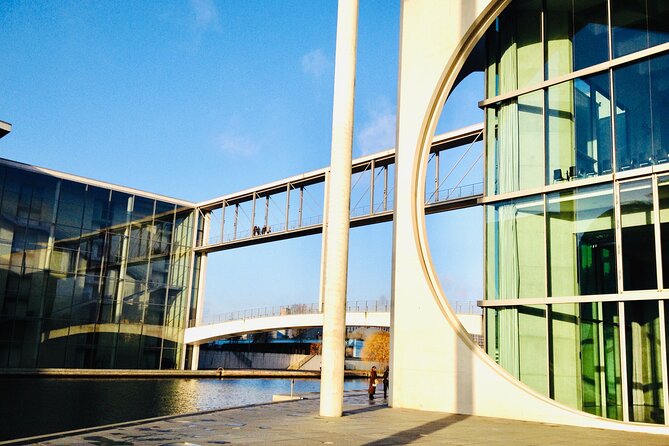
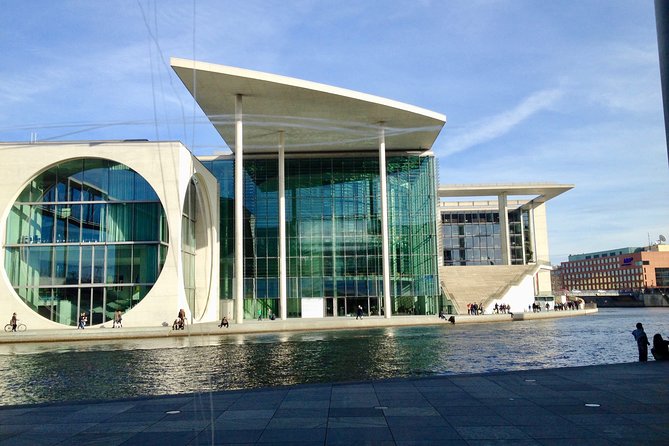
The route also passes the Paul Löbe Building, the working engine of parliament. Speeches take place in the Reichstag, but committees handle much of the serious debate and voting here. Its long, glassy design makes parliamentary work visible from outside, though the largest rotunda contains restricted EU and confidential committees.
Across the river, the Federal Chancellery is deliberately oversized. It contains ten floors, about 500 offices, and space for more than 300 employees. An official apartment was built for the chancellor but is not used, while the chancellor’s office occupies the upper left portion of the building.
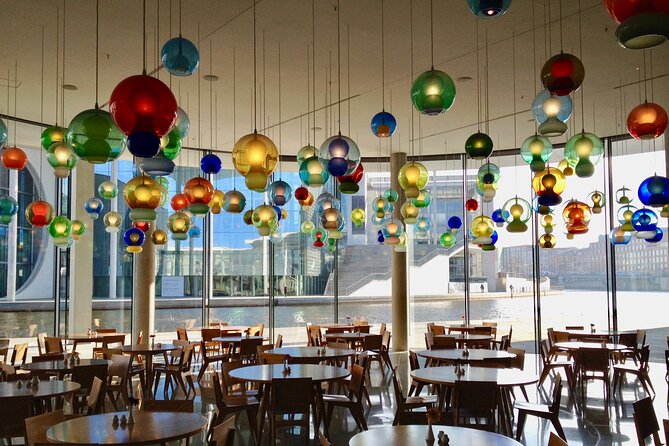
The modern press facility nearby has a giant central window. Accredited journalists gather behind a blue wall for government briefings, and the color carries into the building’s facade. These stops may sound dry on a standard sightseeing route, but they are useful if you want to understand how today’s Berlin government actually functions.
The Wall, Hauptbahnhof, and Friedrichstrasse
The taxi crosses the old East-West boundary again near the harbor. This area recalls the first deaths after the Wall went up. Günter Litfin was shot while trying to swim through the harbor, and a surviving watchtower near Invalidenfriedhof is connected with his story.
Berlin Hauptbahnhof then offers a striking contrast: a huge, modern transport center built for a reunified city. It has underground and elevated tracks, five levels, broad halls, and many shops. The railway calls it Europe’s largest crossing station, with about 300,000 daily transfers.
Gunter also explains why Berlin once had no true central station. Separate terminal stations served different directions, and Hauptbahnhof finally tied the system together. The former Bahnhof Zoo, once West Berlin’s major station, lost its long-distance ICE service, a change that annoyed many residents of Charlottenburg.
Friedrichstrasse provides another quick look at a changing city. It runs south in a straight line toward Mehringplatz and once formed a major route toward the city’s southern districts. Its northern end has had a rougher look and is now being rebuilt, while the former Tacheles area reflects Berlin’s long pattern of mixing commerce, art, workshops, and new development.
If time becomes tight, the nearby Palace of Tears may be skipped. It preserves the atmosphere of the old border station, where East Berliners said goodbye to departing relatives and where barriers, customs checks, and Stasi observation posts controlled movement. A little extra time can reportedly be arranged on site, but do not count on seeing every optional stop during a busy day.
Same city, a completely different sort of afternoon:
- Discover Berlin Half-Day Walking Tour
★ 5.0 · 9,624 reviews - Berlin: Hop-on Hop-off Bus Tour with Live Commentary
★ 4.3 · 8,579 reviews - Berlin: Government District around the Reichstag Guided Tour
★ 4.7 · 8,447 reviews - Berlin: Reichstag, Plenary Chamber, Cupola & Government Tour
★ 4.6 · 8,422 reviews
Unter den Linden and the historic center
Unter den Linden began as a royal riding path from the Berlin Palace toward the hunting grounds. It later became a grand boulevard lined with aristocratic buildings, state institutions, the State Library, Humboldt University, and the State Opera.
The name comes from the linden trees that won out over a proposed planting of nut trees. Today, the cafes in the center strip offer one of the better places to pause, although the main value of this part of the drive is Gunter’s explanation of how Berlin grew westward from its old Spree island core.
The former Soviet embassy is another oversized reminder of postwar power. Built as the Soviet Union’s largest foreign representation in Europe, it was meant to show who controlled central Berlin. The complex includes courtyards, grand rooms, a school, swimming pool, and ballrooms. It is now used by successor states of the former Soviet Union.
At the Forum Fridericianum, you pass the former Royal Court Library, St. Hedwig Cathedral, the State Opera, and Humboldt University. A glass panel in the pavement recalls the Nazi book burning of May 10, 1933, showing an empty underground library.
The nearby palace became the first home of what is now Humboldt University. The university and the square make a handsome ensemble, but this is a place where a quick explanation cannot replace time inside the buildings. If you care about German intellectual history or the Nazi period, make notes and return later.
The Neue Wache, once a guardhouse, now serves as Germany’s central memorial to victims of war and tyranny. The interior contains Käthe Kollwitz’s enlarged Pietà, a mother mourning her son. It is quiet and restrained, with formal wreath-laying ceremonies on important national days.
Hackesche Höfe, Humboldt Forum, and Nikolaiviertel
Hackesche Höfe is one of the most rewarding short walking stops. Built in 1908, the linked courtyards mixed small factories, workshops, printing businesses, and apartments. The idea was practical and modern for its time: work and home in the same complex, with light and greenery in the shared courtyards.
The courtyards deteriorated during the East German period and were partly used for storage. Their restoration after reunification helped set the tone for the surrounding district. Today you will find shops, crafts, Royal Porcelain Manufactory displays, and the famous East Berlin Ampelmännchen traffic-light figure.
The stop is scheduled for about ten minutes. That is enough to see the courtyards, but not enough for serious shopping or a leisurely coffee.
The Humboldt Forum occupies the former site of the Berlin Palace. The palace burned during the war and was later demolished by East German authorities, despite its importance as a major Baroque building. A large parking area occupied the site for decades.
The exterior and parts of the courtyard were reconstructed from detailed photographs. Inside, the building is modern and houses non-European art collections and collections connected with Humboldt University. The roof terrace offers one of the best high views in central Berlin, and some groups have had tickets arranged in advance. Confirm this before booking if the view is a priority.
Nearby Nikolaiviertel offers a more theatrical version of old Berlin. Much of it was reconstructed in the 1980s, when only a few original houses remained. The Nikolaikirche, Berlin’s oldest church, now forms the center of the district, with the original Knoblauchhaus offering a free look at Biedermeier domestic life.
The setting is pleasant, with restaurants and views toward the Spree, but remember that much of the quarter is a reconstruction rather than a perfectly preserved medieval district.
Tiergarten, Victory Column, and the western center
Tiergarten began as a royal hunting ground. Frederick the Great opened it to Berliners, and later Peter Lenné reshaped it into an English-style park with paths, water, views, and the Landwehr Canal. The Second World War left the park badly damaged, but Allied help supported its replanting.
The Victory Column was originally placed in front of the Reichstag and had three drums celebrating Prussian victories over Denmark, Austria, and France. Hitler moved it to its current position during plans for a monumental redesign of Berlin and added another drum. From the taxi, you get the political story even if you do not climb the column.
The Nordic embassies occupy a shared complex of attractive wooden buildings joined by common facilities. There are five countries, including Iceland, which is easy to forget. Nearby Bellevue Palace serves as the official Berlin residence of the Federal President.
West Berlin’s grand shopping center is the Kurfürstendamm and Tauentzien area. The broad boulevard was modeled partly on Paris’s Champs-Élysées and once had villas, cinemas, cafes, and nightlife. Today it is mainly a shopping street, with luxury brands farther west and the KaDeWe department store at its eastern end.
KaDeWe covers about 60,000 square meters and is famous for its gourmet floor. You can stop for oysters, champagne, bread, cheese, chocolate, or simply a look at Berlin’s most famous food hall. The tour does not turn into a shopping trip, so return independently if you want time inside.
At Breitscheidplatz, the Kaiser Wilhelm Memorial Church preserves a damaged tower and west portal beside the modern church designed by Egon Eiermann. The blue glass interior is surprisingly calm despite the traffic outside. A double-wall design provides much of that quiet.
Kreuzberg, the Kulturforum, and Cold War memory
The taxi route follows parts of the Landwehr Canal, one of Berlin’s many waterways. The canal shortened the Spree route, helped drain swampy ground, and carried building materials into expanding districts. From the road, it also gives you a useful sense of how water shaped the city.
At Nollendorfplatz, the elevated subway shows Berlin’s practical response to difficult ground and limited funds. The station and surrounding streets are also tied to the city’s long LGBTQ history, including early twentieth-century dance halls and nightlife across social classes. The district around Motzstrasse and Fuggerstrasse remains one of Europe’s largest gay neighborhoods.
The Kulturforum was planned as a western counterpart to Museum Island. It includes the Philharmonie, New State Library, New National Gallery, Musical Instrument Museum, Arts and Crafts Museum, and Picture Gallery. The Picture Gallery holds Old Masters from Titian to Caravaggio and Rembrandt.
The New National Gallery is the architectural highlight here. Mies van der Rohe’s glass hall has a self-supporting metal roof with the columns placed outside. The upper level has few permanent walls, so changing exhibitions often use temporary panels, while the main collection areas are underground.
Near the canal, the former Reich Navy Office later became a major military headquarters. Claus von Stauffenberg was executed in its courtyard after the failed July 20, 1944 attempt to kill Hitler. Part of Germany’s Defense Ministry now occupies the building, along with the restored Shell House across the way.
At the former Wall line, the Gropius Bau and Berlin House of Representatives reflect different eras of the city. The Topography of Terror adds the darkest chapter, documenting the SS, Gestapo, and other Nazi agencies that planned and carried out persecution from this site.
A short stop at Niederkirchnerstrasse lets you touch one of the last central Wall fragments. Checkpoint Charlie follows, where the 1961 tank confrontation brought the United States and Soviet Union close to a direct clash. The present checkpoint booth is a replica, so treat the site as a historical marker rather than an untouched relic.
East Side Gallery, Oberbaum Bridge, and Stalin-era Berlin
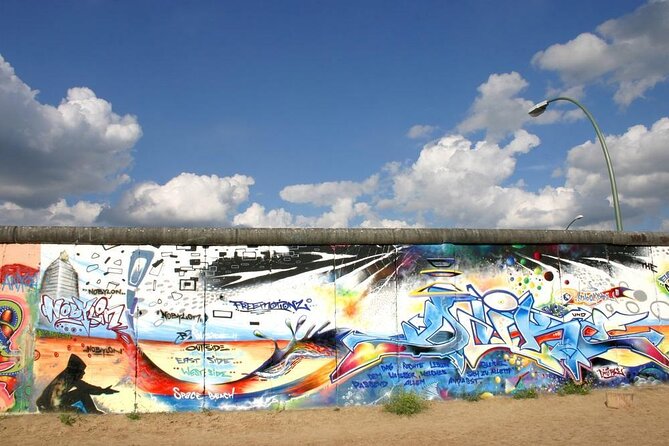
The East Side Gallery preserves about 1,600 meters of Wall. Its famous paintings include the Trabant breaking through the Wall and the Honecker-Brezhnev kiss. The painted surface has been renewed several times, and it is technically a rear Wall rather than the main barrier West Berliners faced.
The scheduled stop is short, about five minutes, so you will see the best-known section but will not have time to inspect every mural. If this is a major reason for booking, ask whether extra time can be added.
Oberbaum Bridge connects Friedrichshain and Kreuzberg. Its medieval-style towers recall the old city boundary and customs barrier, while the subway runs behind the battlements, cars and bicycles use the roadway, and ships pass below. It now links two districts known for nightlife, clubs, street art, and redevelopment.
Kreuzberg itself gives the tour a more ordinary, lived-in side of Berlin. Old buildings, small restaurants, and independent shops line streets that might have been erased by 1960s motorway plans. The district has changed sharply as rents rose, but its mix of immigrant life, alternative culture, and older housing remains important to understanding modern Berlin.
The route may finish with Karl-Marx-Allee, formerly Stalin-Allee. Its monumental apartment blocks were called workers’ palaces and were promoted as proof of socialist progress. Yet wage cuts and production demands helped spark the June 17, 1953 uprising, which Soviet tanks crushed. Today the restored boulevard is one of Germany’s longest protected monument areas.
Who gets the best value from this tour?
I would choose this taxi tour if you have only a day or two in Berlin, prefer not to walk long distances, or want an experienced local voice to connect the city’s many political eras. It also fits families and groups with mobility limits, since most of the time is spent seated and a child seat or booster can be requested.
It is especially useful as a first-day orientation. Write down the museums and neighborhoods that catch your attention, then return by train or on foot with more time.
I would hesitate if you want lengthy museum visits, a slow photography tour, or complete control over every stop. The format covers roughly 60 sites by passing them and pausing at selected places. Gunter gives a lot of information, sometimes almost continuously, and one past account found the pace and vehicle less comfortable for four people.
Pickup is included inside the S-Bahn ring, while BER airport and locations outside the ring require an additional taxi charge. Free cancellation is available until 24 hours before the start time.
Should you book the Berlin private taxi tour?
Book it if you value range, history, and comfort more than long visits inside individual attractions. Gunter Bauer’s strength is the broad story: monarchy, war, Nazism, division, socialism, reunification, and the new Berlin all appear in one moving lesson.
The $179.82 per-person price is easier to justify for a small group sharing a private vehicle. Before confirming, send Gunter your must-see list, ask about vehicle space, and request the Humboldt Forum roof view if it matters to you. If you do that, this can be an efficient and unusually personal way to get your bearings before exploring Berlin on your own.
FAQ
How long does the private taxi tour last?
The tour lasts approximately four to six hours. The exact length and number of stops depend on traffic, weather, road conditions, and how long you spend at each attraction.
What is the price?
The listed price is $179.82 per person.
Is hotel pickup included?
Pickup from a hotel or apartment inside Berlin’s S-Bahn ring is included. Pickup from BER airport or locations outside the ring costs extra.
What language is the tour offered in?
The tour is offered in English.
Is this a private activity?
Yes. Only your group participates in the tour.
What is included in the price?
The experience includes pickup within the eligible central area, an air-conditioned vehicle, private transportation, parking fees, WiFi on board, and the taxi ride and city tour taxes.
Are meals included?
No. Lunch is not included.
Can children join the tour?
Yes. A toddler seat for children from six months to three years and a booster seat for older children are available. A Maxi-Cosi baby seat can be brought on request.
Is the tour suitable for people with limited mobility?
The taxi format can suit people who cannot walk or stand for long periods. You still leave the vehicle at selected stops, so discuss your needs with the provider before the tour.
Can stops be changed or omitted?
Some optional stops may be omitted if traffic or timing makes that necessary. You can discuss personal interests with Gunter before the tour, and additional time may be available for certain stops at an extra charge.
Just added around Berlin
- eSIM for Germany and 34 European Countries★ 4.5 · 16 reviews
- Your ticket to The Wall Museum Berlin★ 3.0 · 60 reviews
- Walking on the Wall: 3-Hour Tour in Berlin★ 4.5 · 34 reviews
- Rickshaw Tours Berlin – Groups of up to 16 people with several rickshaws★ 4.0 · 97 reviews
- Warnemuende Shore Excursion: Private Berlin Tour★ 4.5 · 27 reviews
- Love and War in Berlin: Self-Guided Story Puzzle Walk★ 5.0 · 7 reviews
- Warnemuende Shore Excursion: Berlin Private Sightseeing Tour from Rostock★ 5.0 · 4 reviews
- Cold War Berlin – Private Live Virtual Experience★ 5.0 · 4 reviews
Berlin Tours, compared.

Reichstag, Dome and Government District Guided Tour
Read our review →
1-Hour City Tour by Boat with Guaranteed Seating
Read our review →




Reichstag, Plenary Chamber, Cupola & Government Tour
Read our review →