
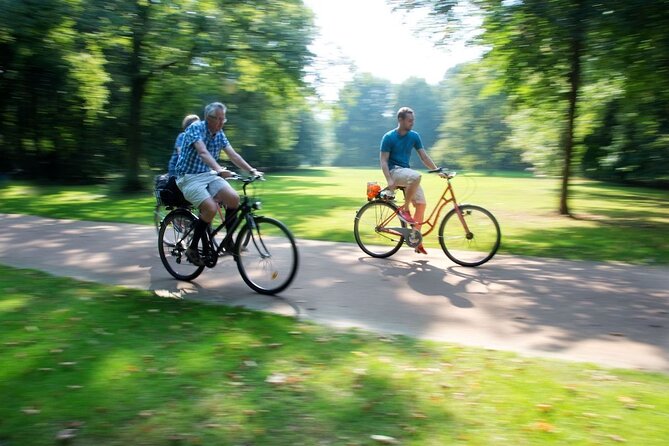
Review · BERLIN TOURS
3-Hour Bike Tour of Tiergarten and Berlin’s Hidden Places
Berlin’s best stories often sit a few streets away from its grand monuments. This three-hour bike tour links leafy Tiergarten paths with quiet lanes and overlooked corners, from the city’s medieval beginnings to postwar housing and Berlin’s ever-changing cultural life. You ride at an easy pace, stopping often for short explanations.
I like the mix of green space and oddball history, and I like that the route goes beyond the standard Brandenburg Gate checklist. The main things to consider are that the tour is offered only in German, and three hours without a planned food or drink stop may feel long for some riders.
Key points to know before you book
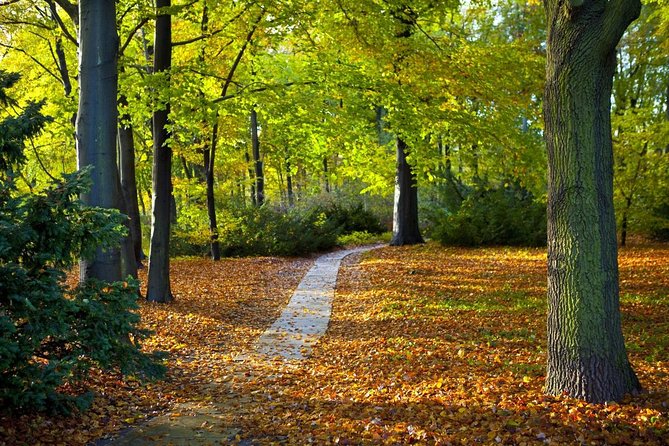
- Tiergarten gives you a calm start: You ride through Berlin’s central park instead of beginning with traffic and major roads.
- The route covers many sides of Berlin: Medieval ruins, reconstructed streets, modern housing, memorials, nightlife, and public art all appear.
- Guide David brings local character: One guide praised in the tour feedback is David, described as both a true Berliner and a funny, well-informed host.
- The group stays fairly small: The tour runs with a minimum of five and a maximum of 15 people.
- You get the practical basics: A bicycle, helmet, and professional guide are included, while food, drinks, and hotel transfers are not.
- German is the regular language: If you need English, you must choose a private tour rather than this standard departure.
Why a bike is the right way to see this Berlin
Berlin spreads out. Its sights are not packed together like those in many European capitals, and the city’s character changes sharply from one district to the next. A bike lets you cover more ground than walking without sealing you inside a bus.
The route uses bike lanes, garden paths, and quiet side streets. That matters because you can pay attention to the city instead of spending the whole tour watching traffic. You also get a better feel for the gaps between famous sights: the open spaces, small neighborhoods, odd memorials, and traces of destruction and rebuilding.
This is not a hard cycling trip. The description presents it as a leisurely ride, and the stops are short enough to break up the pedaling. Still, you should be comfortable riding for about three hours. Children must be accompanied by an adult, and the tour operates in all weather, so a rain jacket or warm layer is sensible.
The group size is another plus. With no more than 15 participants, the guide should have a better chance to speak to the whole group than on a large coach excursion. The minimum of five also means the departure depends on enough bookings.
More bike days around Berlin:
- Berlin: Sights and Highlights Bike Tour with a Local Guide
★ 4.8 · 2,698 reviews - Berlin Highlights 3-Hour Bike Tour
★ 5.0 · 948 reviews - Berlin City Bike Tour with Beer Garden Stop
★ 5.0 · 917 reviews
Starting at Poststraße in central Berlin
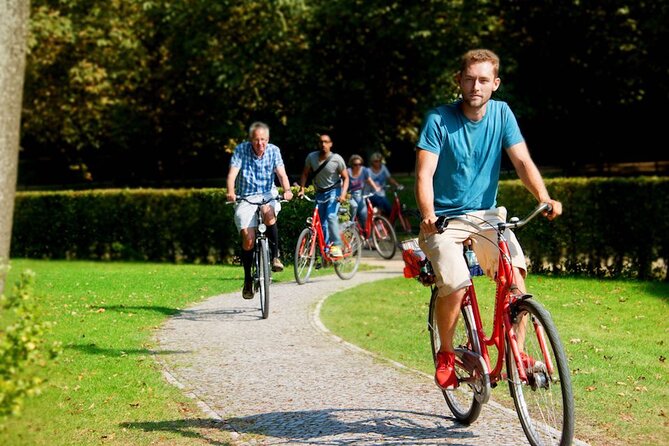
The tour begins and ends at Poststraße 11, 10178 Berlin, near public transportation. The meeting point is also the bike rental location, so you do not spend the opening minutes waiting for a separate equipment transfer.
The first 15 minutes are devoted to the departure point and bicycles. Expect to get set up with the included bike and helmet before heading out. The exact bike adjustment process is not specified, so arrive with enough time to settle onto the saddle and make sure the fit feels right.
Because the activity returns to its starting point, you can leave luggage at your hotel rather than arrange a second pickup. Hotel transportation is not included, so you make your own way to Poststraße and back afterward.
The use of a mobile ticket keeps check-in simple. Confirmation normally arrives when you book, although reservations made within two days of departure may require up to 48 hours for confirmation, subject to availability.
Tiergarten: Berlin’s quiet green center
Tiergarten is the natural opening for this ride. Berlin’s central park offers a sharp change from the stone and traffic of the city center, with leafy paths and room to settle into the bike.
The tour allows about 30 minutes here. That is enough for a short ride through the park and a story or two about its place in Berlin, but not enough for an extended nature outing. Think of Tiergarten as a calm introduction to the route rather than a full park exploration.
I like this part because it helps you get comfortable before the tour turns toward denser city streets. You also see why a bicycle works well in Berlin. The park links central areas without forcing you onto the busiest roads.
The drawback is simple: if you expect a long, leisurely stop with time to wander on foot, 30 minutes will feel brief. This is a sightseeing ride, not a park picnic.
Nikolaiviertel and the city’s point of origin
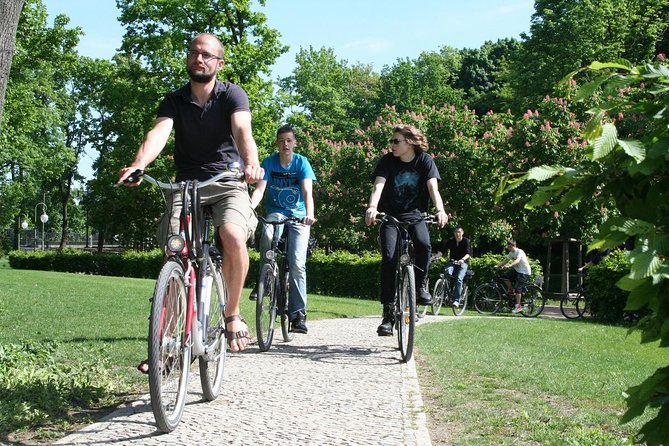
From the park, the route reaches Nikolaiviertel, described as the place where Berlin began. This small quarter sits in the heart of the city and was remodeled after heavy destruction, with much of its present form created during the 1980s.
That history makes the district more complicated than its quiet streets first suggest. It is not simply an untouched medieval neighborhood. You are looking at a later reconstruction shaped by changing ideas about what old Berlin should look like.
The 10-minute stop is short, but the topic is substantial. It introduces one of the tour’s main themes: Berlin repeatedly loses parts of itself, then decides what to rebuild and how to remember it. If you want to understand why Berlin can feel both old and newly made at the same time, this is a useful stop.
A few more Berlin half-days to weigh up
- Berlin Highlights: 3-Hour Bike Tour
★ 4.9 · 809 reviews - Berlin: 3-Hour Street Art Tour
★ 4.7 · 778 reviews - Berlin: 3-Hour Secret Food Tour
★ 4.8 · 269 reviews - Berlin: 3-Hour Segway Tour
★ 4.7 · 112 reviews
Märkisches Museum and Berlin in model form
Near the Märkisches Museum, the guide points out large three-dimensional city models. The purpose is practical: you can see Berlin as a changing physical whole rather than as a collection of separate attractions.
The stop lasts around 15 minutes. The models help explain urban renewal and the constant reshaping of the city. Berlin has had to rebuild, expand, alter, and rethink itself many times, and a city model makes those changes easier to grasp.
This is one of the more useful stops for first-time visitors because it gives context to everything else you see. Instead of treating each district as a separate story, you begin to see how neighborhoods, roads, open areas, and new construction fit together.
The tour does not include admission to the museum. The stop is focused on the city models near it, so anyone expecting a museum visit should plan that separately.
Bärenzwinger and the bear in Berlin’s name
At Bärenzwinger Berlin, the guide tackles a classic city question: where does the name Berlin come from, and what does it have to do with bears?
The stop lasts about 10 minutes. It adds a bit of local folklore and civic identity to the route, a nice change from discussions of war, destruction, and reconstruction. Berlin’s bear symbol appears throughout the city, and this stop gives you a chance to connect that familiar emblem with the city’s name and history.
The appeal here is the question itself. You do not need a long lecture to remember a story built around a bear. It is also the kind of detail you might miss entirely on a standard monument tour.
Parochialkirche and the marks of destruction
The brief stop at Parochialkirche brings the route back to more serious ground: religion, wartime destruction, rebuilding, and the people or structures that survived.
Berlin’s past is not presented as a smooth timeline. This stop shows how a church can carry several periods at once, including its original religious role, damage, later reconstruction, and the question of what deserves to remain.
With about 10 minutes here, you should expect an explanation from outside rather than a lengthy church visit. The value lies in the story and the setting. The pace also keeps the tour moving, which matters because many stops are packed into the three-hour route.
Franziskaner Klosterkirche and medieval Berlin
The Franziskaner Klosterkirche is another short stop, but it offers a rare look at Berlin’s medieval past. The site is abandoned and serves as an unusual memorial to the city before modern Berlin took shape.
This is the sort of place that makes the tour different from a regular city highlights ride. The famous landmarks show the Berlin most people come to see. A ruined or abandoned church shows what has slipped out of daily use, yet still helps explain how old the city is.
The 10-minute visit will suit you if you enjoy fragments and atmosphere more than polished interiors. If you want access to every site or a long period for photographs, the schedule may feel tight.
Global Stone Project, Berlin’s unusual Stonehenge
The Global Stone Project is presented as Berlin’s Stonehenge, with a playful reference to love and difficult relationships. The stop lasts about 15 minutes.
This is a good example of the tour’s tone. You are not only being taken to official monuments. You also see unusual public works that invite a question, a joke, or a second look. The guide’s interpretation is important here, since the attraction alone may not explain why it belongs on a Berlin route.
The stop adds variety after several churches and historical sites. It also reinforces the sense that Berlin’s public spaces are filled with pieces that do not fit a single period or style.
Hansaviertel and the future imagined in 1957
At Hansaviertel, the subject shifts to housing and city planning. The district reflects ideas about the future from 1957, giving you a look at postwar modernist thinking.
The stop is planned for about 15 minutes. Rather than focusing only on famous buildings, the guide uses the neighborhood to ask how people should live in a modern city. That makes the stop useful for anyone interested in architecture, urban design, or Berlin’s divided postwar development.
Hansaviertel also adds an important counterpoint to the older quarters. Berlin is not only about restored facades and medieval remnants. It is also about ambitious experiments in housing and the belief that new forms could improve everyday life.
The limitation is that 15 minutes gives you only an introduction. If modern architecture is your main interest, you may want to return independently with more time.
Clärchens Ballroom and Berlin after dark
The route then reaches Clärchens Ballroom, a famous dance hall surrounded by what the tour describes as a morbid charm. The stop lasts around 10 minutes.
This is a lively cultural change of pace. After churches, ruins, city models, and housing schemes, you get a place connected with dancing and Berlin’s social life. The setting also fits the city’s habit of placing old and new, elegant and shabby, serious and playful close together.
The tour does not list a dance-floor visit or admission, so think of this as a short exterior stop and story. It may leave you curious enough to return later, especially if you want to see the ballroom in operation.
Scheunenviertel: courtyards, food, art, and nightlife
The final major stop is Scheunenviertel, a central district now known for courtyard spaces, shopping, restaurants, culture, art, and nightlife. The tour allows about 15 minutes here.
This neighborhood shows present-day Berlin more clearly than the medieval stops do. You get a sense of how former urban spaces become places for eating, going out, browsing, and creative work. The route also highlights the courtyards, which can be easy to miss if you rush along the main streets.
Scheunenviertel is a fitting end because it brings the tour back to Berlin’s current identity. The city’s story does not stop with war memorials or rebuilding. It keeps changing through housing, commerce, art, and nightlife.
You should not expect time for a full meal here. Food and drinks are not included, and the schedule remains a guided route rather than a neighborhood break. If you want to eat, plan to do so after the tour, when you return to Poststraße.
What the $45.10 price really buys you
At $45.10 per person, the cost is reasonable for a three-hour guided activity that includes the bicycle, helmet, and professional guide. You are paying for more than bike rental because the route links a large number of places and supplies the stories that connect them.
The value is strongest if you want orientation and local context. Renting a bike alone may cost less, but you would need to plan the route, find each stop, and understand why a reconstructed quarter, an abandoned church, a city model, or a 1950s housing district matters.
The value is weaker if you already know central Berlin well or prefer to explore at your own speed. The tour moves through many stops, and the fixed timing means you cannot linger whenever a place catches your eye.
The price does not cover food, drinks, hotel pickup, or drop-off. Bring water before you start. One piece of tour feedback specifically pointed out that three hours is a long time without a short pause to buy food or drink, so this is a practical issue rather than a minor detail.
Language, weather, and who should book
The standard tour is available only in German. That is the most important booking decision. If your German is limited, you should choose a private English tour instead of assuming the regular group departure will be bilingual.
This experience fits you best if you:
- Enjoy active sightseeing but want a relaxed pace.
- Have already seen some major Berlin sights and want lesser-known places.
- Like urban history, architecture, public art, and local stories.
- Are comfortable cycling for about three hours.
- Prefer a group capped at 15 people.
- Can follow the tour in German, or are willing to book the private English option.
It is less suitable if you want a food tour, a museum-heavy outing, or a fully flexible bike rental. It may also be a poor fit if rain or cold would spoil your day, since the tour runs in all weather.
The guide can make a real difference. David is praised in the supplied feedback as a genuine Berliner who combines strong subject knowledge with humor. That combination suits this route, since its best moments depend on storytelling rather than grand interiors or formal attractions.
The tour has a 4.8 out of 5 rating and a 96 percent recommendation rate from 26 reviews. Those figures suggest a strong track record, but the practical details still matter more than the score: German language, no planned refreshment break, and a three-hour ride.
Should you book this Berlin bike tour?
Book it if you want Berlin explained through small places and big changes. Tiergarten, Nikolaiviertel, Bärenzwinger, the churches, Global Stone Project, Hansaviertel, Clärchens Ballroom, and Scheunenviertel create a broad portrait of the city in a short time.
I would especially choose it for a first or second Berlin visit when you want more than the standard central sights. Pack water, dress for the forecast, and arrive ready to ride. If you need English, book the private version instead.
You can cancel for a full refund up to 24 hours before the start time. Cancellations or changes within 24 hours are not refunded or accepted, and the tour may be canceled if its minimum group size is not reached.
FAQ
How long is the bike tour?
The tour lasts approximately three hours and returns to the original meeting point.
Where does the tour begin and end?
It begins at Poststraße 11, 10178 Berlin, Germany, and ends back at the same meeting point.
Is bicycle use included?
Yes. The bicycle and helmet are included, along with a professional guide.
Is the tour offered in English?
The regular tour is available only in German. An English private tour should be selected instead.
What happens if the weather is bad?
The tour operates in all weather conditions, so you should dress appropriately for the forecast.
Can I cancel for a full refund?
Yes. You can cancel at least 24 hours before the start time for a full refund. Cancellations or changes made less than 24 hours before the start are not refunded or accepted.
Just added around Berlin
- eSIM for Germany and 34 European Countries★ 4.5 · 16 reviews
- Your ticket to The Wall Museum Berlin★ 3.0 · 60 reviews
- Walking on the Wall: 3-Hour Tour in Berlin★ 4.5 · 34 reviews
- Rickshaw Tours Berlin – Groups of up to 16 people with several rickshaws★ 4.0 · 97 reviews
- Warnemuende Shore Excursion: Private Berlin Tour★ 4.5 · 27 reviews
- Love and War in Berlin: Self-Guided Story Puzzle Walk★ 5.0 · 7 reviews
- Warnemuende Shore Excursion: Berlin Private Sightseeing Tour from Rostock★ 5.0 · 4 reviews
- Cold War Berlin – Private Live Virtual Experience★ 5.0 · 4 reviews
Berlin Tours, compared.

Reichstag, Dome and Government District Guided Tour
Read our review →
1-Hour City Tour by Boat with Guaranteed Seating
Read our review →




Reichstag, Plenary Chamber, Cupola & Government Tour
Read our review →
Browse the lists this tour appears in