
Review · FRANKFURT TOURS
Frankfurt on Foot Daily Walking Tour in English
Frankfurt’s story changes quickly on this walk. In three hours, you move from the medieval Römer to rebuilt old-town streets, from the Main River skyline to memorials that confront the city’s Nazi past. Guides such as Justin, Jennifer, Phillip, Anne, and Hans bring different personalities, but the route consistently aims to give you a useful first picture of Frankfurt.
I like the wide historical range, from imperial coronations to World War II and modern city life. I also like the practical rhythm: photo stops, a restroom break, and time around Kleinmarkthalle. The main consideration is the distance, about 7 kilometers, much of it on city streets and some cobblestones. Three hours can feel long if you want a slow museum morning.
Key points to know before booking
- A 7-kilometer route covers old Frankfurt, the Main River, and Jewish heritage sites.
- The tour tackles World War II and the Holocaust directly, rather than sticking to postcard views.
- The rebuilt Altstadt is explained in context, including why it looks old but is largely modern.
- Eiserner Steg offers one of the best skyline photo stops on the route.
- Kleinmarkthalle adds a welcome local-food break, though it is closed on Sundays and holidays.
- English is the only tour language, and children 12 and under may join free if they can manage the walk.
Why this walking tour gives you a useful Frankfurt introduction
Frankfurt is easy to underestimate. Many visitors see the cathedral, Römerberg, and glass towers, then assume they have understood the city. This tour makes a better case for Frankfurt by showing how its medieval core, financial power, religious history, Jewish life, wartime destruction, and modern rebuilding fit together.
I find the route especially useful on a first morning in town. You get a mental map before setting off on your own, plus suggestions for food and places to visit later. Several guides, including Justin, Jennifer, and Phillip, are praised for explaining complicated events in clear, approachable English. That matters here, since the tour moves through several centuries without turning into a lecture.
The price is $35 per person. That is fair for a three-hour guided walk with a professional English-speaking guide and no extra admission charges along the route. You still pay for your own snacks and drinks, and you should not expect a formal museum tour with long indoor visits. The value comes from the connections between places, the guide’s commentary, and the time saved finding the sights yourself.
More walking tours in Frankfurt:
- Frankfurt Highlights English Walking Tour
★ 5.0 · 1,203 reviews - Frankfurt: Private or Shared Walking Tour
★ 4.8 · 156 reviews - Frankfurt Self-Guided Historical Walking Tour
★ 4.0 · 58 reviews
Starting at Römerberg and the old city hall
The meeting point is across from the Tourist Info on Römerberg, in front of the Binding Schirn Pub. Look for a guide holding a Frankfurt on Foot Walking Tours sign. This central location is convenient for anyone already exploring the old town, though you should arrive with enough time to find the exact spot.
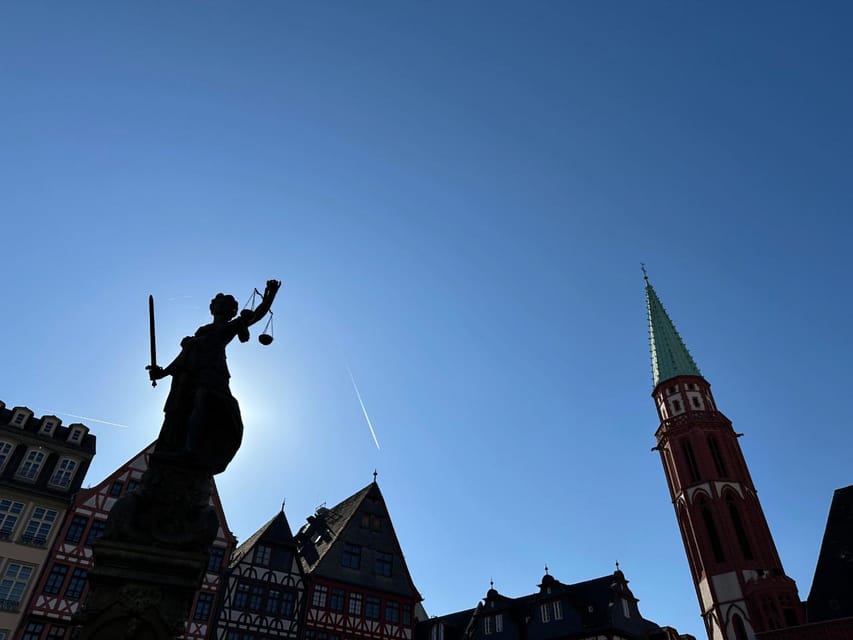
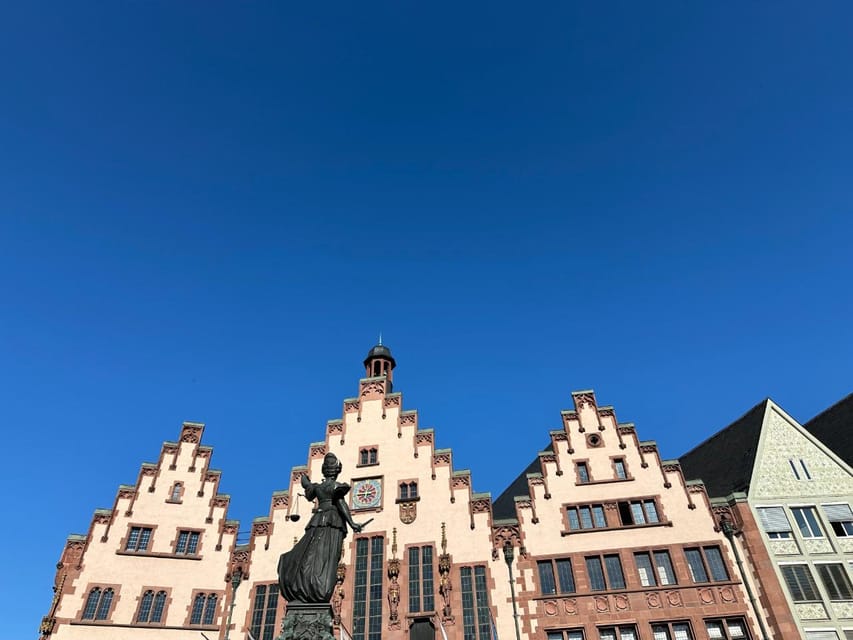
The first major stop is the Römer and Römerplatz. The Römer has served as Frankfurt’s city hall since 1405, and the square around it is the city’s best-known historic setting. Here, I would pay attention to the contrast between the attractive half-timbered façades and the much more difficult story behind them.
This is also where the guide begins explaining how Frankfurt developed as a center of trade, politics, and imperial power. The setting looks compact, but it gives you a strong start because many later stops return to themes introduced here: power, religion, commerce, destruction, and reconstruction.
Understanding the New Altstadt
Frankfurt’s New Altstadt can confuse first-time visitors. It looks like a preserved medieval quarter, but much of it was rebuilt after wartime destruction. The tour explains both the destruction and the decision to recreate historic streets and façades.
I like this part because it helps you read the city instead of simply photographing it. You learn why some buildings are original, why others are modern reconstructions, and how Frankfurt chose to present its past. The result is attractive, but it is not an untouched medieval neighborhood. A good guide makes that distinction clear.
The tour also gives you time for photos without treating every stop as a rushed snapshot. Several people who took the walk appreciated the steady pace and the way the guide allowed enough time at each place. Still, the route covers a lot, so you should expect short explanations at many stops rather than lengthy visits at only two or three sites.
Book burning, churches, and the city’s difficult memory
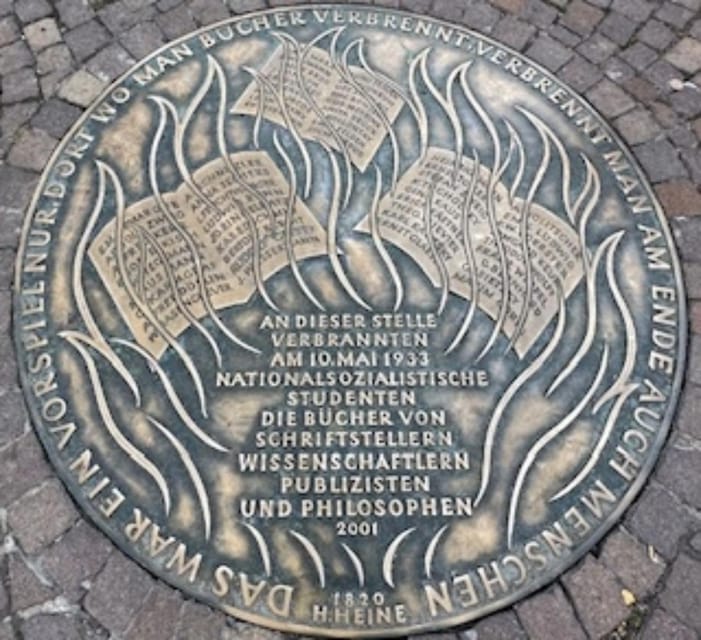
The Book Burning Memorial marks the site associated with the Nazi book burnings. It is a small but powerful reminder that censorship and political terror affected public life in Frankfurt, not just distant parts of Germany.
From there, the route includes the exterior of Alt Nikolai Church, a Gothic church dating to 1290. On Sundays, the church exterior is the focus rather than an indoor visit. The same Sunday and religious-holiday limitation applies to the exterior viewing of St. Bartholomew Cathedral, better known as the Kaiserdom.
The Kaiserdom is one of Frankfurt’s major historical landmarks. For centuries, it was chosen for the elections and coronations of Holy Roman Emperors. Even if you do not enter, the guide gives the building a political role, not just an architectural one.
The tour’s treatment of the Nazi era is one of its strongest features. It does not hide behind easy sightseeing. At the Stumble Stones, or Stolpersteine, you learn about the small brass plaques placed in city sidewalks to remember people persecuted and killed under the Nazi regime.
You also visit Frankfurt’s Jewish Holocaust Memorial Wall. The memorial honors roughly 12,000 Jewish citizens of Frankfurt who were killed in the Shoah. The names of Anne, Margot, and Edith Frank are included. This is a personal stop, and the route gives you a chance to consider the individual lives behind the numbers.
The medieval Jewish cemetery is viewed from outside. It is one of Germany’s oldest and largest Jewish cemeteries, but this is not a cemetery visit with interior access. You then see the Jewish Ghetto Wall, which began as part of Frankfurt’s defenses in 1180 and later formed part of the medieval Jewish ghetto.
I value the way these places are linked. You are not only hearing about a vanished community in the abstract. You are walking through the spaces where Jewish life, confinement, remembrance, and loss remain part of the city’s physical record.
A few more Frankfurt half-days to weigh up
- Frankfurt: River Main Sightseeing Cruise with Commentary
★ 4.3 · 5,127 reviews - Frankfurt: Hop-On, Hop-Off Grand or Express Bus Ticket
★ 3.9 · 2,088 reviews - Frankfurt: 1-Hour Panorama Boat Cruise on the river Main
★ 4.4 · 1,822 reviews - From Frankfurt: Rhine Valley Day Trip
★ 4.4 · 1,317 reviews
The Karmeliter Cloister and its remarkable paintings
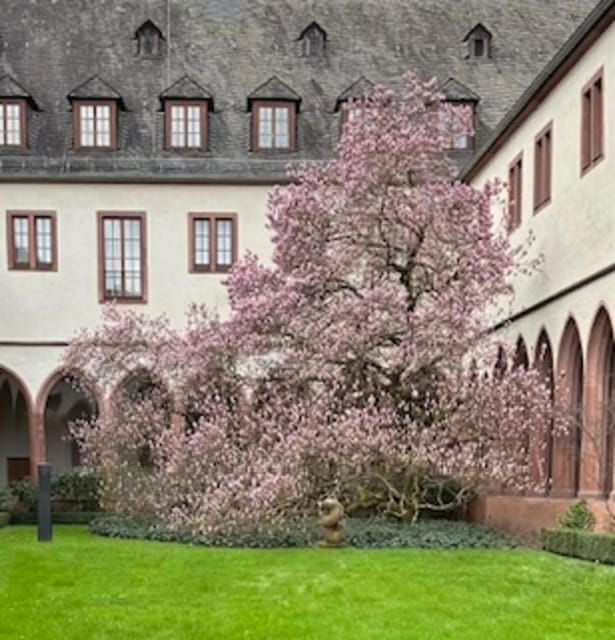
The Karmeliter Cloister brings a different kind of history. Its walls hold paintings by Jörge Ratgeb from the early 1500s. They are described as the largest religious wall paintings north of the Alps.
This stop can be easy to miss if you explore Frankfurt alone. It is not the city’s most famous image, yet it rewards attention. The paintings show how much of Frankfurt’s story sits just beyond the main tourist square.
The cloister is not available on some holidays, so the exact experience depends on the date of your visit. If this is a major reason for booking, check the day carefully before you reserve. The tour still has plenty to offer when access is limited, but the stop loses some of its impact if you cannot see the paintings.
Crossing the Main on Eiserner Steg
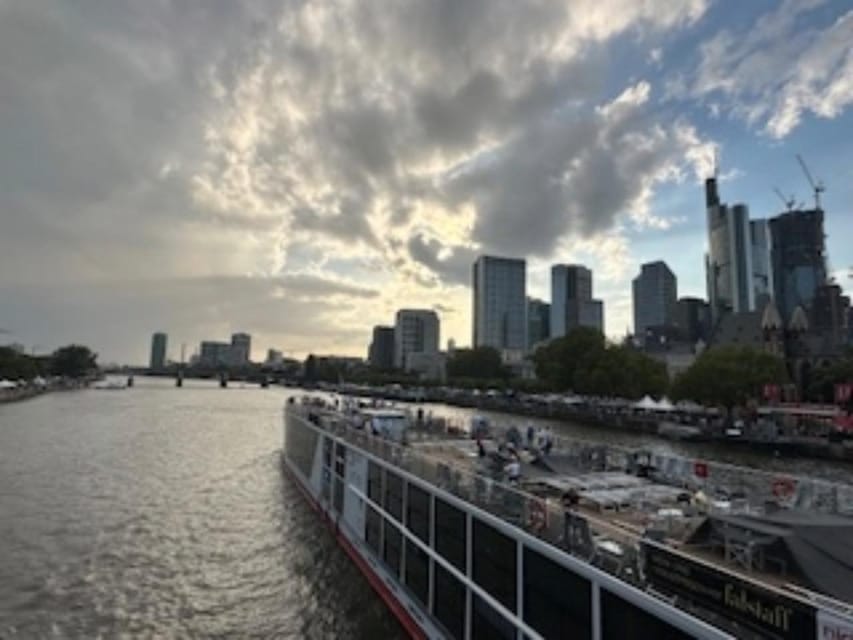
Eiserner Steg, the pedestrian bridge over the Main, is the route’s best open-air pause. From the bridge, you get a clear view of Frankfurt’s skyline and the museums lining the riverbanks.
This is where the city’s old and new identities share the same frame. Behind you are the cathedral, old streets, and reconstructed Altstadt. Ahead are the river, museum district, and modern towers. The guide uses the view to explain Frankfurt as a present-day financial center without losing sight of its older roots.
Bring a camera, but also look around before reaching for it. The bridge is one of those places where the city makes sense in a single glance. The route does not use buses or other transportation, so crossing on foot also gives you a welcome change from the tighter streets of the old center.
A short break at Kleinmarkthalle
Kleinmarkthalle is a favorite part of the walk for good reason. This covered produce hall is filled with fruit, vegetables, chocolates, pastries, cheeses, bread, meat, fish, and international specialties.
The stop adds taste and smell to a tour that is otherwise heavy on stone, plaques, and architecture. I would use it to buy a small snack and notice what local shoppers are choosing. Snacks and drinks are not included, so bring a little spending money.
Do not expect a leisurely lunch here. One person found the time too short for sitting down for more than a few minutes, and that is a useful warning. The break is designed to refresh you and give you a look at the market, not to replace a full meal.
Kleinmarkthalle is closed on Sundays and holidays. The tour runs every day of the year, but this stop may be skipped or handled differently on those dates. That is one of the few itinerary limitations worth checking before you book.
The guides and the pace
The strongest part of the experience is the guiding. Justin is praised for linking Frankfurt’s past to present-day life and for answering questions in plain, easy-to-follow English. Jennifer is often described as warm, clear, and energetic, while Phillip is noted for his enthusiasm and detailed grasp of German history.
Anne brings personal stories and a lively manner. Hans is praised for humor and for explaining how Frankfurt was built. Other guides, including Jo, Anna, Jean, and Hannes, have also led highly rated walks.
That range means the exact personality of your tour depends on the guide assigned that day. The common thread is an English-only format, which is useful if you want a full explanation without switching languages. A clear voice matters in a city street, and several guides are specifically praised for speaking loudly and clearly enough to follow.
The walk is described as easy, but easy does not mean short. Plan on about 7 kilometers over three hours. You will stop often, but you will still be on your feet for most of the morning. Wear comfortable shoes with a good grip, especially if rain makes the cobblestones slippery.
There is a restroom break, and the route is wheelchair and stroller friendly. Weather does not stop the daily schedule, so bring an umbrella and suitable clothing if rain is likely. The tour does not provide food or drinks, though it includes time to buy something.
Who will get the most from the $35 price
I would recommend this walk to first-time visitors, cruise or rail stopovers, and anyone who wants a fast but thoughtful introduction to Frankfurt. It is also useful for people who have lived in the city for years but want the larger story explained. One local who had been in Frankfurt for a decade still found new reasons to revisit familiar places.
The tour suits history-minded visitors who want more than the main square and cathedral. The Jewish memorials and Nazi-era sites receive real attention, so this is not a purely light sightseeing stroll. Families can join, and children 12 and under are free, but younger walkers should be comfortable covering about 7 kilometers.
I would be more cautious if you have limited mobility, although the route is listed as wheelchair accessible and stroller friendly. Cobblestones, standing, and the length of the walk may still affect comfort. If you prefer extended indoor visits, a museum-focused tour may suit you better.
The tour is also less ideal for a slow food experience. Kleinmarkthalle is a stop, not a long lunch. You can return later if you want to shop or eat at greater leisure.
Practical details that make booking easier
The walk starts at 10:00 from Braubach Strasse 41, with the meeting point on Römerberg across from the Tourist Info. Confirm the current starting details when booking, then arrive in comfortable shoes and ready to walk outdoors for three hours.
All tours are in English, and the tour operates 365 days a year. There is no transportation, which is a benefit here because Frankfurt’s central sights sit close enough to connect on foot. It also means rain, cold, or hot weather will shape your experience more than they would on a bus tour.
You can cancel up to 24 hours before the start for a full refund, and the reserve-now, pay-later option keeps your plans flexible. These policies are useful if your Frankfurt visit depends on a changing train or flight schedule.
Should you book Frankfurt on Foot?
Book it if you want a strong first look at Frankfurt with clear historical context, a thoughtful treatment of Jewish life and Nazi persecution, and practical tips for the rest of your stay. At $35, the three-hour route offers good value, especially when you consider the number of major sights covered and the fact that no extra entry fees are required.
Skip it if you want to linger at each church, eat a full meal at Kleinmarkthalle, or avoid a 7-kilometer walk. For most visitors, though, this is a smart way to get oriented. Bring good shoes, keep an eye on the weather, and save time afterward to revisit the places that caught your attention.
FAQ
What is included in the Frankfurt on Foot tour?
The tour includes an English-speaking guide, all included entries along the route, photo opportunities, restroom breaks, and a snack break. Snacks and drinks cost extra.
How long is the walking tour?
The tour lasts three hours. The route covers about 7 kilometers, with regular stops for explanations, photos, and breaks.
Where does the tour meet?
The meeting point is across from the Tourist Info on Römerberg, in front of the Binding Schirn Pub, on the street. The guide carries a Frankfurt on Foot Walking Tours sign.
What language is the tour offered in?
The tour is offered only in English.
Does the tour run every day?
Yes. The tour takes place 365 days a year and starts at 10:00.
Is the tour suitable for children?
Children 12 and under are welcome and join free. They should be comfortable walking about 7 kilometers.
Is the route wheelchair and stroller accessible?
Yes. The tour is listed as wheelchair accessible and stroller friendly.
What should I bring?
Bring comfortable shoes. An umbrella and weather-appropriate clothing are also sensible because the tour takes place outdoors and runs in rain or shine.
Just added around Frankfurt
- Frankfurter Kunstverein: Admission ticket★ 3.7 · 54 reviews
- Welcome to Frankfurt: Private Tour with a Local★ 4.7 · 81 reviews
- Frankfurt: Verbrecherjagd und gefährlich leckeres Schnitzel★ 4.4 · 22 reviews
- Frankfurt: Private or Shared Walking Tour★ 4.8 · 156 reviews
- Frankfurt: Walking Tour – discover the city with VR glasses★ 4.2 · 12 reviews
- Frankfurt: Struwwelpeter Museum Entry Ticket w/Audio Guide★ 4.5 · 22 reviews
- Frankfurt: “The Sandman” Nightmarish Walking Tour★ 4.4 · 45 reviews
- Frankfurt: Unique E-Bikes Tours★ 4.8 · 22 reviews
Frankfurt Tours, compared.
River Main Sightseeing Cruise with Commentary
Read our review →
1-Hour Panorama Boat Cruise on the river Main
Read our review →
New Old Town and Highlights German-Language Tour
Read our review →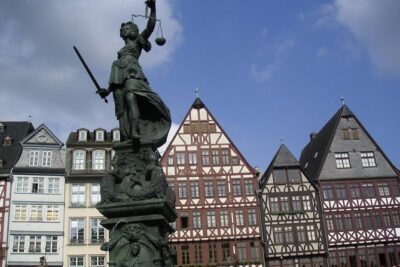
Rhine Valley Trip from Frankfurt including Rhine River Cruise
Read our review →
Browse the lists this tour appears in