
Review · FRANKFURT TOURS
Frankfurt Highlights English Walking Tour
Frankfurt’s past comes into focus on this walk because the route connects imperial ceremonies, Jewish life, postwar rebuilding, food culture, and today’s skyline. You move from the cathedral and Römerberg to the Main River, with a local guide explaining how the pieces fit together rather than simply pointing at monuments.
I like the range of subjects, from Holy Roman Emperor elections to wine, architecture, food, and modern urban planning. I also like the steady pace and frequent stops, which give you time to listen, look around, and ask questions.
The main caution is timing. Three hours can feel long in cold, wet weather or if you have back or mobility problems, and the route includes intermittent steps. Sunday also changes the plan, since several indoor stops are closed and the cathedral and Old Nicholas Church are viewed from outside.
Key points to know before you book
- Ten stops tell a connected Frankfurt story: You see the cathedral, Römerberg, Jewish cemetery, New Old Town, medieval wall, and Main River.
- The guide makes the difference: Hannes, Jennifer, Anna, Anne, Anika, Anneke, Justin, and Philip are among the guides praised for clear explanations and lively storytelling.
- Sunday has a different route: The cathedral and Old Nicholas Church are exterior visits, while Kleinmarkthalle and the City Planning Department are not open on Sundays or German holidays.
- The walk is gentle but not effortless: It is suitable for most people and stroller-friendly, but there are intermittent steps and the pace may challenge some older visitors.
- A small group helps: The maximum is 20 people, and some departures have been much smaller, making questions easier.
- You get practical advice along the way: Guides may point out places for food, drinks, snacks, bathrooms, and further sightseeing.
Starting among emperors at Frankfurt Cathedral

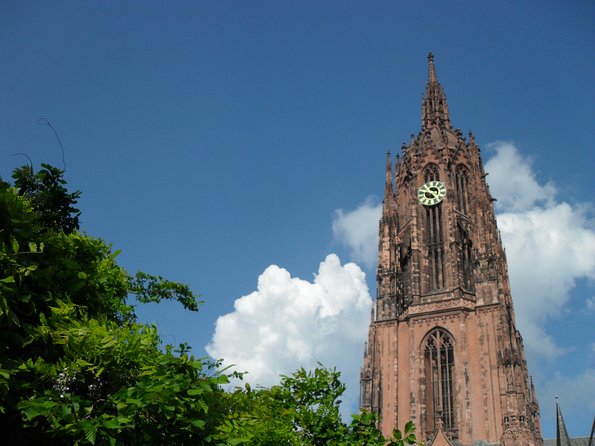
The walk begins at Braubachstraße 41 at 10:00 a.m., in the heart of Frankfurt’s old center. The first major stop is Frankfurt Cathedral, or Kaiserdom St. Bartholomäus, where the Holy Roman Emperors were elected and crowned.
You see the cathedral from the outside on Sundays, but even an exterior explanation gives the building unusual weight. This was not simply a parish church. It was tied to the political machinery of the Holy Roman Empire, and the guide uses the site to explain Frankfurt’s role in European power.
Allow about 20 minutes here. That is enough time to hear the basic story, study the Gothic exterior, and understand why Frankfurt became an important imperial city. If you want to explore the interior, check the day of your tour carefully, since Sunday’s visit is exterior only.
This opening works well because it gives you a historical frame before the walk moves into streets and squares. The guide’s storytelling matters here. Several guides, including Hannes, Jennifer, Anne, and Anna, are praised for making complicated subjects such as the empire and German history easy to follow.
More walking tours in Frankfurt:
- Frankfurt on Foot Daily Walking Tour in English
★ 4.9 · 323 reviews - Frankfurt: Private or Shared Walking Tour
★ 4.8 · 156 reviews - Frankfurt Self-Guided Historical Walking Tour
★ 4.0 · 58 reviews
Römerberg, city hall, and a difficult memory
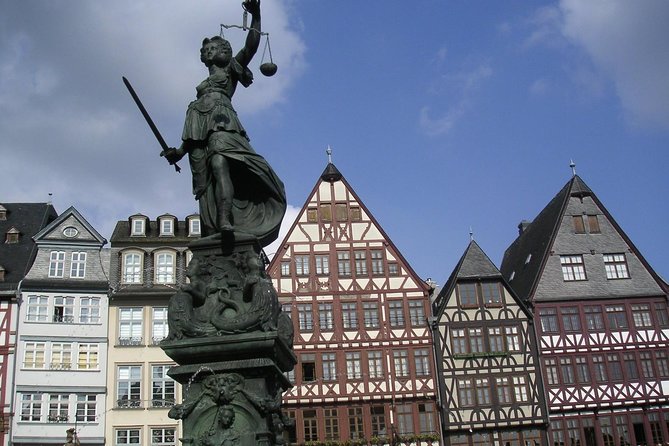
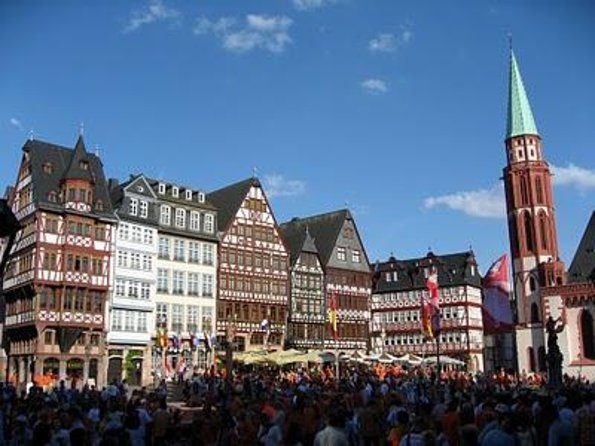
Römerberg is Frankfurt’s postcard square, lined with reconstructed half-timbered houses and anchored by the Römer, the city hall. You spend about 15 minutes here, learning how the square functioned as the city’s civic center and how the Römer became one of Frankfurt’s best-known symbols.
The stop also includes Justicia, the allegorical figure associated with justice, and the Book Burning Memorial. That pairing gives the square more depth than a quick photo stop. You get the attractive medieval-style architecture, but you also confront a reminder of political repression and the destruction of books.
I like this part of the route because it refuses to treat Frankfurt as a pretty old town with no difficult chapters. The rebuilt appearance of the square can seem almost storybook-like, so the memorial helps you remember that the city’s past includes both ceremony and loss.
Your guide may spend longer here if the group has questions. The strongest part of the experience is not the number of facts, but the way individual sites are linked to broader events. Visitors who enjoy history will get more from this stop than someone looking only for quick photographs.
Old Nicholas Church and the New Old Town
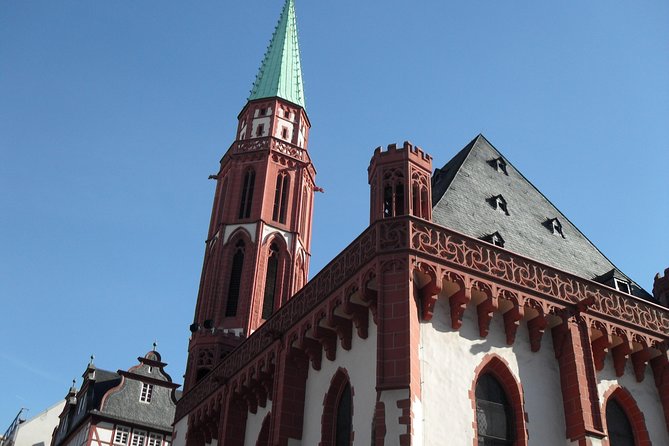
The Old Nicholas Church, or Alte Nikolaikirche, is one of Frankfurt’s oldest churches. The tour allows about 10 minutes here, with an exterior visit on Sundays.
This is a short stop, but it adds another layer to the old center. You have already heard about imperial power at the cathedral and civic life at the Römer. The church helps show how religion and daily city life shaped the same compact area.
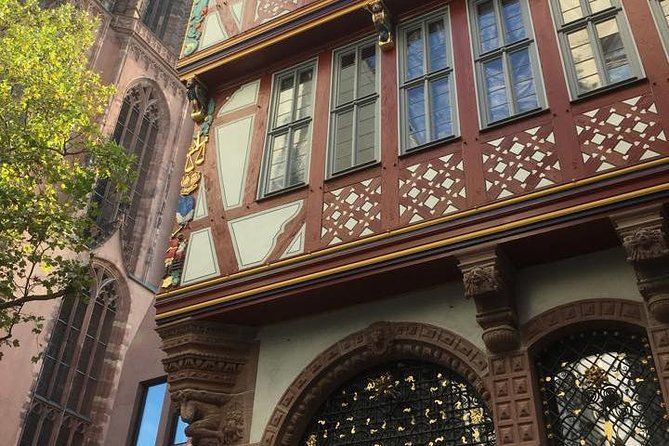
From here, the walk reaches Frankfurt’s New Old Town. The name sounds contradictory, but that is the point. This district was rebuilt in a historic style after wartime destruction, creating a new version of the old center.
You also walk along the former coronation route used by Holy Roman Emperors. The guide can connect the route to the grand ceremonies discussed at the cathedral, letting you picture how rulers once moved through the city.
The New Old Town is useful for understanding Frankfurt’s modern debate about rebuilding. It looks historic, but much of what you see is recent reconstruction or new construction based on older forms. That makes it a good place to ask how a city decides what to preserve, recreate, or leave behind.
Karmeliterkloster and Frankfurt’s art
The Karmeliterkloster provides a change of mood. This former Carmelite monastery is known for wall paintings created between 1513 and 1521, and the tour spends about 15 minutes here.
The paintings give you a direct look at religious art from the early sixteenth century. After the open spaces of Römerberg and the New Old Town, the monastery offers a quieter setting and a chance to focus on details.
A guide who can explain art without turning the stop into a lecture adds real value here. The tour’s strongest guides are praised for covering architecture, art, wine, and local customs along with major political events. That broad approach suits you if you want more than a list of dates.
Keep your expectations practical. The tour does not include a long museum visit, and the stop is part of a larger walking route. You get context and a focused look, not an extended study of the monastery’s collection.
A few more Frankfurt half-days to weigh up
- Frankfurt: River Main Sightseeing Cruise with Commentary
★ 4.3 · 5,127 reviews - Frankfurt: Hop-On, Hop-Off Grand or Express Bus Ticket
★ 3.9 · 2,088 reviews - Frankfurt: 1-Hour Panorama Boat Cruise on the river Main
★ 4.4 · 1,822 reviews - From Frankfurt: Rhine Valley Day Trip
★ 4.4 · 1,317 reviews
A food stop at Kleinmarkthalle
Kleinmarkthalle is one of the most appealing stops for anyone who wants a taste of present-day Frankfurt. This indoor market sells produce, chocolate, cheeses, meats, pastries, and other foods. The planned visit lasts about 15 minutes.
I especially like this stop because food gives you a break from monuments. It also helps you see how locals shop and what kinds of products define the city’s everyday culture. A guide may offer suggestions about foods and drinks to try, which can help you make better choices later in the visit.
The market is not open on Sundays or German holidays, so the route changes on those days. There is no admission charge for the tour stop, but food purchases are your own expense.
Fifteen minutes is enough for orientation and perhaps a quick purchase, but not enough for a leisurely market lunch. If Kleinmarkthalle is high on your list, consider returning after the tour. The walking tour gives you an introduction, then you can come back when you have more time.
Frankfurt’s Jewish past at the old cemetery
The Old Jewish Cemetery is one of the most serious stops on the route. Here you learn about Frankfurt’s Jewish community, which has been present since the 1100s, and about the medieval Jewish ghetto.
The cemetery is viewed through the gate. A Holocaust remembrance wall surrounds the medieval cemetery, creating a powerful link between medieval Jewish life and the crimes of the twentieth century.
The tour allows about 30 minutes here, the longest stop on the itinerary. That extra time is appropriate. This is not a place to rush through for a photograph. You need time to understand the setting, the long history of the community, and the meaning of the memorial wall.
The stop also helps correct a common impression of Frankfurt as mainly a banking center with a reconstructed old town. Jewish history is a central part of the city’s story, and this portion of the walk gives it proper attention.
You may find this part emotionally demanding. The guide’s tone matters, and the best guides handle the subject with care while keeping the explanation clear. If you prefer a light sightseeing loop with little serious history, this tour may feel heavier than expected. If you want to understand Frankfurt honestly, it is one of the most valuable stops.
City planning and the shape of modern Frankfurt
At the Stadtplanungsamt, Frankfurt’s City Planning Department, you see a large-scale model of the present-day city. The tour spends about 15 minutes here.
This is an unusual stop for a highlights walk. Instead of looking only backward, you get a visual explanation of how Frankfurt is organized today. The model can help you make sense of the contrast between the old center, the Main River, Sachsenhausen, the museum district, and the modern financial area.
The department is not open on weekends or German holidays, so this stop is another reason to consider a weekday departure. On a Sunday, the route focuses more on exterior sights and streets.
I like the planning model because it gives your walk a wider frame. After seeing individual buildings and memorials, you can understand the city as a whole. It also makes the tour feel less like a standard monument checklist.
Crossing the Eiserner Steg
The Eiserner Steg is Frankfurt’s pedestrian bridge across the Main and is often called the Love-lock Bridge. The tour allows about 10 minutes here.
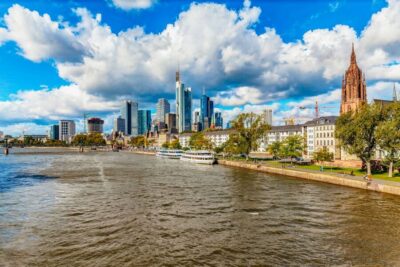
From the bridge, you get views in both directions. Look for the European Central Bank, the museums along the riverbank, and Sachsenhausen on the opposite side. This is the walk’s best broad city view, especially if you want a break from close-up streets and façades.
The bridge also shows Frankfurt’s unusual mix of old and new. One direction points toward historic churches and the old center. Another takes in the financial district and modern city life. Across the river, Sachsenhausen adds another part of Frankfurt’s identity.
Ten minutes goes quickly, especially if the group pauses for photographs. The guide’s commentary helps you know what you are looking at, so this is more useful than crossing the bridge alone without context.
The Staufenmauer and the medieval Jewish wall
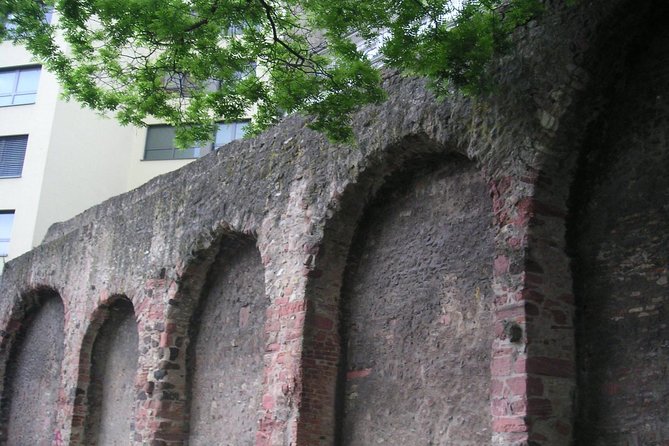
The final listed sight is the Staufenmauer, a city wall dating from the 1100s and part of the medieval Jewish wall. The tour allows about 15 minutes here before returning to the starting point at Braubachstraße 41.
This is an easy detail to miss if you are walking around Frankfurt on your own. It does not have the scale of the cathedral or the visual drama of the river bridge, but it shows how compact and fortified medieval Frankfurt once was.
The wall also returns you to the Jewish history introduced at the cemetery. That connection gives the route a satisfying thread. You have seen the city’s imperial center, religious buildings, market life, memorials, river, and defenses, then finished with a reminder that different communities shared this limited urban space.
How much walking and talking to expect
The tour lasts about two to three hours. It is described as suitable for most people and stroller-friendly, with frequent stops that make the pace manageable.
Still, do not mistake leisurely for completely effortless. One guide was praised for setting a good pace, while another experience was described as too fast for some older participants. Intermittent steps are also part of the route, and one visitor noted that the walk became difficult because of back pain.
If you have mobility concerns, contact the provider before booking and be ready to tell the guide what you need. Service animals are allowed, and the activity is near public transportation. There is no promise of a separate slower group, so you should treat the stated two to three hours as a real commitment.
Cold or rainy weather can change how the walk feels. Several stops are outdoors, and the bridge and squares offer little shelter. Wear suitable shoes and clothing, and do not schedule an important train or flight immediately after the tour.
The group limit is 20. That is a reasonable size for city streets, though an especially small departure will feel more personal. Guides including Hannes, Jennifer, Anna, Anne, Anika, Anneke, Justin, and Philip are praised for clear speaking, good answers, humor, and practical advice. Since guide quality shapes a walking tour, this is important.
Price, booking, and the Sunday question
At $36.28 per person, the price is fair if you want a guided introduction to Frankfurt rather than a self-guided walk. The route includes ten stops, and no admission fees are charged at the listed sights. You are paying mainly for the guide’s time, local interpretation, and the organized route.
That value is strongest for a first visit or a short stay. In three hours, you cover the old center, Jewish history, the river, and a modern planning viewpoint. You also get recommendations for food and drinks, which can save you from making random choices later.
The price is less attractive if you want extensive interior visits or lots of free time at each sight. The cathedral and Old Nicholas Church are exterior-only on Sundays, Kleinmarkthalle is closed on Sundays and German holidays, and the City Planning Department is closed on weekends and German holidays.
The tour is often booked about 27 days ahead, so popular dates may fill. You receive confirmation when you book, and free cancellation is available up to 24 hours before the start time. If you book, check the exact meeting address carefully: Braubachstraße 41 is the stated start point, and the map marker may not always match the printed address. Arrive early enough to compare both.
Who will enjoy this Frankfurt walk
I would choose this tour if you want a clear introduction to Frankfurt and enjoy asking questions. It suits first-time visitors, history fans, families who can manage a few hours on foot, and anyone who wants local suggestions for food and further sightseeing.
It is also a good fit for you if you like a tour that includes serious subjects. The Holocaust remembrance wall and old Jewish cemetery are handled as part of the city story, not skipped in favor of only cheerful sights.
You may prefer a shorter self-guided route if you have limited stamina, back problems, or little interest in commentary. The tour can run close to three hours, and the guide may keep a steady pace. It is also not the best choice if your main goal is shopping at Kleinmarkthalle, since the market visit is brief.
Should you book Frankfurt Highlights?
Book it if you want Frankfurt to make sense quickly. The best part is the connection between sites: emperors at the cathedral, civic power at the Römer, Jewish life and loss, rebuilt streets, market food, modern planning, and the river views all become part of one story.
Choose a weekday if you want the fullest version of the route, including Kleinmarkthalle and the City Planning Department. Choose another activity if you need a very slow pace or a mostly indoor experience.
For $36.28, a maximum group of 20, and two to three hours of guided sightseeing, this is a strong-value orientation walk. Bring comfortable shoes, check the day’s closures, and use the exact Braubachstraße address. You will finish with both a better map of Frankfurt and a better sense of why the city is more than banks and rebuilt façades.
FAQ
How long does the Frankfurt Highlights English Walking Tour last?
The tour lasts approximately two to three hours and ends back at the meeting point.
Where does the tour start?
The tour starts at Braubachstraße 41, 60311 Frankfurt am Main, Germany, at 10:00 a.m.
Is the tour offered in English?
Yes. The walking tour is offered in English and includes a mobile ticket.
Are the sights included with admission?
The listed stops have no admission charge for the tour. The route mainly uses exterior areas and public city sights.
Does the itinerary change on Sundays?
Yes. Frankfurt Cathedral and Old Nicholas Church are exterior-only on Sundays. Kleinmarkthalle is not included on Sundays or German holidays, and the City Planning Department is not open on weekends or German holidays.
Is the walking tour suitable for people with limited mobility?
The activity is stroller-friendly, and most people can participate, but the route includes intermittent steps and may be difficult for some older visitors or anyone with back problems. Service animals are allowed.
Just added around Frankfurt
- Frankfurter Kunstverein: Admission ticket★ 3.7 · 54 reviews
- Frankfurt: Private or Shared Walking Tour★ 4.8 · 156 reviews
- Welcome to Frankfurt: Private Tour with a Local★ 4.7 · 81 reviews
- Frankfurt: Verbrecherjagd und gefährlich leckeres Schnitzel★ 4.4 · 22 reviews
- Frankfurt: Walking Tour – discover the city with VR glasses★ 4.2 · 12 reviews
- Frankfurt: Struwwelpeter Museum Entry Ticket w/Audio Guide★ 4.5 · 22 reviews
- Frankfurt: “The Sandman” Nightmarish Walking Tour★ 4.4 · 45 reviews
- Frankfurt: Unique E-Bikes Tours★ 4.8 · 22 reviews
Frankfurt Tours, compared.
River Main Sightseeing Cruise with Commentary
Read our review →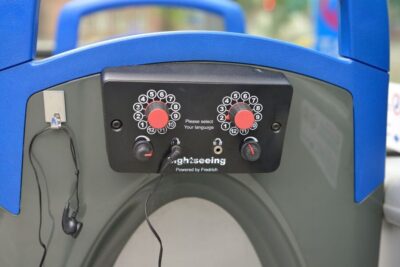
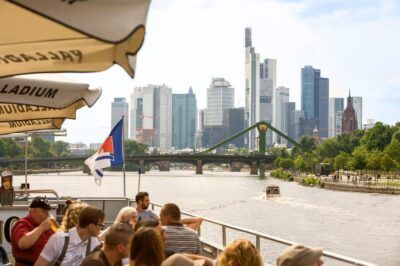
1-Hour Panorama Boat Cruise on the river Main
Read our review →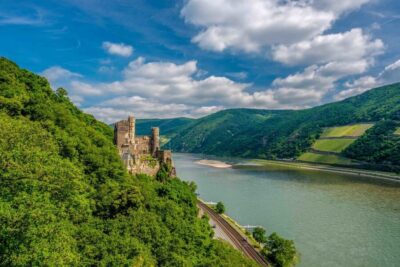
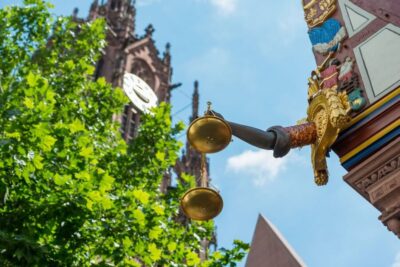
New Old Town and Highlights German-Language Tour
Read our review →
Rhine Valley Trip from Frankfurt including Rhine River Cruise
Read our review →
Browse the lists this tour appears in