
Review · BERLIN TOURS
Berlin East Side Tour 2.5 hour cruise with commentary
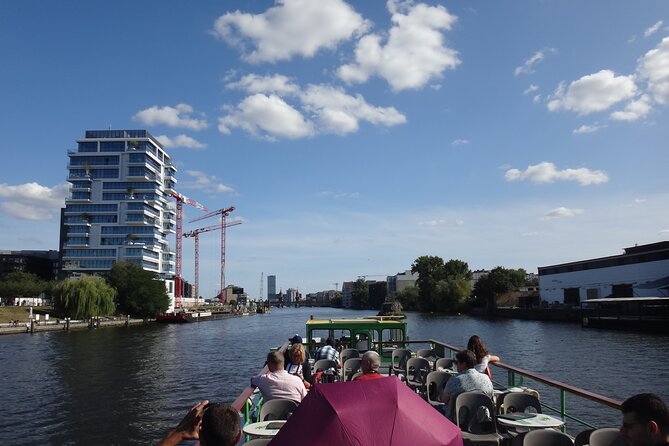
Berlin’s story unfolds unusually well from the Spree. On this 2.5-hour East Side cruise, you glide past royal museums, government buildings, remnants of the Berlin Wall, working locks, modern art, and everyday city architecture without changing trains or wearing out your shoes.
I like the different view of Berlin and the way the route reaches places a short city cruise skips, including Molecule Man, the East Side Gallery, the old founding area near Mühlendammschleuse, and the newer eastern waterfront. I also like the slow pace, which gives you time for photographs and a coffee or small beer from the onboard bar.
The main catch is the length. Two and a half hours can feel just right on a clear afternoon, but long for young children or anyone who wants only the headline sights. Commentary is given in German and English, and some people find the English harder to follow on the open upper deck.
Quick takeaways from the Berlin East Side cruise
- A 150-minute route: This goes well beyond the usual one-hour central Berlin boat ride.
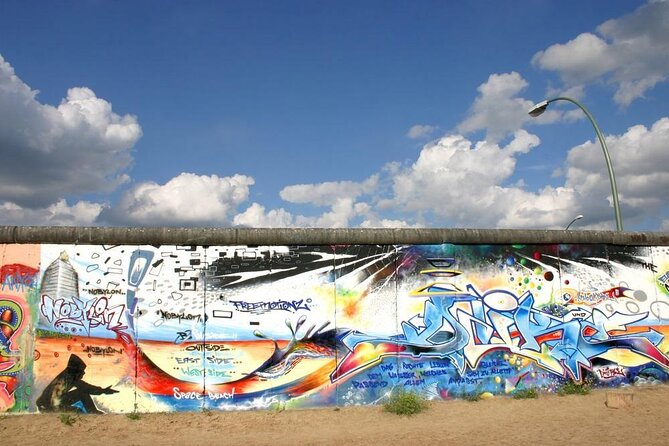
- The East Side Gallery from the river: You see the painted Berlin Wall section from the Spree, though you do not get off for a walk.
- A working lock: The boat spends about 20 minutes at Mühlendammschleuse, near Berlin’s original settlement area.
- The best views are upstairs: The open top deck is ideal for photographs, but commentary can be harder to hear there.
- History and architecture together: Expect explanations of buildings, bridges, city planning, and Berlin’s divided past.
- A practical afternoon outing: Start at Alte Börse, return to the same pier, and use the onboard toilet and bar.
Why this longer Spree route earns its extra time
At about $36.04 per person, this cruise costs more than Berlin’s short one-hour boat trips. The value depends on how you like to see a city.
If you want a quick look at Museum Island and the central government quarter, an hour may be enough. If you want to connect central Berlin with the East Side Gallery and the eastern waterfront, the longer route makes more sense. You get a broader picture of the city rather than a quick parade of famous façades.
I see the real benefit in the combination of sitting down and covering a lot of ground. Berlin is spread out, and several sights are separated by busy roads, rail tracks, and wide urban spaces. From the river, you can take them in at an easy pace. The boat moves slowly enough for photos, and the route includes a lock passage that short cruises often skip.
The cruise is not a hop-on, hop-off boat. It returns to Alte Börse, and the sightseeing is from onboard. If you want time inside the East Side Gallery, at the Reichstag dome, or in the museums, plan those visits separately.
A few more Berlin half-days to weigh up
- Berlin: Reichstag, Dome and Government District Guided Tour
★ 4.7 · 18,288 reviews - Berlin: 1-Hour City Tour by Boat with Guaranteed Seating
★ 4.3 · 16,993 reviews - Berlin: Boat Tour Along the River Spree
★ 4.4 · 11,252 reviews
Starting at Alte Börse at 2:45 pm
The departure point is the BWSG pier at Alte Börse, Burgstraße 27, near the northern part of central Berlin. The cruise begins at 2:45 pm and ends back at the same place, so you do not need to arrange a separate ride home.
The boat holds a maximum of 55 people. That is large enough to create a proper sightseeing atmosphere, but not an enormous sightseeing ship. Arrive early if you care about your seat, especially if you want the upper deck or a forward-facing position.
One practical detail matters here: some tables and chairs may be reserved. If you want a particular table, ask at the wharf booking booth about reserved seating before boarding. This is especially important if facing backward makes you queasy. The seating can also be fairly tight, with connected chairs in rows of three.
The boat has an onboard toilet and a bar selling drinks and food at your own expense. Food supplies may not always be available, so do not assume the bar can replace a meal. Bringing your own food may not be allowed, making a snack before boarding a sensible move.
Museum Island, Berlin Cathedral, and the Humboldt Forum
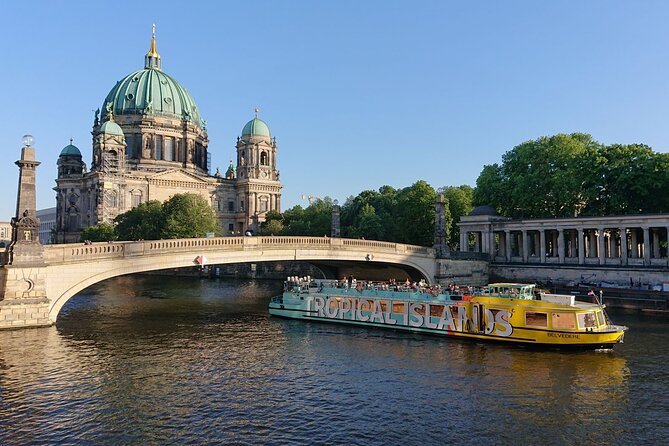
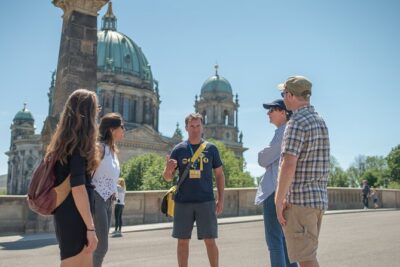
The early part of the route gives you Berlin’s historic center from the water. The Berlin Cathedral rises beside the Lustgarten with its huge dome and ornate Neo-Renaissance and Neo-Baroque design. Built between 1894 and 1905, it is Germany’s largest Protestant church by area and an important Hohenzollern burial site.
From the river, you appreciate the cathedral’s scale better than you do on a crowded pavement. You will not tour the interior on this excursion, but the exterior is one of the strongest photo subjects near the start of the cruise.
Nearby, the Humboldt Forum occupies the reconstructed Berlin Palace site. The complex houses the Ethnological Museum, the Museum of Asian Art, Berlin city exhibits, and the Humboldt Laboratory. Its palace-style exterior can seem old at first glance, but the building and cultural program are very much part of modern Berlin’s attempt to rethink its imperial center.
The boat also passes Museum Island, the UNESCO-listed group of five museums built between 1830 and 1930. Look for the Old Museum, New Museum, Old National Gallery, Bode Museum, and Pergamon Museum, along with the newer James Simon Gallery visitor center.
This section suits you if grand buildings and city design interest you. If you mainly want Cold War stories, the first part may feel heavy on architecture. The commentary tries to cover both, but the number of sights means explanations cannot linger for long.
Mühlendammschleuse and Berlin’s earliest beginnings
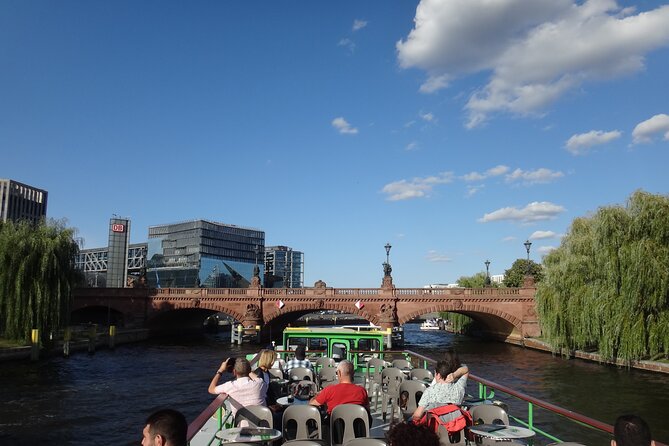
One of the route’s most unusual moments comes at Mühlendammschleuse, the lock on the Spree near Fischerinsel. The lock opened in 1942 and handles a water-level difference of about 1.51 meters.
The boat spends roughly 20 minutes here, and the route includes the lock passage more than once. This is not a dramatic engineering spectacle, but it gives you a close look at how Berlin’s waterways still function. You may find this pause relaxing, though children can lose patience while the boat waits.
The location also carries unusual historical weight. A former weir connected the early settlements of Berlin and Cölln, the two communities from which Berlin grew. In simple terms, this is near the city’s founding point.
That detail gives the cruise a useful sense of time. You move from medieval Berlin to royal Prussia, from the German Empire to the divided city, and then into the modern capital, all along one waterway. The narration tends to mix historical events with facts about buildings and bridges, so you should not expect a nonstop Cold War lecture.
Same city, a completely different sort of afternoon:
- Discover Berlin Half-Day Walking Tour
★ 5.0 · 9,624 reviews - Berlin: Hop-on Hop-off Bus Tour with Live Commentary
★ 4.3 · 8,579 reviews - Berlin: Government District around the Reichstag Guided Tour
★ 4.7 · 8,447 reviews - Berlin: Reichstag, Plenary Chamber, Cupola & Government Tour
★ 4.6 · 8,422 reviews
Nikolaiviertel and the television tower
As the boat continues through Mitte, it passes the Nikolaiviertel, Berlin’s oldest settlement area. Much of the quarter was destroyed in World War II and rebuilt between 1980 and 1987 for East Berlin’s 750th anniversary.
The result is an unusual mix of reconstructed historic houses and prefabricated buildings adapted to an almost medieval street plan. From the river, you get a compact view of a neighborhood that can feel more complicated on foot. The Nikolaikirche anchors the area.
The Berlin television tower then provides a useful orientation point. At 368 meters, it is Germany’s tallest building and one of the city’s most recognizable sights. Completed in 1969, it was built in East Berlin and remains a strong reminder of the former GDR’s ambition and city planning.
The tower is not directly on the riverbank at every point, so views can change as the boat turns and passes buildings. Keep your camera ready rather than waiting for one perfect moment.
Bridges, the East Side Gallery, and the Berlin Wall
The eastern section is where this cruise earns its name. You pass the East Side Gallery, the 1,316-meter open-air gallery painted in 1990 by 118 artists from 21 countries.
The paintings cover the former Hinterland Wall, not the exact riverbank where the border ran. The actual border was on the Kreuzberg side of the Spree. That distinction matters because the wall you see today formed part of the wider border system rather than the whole frontier.
The original paintings were restored and, in many places, replaced by replicas in 2009. From the boat, you see the long painted stretch as one broad piece of post-Cold War public art. You do not have to fight the pavement crowds, but you also cannot stop for close views or read every painting.
The cruise passes beneath or near several historic bridges, including the Oberbaum Bridge, one of Berlin’s most attractive crossings. Its brick towers and pointed details make a strong contrast with the industrial waterfront. The bridge connects Friedrichshain and Kreuzberg, two districts that now feel lively and creative but once sat on opposite sides of the Wall.
You also hear about the area’s earlier bridges and customs points. A predecessor near the old city wall used a narrow passage and wooden walkways to collect customs duties. The later Upper Tree bridge marked an eastern entrance to Berlin near Stralauer Tor. These details help turn a pleasant bridge view into a lesson about how the city controlled movement and trade.
Molecule Man and the changing eastern waterfront
Near the meeting point of Kreuzberg, Friedrichshain, and Alt-Treptow, three metal figures rise from the Spree in Molecule Man, an artwork by American sculptor Jonathan Borofsky installed in 1999.
The sculpture is best appreciated from the river. Three perforated human forms lean toward one another, creating a memorable photograph and a clear example of Berlin’s fondness for large public art. The view is one of the cruise’s most distinctive moments.
The route also takes in the newer Osthafen area, the Badeschiff, the Uber Arena district, and the alternative cultural center Holzmarkt 25. These places show Berlin after reunification, when former industrial edges became offices, entertainment sites, housing, and experimental cultural spaces.
This part may be less satisfying if you want only famous monuments. Some of the commentary covers ordinary buildings and architectural changes rather than major historical events. I think that is part of the point: Berlin is not just a collection of postcard sights. The river lets you see how the city keeps rebuilding itself.
The Reichstag, government quarter, and Humboldthafen
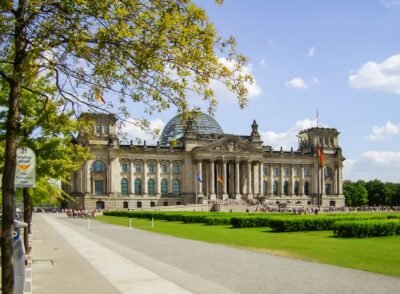
On the return section, the boat passes the Reichstag, home of the German Bundestag since 1999. The building dates from 1884 to 1894, suffered severe damage in the 1933 fire and World War II, and was later redesigned by Norman Foster for Germany’s reunited parliament.
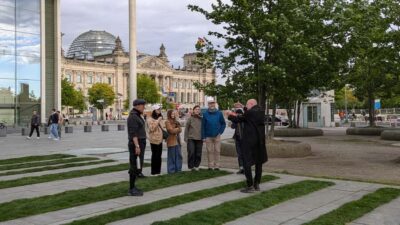
The glass dome is the familiar feature, though your river view may not show every detail. The cruise does not include entry to the dome. Still, seeing the Reichstag from the Spree puts it in context with the new government buildings around it.
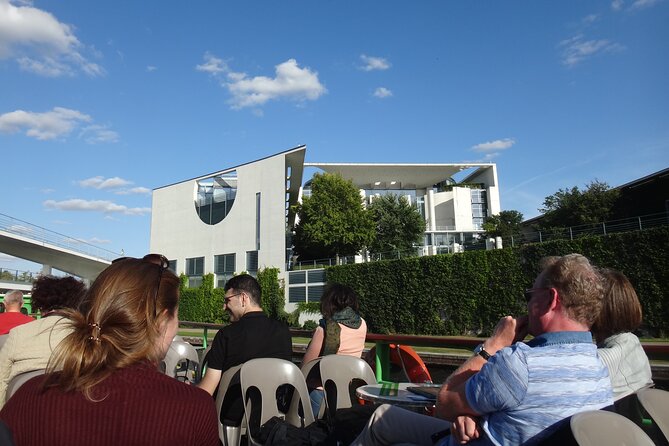
You pass the Kronprinzenbrücke, the Spreebogenpark, and the Federal Chancellery, built as part of the government district’s post-reunification development. The Humboldthafen, a listed dock with a water surface of about 33,500 square meters, adds another layer of waterfront history and planning.
The House of World Cultures sits in the former Congress Hall, a modernist building known locally for its curved Pregnant Oyster shape. It now presents international contemporary art, with a focus on non-European cultures and societies.
This stretch is particularly good for understanding how Berlin’s capital functions today. It is less about royal drama and more about parliament, public institutions, modern architecture, and the city’s effort to make the Spree a civic center.
The Palace of Tears and central Berlin bridges
Near Friedrichstrasse, you pass the Palace of Tears, the former departure hall at Bahnhof Friedrichstrasse. East Germans used this crossing to say goodbye to Western visitors, often without being allowed to travel themselves.
The nickname comes from those tearful farewells. Inside, East German border officials controlled the counters and departures. From the boat, the building is easy to miss, so listen closely when it is pointed out.
The Weidendammer Bridge follows. This listed bridge crosses the Spree at Friedrichstrasse and traces its origins to a 17th-century crossing. It is also tied to Berlin’s literary life, another reminder that the river has been a working route, a border, and a setting for city stories.
The final stretch returns you toward Museum Island and the cathedral. Seen again from the water, the monuments may look different because you now understand how the central districts connect.
Commentary, weather, and the best seat
The live commentary is offered in German and English. The German explanation generally comes first, and the English version follows. That arrangement can mean the boat has already passed part of a sight before the English details begin, especially from the upper deck.
On a clear day, I would choose the open top deck for the views. You can photograph the bridges, wall art, sculptures, and government buildings without window glare. The tradeoff is sound. Wind, engine noise, and distance from the speaker can make the English commentary difficult to catch.
The lower salon protects you from rain and strong sun, and large screens allow you to follow the route. But the lower area may feel warm if air conditioning is not working, and the windows may limit your photographs. Dress for the weather, and consider a light layer even on a bright afternoon.
The pace is deliberately slow. That is good for pictures and bad only if you need constant action. Rowdy groups can affect the atmosphere, though the boat’s size and seating arrangement give you limited choice about where you sit.
Who should book this Berlin river cruise?
I would choose this tour on a first or second day in Berlin if I wanted an easy orientation without another walking marathon. It suits adults, couples, and families with older children who can handle 150 minutes of sightseeing and commentary.
It is also a good choice for architecture fans, photographers, and anyone curious about how Berlin’s historic center meets its newer eastern districts. The river perspective is the main reason to book it. You see buildings that are awkward to reach on foot, and you can understand the city’s shape in one continuous ride.
I would skip it if your priority is a short, punchy tour of only the top monuments. I would also avoid the longer route for very young children, or if you need guaranteed close-up access to the East Side Gallery. In that case, take a shorter cruise and visit the wall on foot.
The $36.04 price is fair if you value the extra route, the lock passage, the eastern waterfront, and the comfort of staying seated. It is harder to justify if you will spend the final half-hour bored or if poor weather forces you downstairs.
Should you book the 2.5-hour East Side cruise?
Book it if you want Berlin’s broad story from the water, not just a quick central-city loop. The best parts are the East Side Gallery, Oberbaum Bridge, Molecule Man, Mühlendammschleuse, and the contrast between Museum Island and the modern government quarter.
Choose an upper-deck seat early, ask about reserved tables, and bring patience for bilingual commentary. If the weather is kind, this can be a calm and useful afternoon. If you want action, close wall inspection, or a short ride, spend your money elsewhere.
FAQ
Where does the Berlin East Side cruise start?
The cruise starts at the BWSG pier at Alte Börse, Burgstraße 27, 10178 Berlin. It begins at 2:45 pm and returns to the same meeting point.
How long does the cruise last?
The cruise lasts approximately 2 hours and 30 minutes, or 150 minutes.
Is commentary available in English?
Yes. Live commentary is provided in German and English. The German explanation generally comes first, followed by the English version.
Does the boat stop at the East Side Gallery?
The route passes the East Side Gallery from the Spree, but the experience does not include getting off for a walk along the wall.
Are food and drinks included?
No. Food and drinks are not included in the ticket price. An onboard bar sells food and drinks separately, subject to availability.
Can I cancel for a full refund?
Yes, if you cancel at least 24 hours before the scheduled start time. Cancellations or changes made less than 24 hours before departure are not accepted for a refund.
Just added around Berlin
- eSIM for Germany and 34 European Countries★ 4.5 · 16 reviews
- Your ticket to The Wall Museum Berlin★ 3.0 · 60 reviews
- Walking on the Wall: 3-Hour Tour in Berlin★ 4.5 · 34 reviews
- Rickshaw Tours Berlin – Groups of up to 16 people with several rickshaws★ 4.0 · 97 reviews
- Warnemuende Shore Excursion: Private Berlin Tour★ 4.5 · 27 reviews
- Love and War in Berlin: Self-Guided Story Puzzle Walk★ 5.0 · 7 reviews
- Warnemuende Shore Excursion: Berlin Private Sightseeing Tour from Rostock★ 5.0 · 4 reviews
- Karl-Marx-Allee Tour: Life and Architecture in East Berlin★ 5.0 · 19 reviews
Berlin Tours, compared.
Reichstag, Dome and Government District Guided Tour
Read our review →
1-Hour City Tour by Boat with Guaranteed Seating
Read our review →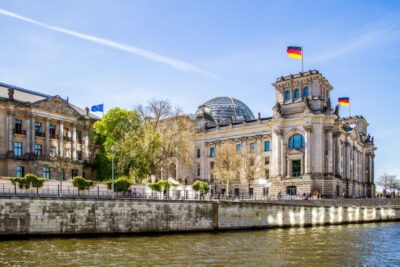
Reichstag, Plenary Chamber, Cupola & Government Tour
Read our review →
Browse the lists this tour appears in