
Review · DRESDEN TOURS
Walking Tour of Historic Dresden with a Christmas Touch. Small group tour.
Dresden’s Christmas season makes a powerful setting for a history walk. You move from the grand Zwinger and royal buildings to the scars and careful rebuilding of World War II, then finish near the Striezelmarkt, Germany’s oldest Christmas market. The tour offers a useful first look at a city that has been destroyed, restored, and still keeps its old traditions alive.
I like two things here. The small group, capped at 17, gives the guide room to answer questions, and the route links architecture with real events instead of treating each building as a postcard. I also like the Christmas angle: you hear about Dresden Stollen, Nutcrackers, Moravian Stars, and Glühwein without paying for a meal or being locked into a market-only tour.
The main consideration is simple: this is mostly a history walk with a Christmas touch, not a two-hour market crawl. One poor experience came from expecting far more Christmas-market time, while the strongest comments praised the historical detail and guides such as Karen and Lawrence. Cold or wet weather can also make a long outdoor explanation feel demanding.
Key points at a glance
- Dresden’s story takes center stage: Cover medieval, Renaissance, Baroque, World War II, and postwar reconstruction in one compact walk.
- The Zwinger opens the route: Spend time in one of Dresden’s most famous architectural settings and learn how it was used.
- Royal Dresden comes alive outdoors: See the opera house, cathedral, palace, Procession of Princes, and Brühl’s Terrace from the street.
- Christmas comes at the end: Reach the Striezelmarkt, founded in 1434, with guidance on Stollen, Glühwein, and Saxon decorations.
- Small groups help: A maximum of 17 people makes it easier to hear the guide and ask questions.
- Plan for winter exposure: You spend the tour outside, and food, drinks, and market purchases are your responsibility.
Why Dresden works so well as a history walk
Dresden is one of those cities where the buildings tell several stories at once. The old center recalls the medieval and Renaissance past, the Baroque age brought royal ambition and grand design, and the destruction of World War II changed the city forever.
What makes this walk useful is the connection between those periods. You are not simply shown a palace, then an opera house, then a church. You hear how Dresden grew into a major royal center, how its buildings were damaged or destroyed, and how much effort went into rebuilding the historic core.
I especially value that context early in a visit. Dresden can look almost too polished in its central squares, and without explanation you may not realize how much of what you see is reconstructed. The tour helps you read the city rather than just photograph it.
The guides appear to be a major part of the experience. Karen is described as professional, funny, patient, and easy to hear, while Lawrence is praised for fitting centuries of history into a clear account. One guide also had an architectural background, which is useful when discussing façades, rebuilding choices, and the relationship between the buildings.
More history-led days in Dresden:
- Elbfloren: Historical city tour
★ 4.8 · 819 reviews - Görlitz: Ghosts and Spooky Historical Night Walking Tour
★ 4.8 · 197 reviews - Historic Dresden Small-Group Walking Tour in English
★ 5.0 · 160 reviews
Starting at Schlossplatz and entering the Zwinger
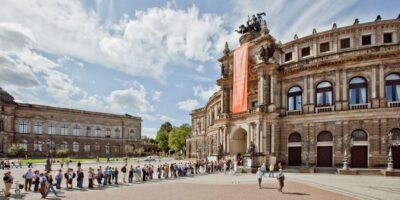
The tour begins at Schlossplatz, the square beside Dresden’s royal complex. From there, you walk through the Zwinger, with about 10 minutes specifically set aside for this stop.
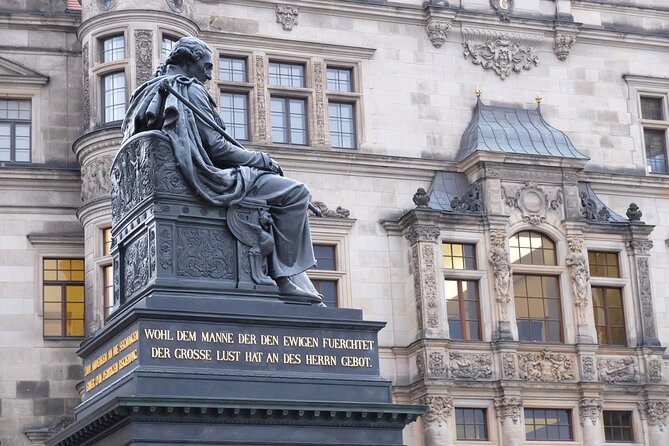
The Zwinger is one of the city’s defining Baroque spaces. It is not just a pretty courtyard. Your guide explains its history and helps you understand why this complex mattered to Dresden’s rulers. The setting gives you an immediate lesson in the city’s taste for ceremony, display, and grand architecture.
The walk through the Zwinger is also a good example of the tour’s format. You see the architecture from outside, listen to the explanation, and keep moving through the center rather than entering every museum. Admission to the Zwinger portion is included because no separate ticket is needed for this outdoor visit.
If you want to spend serious time in the Old Masters Gallery or other Zwinger collections, plan a separate visit. This tour gives you orientation and context, not a museum tour.
Seeing Dresden’s royal center from the street
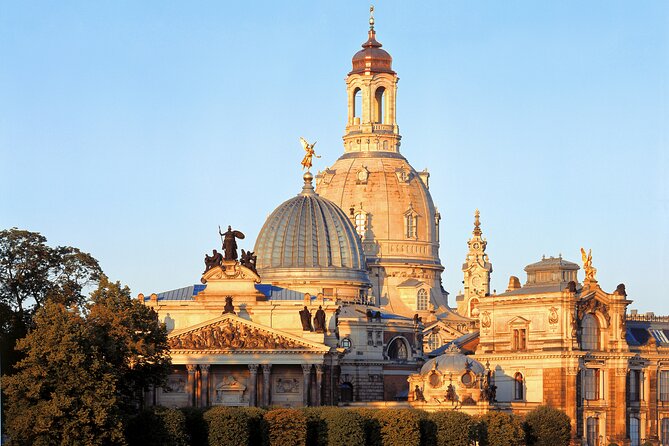
After the Zwinger, the route continues past several of Dresden’s best-known buildings. You see the opera house, the Royal Cathedral, and the Old Masters Gallery from outside, with attention to their architecture, destruction, and reconstruction.
That outside focus is important. The experience does not include interior visits to the museums of the Royal Palace, and you should not book it expecting long indoor sightseeing. If the royal palace is open, the guide may take you through its large courtyard, where Renaissance sgrafitto decoration and frescoes provide another look at Dresden’s artistic past. This depends on opening conditions.
The exterior stops still give you a strong introduction. You can see how the opera house, cathedral, palace, and surrounding squares form a connected royal district. The guide’s job is to explain what you are looking at and why it matters, especially when the city’s present appearance hides the scale of its wartime loss.
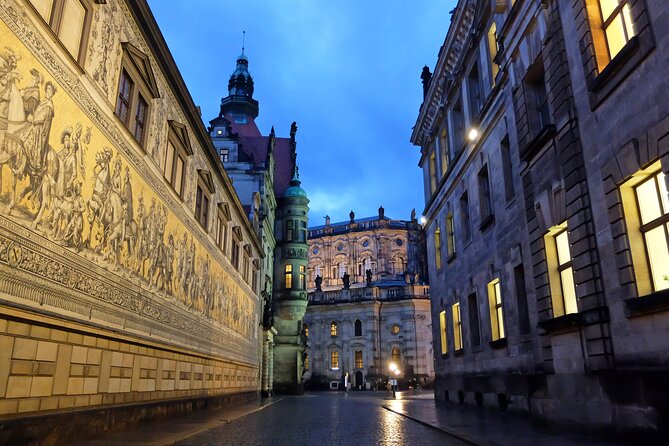
The Procession of Princes adds another layer. You walk past this long, ornate mural and hear how it presents Saxony’s rulers. It is the kind of stop that benefits from a guide because the names, dates, and figures can otherwise blend together.
Brühl’s Terrace and the Balcony of Europe
The route also includes Brühl’s Terrace, known as the Balcony of Europe. This stretch along the Elbe gives the walk a change of pace after the dense royal center.
Here, the guide explains how the terrace got its name and how it fits into Dresden’s development. The viewpoint is part of the appeal, but the historical explanation is the real reason to include it. You get a sense of how Dresden relates to the river and why its setting helped shape the city’s identity.
This is also one of the places where winter conditions matter. Brühl’s Terrace is an outdoor stop, and the tour can be cold or wet during Advent. Bring a warm coat, gloves, and shoes that are comfortable on cobbled streets. The guide may keep the group moving, but you will still spend much of the two hours standing while listening.
More walking tours in Dresden:
- Dresden: City & Semperoper Guided Walking Tour
★ 4.8 · 2,293 reviews - Dresden: Guided City Walk with a Cup of Coffee
★ 4.7 · 1,568 reviews - Görlitz: Old Town Guided Walking Tour
★ 4.7 · 723 reviews - Dresden: Complete Walking Tour with Frauenkirche Visit
★ 4.8 · 700 reviews
The Striezelmarkt and Dresden’s Christmas traditions
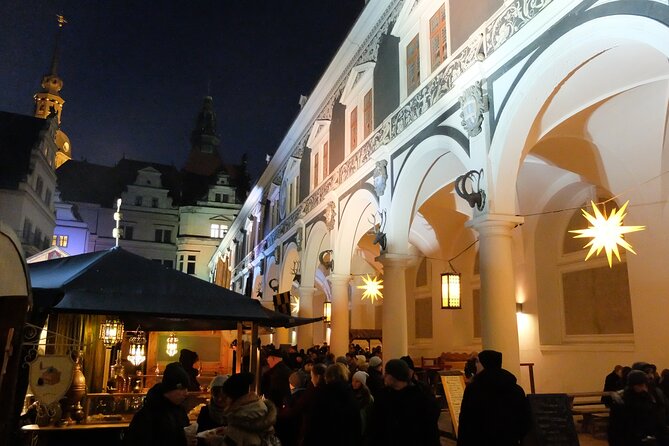
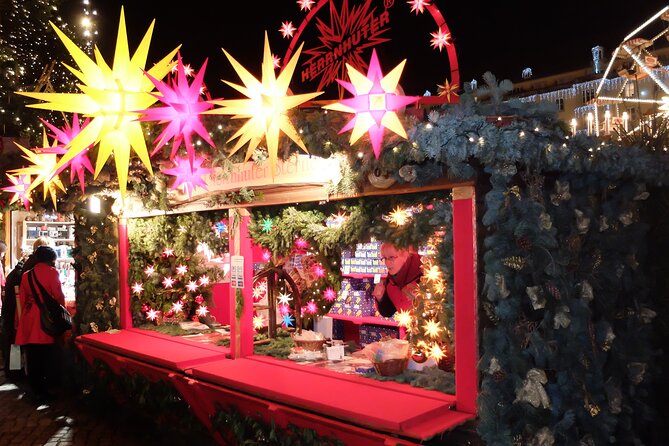
The Christmas portion comes toward the end, at or near the Striezelmarkt. Founded in 1434, it is described as Germany’s oldest Christmas market. That age gives the market more meaning than a standard seasonal shopping stop.
The name Stollen is tied to Dresden’s Christmas story, and the guide points you toward a baker who may allow you to sample it. The tour explains the tradition behind this dense Christmas cake and identifies local foods you can try on your own.
You also hear about Glühwein, the hot spiced wine served at German Christmas markets. Alcohol is not included, and neither are food or drinks, but the guide can point you toward places to buy them. That arrangement keeps the price low and lets you decide how much you want to spend after the walk.
The tour also introduces Christmas decorations associated with Saxony, including Nutcrackers and Moravian Stars. These details give the market visit a local frame. You are not simply told to browse stalls. You learn why certain ornaments and foods belong to the region’s Christmas culture.
Still, keep your expectations in check. The market section may be brief. One dissatisfied participant felt there were only about 10 minutes in the Christmas markets, while the guide’s response clarified that the experience is a history tour with a Christmas touch. If your priority is shopping, eating, and spending most of the afternoon among stalls, choose a dedicated market visit instead.
What the two-hour format means for you
The advertised duration is about two hours, which makes this a practical first activity in Dresden. You can use it to get your bearings, then return to the places that caught your interest. The end point is listed as Altmarkt, though the group may finish at another nearby market.
One account described spending three hours with the guide, so the exact pace may vary. That could be useful if you enjoy detailed explanations, but it also means you should not schedule another activity immediately afterward.
The small-group limit of 17 is a good middle ground. You get more room for questions than on a large coach tour, but it is still large enough to have the feel of a public group walk. The guides have been praised for speaking clearly, answering questions, and adjusting to group needs.
The mobile ticket is convenient, and the meeting point at Schlossplatz is near public transportation. The route stays in the historic center, so you do not need a separate sightseeing transfer. Service animals are allowed, and the activity states that most people can participate.
The $25.35 price and what you receive
At $25.35 per person, the price is reasonable if you want a guided introduction to Dresden’s central sights. You are paying for the guide’s time, historical interpretation, and route planning rather than admission tickets, meals, or entertainment.
That distinction matters. The tour does not include alcoholic drinks, lunch, or any food and drink. If you sample Stollen, buy a snack, or order Glühwein, you pay separately. I see this as a fair setup because food preferences and market spending vary widely.
The value is strongest for a first visit, especially if you want to understand the city before choosing museums or churches to visit on your own. It is also useful for English speakers, since English-language options can be limited according to one experience.
The value drops if you already know Dresden well or want a relaxed market tasting tour. In that case, the history explanations may feel too long, especially while standing outside in winter.
Who should book this Dresden walk
I would choose this tour if you want a clear introduction to Dresden’s historic center and enjoy hearing how architecture connects to politics, war, and rebuilding. It suits visitors who prefer a guide to point out museums, churches, and buildings worth returning to later.
It is also a good fit if you are visiting during Advent and want some seasonal atmosphere without giving up the broader city story. The Striezelmarkt, Stollen, Glühwein, Nutcrackers, and Moravian Stars add local flavor to a route that would otherwise be a standard historical walk.
Families and mixed-age groups may find the small group easier to manage than a large tour, though the experience is still built around listening to historical explanations. If your group includes someone who dislikes standing in the cold, consider that before booking.
I would not choose it as your main Christmas-market outing. The market visit is a short closing element, and the tour’s purpose is to explain Dresden from the medieval period through its Baroque peak, World War II destruction, and postwar restoration.
Practical details before you go
The walk begins at Schlossplatz, Schloßpl., 01067 Dresden, and ends at Altmarkt or another nearby Christmas market. Since the route uses central streets and outdoor squares, wear shoes suited to cobblestones and dress for winter weather.
Arrive on time, but note that one guide was patient when a group arrived late after receiving poor directions from a hotel. That kindness should not be treated as a guarantee. The route works best when the whole group can start together.
You receive confirmation when booking, and free cancellation is available up to 24 hours before the start time. Changes or cancellations made inside that 24-hour window are not accepted for a refund. The activity also requires a minimum number of participants, so a cancellation by the operator would bring an alternative date or a full refund.
Should you book it?
Book this walking tour if you want Dresden explained, not simply displayed. The strongest reason to choose it is the combination of clear city orientation, major architecture, wartime and postwar context, and a short visit to one of Germany’s oldest Christmas markets.
Skip it if you mainly want market food, shopping, and long stretches with a mug of Glühwein. For the right audience, $25.35 is a solid price for a small-group introduction. Pack for the weather, expect a history-led walk, and stay afterward to explore the market at your own pace.
FAQ
How long is the walking tour?
The stated duration is approximately two hours. One account describes spending three hours with a guide, so the actual timing may vary depending on the group and pace.
Where does the tour begin?
The meeting point is Schlossplatz, Schloßpl., 01067 Dresden, Germany.
Where does the tour end?
The listed end point is Dresden Altmarkt. The group may also finish at another nearby Christmas market.
Is the Christmas market visit the main focus?
No. The tour focuses on Dresden’s history and historic architecture, with a Christmas-market visit near the end.
Which Christmas market does the tour visit?
The tour includes the Striezelmarkt, described as Germany’s oldest Christmas market, founded in 1434. The group may also pass smaller markets.
Is food included?
No. Lunch, food, and drinks are not included. The guide explains local delicacies and may point you toward a baker where you can try Stollen.
Is Glühwein included?
No. Alcoholic beverages are not included. You can buy Glühwein at the Christmas market on your own.
Does the tour enter Dresden’s museums?
No. The tour does not go inside the museums of the Royal Palace. If the palace is open, the guide may take you through its large courtyard.
How large is the group?
The experience has a maximum of 17 participants.
Can I cancel for a refund?
Yes. You can cancel at least 24 hours before the start time for a full refund. Cancellations or changes made less than 24 hours before the start are not accepted for a refund.
More Christmas in Dresden
- Dresden with a touch of Xmas: English small group tour
★ 4.7 · 41 reviews - Dresden: Festive Christmas Concert in the Zwinger
★ 5.0 · 26 reviews - Dresden: Christmas Sightseeing Tour with a ‘Pflaumentoffel’
★ 4.5 · 13 reviews - Original Munich Christmas Market Tour with Festive Wine and Food
★ 5.0 · 85 reviews
Just added around Dresden
- Tickets Dresden Transport Museum★ 4.0 · 23 reviews
- Top Full-Day Adventure: Bohemian & Saxon Switzerland from Dresden★ 5.0 · 68 reviews
- Winterland Tour to Bohemian and Saxon Switzerland from Dresden★ 5.0 · 22 reviews
- The Best of Bohemian and Saxon Switzerland Day Trip from Dresden★ 5.0 · 68 reviews
- Historic Dresden Small-Group Walking Tour in English★ 5.0 · 160 reviews
- Private Segway tour through the highlights in Dresden★ 5.0 · 94 reviews
- 1.5 hours Segway Elbe Mini Tour★ 5.0 · 66 reviews
- Sightseeing tour by ConferenceBike★ 5.0 · 14 reviews
Dresden Tours, compared.
The Original Night Watchman Tour in Lantern Light
Read our review →


Browse the lists this tour appears in