
Review · DRESDEN TOURS
Historic Dresden Small-Group Walking Tour in English
Dresden’s story is written in sandstone, porcelain, and carefully rebuilt façades. This two-hour walk takes you from the grand Theaterplatz through royal courtyards and along Brühl’s Terrace, ending with the moving story of the Frauenkirche. I especially like the small-group format and the way the route mixes famous sights with details you could easily miss, such as the hidden grotto at the Zwinger and clues in the long porcelain mural.
I also like that you get practical museum advice without spending the tour indoors. Guides such as Laura, Leo, Christina, Doris, and Karen have been praised for clear English, lively storytelling, and helpful answers. The main consideration is sound: headsets are not normally provided, and a group near the maximum of 15 can be hard to hear in busy squares.
Key points at a glance
- See Dresden’s grandest center in two hours: Theaterplatz, the Zwinger, the Residenzschloss, Stallhof, Brühl’s Terrace, Neumarkt, and Frauenkirche all fit into one focused walk.
- Follow the city’s destruction and rebirth: The guide explains the wartime ruin of Dresden and the long rebuilding of landmarks such as the Frauenkirche.
- Look for small details: The Procession of Princes mural contains hidden stories, while the Zwinger may reveal an open-air grotto if access and time allow.
- Get museum planning help: You see the Royal Palace courtyard but not its collections, so your guide can help you choose which museums and tickets make sense later.
- Expect a manageable pace: The route includes some stairs, but one senior guest found the walking comfortable overall.
- Best for first-time visitors: The walk gives you a clear framework for Dresden before you return to explore churches, museums, river views, and cafés on your own.
Why this walk works as a first look at Dresden
Dresden can feel confusing at first. Its old center is compact, yet the story behind each restored building reaches across Saxon royalty, religious politics, World War II, East Germany, reunification, and modern reconstruction.
This walk gives you that framework without asking you to spend two hours inside a museum. You move through the open-air center, stop often, and have time to ask questions. That matters in Dresden, where a single façade can represent several different periods at once.
The guides bring different personalities to the route. Laura is frequently praised for an engaging pace and personal touches. Leo is described as warm and energetic, while Christina is noted for spotting small details and drawing on her art-history background. Doris and Karen have also been praised for explaining Dresden before reunification, after reunification, and today.
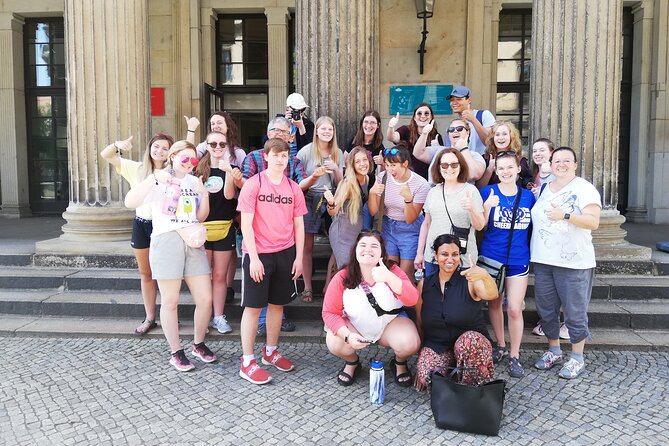
The tour is capped at 15 people. That is small enough for direct questions and conversation, though you should stay close to the guide in large squares. One unusual exception resulted in a group of about 18, and hearing became difficult. The company says this happens rarely when transport delays lead it to accommodate someone on another date.
More history-led days in Dresden:
- Elbfloren: Historical city tour
★ 4.8 · 819 reviews - Görlitz: Ghosts and Spooky Historical Night Walking Tour
★ 4.8 · 197 reviews - Dresden: Guided Beer Tour of the Historic Old City
★ 4.8 · 95 reviews
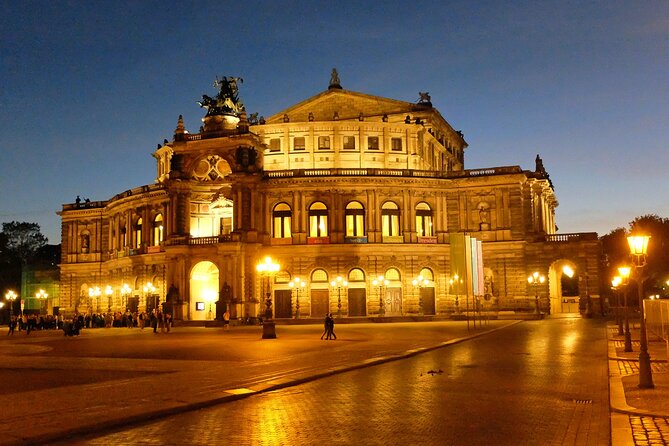
Theaterplatz, where Dresden puts on its grandest face
Begin at Schlossplatz, then move toward Theaterplatz, one of Dresden’s most impressive public squares. This is the place to understand the city’s courtly ambitions in one glance.
The Semper Opera House anchors the view. Its elegant 19th-century design reflects Dresden’s long connection with music and performance. Nearby, the Zwinger brings a more playful baroque note, while the Residenzschloss recalls the Saxon ruling family. The Dresden Cathedral rises close by, adding a Catholic presence to a square shaped by royal power.
Ask your guide to point out the Old Masters Gallery from here. That small piece of orientation is useful because you can later decide if you want to return for art rather than trying to work out the museum layout on your own.
The stop lasts about 15 minutes. That is enough for an overview and photographs, but not for detailed architectural study. I would treat this as your visual introduction to Dresden, not as a substitute for visiting the opera house or gallery.
The Zwinger and the ambitions of Augustus the Strong
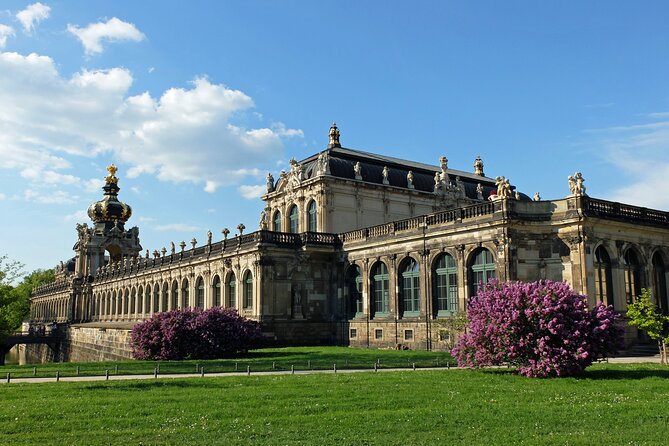
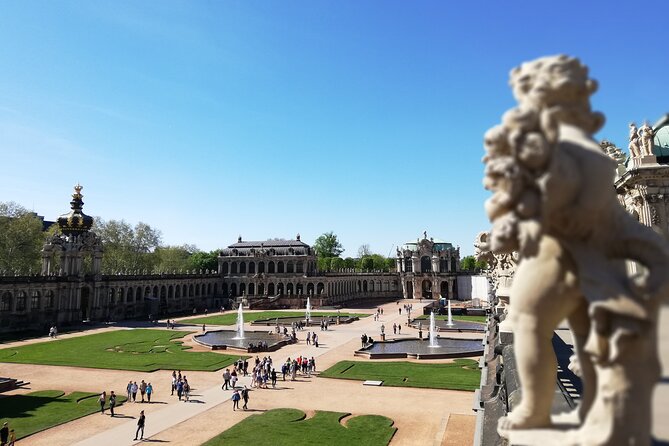
The Zwinger is one of Dresden’s most distinctive buildings. It was designed as a single sculptural composition, full of curves, ornament, galleries, and theatrical spaces.
Its original purpose was grander than what you see today. It was meant to form the entrance to a new royal palace that was never built. The result is a splendid fragment, created for court celebrations and elaborate festivities about 300 years ago.
Your guide will explain Augustus the Strong, the Saxon ruler who commissioned the complex. His appetite for display and beauty appears throughout the Zwinger, from the large architectural gestures down to the small decorative details.
If the site is open and the schedule permits, the guide may show you an open-air grotto that is easy to miss. This is a good example of what a local guide adds: you are not simply pointed toward the main courtyard and sent on your way.
The Zwinger stop is listed at about 15 minutes. That gives you a strong first impression, but you will need to return on your own if you want to examine the galleries, fountains, or museums at length.
The Residenzschloss courtyard and Saxon royal power
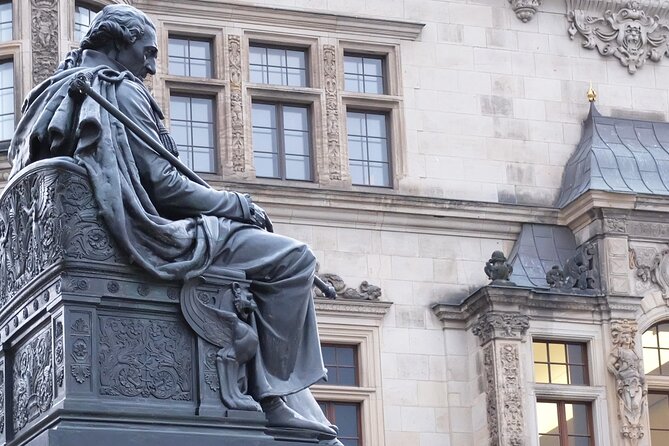
The Royal Palace has had a rough life. It was built, burned, rebuilt, repaired, extended, burned again, and rebuilt once more.
That complicated past makes the Residenzschloss especially useful for understanding Dresden. It is not a perfectly preserved medieval palace. It is an architectural record of changing rulers, changing tastes, war, and reconstruction.
You walk through one of its courtyards, where Renaissance sgraffito decoration covers the walls. Sgraffito is made by scratching through layers of plaster to create a design. Look closely, because the technique rewards attention more than a quick photograph.
The tour does not enter the museum collections. That is a limitation if you hoped to see royal treasures during the walk, but it also keeps the route moving. Your guide can explain the different collections and help you decide what deserves a separate visit.
This advice can save both time and money. The Royal Palace contains several major collections, and buying a ticket without knowing what you want to see could leave you rushing through rooms or paying for more than you need.
More walking tours in Dresden:
- Dresden: City & Semperoper Guided Walking Tour
★ 4.8 · 2,293 reviews - Dresden: Guided City Walk with a Cup of Coffee
★ 4.7 · 1,568 reviews - Görlitz: Old Town Guided Walking Tour
★ 4.7 · 723 reviews - Dresden: Complete Walking Tour with Frauenkirche Visit
★ 4.8 · 700 reviews
Stallhof, Dresden’s quieter royal courtyard

Behind the palace, Stallhof offers a change of mood. It is smaller and calmer than Theaterplatz, with arcaded galleries and sandstone columns enclosing a Renaissance courtyard.
The space was used for jousting tournaments and royal festivities. You can picture horses, court ceremonies, and carefully staged pageantry here, but the courtyard does not feel overly theatrical today. Its value is in the pause. After the large royal buildings, Stallhof gives you a more intimate sense of how the court functioned.
The stop takes about five minutes, so listen closely. This is a brief orientation rather than a long historical lecture. It is also one of the route’s better reminders that Dresden’s center includes more than its postcard façades.
The Procession of Princes and 24,000 porcelain tiles
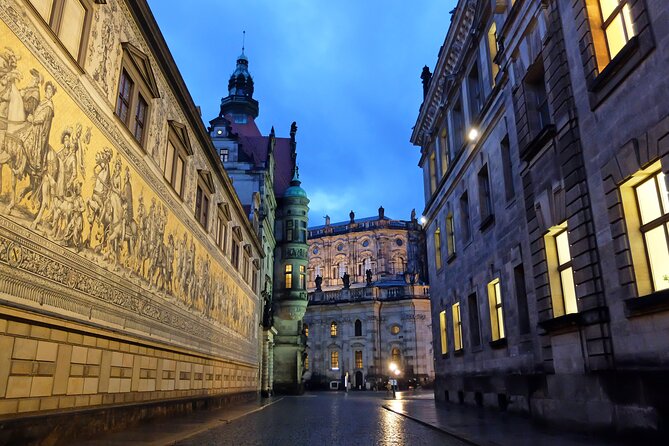
One of Dresden’s most memorable outdoor artworks stretches for 100 meters and uses 24,000 porcelain tiles. Known as the Procession of Princes, it presents a long sequence of Saxon rulers and historical figures.
Your guide will point out stories and small details hidden in the image. Take time to scan the procession instead of treating it as a background for a quick photo. The scale can make individual faces and symbols easy to overlook.
The mural is practical to visit because it is outdoors and built into the city walk. You do not need a museum ticket or a separate block of time. You simply need a few minutes and a guide who knows what to highlight.
Dresden Cathedral and the politics of religion
The Royal Cathedral, also called the Dresden Cathedral, has an unusual story. It was built in secret by a Catholic ruler in Protestant Saxony and served as the former court church.
That detail makes the building more than an attractive façade. It reflects the religious tensions and political calculations of the Saxon court. The church also contains royal burial sites, adding another layer to its connection with the ruling family.
You see the cathedral from outside. If you want to enter, attend a service, or explore further, plan that for later. The guide’s role here is to explain why the building belongs in the city’s story, even if the walk does not spend much time indoors.
Brühl’s Terrace and the Elbe views

Brühl’s Terrace is known as the Balcony of Europe, and the nickname makes sense once you reach the top of the stairs. From here, you can look across the Elbe River toward Dresden’s waterfront buildings, church steeples, historic steam boats, and distant wine slopes.
Most guides in the team take you up the stairs and point out what lies beyond the old center. This is useful because it turns Dresden from a collection of monuments into a city you can continue exploring.
You may want to note the White Fleet, the historic steam boats on the Elbe. The distant wine-growing slopes also give you a reason to consider a later river outing or a trip beyond the central sights, though the tour itself does not include those activities.
The stop lasts about ten minutes. The stairs are the main physical point to keep in mind. The overall walk is not especially demanding, and one older participant found the pace comfortable, but anyone with mobility concerns should be aware of the climb.
Neumarkt and the Frauenkirche’s difficult return
Neumarkt was reduced to rubble during World War II and later restored to its 18th-century appearance. Its colorful baroque façades now frame the Frauenkirche and create one of Dresden’s most recognizable views.
The rebuilding raises an important question: is this old Dresden, new Dresden, or both? Your guide can help you understand the choices behind the restoration rather than presenting the square as untouched history.
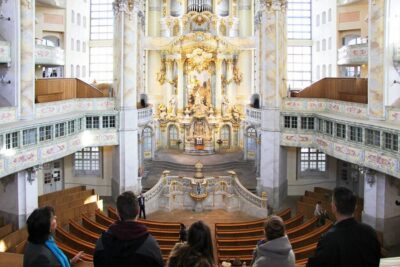
The Frauenkirche is the emotional center of the route. Its dome was rebuilt from the ruins after the war, and its return became a symbol of Dresden’s recovery and reconciliation. The guide explains its destruction, the decades-long reconstruction, and the international effort that helped bring the church back.
I recommend returning inside after the walk. The calm pastel interior offers a sharp contrast to the violence and ruin in the church’s story. You can also go down to the crypt, where a small exhibition explains the rebuilding.
The route usually ends around Neumarkt and the Frauenkirche, leaving you well placed for a church visit or a meal. The booking information gives the end point as back at the meeting point, so check the day’s exact instructions if returning to Schlossplatz matters for your plans.
What the $30.25 price buys you
At $30.25 per person, this is not a free walk, and that difference matters. You are paying for a professional English-speaking guide, a planned route, local interpretation, and the chance to ask questions in a group limited to 15.
The tour includes no museum admissions, which keeps the cost moderate. It also means you can choose where to spend more money later, instead of paying one bundled price for attractions you may not want.
I see the strongest value in the historical connections. A sign or façade can tell you what a building is, but a guide can explain why a Catholic cathedral was built in Protestant Saxony, why the Zwinger is incomplete, and how the Frauenkirche became a symbol of rebuilding.
The price is easiest to justify if Dresden is new to you or if you have only a short stay. If you already know the old center well, you may prefer to spend the same two hours inside the palace collections or the Old Masters Gallery.
Tips are not included. Bring a little extra if you feel the guide made the walk worthwhile.
Who will get the most from this walk
I would choose this tour for a first visit, a short stop in Dresden, or the first morning of a longer stay. It gives you the basic map and story you need before deciding how to spend the rest of your time.
It also suits people who like history delivered through stories rather than dates alone. Several guides add personal observations, including memories of Dresden before German reunification and reflections on how the city changed afterward.
The tour can work well for older adults because the pace is generally moderate. Still, there are stairs at Brühl’s Terrace, and you need to remain close enough to hear the guide.
Families and mixed-interest groups may also find it useful. You see major sights without committing to long museum visits, and the frequent stops prevent the walk from becoming a single extended lecture.
The main weakness is the lack of headsets. In a group of 15, or in a noisy square, hearing may require standing near the guide. If clear audio is important to you, ask at the start where best to position yourself.
Practical details before you book
The experience lasts about two hours and is offered in English. It uses a mobile ticket, and confirmation is provided when you book.
Meet at Schlossplatz in Dresden’s Altstadt. The route stays near public transportation, and most people can take part. Service animals are allowed.
The activity requires a minimum number of participants. If that minimum is not reached and the tour is canceled, you are offered another date or experience, or a full refund.
You can cancel for a full refund up to 24 hours before the start time. Cancellations or changes made inside that window are not accepted, and the local time in Dresden controls the cutoff.
The tour is often booked about three weeks ahead, so do not leave it until the last day if your schedule is tight.
Should you book the Historic Dresden Small-Group Walking Tour?
Yes, if you want a clear, story-led introduction to Dresden’s historic center. The route covers the city’s essential sights, but its best moments come from the connections between them: royal display at the Zwinger, political calculation at the cathedral, court life at Stallhof, and rebuilding at the Frauenkirche.
Book it early in your stay so you can use the guide’s museum and sightseeing advice afterward. Choose a place close to the guide if the group is large, and remember that the tour is mainly outdoors.
I would skip it only if you already know Dresden well or want a tour centered on indoor collections. For most first-time visitors, $30.25 is a fair price for two hours of context, orientation, and direct access to an English-speaking guide.
FAQ
How long is the Historic Dresden Small-Group Walking Tour?
The tour lasts approximately two hours.
What language is the tour offered in?
The tour is offered in English.
Where does the tour begin?
The meeting point is Schlossplatz in Dresden’s Altstadt, at Schloßpl., 01067 Dresden, Germany.
What sights are included?
The route includes Theaterplatz, the Zwinger, the Residenzschloss courtyard, Stallhof, the Procession of Princes mural, Dresden Cathedral, Brühl’s Terrace, Neumarkt, and the Frauenkirche area.
Does the tour enter the Royal Palace museums?
No. The walk visits one of the Royal Palace courtyards, but it does not enter the museum collections. Your guide can offer information to help you plan a separate visit.
Does the tour enter the Frauenkirche?
The guide explains the Frauenkirche from the outside. You can visit the interior and crypt on your own afterward.
How large is the group?
The maximum group size is 15 people. On rare occasions, a larger group may be accommodated because of transport delays or cancellations.
Are museum tickets included?
No. The tour includes the two-hour walk and a professional guide, but admission tickets are not included.
Can I cancel for a full refund?
Yes. You can cancel at least 24 hours before the start time for a full refund. Changes or cancellations made less than 24 hours before the start time are not accepted.
Just added around Dresden
- Walking Tour of Historic Dresden with a Christmas Touch. Small group tour.★ 4.5 · 9 reviews
- Tickets Dresden Transport Museum★ 4.0 · 23 reviews
- Top Full-Day Adventure: Bohemian & Saxon Switzerland from Dresden★ 5.0 · 68 reviews
- Winterland Tour to Bohemian and Saxon Switzerland from Dresden★ 5.0 · 22 reviews
- The Best of Bohemian and Saxon Switzerland Day Trip from Dresden★ 5.0 · 68 reviews
- Sightseeing tour by ConferenceBike★ 5.0 · 14 reviews
- Private Segway tour through the highlights in Dresden★ 5.0 · 94 reviews
- 1.5 hours Segway Elbe Mini Tour★ 5.0 · 66 reviews
Dresden Tours, compared.
The Original Night Watchman Tour in Lantern Light
Read our review →



Browse the lists this tour appears in