
Review · STUTTGART TOURS
Stuttgart: Museum of Illusions Entry Ticket
The most entertaining part of Stuttgart’s Museum of Illusions is that your body knows one thing while your eyes insist on another. You can stand on a flat floor that feels unstable, watch your reflection stretch and multiply, and see images appear to change before you.
I like the mix of playful photo spots and real explanations about vision. I also like the family-friendly format: you can try the exhibits at your own pace instead of following a fixed tour. The main consideration is that some displays, including the Vortex Tunnel, Zoetrope, and Tilted Room, are not suitable for people with epilepsy.
Key points at a glance

- Walk through the Vortex Tunnel: A rotating cylinder can make you feel off balance even though the floor beneath you is stable.
- Take unusual mirror photos: The Mirror Room and other distorted displays turn simple portraits into the main souvenir.
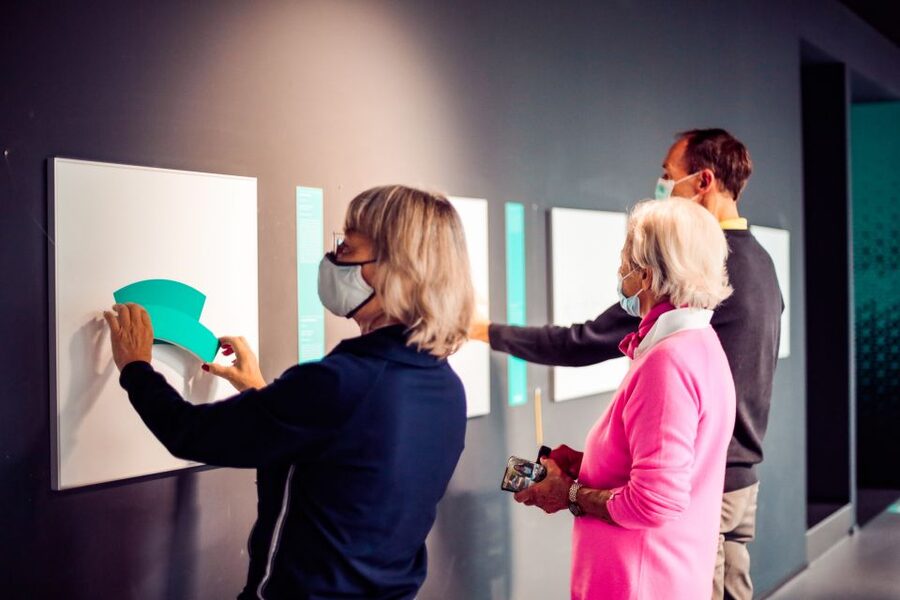
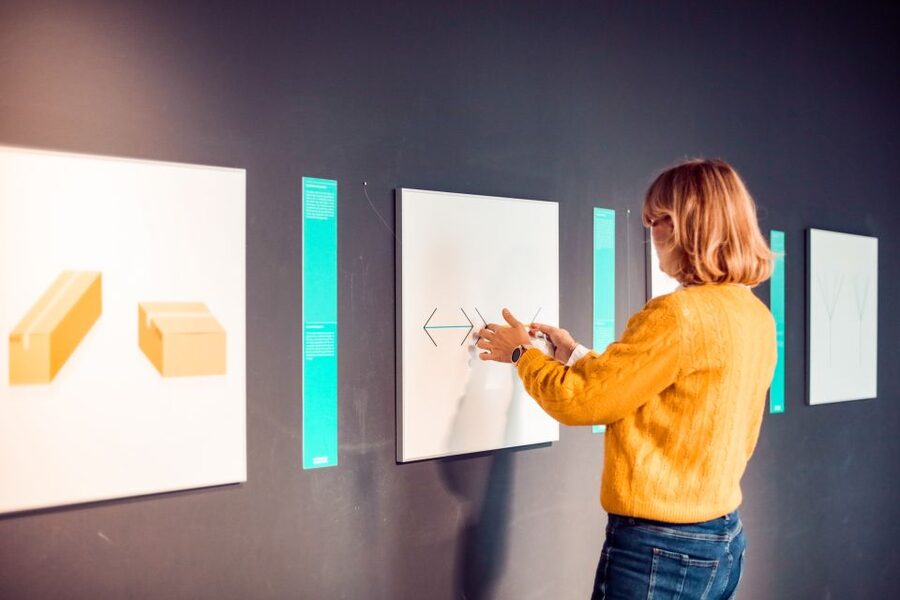
- See how perception tricks the brain: Explanations connect each illusion to human vision, the senses, and the way the intellect processes information.
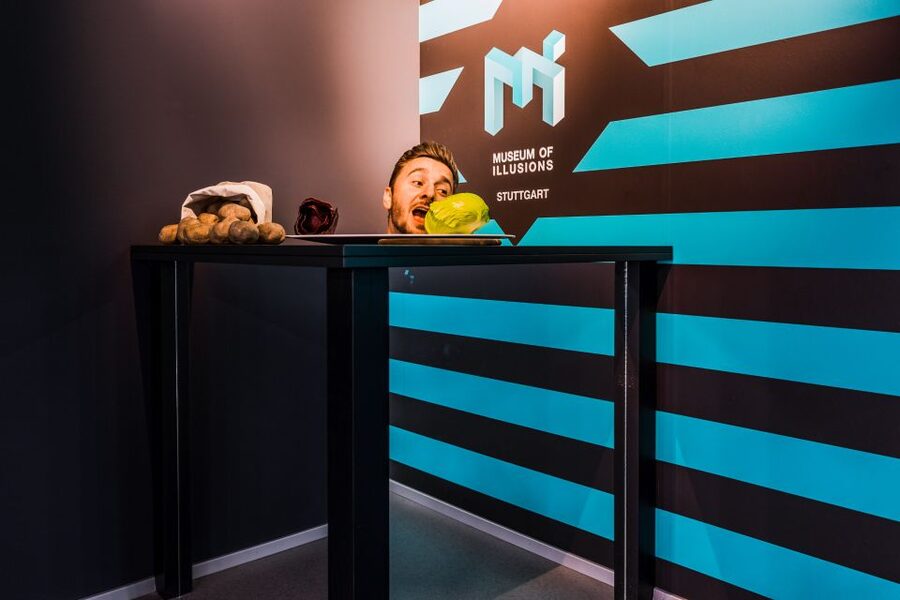
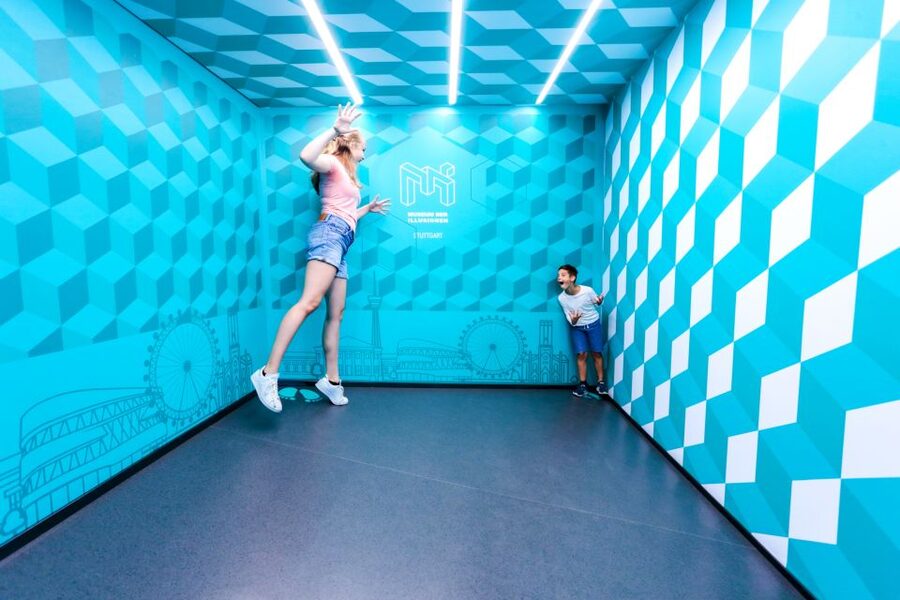
- Try several interactive rooms: The Anti-Gravity Room, Clone Table, Head on the Platter, and Tilted Room invite you to become part of the illusion.
- Use the ticket for one day: Entry costs $16 per person, with no transportation, food, or drinks included.
- Plan for access needs: The museum is wheelchair accessible, but several motion-based exhibits have an epilepsy warning.
Why the Stuttgart Museum of Illusions is more than a photo stop

This is not a traditional museum where you quietly look at objects behind glass. The exhibits ask you to step inside, pose, turn, balance, and test your own senses.
That difference matters. You do not simply read that an image is distorted. You watch your own reflection change in front of you. You do not just hear that balance depends on visual cues. You feel the effect inside a room designed to confuse those cues.
I find the best part of this format is its directness. The museum turns a science lesson into something you can test with your own body. The explanations at the end give the fun a useful purpose, helping you understand why an illusion works instead of leaving you with nothing but a funny photograph.
The setting is in Stuttgart, Baden-Württemberg, and the ticket is valid for one day. Check the available starting times when you book, since the supplied details do not give a fixed daily schedule.
More museums and galleries in Germany:
- Berlin: Jewish Museum Berlin Entrance Ticket
★ 4.5 · 8,393 reviews - Berlin: DDR Museum Tickets
★ 4.3 · 3,443 reviews - Berlin: Natural History Museum Entrance Ticket
★ 4.6 · 3,382 reviews
Start with the Mirror Room and warped reflections
The Mirror Room is one of the clearest examples of what this museum does well. Mirrors alter the way you see your body and surroundings, creating reflections that can look stretched, repeated, or out of place.
You will probably spend more time here than expected because the room works both as an illusion and as a photo set. Try different positions and poses rather than taking only one quick picture. A charged smartphone is listed as something to bring, and that advice makes sense here.
The room is also a good introduction for children. The effect is immediate, and you do not need a long explanation before understanding that the reflection is not telling the whole truth.
There is a small practical drawback. Mirror rooms are most enjoyable when you have enough time to look carefully, but they can become less engaging if you rush from one exhibit to the next. I would treat the room as an experiment, not just a backdrop.
Find your way through the Infinity Room

The Infinity Room uses repeated reflections to make the space feel much larger than it is. You may feel as if the room keeps extending in every direction, even though the actual area is limited.
This is a good example of how the museum turns a simple construction into a powerful visual effect. The room does not need machinery or a complicated story. It relies on your expectations about distance and space, then quietly breaks them.
I like this exhibit because it gives you a moment to slow down. After the more active displays, the Infinity Room lets you look, turn, and work out what your eyes are reporting.
For photographs, keep your phone ready before entering. The room is designed around reflections, so a quick snapshot can capture a much stranger scene than an ordinary portrait.
Test your balance inside the Vortex Tunnel
The Vortex Tunnel is the most physical exhibit described here. It is a rotating cylinder that can make you lose your sense of balance even though you are walking on a stable, flat surface.
That contrast is the point. Your eyes detect movement around you, and your body reacts as if the floor itself has changed. The result can feel surprisingly strong because balance depends on more than your feet.
I would approach this exhibit carefully. Do not treat it as a race, and hold off if motion-based attractions make you uncomfortable. The Vortex Tunnel is specifically not suitable for people with epilepsy, along with the Zoetrope and Tilted Room.
This is also one of the displays where the science explanation has real value. Once you understand that the visual environment is rotating while the floor remains flat, the sensation becomes easier to make sense of, even if it still feels odd.
A few more Germany half-days to weigh up
- Stuttgart 24-Hour Hop-On Hop-Off Sightseeing Bus Tour
★ 4.4 · 1,647 reviews - Stuttgart: Mercedes-Benz Museum Entry Ticket
★ 4.8 · 1,400 reviews - Tickets SWR Fernsehturm Stuttgart
★ 4.5 · 674 reviews - Stuttgart: Guided Ghost Walking Tour
★ 4.5 · 662 reviews
Look for the Anti-Gravity Room and Tilted Room
The Anti-Gravity Room plays with your sense of what is upright. It creates the impression that ordinary physical rules have changed, giving you a chance to pose in ways that look impossible in a photograph.
The appeal is partly visual and partly social. You can watch friends or family members try to position themselves, then compare the photo with what actually happened in the room.
The Tilted Room uses a related idea by changing the visual cues that tell you which way is level. Your body may respond to the apparent angle even when the surface itself does not behave as expected.
Both exhibits work best if you pause to notice your first reaction. I would not simply take a picture and move on. Look at the walls, floor, and surrounding lines, then ask yourself which details are guiding your sense of balance.
The Tilted Room carries the same epilepsy warning as the Vortex Tunnel and Zoetrope. That warning is important, not a minor footnote, because these displays rely on visual movement and disorientation.
Meet the Clone Table and the Head on the Platter
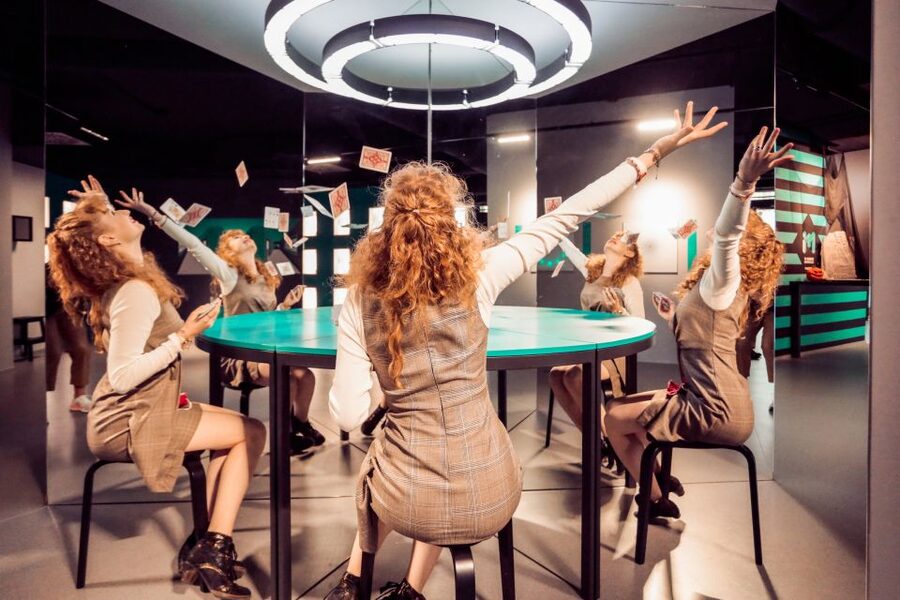
The Clone Table is another hands-on illusion built for shared fun. It can make one person appear in several places around a table, creating the impression of multiple versions of the same person.
This is an easy exhibit for families and groups because the idea is clear without much explanation. Take turns posing, then see how the arrangement changes the final image.
The Head on the Platter is more theatrical. It creates the comic effect of a head appearing on a serving platter, making it especially suited to playful photos and exaggerated poses.
These displays are not meant to be solemn. That is part of their strength. The museum gives you permission to be silly, and the results can be more memorable than a standard posed picture.
Watch holograms and shifting images
The hologram collection adds a quieter kind of illusion. Images appear, disappear, and transform as you look at them, making it difficult to decide what is actually present.
I like the contrast with the rooms that require movement. Here, you can stand still and watch your eyes search for a stable image. The effect shows that an illusion does not always need to make you spin or feel unsteady.
The holograms also help explain why the museum suits different ages. Younger children can enjoy the changing pictures at once, while older children and adults can think about how light and visual perception produce the effect.
Do not rush these displays. Their changes may be easy to miss if you glance quickly and move on.
Study the Turntables and the Zoetrope

The Turntables create hypnotic visual patterns through rotating forms. As the patterns change, your eyes try to follow their movement and find a repeating order.
This section adds variety to the visit. Instead of making your body feel as if the room is moving, it asks your eyes to keep up with the pattern. The result can be calming for some people and uncomfortable for others.
The Zoetrope is also listed among the exhibits that are not suitable for people with epilepsy. If that applies to you, skip it and any other display that produces rapid or rotating visual effects.
For everyone else, the Turntables and Zoetrope offer a useful reminder: an illusion can be created by motion, repetition, contrast, or a carefully controlled viewpoint. The museum does not rely on one single trick.
Finish with the science behind the illusions
The explanatory material gives the visit its educational backbone. As you move through the museum, you can learn about human vision, perception, and the functioning of the intellect.
I would save enough attention for this part. It is easy to spend the whole visit chasing the next photograph, but the explanations help connect the exhibits. You begin to see why a mirror can change your sense of shape, why a rotating room can disturb balance, and why a stable image can seem to move.
That makes the museum useful for families who want an activity with a learning element but do not want a formal lecture. You can start with play, then return to the ideas behind what you have just felt and seen.
The science does not remove the fun. It gives you a better way to repeat the illusion and explain it to someone else afterward.
How much time and money should you plan?
The ticket costs $16 per person and is valid for one day. No specific visit length is provided, so I would leave your schedule flexible rather than trying to fit the museum into a tightly timed gap.
At that price, the value depends on how actively you use the exhibits. If you walk through quickly and take only a few pictures, the ticket may feel less worthwhile. If you try the rooms, repeat the photo setups, and read the explanations, you get a more complete visit.
The price also makes sense for a family or group activity because many exhibits work better with two or more people. Someone can pose while another person takes the picture, and then you can switch roles.
The entry ticket does not include transportation, food, or drinks. Plan those parts separately. The museum itself is an indoor activity, so it can provide a change of pace from sightseeing in Stuttgart, but the available information does not give travel directions or nearby dining details.
Booking offers some flexibility. You can reserve now and pay later, and cancellation is free up to 24 hours in advance for a full refund. That is useful if your Stuttgart plans may change.
Who will enjoy this museum most?
I would recommend the Museum of Illusions to families, friends, couples, and anyone who likes interactive exhibits more than conventional displays.
It is especially suitable if you enjoy taking photos and do not mind looking a little ridiculous for a good result. The Head on the Platter, Mirror Room, Clone Table, and Anti-Gravity Room all reward playful poses rather than serious sightseeing.
It also suits visitors who want a light educational activity. The displays are easy to approach, but the explanations give adults and older children something to think about beyond the visual joke.
You should think twice if rotating or tilted visual effects make you uncomfortable. The Vortex Tunnel, Zoetrope, and Tilted Room are not suitable for people with epilepsy, and the physical sensation of the Vortex Tunnel may not appeal to everyone.
The museum is wheelchair accessible, which makes it a practical option for many visitors with mobility needs. Still, the information provided does not describe the layout of each individual exhibit, so anyone needing detailed exhibit-by-exhibit access information should confirm directly before booking.
Practical tips for a smoother visit
Bring a fully charged smartphone. Several exhibits are built for photos, and the most enjoyable part is often seeing how an ordinary pose looks once the room alters your reflection or viewpoint.
Give yourself permission to repeat an exhibit. A first attempt may show you how the trick works, while a second attempt lets you create a better pose or understand the visual effect more clearly.
If you are visiting with children, explain that some rooms may feel strange because the eyes and body receive different signals. That can turn surprise into curiosity.
Read the scientific explanations even if you are mainly there for photographs. They add context to the Vortex Tunnel, mirrors, holograms, and rotating displays, and they make the museum feel like more than a collection of photo props.
Finally, check the available starting times before setting out. The ticket is valid for one day, but the supplied details do not list exact opening hours or a fixed start time.
Should you book the Museum of Illusions?
Book it if you want a hands-on indoor activity in Stuttgart, especially if you are visiting with family or friends and enjoy taking inventive photographs. A 4.2 out of 5 rating from 507 reviews, along with strong praise calling it a must-see and must-try experience, fits the museum’s clear appeal: it is easy to understand, social, and full of things to test.
I would skip it if you want a quiet art museum, dislike visual disorientation, or have epilepsy and would be affected by the Vortex Tunnel, Zoetrope, or Tilted Room. For most curious visitors, the $16 price is fair when you take time to try the exhibits and learn why your senses keep getting fooled.
FAQ
How much does entry to the Stuttgart Museum of Illusions cost?
The entry ticket costs $16 per person.
How long is the ticket valid?
The ticket is valid for one day. Check availability for the starting times offered when you book.
What does the ticket include?
The ticket includes entry to the Museum of Illusions Stuttgart.
Are transportation, food, and drinks included?
No. Transportation, food, and drinks are not included.
Can I cancel the booking for a full refund?
Yes. You can cancel up to 24 hours in advance for a full refund.
Can I reserve now and pay later?
Yes. The reserve now and pay later option lets you book your spot without paying anything today.
Is the museum wheelchair accessible?
Yes. The Museum of Illusions Stuttgart is wheelchair accessible. The Vortex Tunnel, Zoetrope, and Tilted Room are not suitable for people with epilepsy.
Just added around Germany
- From Berlin: Gardens & Palaces of Potsdam Bike Tour★ 5.0 · 61 reviews
- Berlin: Battle for Seelow Heights WW2 tour -Clash of Titans★ 5.0 · 27 reviews
- From Amsterdam: Cologne Private Sightseeing Tour★ 5.0 · 4 reviews
- From Berlin: Historical Gems of Potsdam Private Day Trip★ 4.4 · 4 reviews
- Freiburg: Veni, vidi, vino – wine hike and tasting★ 4.5 · 144 reviews
- From Alken: Return Day Trip by Boat to Cochem★ 4.6 · 141 reviews
- Fritz Haarmann – Die Mördertour★ 4.6 · 41 reviews
- Freiburg: Tour of the city with cathedral visit★ 4.7 · 167 reviews
Stuttgart Tours, compared.

Stuttgart 24-Hour Hop-On Hop-Off Sightseeing Bus Tour
Read our review →



Sinsheim: Technik Museum Day Pass and IMAX 3D Ticket
Read our review →


Browse the lists this tour appears in