
Review · DRESDEN TOURS
Dresden: Walking Tour with Virtual Reality elements
Dresden’s Old Town is unusually good at showing different eras side by side, and this tour adds a clever tool: 360-degree virtual reality scenes at nine stops. You look at today’s streets, then use the headset to picture earlier Dresden, from Baroque splendor through wartime destruction and socialist rebuilding.
I like the way the tour keeps you moving instead of trapping you in a museum room, and I like that the guide adds stories beyond the standard postcard sights. One guest praised the guide’s warm manner, strong knowledge, and ability to show parts of the city away from the usual tourist route.
The main drawback is language. The live tour is in German only, so the visual scenes may help you follow along, but you’ll miss much of the guide’s commentary if you do not understand German. The VR equipment also needs careful handling, and poor weather can lead to cancellation.
Key points to know before booking
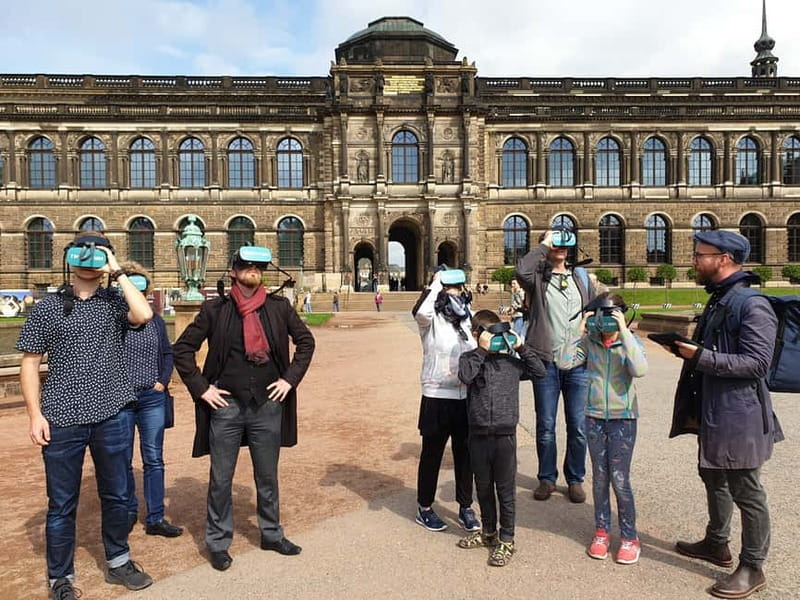
- Nine historic viewpoints: The route links the Zwinger, Postplatz, Old Market Square, Pirnaischer Platz, Neumarkt, Fürstenzug, and the Semperoper.
- Four centuries in 90 minutes: You move from Dresden’s Baroque age to the 1920s, World War II, socialism, and reunification.
- VR adds lost or changed views: The headset helps you compare the city you see with earlier versions of the same places.
- A walking tour, not a museum admission: Museum entrances are not included, so the focus stays on streets, squares, buildings, and guided explanation.
- German-speaking guide: The tour is best for people comfortable listening in German.
- Good city-center orientation: At $34, the experience can be a useful first look at Dresden before exploring its museums on your own.
Seeing four centuries through one headset
The best idea here is simple. Dresden’s story is not told only through preserved buildings. It is also visible in gaps, rebuilt facades, altered squares, and the changing shape of public spaces.
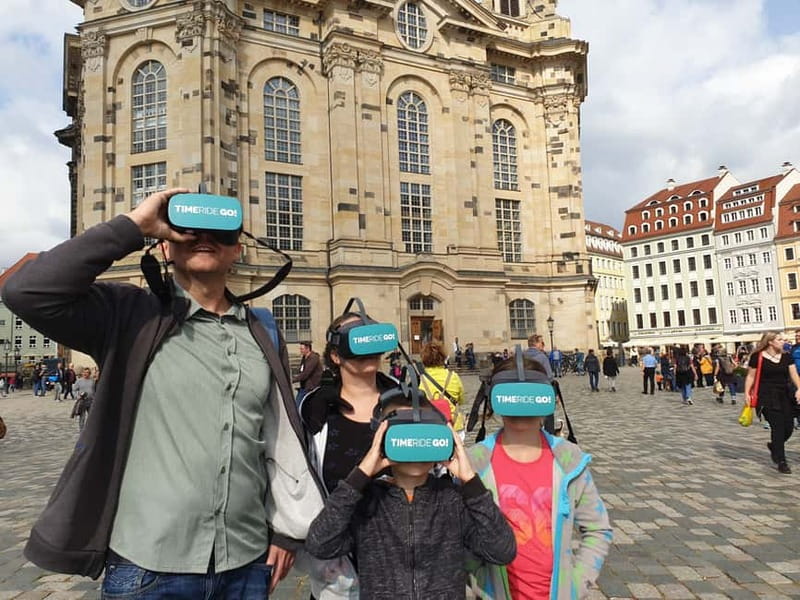
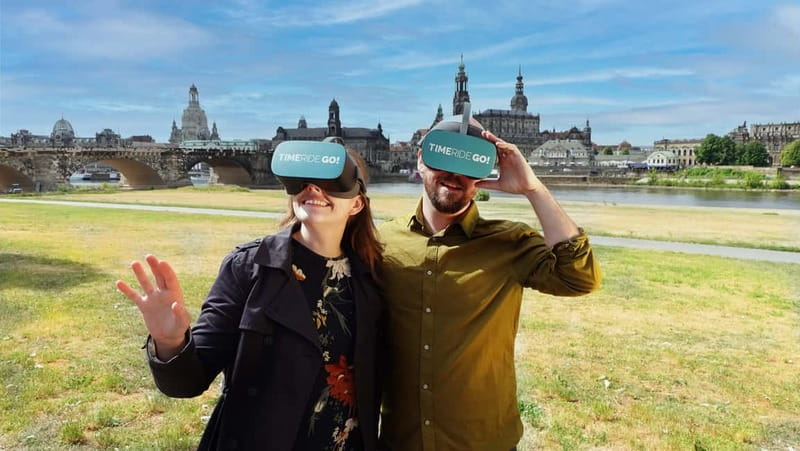
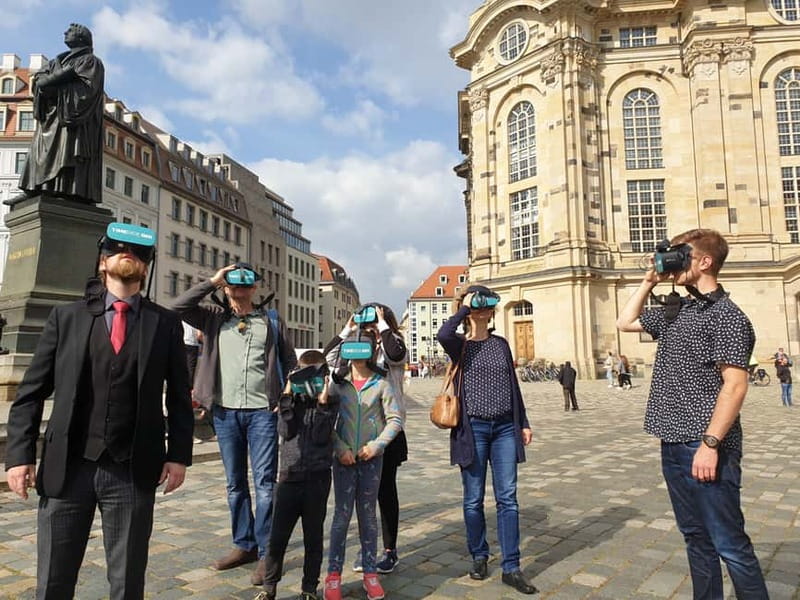
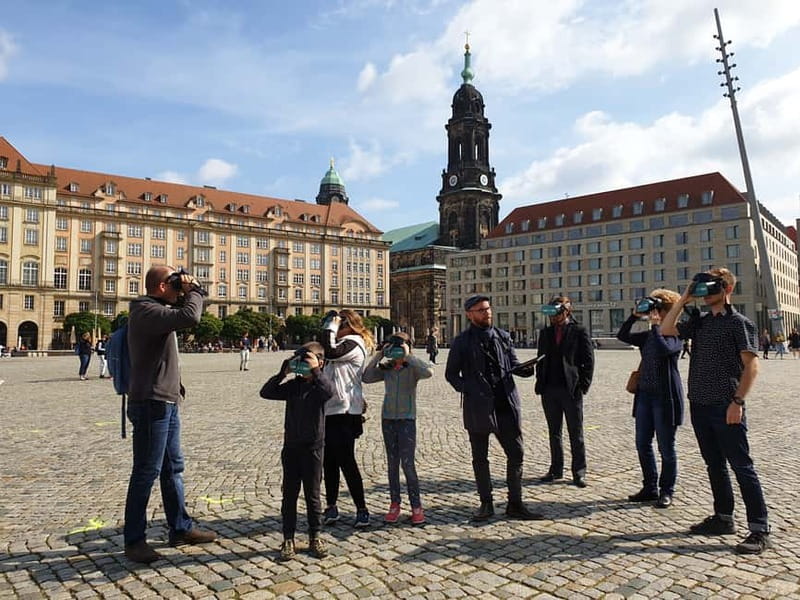
At each stop, you look through a mobile VR headset and see a 360-degree version of an earlier period. The device gives you a visual comparison, while the guide explains what happened and points out details you might otherwise walk past.
That combination matters. A normal walking tour can tell you that a building was destroyed or rebuilt, but the words may remain abstract. Seeing an earlier scene placed over the present location gives the change a sharper edge.
The tour covers roughly 400 years. Expect references to the glamorous Baroque period, Dresden’s development into the 1920s, the destruction of World War II, socialist ideas after the war, and reunification. This is a broad introduction rather than a specialist lecture on one period.
The format also keeps the pace varied. You walk for short stretches, stop for an explanation, use the headset, and move on. The published timing gives about 10 minutes at each listed location, though the total tour lasts 1.5 hours.
More walking tours in Dresden:
- Dresden: City & Semperoper Guided Walking Tour
★ 4.8 · 2,293 reviews - Dresden: Guided City Walk with a Cup of Coffee
★ 4.7 · 1,568 reviews - Görlitz: Old Town Guided Walking Tour
★ 4.7 · 723 reviews
Starting at Taschenberg and entering the Zwinger
The meeting point is at Taschenberg 3, where you look for the TIME RIDE GO! flag in front of the shop. That clear marker is useful in a busy central area, especially if you are arriving on foot and do not want to search for a guide in a large square.
The Zwinger is the first major sight on the route. Its grand Baroque design makes it a natural opening chapter. Here, the VR scenes can help you picture Dresden during the period when its court culture and architecture gave the city much of its fame.
The itinerary lists two stops at the Zwinger, each with about 10 minutes of guided sightseeing and walking. The supplied details do not explain the exact difference between those two points, so expect the guide to use more than one viewpoint or section of the complex rather than treating it as a single quick photo stop.
You should not confuse this with a full museum visit. Entrance to museums is not included. The value here comes from seeing the exterior setting, hearing the explanation, and comparing past and present through the headset.
Wear shoes you can walk in comfortably. The route is not a strenuous hike, but you will be on your feet throughout, with repeated stops and short walks between them.
Postplatz and the marks of change
From the Zwinger, the tour continues to Postplatz. This stop helps shift the story from courtly Dresden toward the city’s later growth and changes in urban design.
Postplatz is useful because it is not simply a single famous monument. It is a place where you can think about how a city changes when transport, public planning, politics, and rebuilding reshape an old center.
The guide’s commentary is especially important here. A headset can show you an earlier view, but it cannot by itself explain why a square changed or what the new design meant at a particular point in Dresden’s history.
The tour’s strongest human element is the live guide. The available feedback describes the guide as sympathetic, well informed, and good at moderating the TimeRide activity. That last point is worth noting. Using VR outdoors can feel awkward if nobody explains where to look or when to remove the device. A guide who manages the technology well makes the experience more natural.
Old Market Square and Pirnaischer Platz
Old Market Square, or Altmarkt, brings the tour into one of Dresden’s central public spaces. This is a good place to consider how historic squares serve different purposes over time. The VR view lets you compare the present square with earlier periods, while the guide connects those images to the larger story of the city.
The route then reaches Pirnaischer Platz. Together, these stops show why Dresden is best understood as a city rebuilt and reinterpreted, not simply a preserved Baroque showpiece.
The historical sequence becomes more difficult here. You are not just looking at attractive architecture. You are moving through the 1920s, wartime destruction, socialist planning, and the changes that followed reunification.
That range is valuable, but it also means the tour cannot give every period equal attention. If you want a detailed study of World War II, East German urban planning, or postwar architecture, you will need a longer specialist tour or museum visit. This experience gives you the outline and visual clues.
The VR headset is most useful when the present-day scene feels incomplete or unfamiliar. You may find that an old view explains the shape of a square more clearly than a modern photograph. At the same time, the effect depends on your ability to listen and operate the equipment while standing outdoors.
A few more Dresden half-days to weigh up
- Dresden: Semperoper Tickets and Guided Tour
★ 4.7 · 12,102 reviews - Dresden: The Original Night Watchman Tour in Lantern Light
★ 4.6 · 6,653 reviews - Dresden: Semperoper and Old Town Tour
★ 4.8 · 5,735 reviews - Dresden: River Sightseeing Boat Cruise
★ 4.3 · 5,323 reviews
Neumarkt and the return of Dresden’s Baroque image
Neumarkt is one of the most important stops for understanding modern Dresden. The square is closely tied to the city’s Baroque identity and to the rebuilding of central Dresden after wartime destruction.
Here, the contrast between earlier Dresden, the damage of the war, and the rebuilt city can become especially clear. The headset gives you a way to compare scenes rather than relying on a guide’s description alone.
This is also where the tour’s central question comes into focus: how much of a city can be restored, and what does restoration mean? A rebuilt facade can resemble an older one, but the decisions behind that reconstruction belong to a later generation.
The tour does not promise a long architectural study, and its 10-minute stop gives only a compact introduction. Still, Neumarkt is a strong place to pause because the present-day setting carries several layers of memory.
If you are interested in Dresden’s famous churches, museums, and royal collections, plan extra time before or after the walk. This tour does not include museum admission, and the 1.5-hour schedule is designed to keep the group moving.
Fürstenzug, a picture made for a history walk
Fürstenzug is a natural highlight. This long outdoor mural, made from porcelain tiles, presents Saxony’s rulers in a procession and is one of Dresden’s most distinctive sights.
The tour lists this as both a visit and a photo stop. You get time for the guide’s explanation and a chance to take pictures, though the stop remains part of a fast-moving walking route rather than a long art lesson.
The visual nature of Fürstenzug works well with the VR format. You are already looking at a historical record on the wall, then using the headset to compare another period of the city. It gives the stop more context than a quick photograph alone.
Bring weather-appropriate clothing. This is an outdoor activity, and the equipment must be handled with care. In very bad weather, the tour may be canceled, so keep that possibility in mind when arranging a tightly packed day.
Finishing near the Semperoper
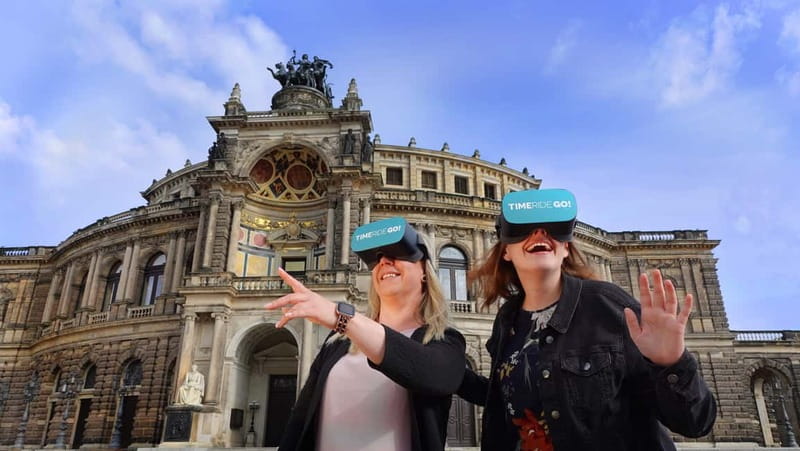
The listed route finishes at the Semperoper, Dresden’s famous opera house. As a final sight, it returns you to the city’s grand architectural image after the tour has covered destruction, rebuilding, and political change.
The Semperoper works well as a closing point because it represents the polished face many people expect from Dresden. By this stage, you should also have a better sense of the less obvious story behind that appearance.
There is one practical detail to clarify when booking. The route information names the Semperoper as the final sightseeing stop, while the meeting instructions say the activity ends back at the meeting point. Confirm the exact end location with the operator if you have a timed reservation afterward.
The tour does not include entry to the opera house or other museums. Think of the finish as an exterior orientation point, not an inside visit.
How the VR equipment changes the walk
Virtual reality is not automatically better than a traditional guide. Its value depends on how well it connects with the physical place in front of you.
Here, the equipment is designed to show earlier versions of nine locations. That makes it more useful than a headset used only for a general historical film. You can look at the present street, then compare it with a 360-degree historical view tied to that exact setting.
The guide remains essential. The device can show a scene, but the guide provides sequence, meaning, and local detail. The strongest parts of the experience are likely to be the moments when the guide points out something that survives today or explains why the present view differs from the virtual one.
You need to handle the headset carefully. This is not a casual gadget you can toss into a bag or pass around carelessly. Follow the guide’s instructions, and be ready to remove it when walking between stops.
The technology may also appeal to children and teenagers, but the activity is not suitable for children under six. Since the tour is in German, younger participants also need enough language ability to follow the live explanation.
A fair look at the $34 price
At $34 per person, this is more expensive than a basic free walking tour, but it includes a guide and dedicated VR equipment. You are paying for the visual production as well as the time and interpretation provided during the walk.
I think the price makes the most sense if you are curious about how Dresden changed, not simply looking for a quick list of famous buildings. The historical comparison is the feature that separates this from a standard Old Town stroll.
It is less compelling if you already plan to spend your day inside museums or want a highly detailed architectural tour. You may prefer to use the money for an admission ticket and explore a collection at your own pace.
The short duration improves the value for many visitors. In 90 minutes, you get a broad city introduction without sacrificing half a day. It fits well on your first afternoon in Dresden, when you want context before choosing which sights deserve more time.
The tour also offers free cancellation up to 24 hours before the start and a reserve-now, pay-later option. Those terms are useful when weather or a changing schedule could affect your plans, but they do not change the main question: are you interested in the VR history format?
Who will enjoy this Dresden walk?
I would choose this tour for you if you like history but prefer seeing it in the street rather than reading long displays. It suits first-time visitors who want a clear introduction to Dresden’s center and a sense of how the city moved through several political eras.
It is also a good match for people who enjoy visual technology but still want a real guide. The headset adds something unusual, while the walking route keeps you connected to actual buildings and squares.
You should think twice if you do not speak German. The headset may communicate some of the story visually, but the live tour language is German, and the guide’s explanation is a major part of the experience.
You may also prefer another activity if you need a slow pace, indoor shelter, or extended time at each monument. This tour visits many places in a short period, with about 10 minutes assigned to each listed stop.
Practical tips for a smoother experience
Meet at the TIME RIDE GO! flag in front of the shop at Taschenberg 3. Arrive ready to begin outdoors rather than expecting a check-in desk inside a museum.
Wear comfortable shoes and clothing suited to the weather. The tour lasts 1.5 hours and includes walking between central sights, standing for explanations, and using the headset at several points.
Keep your schedule slightly flexible if the weather forecast is poor. Very bad weather can cause cancellation, and an outdoor VR activity is not ideal in heavy rain or other difficult conditions.
Do not plan museum visits as part of the $34 price. Entrance fees are not included, so book those separately and leave enough time before or after the walk.
The route is conducted in German. If you understand German well, you can focus on the guide’s stories and use the headset as a visual aid. If you do not, consider choosing an English-language activity instead, since the supplied information does not list another language.
Should you book the Dresden VR walking tour?
Book it if you want a compact, visual way to understand Dresden’s changes from the Baroque age through World War II, socialism, and reunification. The nine locations give you a useful city-center framework, and the VR scenes make lost or altered views easier to picture.
I especially like the mix of real streets, a live guide, and historical 360-degree views. The guide’s friendly manner and ability to keep the technology moving smoothly matter as much as the device itself.
Skip it if German is not workable for you, if you want museum interiors, or if you prefer to spend 10 minutes or more studying each sight at your own pace. For the right audience, though, $34 is a reasonable price for a 90-minute orientation that gives Dresden’s modern appearance some needed context.
FAQ
How long does the Dresden VR walking tour last?
The tour lasts 1.5 hours. Check availability for the current starting times.
What language is the tour conducted in?
The live tour guide speaks German. No other tour language is listed.
Where does the tour start?
Meet at Taschenberg 3, at the TIME RIDE GO! flag in front of the shop.
Which sights are included on the route?
The route includes the Zwinger, Postplatz, Old Market Square, Pirnaischer Platz, Neumarkt, Fürstenzug, and the Semperoper. The Zwinger appears at two points in the route.
Is museum admission included?
No. Entrance to museums is not included in the tour price.
Is the tour suitable for young children?
The activity is not suitable for children under six years old.
What should I bring?
Bring comfortable shoes and clothing suited to the weather. Handle the VR equipment carefully, and remember that the tour may be canceled in very bad weather.
Just added around Dresden
- Freiberg: Scavenger Hunt Self-Guided Walking Tour★ 4.6 · 7 reviews
- Radebeul: Scavenger Hunt Self Guided Tour★ 4.6 · 9 reviews
- Discover Germany’s most exciting photo illusion world!★ 4.7 · 26 reviews
- Dresden: New Year’s Eve Concert at the Zwinger★ 4.8 · 20 reviews
- Dresden: Zwinger Skip-the-Line & 2-Day Hop-On Hop-Off Bus★ 4.5 · 160 reviews
- Dresden: Guided City Walk and Panometer Entrance Ticket★ 4.5 · 176 reviews
- Dresden: Shared Small Group Walking Tour in English★ 4.8 · 172 reviews
- Dresden with a touch of Xmas: English small group tour★ 4.7 · 41 reviews
Dresden Tours, compared.

The Original Night Watchman Tour in Lantern Light
Read our review →

Browse the lists this tour appears in