
Review · DRESDEN TOURS
Dresden Old Town – Guided Walking Tour in English
Dresden’s Old Town tells an unusual story: much of what looks centuries old was rebuilt after the Second World War. This 2.5-hour walk helps you read the city properly, from its Slavic beginnings and Saxon rulers to the bombed-out center and its careful return.
I like the route’s strong sense of place, especially the way it links major sights rather than treating them as isolated photo stops. I also like the guides’ conversational style. Nicolo, Nicolas, Nikolai, and Dominica are among the guides praised for clear explanations, humor, and strong storytelling.
The main drawback is the length. You may be on your feet for longer than the advertised two and a half hours, with no guaranteed toilet stop. Arrive ready to walk, and use a restroom before meeting the guide.
Key points at a glance
- Meet beneath Martin Luther’s statue: Find the Walkative guide with the yellow umbrella at Neumarkt, beside Frauenkirche.
- See Dresden’s rebuilt heart: The walk explains why the Old Town can look baroque and centuries-old even though much of it is modern reconstruction.
- Follow a concentrated historic route: Frauenkirche, Fürstenzug, Dresden Castle, Brühl’s Terrace, Hofkirche, Semperoper, and Zwinger Palace all fit into one outing.
- Hear Dresden in a wider European setting: The guide connects the city’s Slavic roots, Saxon rulers, Polish and Lithuanian links, war damage, and postwar rebuilding.
- Expect an engaging English tour: Guides such as Nicolo and Dominica have been praised for humor, clear speech, and detailed storytelling.
- Pay attention to the timing: The walk can run beyond two hours, so comfortable shoes and a pre-tour restroom stop are sensible.
Why Dresden needs a walking tour
Dresden can seem easy to understand at first glance. You see a grand church, a palace, an opera house, and a river terrace clustered around a compact center. Yet the city’s appearance hides a major question: how much of this is original, and how much was rebuilt?
That question gives the tour its purpose. Dresden’s center was devastated during the Second World War, leaving many famous buildings damaged or destroyed. The Old Town you see today was restored with older designs and traditional methods, producing a place that can feel historic even when its stones are relatively new.
I find that context especially useful at Frauenkirche and Neumarkt. Without it, you may simply admire a handsome square. With it, the square becomes a lesson in memory, restoration, and the choices a city makes after catastrophe.
The walk also places Dresden between Germanic and Slavic cultures. The city began as a small Slavic settlement, and its name has familiar echoes for people who speak Czech, Slovak, Polish, or Sorbian. That early connection is easy to miss if you only look at the later baroque buildings.
More Old Town Walking Tours in Dresden
- Dresden: Semperoper and Old Town Tour
★ 4.8 · 5,735 reviews - Dresden: Night Watchman Tour Through The Old Town
★ 4.8 · 1,758 reviews - Görlitz: Old Town Guided Walking Tour
★ 4.7 · 723 reviews
Starting at Neumarkt and Frauenkirche
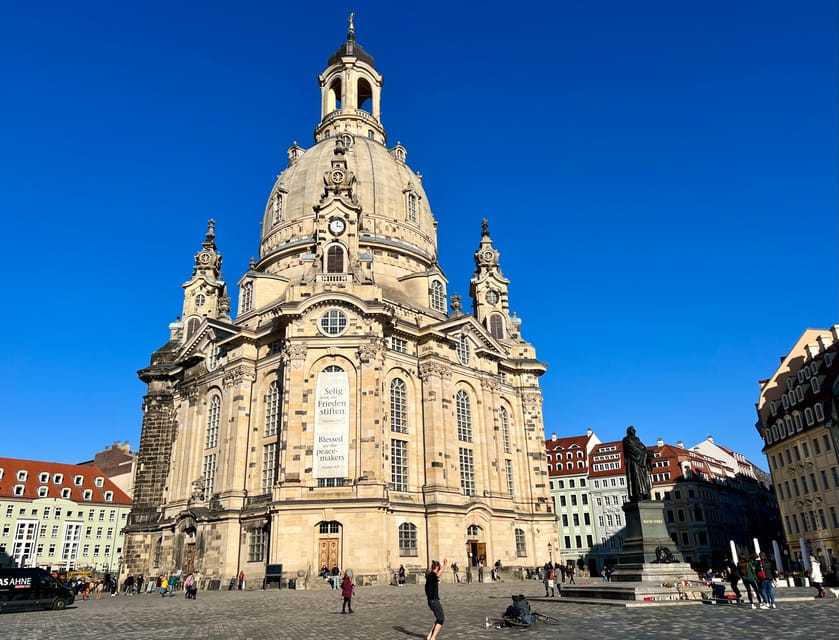
The meeting point is next to the Martin Luther statue at Neumarkt, beside Frauenkirche. Look for the yellow umbrella, the clearest sign that you have found the Walkative guide.
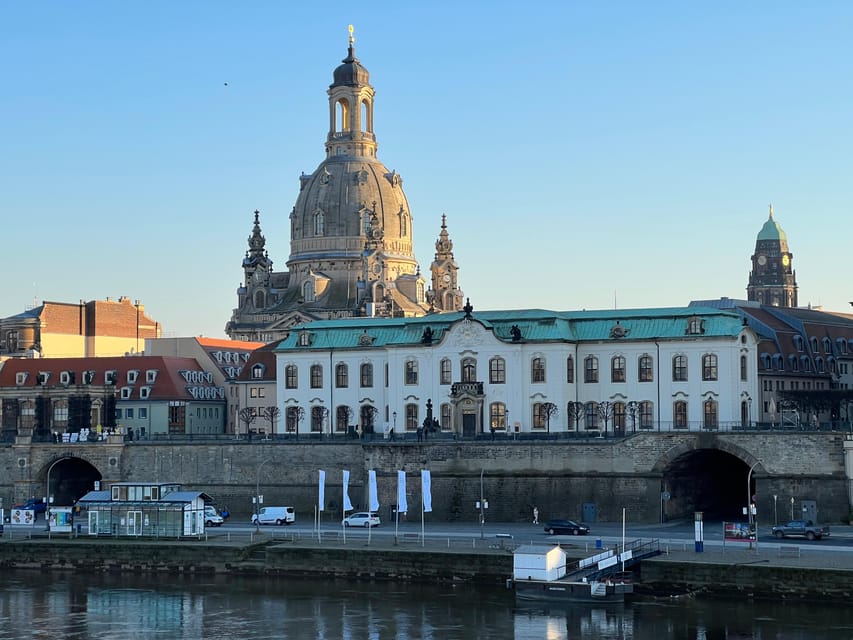
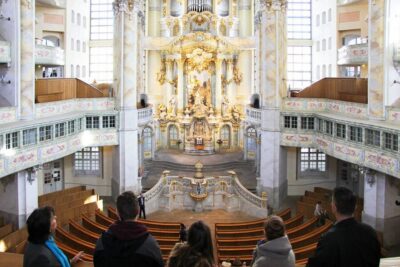
Neumarkt is an excellent starting point because it brings together Dresden’s religious history, royal ambitions, wartime destruction, and modern rebuilding. Frauenkirche dominates the square with its broad stone dome and carefully restored exterior.
Your guide should explain how the church’s destruction and reconstruction shape the meaning of the square today. The building is not simply an old church that survived intact. It is part of Dresden’s long effort to recover its visual identity and make sense of its past.
This opening stop also gives the guide room to introduce Dresden’s early growth. A village formed around a castle in the 13th century and later became an important regional trading center. Silver and lead from the nearby Rudavy mountains helped support its prosperity.
For you, the value is orientation. The guide places the square, church, river, palace, and surrounding streets into one mental map before the walking gets underway.
Fürstenzug and the Saxon rulers
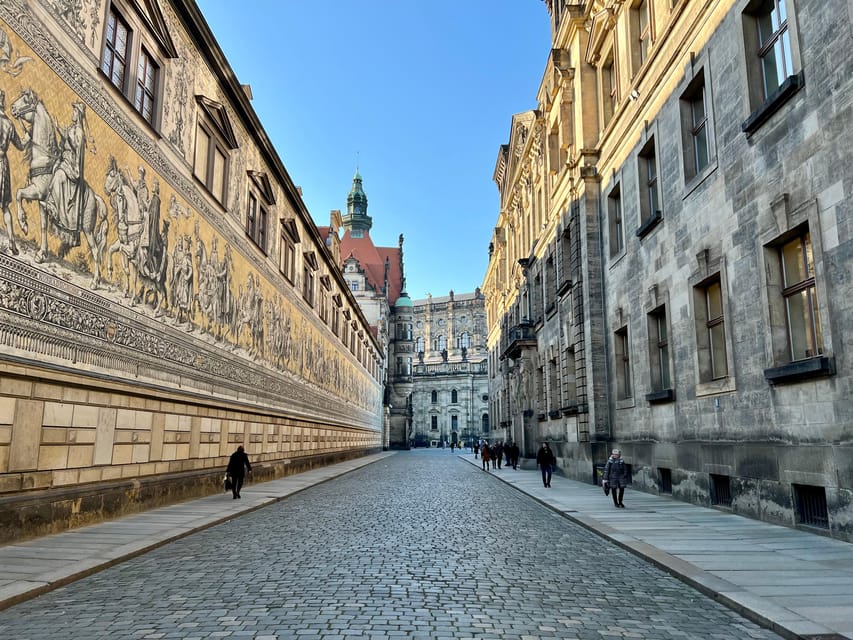
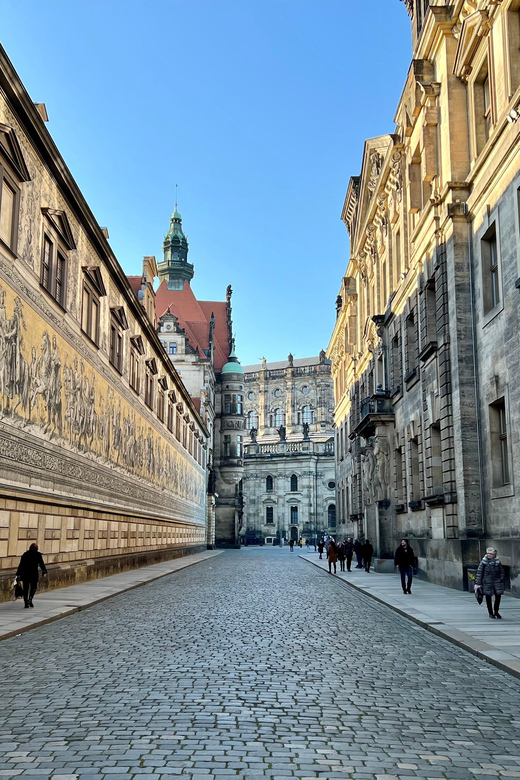
From Neumarkt, the route includes Fürstenzug, the long gallery showing Saxony’s prince-electors and rulers. It is one of Dresden’s most memorable outdoor artworks because you can study a procession of rulers while standing in the same historic center they shaped.
The panel also helps explain why Dresden became so grand. At the end of the 15th century, Dresden became the seat of the prince-electors of the Holy Roman Empire. In the early 18th century, Saxon rulers from the Wettin dynasty were chosen as Kings of Poland and Grand Dukes of Lithuania.
That political connection brought Dresden greater ambition and wealth. The city’s baroque buildings were not random decoration. They reflected the status and reach of a ruling family with power extending well beyond Saxony.
A guide adds value here by turning names and dates into a story about competition, ceremony, and royal image-making. If you like architecture but do not usually enjoy memorizing dynasties, the conversational approach should make this section easier to follow.
Dresden Castle and the city’s royal core
Dresden Castle is another major stop. Its changing appearance reflects the city’s changing fortunes, from medieval stronghold to royal residence and later reconstructed landmark.
The castle belongs to the same story as Fürstenzug and the baroque buildings around it. Dresden was not merely a provincial town with attractive architecture. It became a court city, and its rulers used buildings, art, and public spaces to project authority.
The tour does not include transportation, and the sights are reached on foot through the Old Town. That is a strength here. You see how close the castle is to the churches, galleries, terraces, and palaces that made Dresden’s center so important.
You should not expect a full museum visit inside the castle during this walk. The focus is the city’s public history and architecture. If you want to explore the castle collections in depth, plan a separate visit after the tour.
More old town walks in Dresden:
- Dresden: Segway Tour Along the Elbe and Old Town
★ 4.9 · 392 reviews - Dresden: Old Town Scavenger Hunt for Children
★ 4.6 · 117 reviews - Dresden: Classic Old Town Tour
★ 4.4 · 33 reviews - Nuremberg: Old Town Guided Walking Tour
★ 4.6 · 2,416 reviews
Altmarkt, Kreuzkirche, and the Palace of Culture
The route continues through Altmarkt, one of Dresden’s important central squares, with views toward Kreuzkirche and the Palace of Culture. This part helps balance the royal image of the city with its civic and modern identity.
Kreuzkirche connects the Old Town to Dresden’s religious life beyond the court. The Palace of Culture, by contrast, points to the city’s postwar period and the layers of architecture added after the destruction of the historic center.
This combination is useful because Dresden is not only a collection of baroque façades. It is a living city shaped by medieval trade, royal power, wartime damage, socialist-era planning, and present-day restoration.
The guide’s ability to connect buildings with events matters most here. A quick walk past a postwar structure can feel unremarkable unless someone explains why it is there and how it fits Dresden’s story.
Brühl’s Terrace beside the Elbe
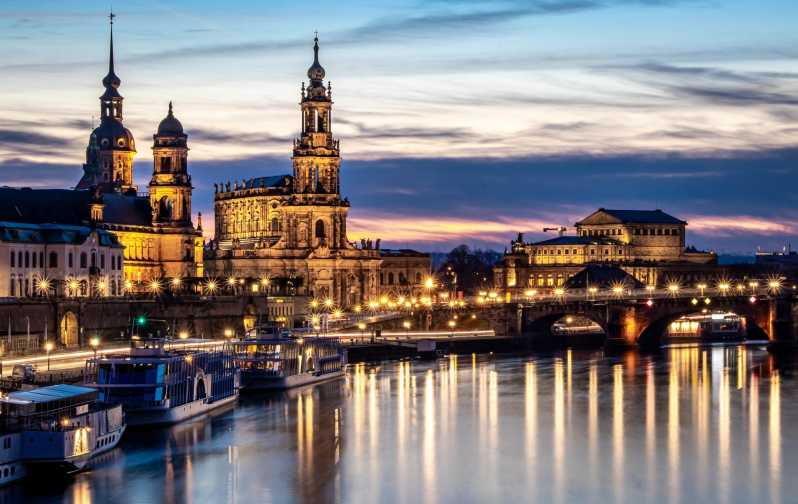
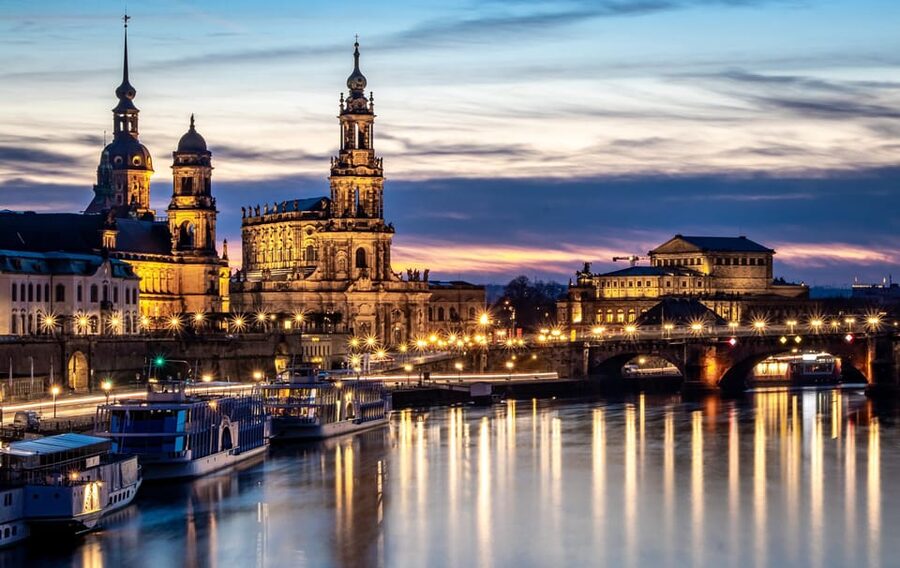
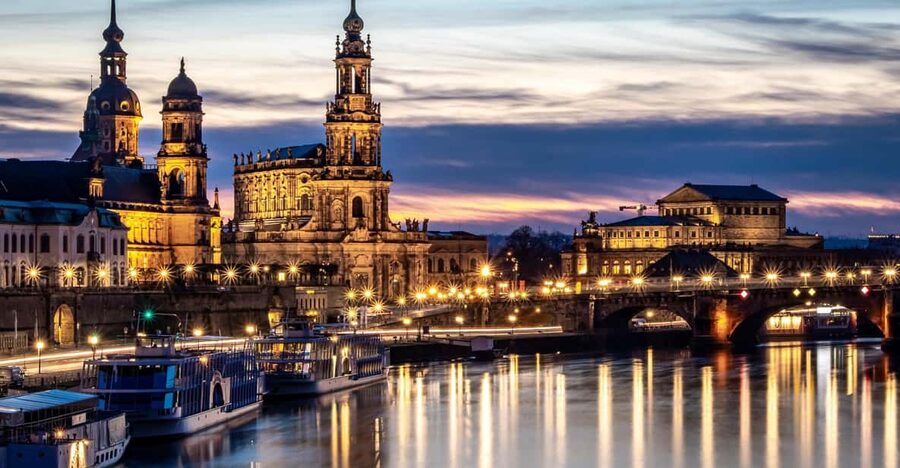
Brühl’s Terrace provides one of the tour’s best changes of mood. After the tighter streets and squares of the Old Town, you reach a broad riverside promenade with views toward the Elbe and the city around it.
The Elbe is central to Dresden’s identity. It has often been described as a dividing line between Germanic and Slavic worlds, but this tour presents it more usefully as a connection between them. That idea fits Dresden, a city shaped by movement, trade, rulers, and cultural exchange.
From Brühl’s Terrace, you can also better understand the city’s layout. The river, Old Town, bridges, and grand buildings are no longer separate points on a map. They form one setting.
This stop can also be a practical pause for photographs, though the tour remains a walking experience rather than a scenic lookout visit. Keep listening while you take pictures, since the guide may use the terrace to explain Dresden’s growth and its relationship with the river.
Hofkirche and Semperoper
Hofkirche brings the tour back to the city’s courtly and religious power. Its location near the castle makes sense once you understand Dresden as the seat of Saxon rulers. The church is part of the architectural group that gave the center its royal character.
Semperoper adds another layer. The opera house represents Dresden’s artistic ambitions and its place in European culture. Together with the churches, castle, galleries, and palaces, it shows why Dresden became known for more than military or political importance.
I like this section because it gives you several ways to read the city. Look at the façades as works of art, but also as statements by rulers, architects, musicians, and city planners. The buildings are attractive, yet they are also evidence of who had money and power.
The guides are central to making this work. Nicolo and Nicolas have been praised for presenting detailed material in an easy, conversational way. Dominica has also been singled out for strong storytelling and enthusiasm. Guide assignments can change, but the experience depends heavily on who leads your group.
Zwinger Palace and the final stretch
The route finishes near Zwinger Palace, close to the Elbe bridge. Zwinger is perhaps the clearest symbol of Dresden’s baroque ambition, with ornate forms designed to impress.
The palace helps bring together the themes introduced at the start. Saxony’s rulers wanted a court city that could match its European rivals, and Zwinger was part of that display. Its position near the river also shows how the royal center opened toward trade routes and movement beyond the city.
Do not expect to see every interior or collection during the walk. The point is to understand the building in its urban setting, then return later if you want more time inside. A guided orientation is useful because it lets you decide which sights deserve a longer visit.
The route covers many major landmarks in one outing. That is convenient, but it also means the pace may feel brisk if you want to stop for long photographs or read every plaque.
What the guides do well
The strongest part of this experience is the human explanation. Dresden’s story includes medieval trade, Slavic origins, royal titles, religious buildings, wartime destruction, reconstruction, and modern city life. A flat list of facts would be hard to absorb.
The best guides make those subjects feel connected. Nicolo has been praised for adding European context, quick humor, and well-timed facts. Nicolas is described as clear, detailed, and funny. Other guides, including James, have provided useful orientation and historical insight.
English ability appears to be strong overall, though speaking speed can vary. One guide from Spain was described as speaking quickly, and it took a little time to adjust. If you have trouble following fast English, stand near the guide and ask for a repeat early rather than letting several explanations pass by.
The tour can also become more personal when the group is small. One outing had only one booking after cancellations, giving the guide plenty of time for direct conversation. That is pleasant for you, though the pay-as-you-wish structure can be less rewarding for the guide when attendance is unexpectedly low.
Price, duration, and practical value
The listed price is $35 per person. That amount covers the reservation fee and the guide’s payment within Walkative’s general pay-as-you-wish format, rather than functioning like a standard fixed-price sightseeing excursion.
For the money, I see good value if you want a broad introduction to Dresden in one morning or afternoon. You cover the city’s main historic sights, get a usable map in your head, and hear the story that ties them together. The cost is easier to justify if this is your first visit or if you have limited time.
The value is lower if you prefer slow museum visits, long photo stops, or detailed interior tours. This is an outdoor walking orientation. It shows you what to return to, rather than replacing every separate visit.
The advertised duration is two and a half hours, but the walk can last longer. Arrive 10 minutes early, wear comfortable shoes, and use a restroom before meeting at Neumarkt. There is no transportation included, so you need to reach the meeting point and complete the route on foot.
The activity is wheelchair accessible. Since it is a walking tour through historic streets and squares, you may still want to confirm current route conditions when booking if you have specific mobility needs.
Who should book this Dresden walk?
I would choose this tour for a first visit, a short stay, or a traveler who wants the city’s major sights explained in a sensible order. It also suits anyone curious about reconstruction, since Dresden’s modern appearance cannot be understood without its 20th-century story.
Families with adults and older children should find the format workable if everyone is comfortable walking for several hours. The humor and short anecdotes help keep a long sequence of historic buildings from feeling like a lecture.
You might choose something else if you want a private tour, guaranteed interior access, or a very slow architectural study. The tour is also less suitable if you need a firm end time, since it may continue beyond the advertised duration.
Should you book it?
Book this Dresden Old Town walking tour if you want clear historical context, strong orientation, and the city’s main landmarks in one route. The combination of Frauenkirche, Fürstenzug, Dresden Castle, Brühl’s Terrace, Hofkirche, Semperoper, and Zwinger gives you a solid first look at the center.
I would especially recommend it before visiting museums or returning inside Frauenkirche. The guide helps you understand what you are seeing and why the rebuilt Old Town matters.
Skip it only if you already know Dresden well and prefer to explore at your own pace. For most first-time visitors, $35 is a fair price for a thoughtful introduction, provided you are ready for a fairly long walk and do not need a guaranteed toilet break.
FAQ
Where does the Dresden walking tour meet?
Meet next to the Martin Luther statue at Neumarkt, beside Frauenkirche. Look for the guide carrying a yellow umbrella.
How long does the tour last?
The scheduled duration is 2.5 hours. The walk may last longer, so avoid scheduling a tight appointment immediately afterward.
What language is the tour in?
The tour is conducted in English by a live English-speaking guide.
What landmarks are included?
The route includes Neumarkt and Frauenkirche, Fürstenzug, Dresden Castle, Altmarkt, Kreuzkirche, the Palace of Culture, Brühl’s Terrace, Hofkirche, Semperoper, and Zwinger Palace near the Elbe bridge.
Is transportation included?
No. Transportation is not included. You meet the guide at Neumarkt and walk between the Old Town sights.
Is the tour wheelchair accessible?
Yes, the activity is listed as wheelchair accessible.
How much does the tour cost?
The listed price is $35 per person. This covers the reservation fee and the guide’s payment within the general pay-as-you-wish tour arrangement.
Do I need to pay when I book?
You can reserve now and pay later, so you do not have to pay anything at the time of booking.
Can I cancel the tour?
Yes. You can cancel up to 24 hours before the activity for a full refund.
How early should I arrive?
Arrive at the meeting point 10 minutes before the scheduled start time.
More Walking Tours in Dresden
- Dresden: City & Semperoper Guided Walking Tour
★ 4.8 · 2,293 reviews - Dresden: Guided City Walk with a Cup of Coffee
★ 4.7 · 1,568 reviews - Dresden: Complete Walking Tour with Frauenkirche Visit
★ 4.8 · 700 reviews - Dresden: Walking Tour with a Night Watchman and Meal
★ 4.4 · 487 reviews
Just added around Dresden
- Freiberg: Scavenger Hunt Self-Guided Walking Tour★ 4.6 · 7 reviews
- Radebeul: Scavenger Hunt Self Guided Tour★ 4.6 · 9 reviews
- Discover Germany’s most exciting photo illusion world!★ 4.7 · 26 reviews
- Dresden: New Year’s Eve Concert at the Zwinger★ 4.8 · 20 reviews
- Dresden: Zwinger Skip-the-Line & 2-Day Hop-On Hop-Off Bus★ 4.5 · 160 reviews
- Dresden: Guided City Walk and Panometer Entrance Ticket★ 4.5 · 176 reviews
- Dresden: Shared Small Group Walking Tour in English★ 4.8 · 172 reviews
- Dresden with a touch of Xmas: English small group tour★ 4.7 · 41 reviews
Dresden Tours, compared.
The Original Night Watchman Tour in Lantern Light
Read our review →


Browse the lists this tour appears in