
Review · DRESDEN TOURS
Dresden: Classic Old Town Tour
Dresden’s historic center packs a remarkable amount into a walk of just two hours. You’ll move from the baroque Zwinger to the grand Semperoper, then across squares and terraces shaped by war, rebuilding, royal power, and modern city life.
I like the private-group format, which gives you a more personal way to ask about Dresden’s past. I also like that the route includes the Frauenkirche interior, not just an outside look. The main consideration is price: $212 for up to 20 people can be good value for a full group, but costly for just one or two guests. Entry fees are extra.
Key Points
- See Dresden’s main monuments in two focused hours, including the Zwinger, Semperoper, Frauenkirche, Dresden Castle, and Fürstenzug.
- Enter the Frauenkirche, giving you a closer look at one of Dresden’s best-known rebuilt landmarks.
- Walk through the rebuilt Neumarkt, where Dresden’s old town character has been carefully restored after wartime destruction.
- Look across the city from Brühl’s Terrace, with views toward the state ministries and the Elbe-side setting.
- Book a private group of up to 20 people, with live guiding in English, French, Italian, or German.
- Ask for hotel pickup if useful, since collection from centrally located hotels is possible.
A Fast Introduction to Dresden’s Old Town
This walking tour is designed to give you a strong first look at Dresden rather than a long, specialized visit inside one building. In two hours, your guide connects the city’s architecture, Saxon culture, royal past, religious landmarks, and wartime destruction.
That broad approach suits you if Dresden is one stop on a larger Germany trip and you want the main sights explained before exploring on your own. It also works well at the start of a stay, since the route helps you understand how the old town fits together.
The tour is private, so your group does not have to follow the pace of a large public walk. The maximum size is 20 people, which is still a fairly large private party, but a small group should have more room for questions and conversation.
The style is described as spirited and humorous. That matters in Dresden, where the subject can quickly become heavy. A good guide needs to explain the city’s destruction and rebuilding without turning the entire walk into a solemn lecture. One guide associated with the experience is Frau Tröster, whose presentation was praised for its very strong command of Dresden’s history.
More Old Town Walking Tours in Dresden
- Dresden: Semperoper and Old Town Tour
★ 4.8 · 5,735 reviews - Dresden: Night Watchman Tour Through The Old Town
★ 4.8 · 1,758 reviews - Görlitz: Old Town Guided Walking Tour
★ 4.7 · 723 reviews
The Zwinger and Its Kronentor Gate
The tour begins among Dresden’s most graceful baroque buildings at the Zwinger. This palace complex is known for its grand courtyards, ornamental details, and the distinctive Kronentor gate.
You’ll get an outside introduction to the complex as your guide explains its place in Dresden’s royal and cultural life. The Zwinger is more than a pretty photo stop. Its formal design shows the scale and confidence of the Saxon court, and the open spaces make it easy to appreciate the relationship between architecture, ceremony, and power.
Do not expect a full museum visit here. Entry fees are not included, and the tour is built around a walking overview. If you want to see the collections inside the Zwinger, you’ll need separate time and tickets.
The advantage of seeing it on a guided route is orientation. You can learn what you’re looking at before returning later for a more focused visit, if your schedule allows.
Theaterplatz and the Semperoper
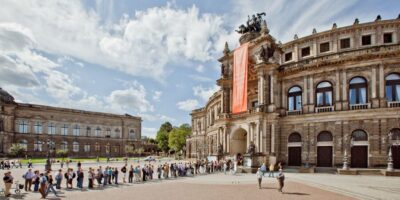
From the Zwinger, the walk continues to Theaterplatz, home of the famous Semperoper. The opera house is one of Dresden’s defining buildings, with an imposing historic design that fits naturally beside the Zwinger and other monumental structures.
Your guide will help you read the square as a unified piece of Dresden, rather than as a set of unrelated sights. This is one of the tour’s strongest features. You see how the opera, palace buildings, cathedral, and old town streets work together to create the city’s grand central stage.
The Semperoper is still associated with music and performance, but this experience does not include an opera performance or an interior entry. You’ll view it as part of the walking tour, so consider adding a separate visit if you want to see inside.
For many people, Theaterplatz will be one of the clearest examples of Dresden’s baroque and royal character. It is also a good place to pause for photographs, though the tour’s two-hour schedule means the guide will keep the group moving.
Taschenbergpalais, Cathedral, and Dresden Castle
The route then takes in the Taschenbergpalais, Dresden Cathedral, and Dresden Castle. Together, these buildings give you a compact lesson in the city’s courtly and religious past.
The Taschenbergpalais adds another elegant palace setting to the walk. Dresden Cathedral brings a different mood, with its strong connection to the city’s religious life. Dresden Castle, meanwhile, anchors the former royal quarter and helps explain why this part of town feels so formal and monumental.
You may find that these stops pass quickly. That is the tradeoff of trying to cover so much in two hours. The guide can explain the role of each building, but you will not have time for an extensive examination of every facade or collection.
I see this part of the itinerary as useful groundwork. If one building catches your interest, you can return later with a better sense of what you are seeing and why it matters.
More old town walks in Dresden:
- Dresden: Segway Tour Along the Elbe and Old Town
★ 4.9 · 392 reviews - Dresden Old Town – Guided Walking Tour in English
★ 4.8 · 135 reviews - Dresden: Old Town Scavenger Hunt for Children
★ 4.6 · 117 reviews - Nuremberg: Old Town Guided Walking Tour
★ 4.6 · 2,416 reviews
The Fürstenzug and Dresden’s Rulers
The Fürstenzug is one of the most memorable details on the route. This long outdoor mural presents the rulers of Saxony in a procession, creating a visual record that is easier to understand with a guide beside you.
Your guide can point out how the artwork relates to Dresden’s royal identity and the wider story of Saxony. Without explanation, it might look like an impressive wall of figures. With context, it becomes a compact history lesson presented in a form you can study at street level.
This is a particularly good stop for visitors who prefer history told through art and public spaces. You do not need to enter a museum to encounter the story, and the mural fits naturally into the walk between Dresden Castle and the Frauenkirche.
Entering the Frauenkirche
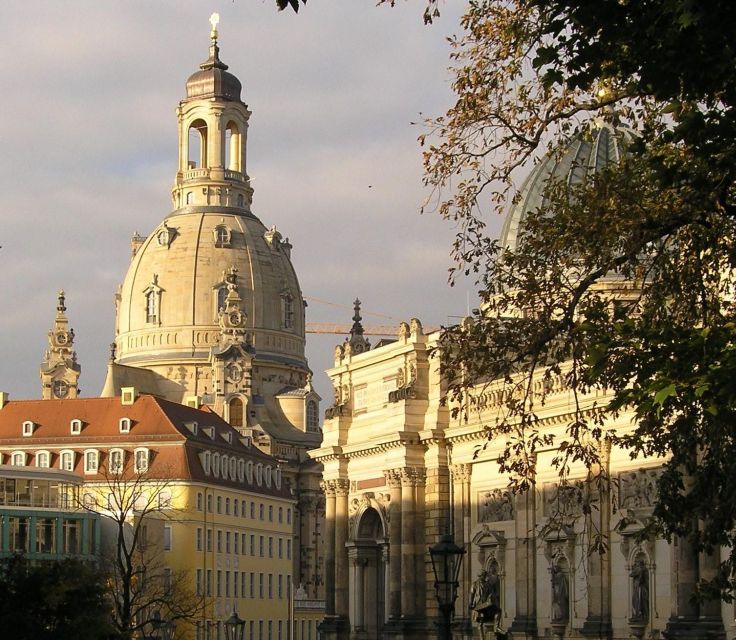
The Frauenkirche is the emotional center of the tour. Its rebuilt dome and carefully restored form are now among Dresden’s most recognizable sights, but the church also carries the weight of the city’s wartime destruction and later reconstruction.
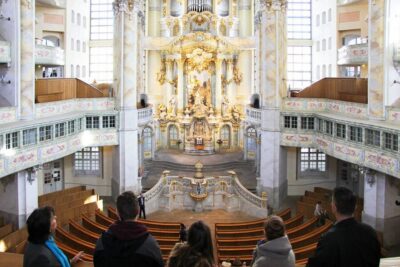
The experience includes an interior visit, which gives you more than the usual quick glance from the square. Inside, you can appreciate the scale and design of the church in a way that is not possible from outside.
Entry fees are not included in the tour price, so confirm how the interior visit is handled when you book. The activity information specifically includes the Frauenkirche interior while also stating that entries are extra. That means you should budget separately for any required admission.
The nearby Neumarkt adds another important layer. The square has been rebuilt to restore the look and feel of Dresden’s old center, making it a useful place to discuss both loss and reconstruction. You’ll see a historic image of the city, but one shaped by modern decisions about what to rebuild and how.
Neumarkt and the Work of Rebuilding
Neumarkt is not simply another attractive square. It helps you understand why Dresden can feel both old and new at the same time.
The rebuilt buildings recall the city’s earlier appearance, while the spaces around them reflect a later period of reconstruction. A guide can make that contrast clearer by explaining what you are seeing instead of letting the restored facades speak for themselves.
I like having Neumarkt included because it adds honesty to the tour. Dresden’s center is beautiful, but its present appearance is tied to destruction, planning, memory, and reconstruction. You get a better sense of the city when those parts are discussed together.
The drawback is that a walking tour cannot give you a full architectural study of the square. If you care about restoration details, ask your guide questions and take note of the buildings you want to examine later.
Brühl’s Terrace and Views Toward the Ministries
The walk continues to Brühl’s Terrace, a raised promenade with views toward the state ministries. This section gives you a change of pace after the dense collection of churches, palaces, and squares.
From the terrace, you can look across the city and see how Dresden’s monumental center relates to its wider setting. The view helps break up the close-up study of facades and provides one of the tour’s better chances to understand the city as a whole.
Brühl’s Terrace is also a good place to ask about modern Dresden. The view toward the state ministries connects the historic center with the city’s current public life, rather than leaving you with the impression that Dresden is only a royal or baroque showpiece.
Since the tour lasts two hours, this will be a short stop rather than a long scenic break. Wear comfortable shoes and be ready to walk at a steady pace.
The New Synagogue and Altmarkt
The New Synagogue brings another important part of Dresden’s story into the route. Including it gives the walk more breadth, since the city’s identity cannot be reduced to palaces, churches, and royal buildings.
Your guide can place the synagogue within Dresden’s changing cultural and religious history. The stop also helps you see the old town as a living center with more than one tradition and community.
The route also includes Altmarkt and the Kulturpalast. Altmarkt is one of the city’s important public squares, while the Kulturpalast represents a later chapter in Dresden’s urban life.
This section makes the tour more balanced. You move from baroque court architecture to religious buildings, public squares, state institutions, and modern cultural spaces. The result is a wider view of Dresden than you would get from a route focused only on the famous postcard sights.
What the Two-Hour Format Really Gives You
Two hours is enough for a strong introduction, but not enough for long interior visits or unhurried photography at every stop. You should think of this as a guided framework for Dresden, not a complete sightseeing day.
The route covers a lot:
- Zwinger and Kronentor
- Semperoper at Theaterplatz
- Taschenbergpalais
- Dresden Cathedral
- Dresden Castle
- Fürstenzug
- Frauenkirche interior
- Rebuilt Neumarkt
- Brühl’s Terrace
- New Synagogue
- Altmarkt and Kulturpalast
That list is the tour’s main strength. You get the city’s essential old town sights without arranging several separate visits.
The limitation is pace. If you like to stop for detailed photographs, read plaques, or enter every building, you may feel rushed. I would book this for orientation, then return independently to the places that interest you most.
Private Pricing and Group Value
The price is $212 per group of up to 20 people. That structure changes the value considerably depending on your party size.
For a full group, the cost works out to about $10.60 per person. For four people, it is about $53 per person. For two, it becomes $106 each, and for a solo visitor the full amount is a serious expense for a two-hour walk.
The private format is the reason to consider it. You are paying for a dedicated guide rather than simply joining a standard group, and you can potentially ask questions that match your interests. Central hotel pickup may also make the arrangement easier if you are staying in the city center.
The tour includes guiding but not entry fees. Keep that extra cost in mind, especially because the Frauenkirche interior is part of the planned experience. The booking also offers free cancellation up to 24 hours before the start and reserve-now, pay-later flexibility, which is useful when your Dresden schedule is still changing.
Language, Access, and Who Should Book
You can take the tour in English, French, Italian, or German. That range makes it practical for many international visitors, but be sure to choose the language you want when checking availability.
The activity is wheelchair accessible. Since it is a walking tour through the historic center, you should still confirm the exact route and pickup details if anyone in your group has specific mobility needs.
I would recommend this tour to:
- First-time visitors who want the main sights explained quickly
- Families or private groups who prefer their own guide
- Visitors with only a short time in Dresden
- History-minded people who want context for the rebuilding of the old town
- People who want a guided introduction before visiting museums independently
I would be less likely to recommend it to you if you want long museum visits, a relaxed photography walk, or a detailed architectural lecture focused on one building. The tour is broad, lively, and efficient.
Should You Book This Dresden Walk?
Book it if you want Dresden’s central sights tied together by one guide, especially if you are traveling with several people and can share the $212 group price. The Frauenkirche interior, Fürstenzug, rebuilt Neumarkt, and Brühl’s Terrace give the walk more substance than a simple facade-by-facade stroll.
For one or two people, compare the private price with your interest in personal guiding. If the cost feels high, you may prefer to see the main squares independently and spend your money on a separate museum entry.
Still, this is a useful choice when you want a clear introduction, a flexible private format, and a guide who can explain Dresden’s complicated past with warmth and humor. If Frau Tröster leads your group, you can expect a guide whose historical command has been especially well noted.
FAQ
How long does the Dresden Classic Old Town Tour last?
The walking tour lasts two hours.
What sights are included?
The route includes the Zwinger and Kronentor, Semperoper, Taschenbergpalais, Dresden Cathedral, Dresden Castle, Fürstenzug, Frauenkirche, Neumarkt, Brühl’s Terrace, New Synagogue, Altmarkt, and Kulturpalast.
Can I visit the Frauenkirche interior?
Yes. An interior visit to the Frauenkirche is included in the planned tour experience.
Are entry fees included in the price?
No. Entry fees are not included.
How much does the tour cost?
The price is $212 per private group of up to 20 people.
What languages are available?
Live guiding is available in English, French, Italian, and German.
Is the tour wheelchair accessible?
Yes. The activity is listed as wheelchair accessible.
Is hotel pickup available?
Pickup from centrally located hotels is possible.
Just added around Dresden
- Freiberg: Scavenger Hunt Self-Guided Walking Tour★ 4.6 · 7 reviews
- Radebeul: Scavenger Hunt Self Guided Tour★ 4.6 · 9 reviews
- Discover Germany’s most exciting photo illusion world!★ 4.7 · 26 reviews
- Dresden: New Year’s Eve Concert at the Zwinger★ 4.8 · 20 reviews
- Dresden: Zwinger Skip-the-Line & 2-Day Hop-On Hop-Off Bus★ 4.5 · 160 reviews
- Dresden: Guided City Walk and Panometer Entrance Ticket★ 4.5 · 176 reviews
- Dresden: Shared Small Group Walking Tour in English★ 4.8 · 172 reviews
- Dresden with a touch of Xmas: English small group tour★ 4.7 · 41 reviews
Dresden Tours, compared.

The Original Night Watchman Tour in Lantern Light
Read our review →



Browse the lists this tour appears in