
Review · COCHEM TOURS
Cochem: Private Guided Walking Tour
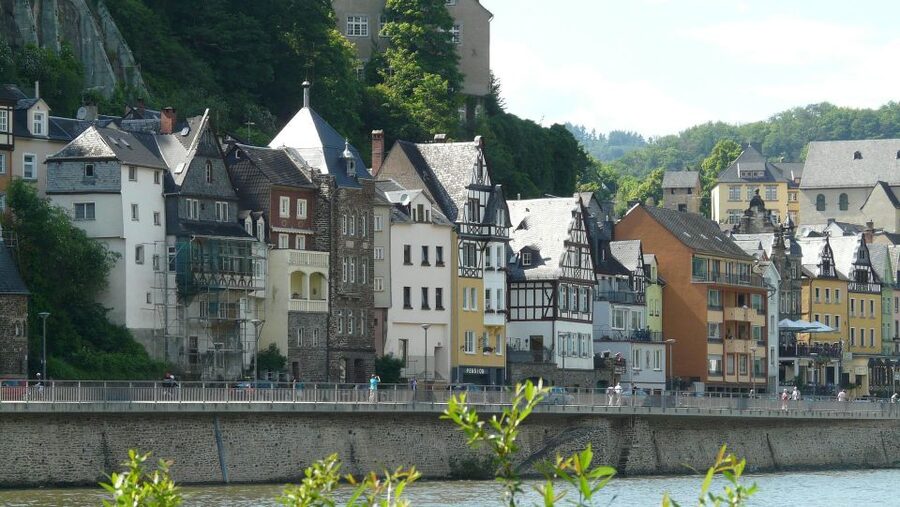
Cochem’s postcard looks simple: a river, steep hills, half-timbered houses, and a castle perched above it all. The better surprise is how much history is packed into this small Mosel town, from Celtic settlers and Romans to Louis XIV, Napoleon, the Metternich family, and the dark years of the Second World War. This private walk gives you that story in 90 focused minutes, without the stop-and-go rhythm of a large group.
I like the private format, since your guide can adjust the emphasis and pace for your group. I also like the local angle. Guides have shared personal knowledge of Cochem, and Bridget is specifically named as a guide who connected the town’s past with its wine and everyday life. The main consideration is that this is an overview on foot, not a full castle visit, and entrance fees are not included.
Key points to know before you book
- Cochem’s story reaches from Celtic times to the Second World War, giving this short tour more range than its pretty streets suggest.
- The private group can include up to 15 people, so the $272 price is strongest for families or larger groups.
- St. Martin’s Church, the Market Square, Capuchin Monastery, and Reichsburg anchor the walk.
- English and German guides are available, with possible changes to the emphasis during the tour.
- The tour does not include entrance fees, so plan on seeing the main sights from the outside unless you arrange separate admission.
- Comfortable shoes matter, and the tour is not suited to wheelchair users or people with mobility impairments.
Cochem in 90 minutes: a small town with a long story
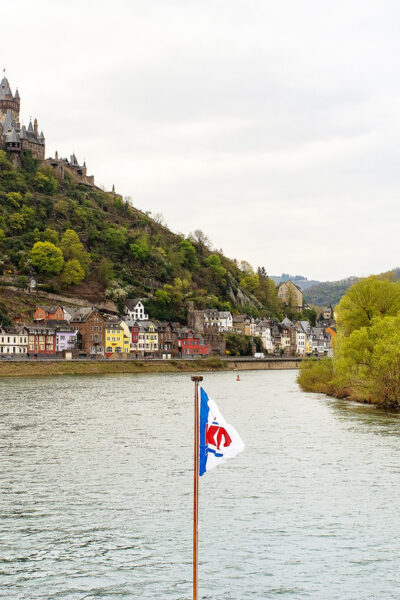
Cochem is often called the pearl of the Mosel, and the setting explains why. The town sits beside the river with wooded hills rising behind it, while Reichsburg occupies a high point above the rooftops. The scenery is easy to admire, but a guide helps you see that the town was never just a pretty stop for photographs.
People lived here in Celtic times, and the Romans later brought the area into their empire. Cochem first appears in written records in the ninth century under the Latin name Villa Cuchema. That name is a useful reminder that the town’s story began many centuries before its half-timbered houses and wine shops appeared.
I like this broad time span because it keeps the tour from becoming a parade of attractive buildings. You hear how power, religion, war, trade, and local government shaped the same streets you are walking through. In a town this compact, those changes are easier to picture than they would be in a large city.
More walking tours in Germany:
- Discover Berlin Half-Day Walking Tour
★ 5.0 · 9,624 reviews - Berlin: Third Reich and Cold War 2 Hour Walking Tour
★ 4.9 · 6,830 reviews - Munich: Third Reich & WWII Walking Tour
★ 4.6 · 6,181 reviews
Starting at Endertplatz and finding your bearings
The meeting point is in front of the tourist office at Endertplatz 1. This is a practical place to begin because you can find the location without hunting through side streets, and the guide can take over from there.
The tour lasts 90 minutes, so expect a brisk but manageable introduction rather than a leisurely half-day outing. The exact starting time depends on availability when you book. I would arrive ready to walk, with comfortable shoes and water if needed, since the route includes Cochem’s historic center and the approach to its hilltop castle area.
A private guide changes the feel of the first few minutes. You are not trying to hear a guide speaking to a crowd several yards away. Your group can ask why a building matters, request more detail about wine or wartime history, or spend less time on a subject that does not interest you.
The group limit is 15 people. For a couple, the flat price is a considerable spend. For a family or group of friends sharing the booking, it becomes much more reasonable. At the full group size, the cost works out to about $18 per person, before any entrance fees.
St. Martin’s Church and the religious center of town
St. Martin’s Church is one of Cochem’s most recognizable landmarks and an important stop early in the town story. Here, you can expect the guide to explain the church’s place in local life and point out why it matters beyond its appearance.
The church also helps set up the role of religious institutions in Cochem. The Capuchin Monastery was founded in 1623 by Elector Lothar von Metternich, a member of the family whose rule left a mark on the region. That date places the monastery in the period after the Reformation, when religious identity and political authority were closely tied.
You should keep the scope in mind. The activity includes a guided walk, not admission to every building. Entrance fees are not included, and the supplied details do not promise interior access to St. Martin’s Church or the monastery. If entering either site is important to you, ask the guide what is possible on the day and budget separately.
This is also where a local guide can add something a signboard cannot. The information provided for the tour emphasizes local stories and the option to customize the discussion on the spot. That gives you a chance to connect the church and monastery with the town’s people, not just memorize dates.
The Market Square and Cochem’s half-timbered center
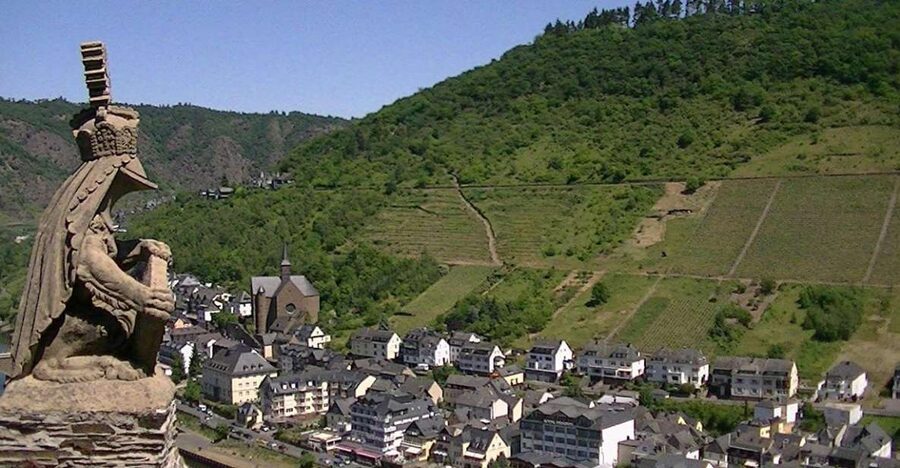
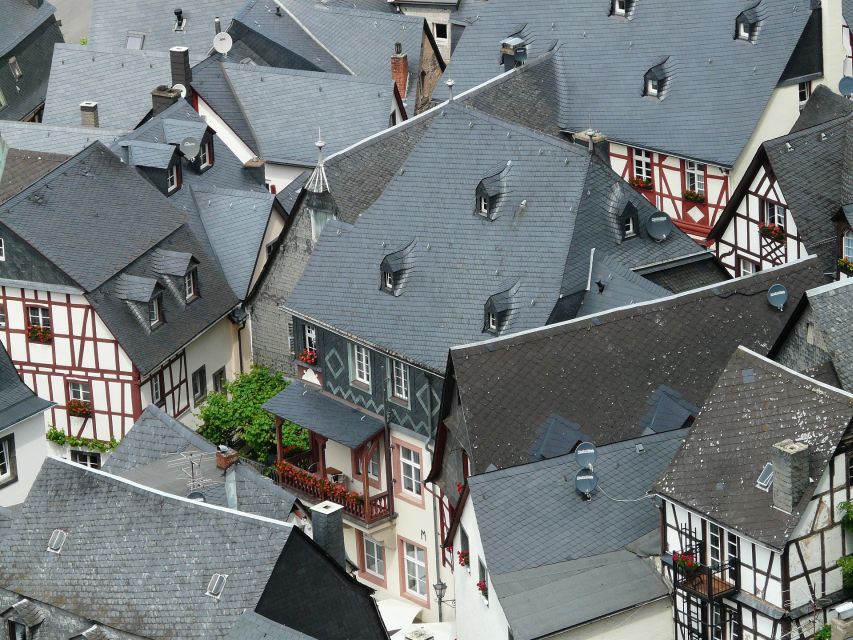
The Market Square is a natural heart of the walk. Its importance reaches back to the late Middle Ages, when market activity helped organize economic and civic life. Today, the square gives you the classic Cochem scene: traditional half-timbered houses, a compact urban plan, and the hills rising beyond.
I like the square as a teaching stop because it makes medieval Cochem easy to imagine. A market was not simply a place to buy food. It was a meeting point, a source of local income, and a visible sign that the town had a role in the wider Mosel region.
The half-timbered houses also deserve a closer look. From a distance, they can blur into one charming picture. Your guide can help you notice how the buildings frame the square and how the old center survived and changed over time.
That last point matters because Cochem’s historic appearance can give a false impression of uninterrupted survival. Much of the town was destroyed during the Second World War. The streets you admire today are connected to an older town, but they also reflect reconstruction after severe damage.
A few more Germany half-days to weigh up
- Cochem: Panoramic Cruise on the Moselle River
★ 4.4 · 1,004 reviews - Cochem: Panorama-Schiff-Tour 1 Stunde bis Ernst und zurück
★ 4.3 · 122 reviews - Cochem, Moselle: Castle, boat and wine tour
★ 3.7 · 96 reviews - Cochem: KD Panoramic Evening Cruise on the Moselle River
★ 4.1 · 76 reviews
French conquest, Louis XIV, and the long rebuilding
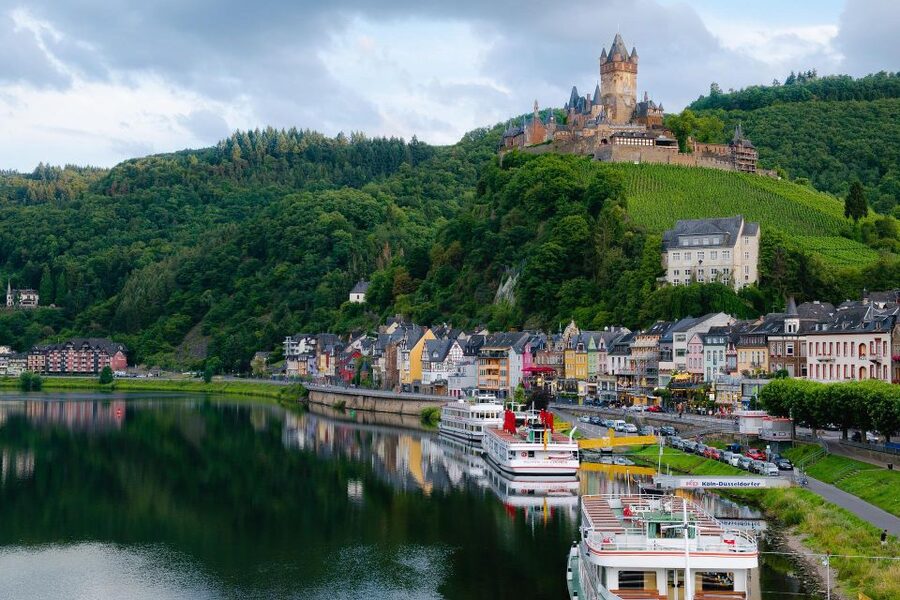
Cochem was once an Imperial estate, then endured French siege and occupation. Under King Louis XIV, the original castle was burned and the city was conquered. Rebuilding followed, and the effects of that upheaval form an important part of the town’s story.
This is one of the strongest reasons to take the walk with a guide. Without context, Reichsburg looks like a romantic medieval castle that simply happens to sit above the river. The story is less tidy. Its earlier form was destroyed, and the town had to recover from military rule and major disruption.
Napoleon’s army later occupied Cochem in the 18th century. After Napoleon’s fall, the town was assigned to Prussian rule. These changes show how often the Mosel was caught between larger powers. Cochem’s location brought trade and attention, but it also exposed the town to armies and political decisions made elsewhere.
I would listen for the links between these events rather than trying to remember every ruler. The useful takeaway is that the castle and old town are products of conflict, rebuilding, and changing authority. That gives the scenery more weight without turning a 90-minute tour into a classroom lecture.
Reichsburg above the Mosel
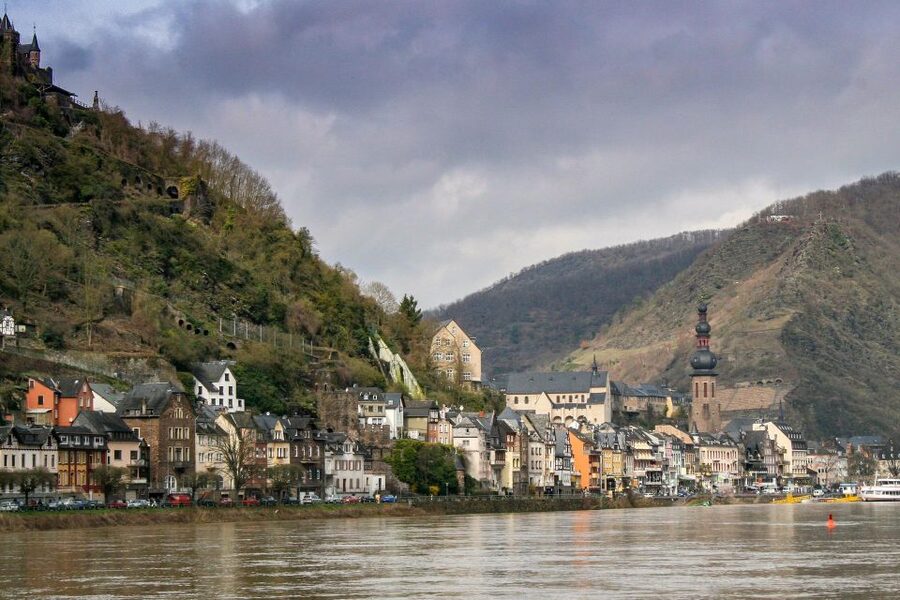
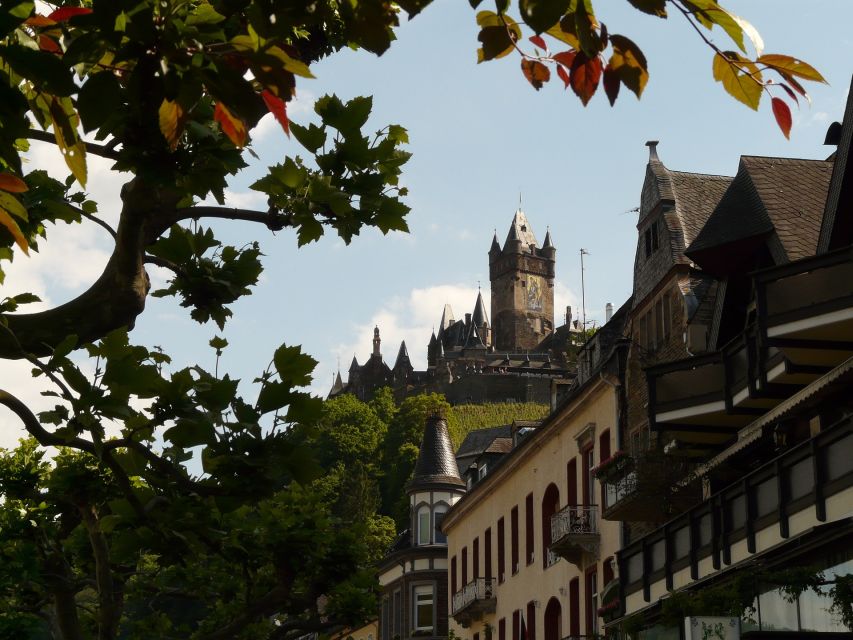
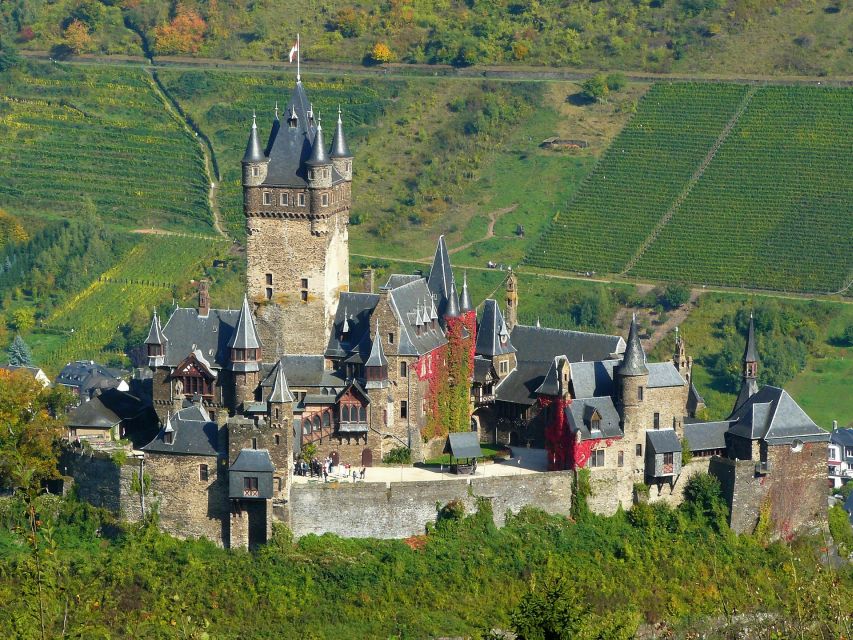
Reichsburg is the visual prize of Cochem. The castle rises high above the river and is one of the highest hill castles on the Mosel. Its position explains why it has such commanding views, but it also explains its strategic importance.
The castle you see today is beautifully restored, yet the original was destroyed during the reign of Louis XIV. That distinction is worth knowing. You are looking at a recreation of a medieval stronghold, not an untouched building that escaped every war and change of ownership.
The walk gives you the castle’s story and the chance to admire its setting. It does not include entrance fees, and the description does not promise an interior castle tour. If you want to explore the rooms, arrange that separately. If your main goal is understanding how Reichsburg fits into Cochem’s story and taking in its position over the Mosel, the guided stop should do that within the allotted time.
The hill also affects comfort. Cochem is not flat, and the activity is specifically unsuitable for people with mobility impairments or wheelchair users. Comfortable shoes are not a formality here. They are the sensible choice for cobbled streets, changing grades, and a route shaped by a hill town.
The Second World War and Cochem’s difficult memory
A good town walk should not hide the hard parts, and this one includes Cochem’s Second World War history. Much of the town was destroyed, and Cochem was connected to subcamps of the Natzweiler concentration camp system. That history gives the pretty setting a painful layer that visitors should not skip.
The subject may feel heavy beside the castle and river views, but it belongs in any honest account of Cochem. A guide can explain how war affected the town and why reconstruction matters. The supplied information does not specify a separate memorial visit or a long stop at a particular camp site, so expect historical explanation rather than a dedicated concentration camp excursion.
After the war, Cochem became part of the newly founded German state of Rhineland-Palatinate. This political change closes the tour’s long arc, bringing the town from imperial rule and French occupation into the modern German federal system.
I appreciate that the experience includes this chapter. It keeps the tour from presenting Cochem as a frozen picture of old Germany. You get beauty, but you also get destruction, responsibility, and the fact that a restored town can carry difficult memories.
Local stories, wine, and the value of a private guide
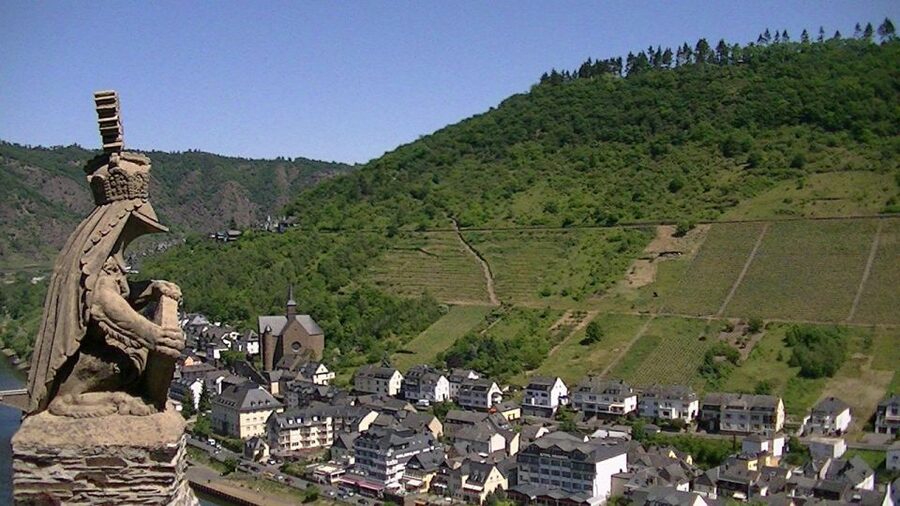
The strongest personal touch comes from the guide rather than from any single monument. English and German tours are available, and the guide stays with your group only. The experience also allows possible customization during the walk, which is useful if your interests are specific.
You might ask for more attention to wine, local customs, church history, military events, or the town’s modern identity. One guide, Bridget, is specifically associated with combining Cochem’s history with the wine of the Mosel and personal stories about life in town. That kind of local perspective can make the walk feel less like a list of dates.
The feedback attached to the experience repeatedly praises guides for being friendly, clear, funny, and well paced. One German-language comment describes the tour as pleasant, amusing, informative, short, and neatly tailored to the group. That is a good description of what this format aims to do: cover a lot without dragging.
The overall rating is 4.8 from nine ratings, with the available comments giving all five-star scores. That is a small sample, so I would treat it as encouraging rather than final proof. Still, the pattern is clear: the most praised qualities are the guide’s warmth, local knowledge, personal stories, and ability to explain the area without overloading the group.
Who gets the best value from the $272 price
At $272 for up to 15 people, this is not the cheapest way for one or two people to see Cochem. A self-guided walk costs far less, and the town center is compact enough that you can admire the main views on your own.
The private format becomes more attractive when you are traveling with several relatives or friends. At 10 people, the price is about $27 per person. At 15, it is roughly $18 per person. You are paying for a guide dedicated to your group, the ability to ask questions freely, and the chance to adjust the emphasis rather than follow a fixed large-group script.
I would book it for a group that wants context without spending several hours on a formal historical tour. It also suits people arriving in Cochem for a short stop who want to get oriented quickly. The 90-minute length leaves time afterward for independent sightseeing, food, wine, or a separate visit to Reichsburg.
The value is weaker if you only want castle admission or a long interior visit. Entrance fees are separate, and the experience itself is a walking overview. You should see it as a foundation for exploring Cochem, not as the complete town experience.
Practical details that shape the day
You meet at the tourist office in front of Endertplatz 1, 56812 Cochem. The guide speaks English or German, and the booking is for a private group rather than a shared public tour.
You can cancel up to 24 hours before the start for a full refund. The reserve-now, pay-later option lets you hold the plan without paying at once, which is useful when your Mosel schedule is still shifting. Check the available starting times before committing, since the tour does not list one fixed departure hour.
Bring comfortable shoes. The tour is not suitable for wheelchair users or people with mobility impairments, so anyone with walking concerns should consider that limitation seriously before booking.
The price does not cover entrance fees. The supplied information also does not promise transportation, food, drinks, or hotel pickup. Plan to reach the meeting point yourself and treat the activity as a guided walk through town.
Should you book this Cochem walking tour?
Book it if you want Cochem’s beautiful center explained by a local guide, especially if you are traveling with a group large enough to share the $272 cost. The mix of Celtic and Roman beginnings, medieval markets, the Metternich family, French and Napoleonic occupation, Reichsburg, wine, and the Second World War gives the walk real substance.
I would be especially comfortable recommending it to first-time visitors with only a short time in town. You get a useful map of Cochem’s past and present in 90 minutes, then you can decide what deserves a longer look.
Skip it if you prefer wandering alone, need wheelchair access, or mainly want an included tour inside Reichsburg. For everyone else, this is a practical way to see the famous views while learning why Cochem looks the way it does.
FAQ
How long is the Cochem private walking tour?
The tour lasts 90 minutes.
Where does the tour meet?
You meet in front of the tourist office at Endertplatz 1, 56812 Cochem, Germany.
What languages are available?
The tour is offered in English and German.
Is this a private tour?
Yes. It is a private group experience, with a local professional guide accompanying only your group.
How many people can join the group?
The listed price covers a group of up to 15 people.
Are entrance fees included?
No. Entrance fees are not included in the tour price.
Is the tour suitable for wheelchair users?
No. The activity is listed as unsuitable for wheelchair users and people with mobility impairments.
Can I cancel for a full refund?
Yes. You can cancel up to 24 hours in advance for a full refund.
Just added around Germany
- Berlin: Battle for Seelow Heights WW2 tour -Clash of Titans★ 5.0 · 27 reviews
- From Berlin: Gardens & Palaces of Potsdam Bike Tour★ 5.0 · 61 reviews
- From Amsterdam: Cologne Private Sightseeing Tour★ 5.0 · 4 reviews
- From Berlin: Historical Gems of Potsdam Private Day Trip★ 4.4 · 4 reviews
- Freiburg: Veni, vidi, vino – wine hike and tasting★ 4.5 · 144 reviews
- From Alken: Return Day Trip by Boat to Cochem★ 4.6 · 141 reviews
- Fritz Haarmann – Die Mördertour★ 4.6 · 41 reviews
- Freiburg: Tour of the city with cathedral visit★ 4.7 · 167 reviews
Cochem Tours, compared.
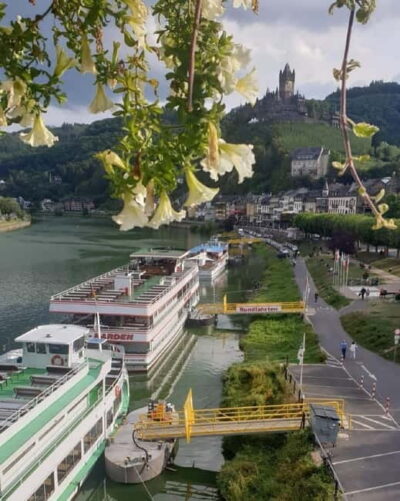
Panorama-Schiff-Tour 1 Stunde bis Ernst und zurück
Read our review →
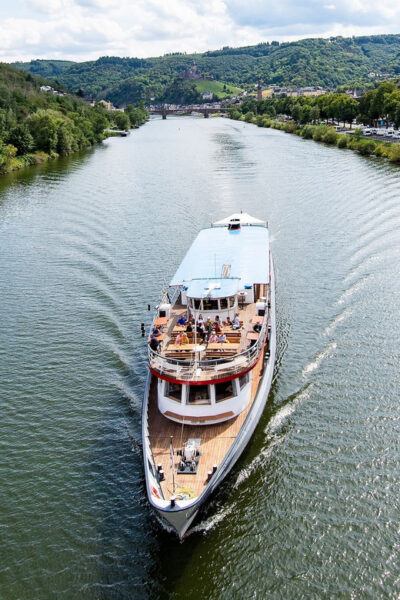
KD Panoramic Evening Cruise on the Moselle River
Read our review →
Bike and Boat Tour with Picnic and Wine Tasting
Read our review →Browse the lists this tour appears in