
Review · DRESDEN TOURS
Walking Through Dresden’s Past with Dr. Fraser Macdonald
Dresden’s past is written into its rebuilt churches, vanished monasteries, royal palace, and broad riverfront. This walking tour with Dr. Fraser Macdonald follows that story from the Elbe and Neustadt across Augustus Bridge into the Altstadt, ending among Dresden’s grandest sights.
I like the route’s clear historical shape and its manageable two-hour length. I also like that Fraser brings an anthropology background and links buildings to people, religion, politics, and daily life, rather than rattling off dates. The main consideration is that the tour is primarily an outdoor introduction: entrance fees and interior visits are not included.
Key points at a glance
- Starts beside the Elbe at the Golden Rider, where Dresden’s earliest settlement and displaced communities enter the story.
- Covers both Neustadt and Altstadt, using Augustus Bridge to connect the two historic parts of the city.
- Explains churches as political records, from the Reformation and royal power to wartime destruction and rebuilding.
- Ends at Dresden Castle and Theaterplatz, close to the Zwinger, Semperoper, and other major sights.
- Keeps the walk to about two hours, useful if you have only a short time in Dresden.
- Costs $60.34 per person, with a maximum group size of 30 and free cancellation up to 24 hours before departure.
Why this Dresden walk works as a first introduction
I like city tours that give you a mental map before you start visiting museums. This one does that well. You begin in Neustadt, walk through several important religious and royal sites, cross into the older Altstadt, and finish at Theaterplatz. By the end, you have a sense of how Dresden fits together, not just a list of famous facades.
Fraser’s approach is especially useful if you want history connected to modern Dresden. The tour reaches back to the medieval period, covers the Reformation, follows Saxony’s rise in power, and addresses the bombing of Dresden, postwar reconstruction, and the years under the German Democratic Republic. Several accounts of the tour specifically valued the explanation of how different architectural periods can still be read across the city.
The walk is in English and takes roughly two hours. That makes it a good opening activity on a first day, leaving time afterward for the Zwinger, Semperoper, Dresden Castle, churches, or museums. It also suits a short stop in the city. One useful practical detail: the route is about a mile according to the tour information, though the exact walking feel depends on pauses, group movement, and time spent at each stop.
More walking tours in Dresden:
- Dresden: City & Semperoper Guided Walking Tour
★ 4.8 · 2,293 reviews - Dresden: Guided City Walk with a Cup of Coffee
★ 4.7 · 1,568 reviews - Görlitz: Old Town Guided Walking Tour
★ 4.7 · 723 reviews
Starting at the Golden Rider and the Elbe
The meeting point is the Golden Rider at Neustädter Markt, near Köpckestraße and the Elbe. This is a convenient place to begin because the riverfront gives you immediate orientation. You are looking toward the historic core while standing in an area tied to Dresden’s earliest permanent settlement.
The first discussion considers the people who lived here before Dresden became the royal and cultural center known today. Fraser also addresses culture, language, and the eventual displacement of those early communities. That opening gives the tour a human beginning. Dresden is not introduced as a collection of palaces, but as a place shaped by people who lived along the river before later rulers remade the city.
You should expect about 15 minutes here. There is no admission charge, and the stop is outdoors. On a wet or cold day, this is one reason to dress sensibly. The experience depends on walking and listening in open spaces, so good weather matters.
From monastery to royal hunting lodge
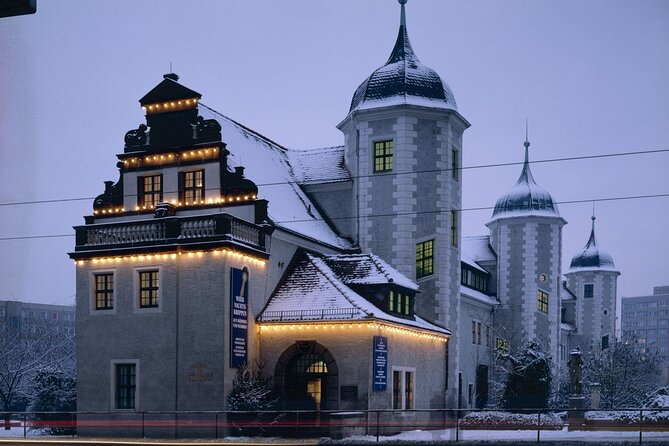
The next stop is the Museum für Sächsische Volkskunst mit Puppentheatersammlung. The building’s story begins in the 15th century, when the site served as a wealthy Augustinian monastery. After Luther’s Reformation, the monastery was demolished and replaced by a royal hunting lodge in the 16th century.
That change captures one of Dresden’s recurring themes: religious institutions, princely authority, and public identity repeatedly reshaped the same streets and buildings. You are not simply hearing about a museum. You are seeing how a site can change meaning when the city’s religious and political order changes.
The tour does not include entry to the museum. You can visit independently, with admission listed at €5. The guided stop lasts about 15 minutes, so treat it as an introduction and decide later if the folk art and puppet theater collections deserve more of your time.
Dreikönigskirche and the former Altendresden
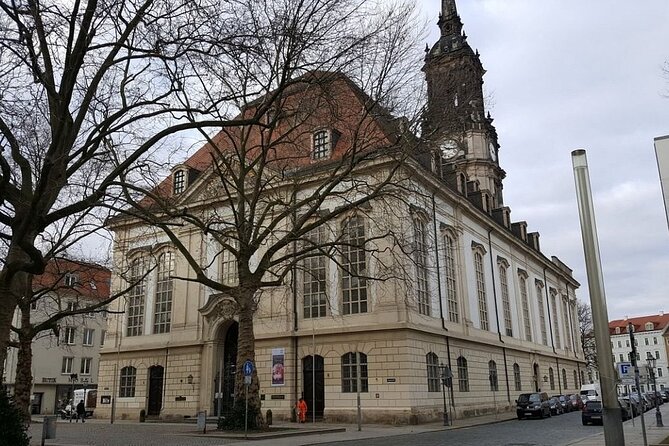
At Haus der Kirche, also known as Dreikönigskirche, the focus turns to the former Altendresden. The church is now an attractive Baroque landmark, but its importance reaches back to the early 15th century. Fraser uses the site to explain the older settlement and the changes that made this part of Dresden important.
This stop is helpful because it shifts attention away from the most photographed buildings. You begin to see Neustadt as more than a place across the river from the famous old center. Its churches and streets preserve a separate story, one that becomes easier to understand before you cross Augustus Bridge.
The tour does not include the church interior or tower climb. The tower costs €5 per person, according to the supplied information. If the tower is open and you want a wider view, you can return on your own, but do not count it as part of the guided experience.
A few more Dresden half-days to weigh up
- Dresden: Semperoper Tickets and Guided Tour
★ 4.7 · 12,102 reviews - Dresden: The Original Night Watchman Tour in Lantern Light
★ 4.6 · 6,653 reviews - Dresden: Semperoper and Old Town Tour
★ 4.8 · 5,735 reviews - Dresden: River Sightseeing Boat Cruise
★ 4.3 · 5,323 reviews
Crossing Augustus Bridge into the Altstadt
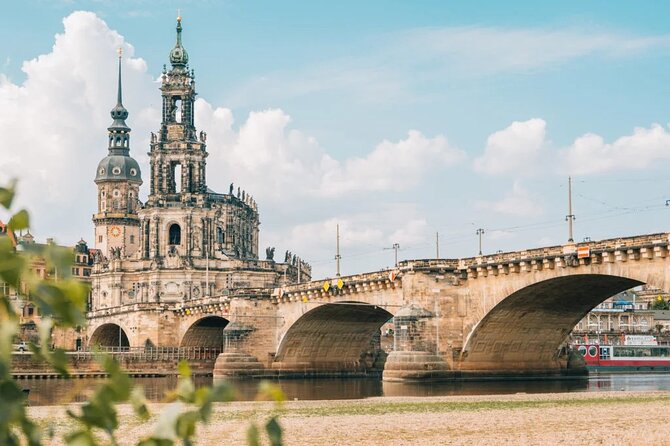
The walk then crosses Augustus Bridge. This is the route’s natural hinge. You leave Altendresden and enter the Altstadt, moving from one historic section of Dresden to the other.
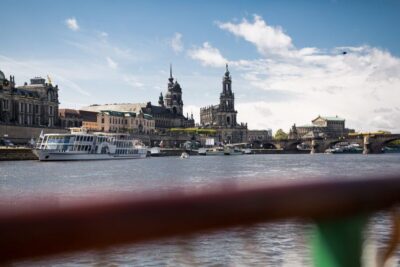
The bridge offers a useful visual pause. You can look along the Elbe, back toward Neustadt, and ahead toward the domes, towers, and palace buildings of the old center. The route uses that change of viewpoint to explain Dresden as a city with connected but distinct parts.
This is also where the tour becomes especially practical. If you are still getting your bearings, the bridge helps you understand where major attractions sit in relation to one another. You finish the walk near Theaterplatz, so you can easily continue sightseeing instead of retracing the route.
Frauenkirche and seven centuries of change
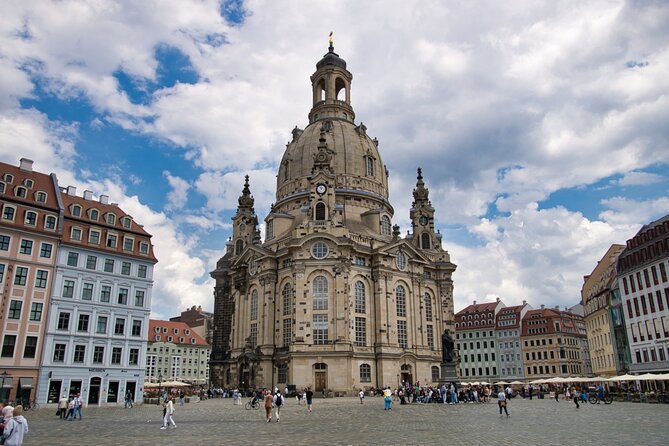
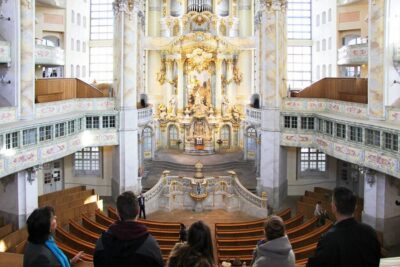
The Frauenkirche is one of Dresden’s essential stops, but this tour aims to give you more than the standard postcard story. Fraser discusses the church’s 700-year background, the later Baroque construction, and the religious and structural changes it witnessed.
The church is also central to understanding Dresden’s destruction and rebuilding. The tour’s wider discussions include the Second World War bombing, and the Frauenkirche provides one of the clearest places to connect that difficult past with the city you see today.
The guided visit here lasts about 20 minutes, and entry is not required. That keeps the tour moving while still giving you time to see the exterior and understand its place in Dresden’s story. If you want to go inside, you can do so separately during your own time in the city.
Holy Cross Church and the Reformation
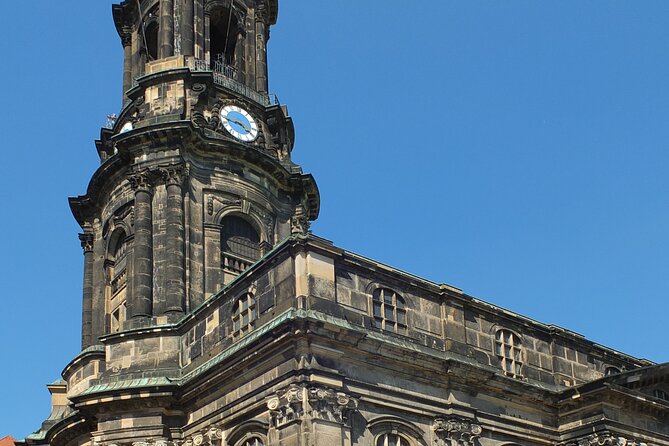
Holy Cross Church brings the story back to a much older religious foundation. The church was first built in the 13th century and has been destroyed more than once. It also witnessed important moments during the Reformation.
I find this kind of stop valuable because it prevents Dresden’s past from becoming a simple story of one golden age followed by wartime loss. Churches were rebuilt, altered, contested, and reused across centuries. Their changes reveal how faith and political power affected ordinary city life.
The stop lasts about 15 minutes and does not require an admission ticket as part of the tour. You will hear the main story, then have the option to return later if you want more time inside.
Denkraum Sophienkirche and a church that disappeared
Denkraum Sophienkirche may be the most unusual stop on the route. It recalls Dresden’s first Franciscan monastery, originally built in the 13th century, and follows the later life and loss of the Sophienkirche.
The church offers a sharp lesson in how much Dresden has lost. Its story reflects shifting religious authority, political decisions, war, and later urban change. Unlike the Frauenkirche, which has become a powerful symbol of reconstruction, the Sophienkirche is remembered as an important building that did not return in the same form.
This is one of the places where Fraser’s cultural and anthropological perspective appears most useful. The subject is not only architecture. It is also memory: what a city chooses to rebuild, what disappears, and how people continue to mark places that no longer look as they once did.
You spend about 20 minutes here. The stop is free, and it adds a less obvious chapter to the route. If you want only the standard Dresden highlights, this may feel like a detour. If you want to understand the city’s changing identity, it is one of the strongest parts of the walk.
Dresden Castle and the rise of Saxon power
The final main stop is Dresden Castle, or Residenzschloss. Here the story shifts from local churches and settlements to the growth of Dresden as a major seat of power in the Holy Roman Empire.
The palace housed the Electors and Kings of Saxony. Fraser explains how Dresden developed from a relatively small city into an important political center, and how the castle’s many transformations reflect that rise. This gives you context for the grand buildings around Theaterplatz. They were not built at random. They belong to a long effort by Saxon rulers to display authority, wealth, culture, and dynastic ambition.
The guided stop lasts about 20 minutes. Entry to the castle and its museums is not included, with admission listed at €14. If you have time after the walk, this is a sensible place to continue. The tour gives you the background needed to make better sense of the palace collections rather than entering with no idea why the building matters.
Finishing at Theaterplatz
The tour ends at Theaterplatz, one of Dresden’s best bases for further sightseeing. From here, you can explore the Zwinger, the Semperoper, Dresden Castle, and nearby Altstadt attractions. You can also take a tram to your next destination.
That ending is a real strength. Some walking tours finish in a residential area or at a random square, leaving you to find your next stop. Here, the final location is useful even if you have only a few hours left. You can choose a museum, take photographs, find a place to eat, or simply continue walking through the center.
The tour itself does not enter the main museums or include church tower access. I see that as both a limit and an advantage. You are not paying twice for places you may not want to visit, and you can choose your own pace afterward. The tradeoff is that your total sightseeing cost will rise if you add the castle, folk art museum, or tower.
What the $60.34 price gives you
At $60.34 per person, this is not the cheapest way to see Dresden’s center. The price pays for a professional English-language guide, a planned route, and two hours of explanation across both Neustadt and Altstadt. It does not cover museum admissions or the Dreikönigskirche tower.
The value depends on how you use the walk. If you are comfortable reading guidebooks and city signs on your own, you may prefer to spend the money on an attraction ticket. But if you want Dresden’s churches, royal buildings, medieval roots, wartime story, and GDR-era changes tied together by one person, the cost is easier to justify.
The group can reach 30 people, though some tour sessions may feel more intimate. A smaller group makes questions and conversation easier. Fraser’s friendly style and willingness to answer questions are useful if you want to ask about the bombing, architecture, modern Dresden, or places to visit afterward.
Who should book this walk
I would choose this tour for a first visit, especially if you have one day or less in Dresden. It gives you a physical map of the city and points out places you may want to revisit. It also suits history buffs who want more than dates and royal names.
The walk works well for people interested in architecture, religious change, World War II, the GDR period, and reconstruction. Families can participate, and most people can take part, but remember that this is a walking activity that depends on outdoor conditions.
It is less suitable if you want lengthy museum visits, a deep examination of art collections, or a tour conducted entirely indoors. You will need to pay separately for the museum and castle entrances, and poor weather can lead to a changed date or full refund.
Book at least a little ahead if possible. The experience is booked an average of 36 days in advance, which suggests that popular dates may fill before a last-minute visit. You receive confirmation when booking, and free cancellation is available until 24 hours before the start time. If the minimum group size is not reached, or weather makes the walk impractical, you can receive another option or a full refund.
Should you book it?
Book this tour if you want a brisk, well-organized introduction to Dresden that connects famous sights with less obvious places. Dr. Fraser Macdonald’s strongest contribution is the way he links architecture to people, faith, political power, war, and memory.
Skip it if you would rather explore silently with a map or spend two hours inside museums. For most first-time visitors, though, the route is a smart use of the morning or afternoon. Start here, note the places you want to revisit, then use the finish at Theaterplatz to build the rest of your Dresden day.
FAQ
How long is the Dresden walking tour?
The tour lasts approximately two hours.
Where does the tour start?
It starts at the Golden Rider, Neustädter Markt 14, 01097 Dresden, Germany.
Where does the tour end?
The tour ends at Theaterplatz, 01067 Dresden, Germany.
Is the tour offered in English?
Yes. The tour is offered in English.
Are museum and church entrance fees included?
No. The tour does not include entry to Dreikönigskirche, Dresden Castle and its museums, or the Museum für Sächsische Volkskunst.
How much does the Dreikönigskirche tower cost?
The tower climb costs €5 per person.
How much are the listed museum and castle admissions?
The Museum für Sächsische Volkskunst admission is listed at €5, and Dresden Castle admission is listed at €14.
Can I cancel for a full refund?
Yes. You can cancel at least 24 hours before the start time for a full refund. Poor weather or failure to meet the minimum number of participants may also result in another date, another experience, or a full refund.
Just added around Dresden
- Walking Tour of Historic Dresden with a Christmas Touch. Small group tour.★ 4.5 · 9 reviews
- Tickets Dresden Transport Museum★ 4.0 · 23 reviews
- Top Full-Day Adventure: Bohemian & Saxon Switzerland from Dresden★ 5.0 · 68 reviews
- Winterland Tour to Bohemian and Saxon Switzerland from Dresden★ 5.0 · 22 reviews
- The Best of Bohemian and Saxon Switzerland Day Trip from Dresden★ 5.0 · 68 reviews
- Historic Dresden Small-Group Walking Tour in English★ 5.0 · 160 reviews
- Sightseeing tour by ConferenceBike★ 5.0 · 14 reviews
- Private Segway tour through the highlights in Dresden★ 5.0 · 94 reviews
Dresden Tours, compared.
The Original Night Watchman Tour in Lantern Light
Read our review →

Browse the lists this tour appears in