
Review · BAMBERG TOURS
Culinary-historical walk through Bamberg
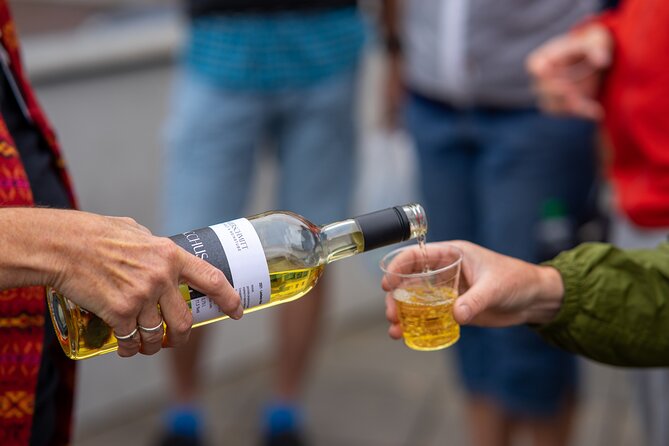
Bamberg’s third river is beer, or so the old local joke goes. This two-hour culinary walk shows why that line fits, moving from medieval eating habits and market life to smoked beer, old breweries, and a final drink at Eckerts Wirtshaus.
I like the mix of small tastings and city history, especially the shift from Bamberg’s medieval meat-heavy diet to its later brewing culture. I also like the route itself: it links the river, the market, the Little Venice quarter, and a traditional inn without turning the experience into a long sit-down meal.
The main consideration is language. This is a German-speaking tour, so you will get much more from it if you can follow everyday German. The tastings are part of the storytelling, but this is not a full meal or a brewery tour with extended production access.
Key points to know before booking
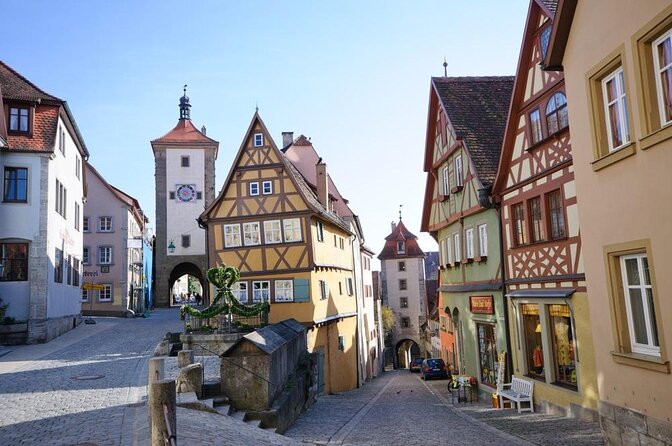
- A compact route through central Bamberg: Seven stops connect Am Kranen, Grüner Markt, the Lower Bridge, Schlenkerla, and Eckerts Wirtshaus.
- Bamberg’s beer story has a twist: The city was once known as a wine town, and the walk explains that change.
- Food is used as history: Expect tastes linked to medieval meat, local Hörnla, market produce, and beer culture.
- The famous smoked beer gets its own stop: Schlenkerla provides the setting for a close look at Bamberg’s brewing tradition.
- The tour ends with your choice of beer: At Eckerts Wirtshaus, each participant can choose a beer to try.
- It is best for German speakers: The guide-led stories, guessing games, and scent samples depend on understanding the spoken explanation.
Starting at Am Kranen with medieval eating habits
The walk begins at Alter Schlachthof, Am Kranen 1, at 4:00 pm. This puts you beside the Regnitz and close to the historic center, where the guide introduces the food habits of the Middle Ages.
The first taste focuses on meat. That is a useful opening because it moves the tour beyond the simple idea that Bamberg equals beer. You begin with the food on the table, then see how markets, trade, farming, brewing, and river life shaped what people ate.
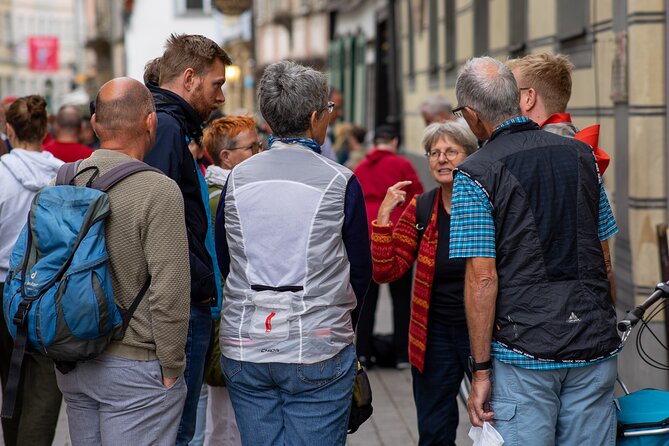
You spend about ten minutes here. That short format continues throughout the walk, so do not expect a long lecture at any one site. Instead, the guide uses each place as a quick chapter. For you, the advantage is variety. The drawback is that anyone wanting detailed historical discussion may find the pace brisk.
The start is also practical for visitors already exploring the center. The tour uses public areas rather than requiring admission to a museum or monument, and the walk finishes elsewhere in town, so plan to continue your evening from Eckerts Wirtshaus rather than return to the starting point.
More history-led days in Bamberg:
- Bamberg: Guided Beer History Tour with Optional Tasting
★ 4.6 · 772 reviews - Bamberg: Guided Historical Culinary Tour
★ 4.6 · 461 reviews - Leipzig: City History Canal Sightseeing Tour on a Motorboat
★ 4.7 · 6,232 reviews
Reading the market at Grüner Markt
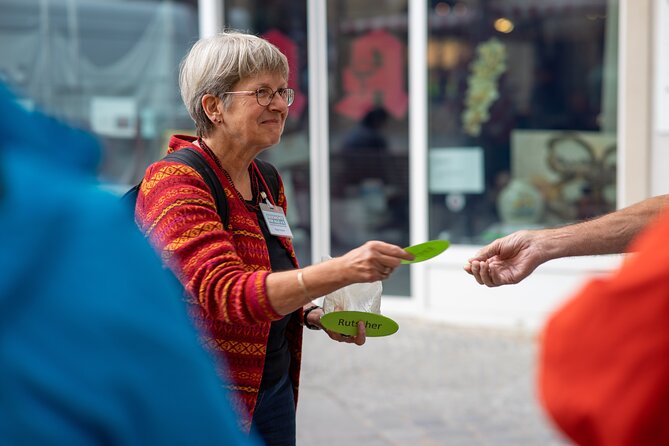
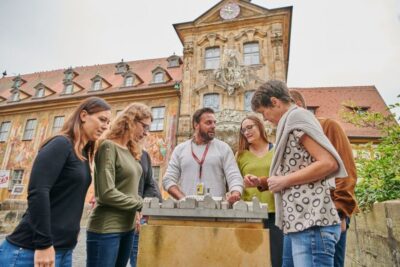
At Grüner Markt, the focus shifts from old eating habits to Bamberg’s weekly market. Guessing games and scent samples help you think about the market through your senses rather than as a simple sightseeing stop.
That format should work well if you enjoy taking part instead of standing quietly while a guide speaks. You may be asked to identify aromas or work out clues connected with the market’s past. The details supplied for the tour do not specify every tasting, so expect small food-related samples rather than a fixed menu.
The market stop lasts about ten minutes. It is enough time to understand why this square mattered, but not enough for a full market visit. If you want to shop or inspect stalls at leisure, arrive early or return another day. The tour’s purpose is to connect the market to the city’s food traditions, not to replace a normal market morning.
From wine town to brewing town at Michelsberg
The next stop, beside Igor Mitoraj’s Centurione I, brings one of the most interesting facts on the route: medieval Bamberg was a wine town. That detail gives the brewing story some needed depth.
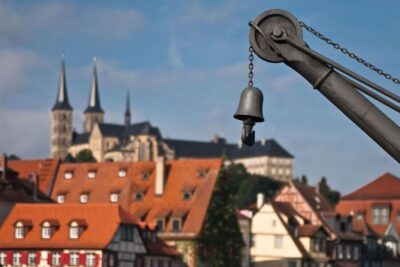
With a view toward the monastery on Michelsberg, you consider the older wine culture before turning to beer. The stop includes a chance to test the idea yourself, apparently through a taste connected with wine. The available information does not specify the exact wine serving, so do not book this expecting a formal wine tasting.
I like this part because it avoids presenting Bamberg’s beer tradition as something that appeared fully formed. Cities change. Drinks change with trade, agriculture, local habits, and available resources. A short stop with a view can make that change easier to understand than a list of dates.
The artwork at the stop also adds a modern note to the route. You are not moving only between old breweries and historic buildings. Bamberg’s culinary past is set against a city that continues to use public spaces for art and daily life.
Little Venice and the Lower Bridge
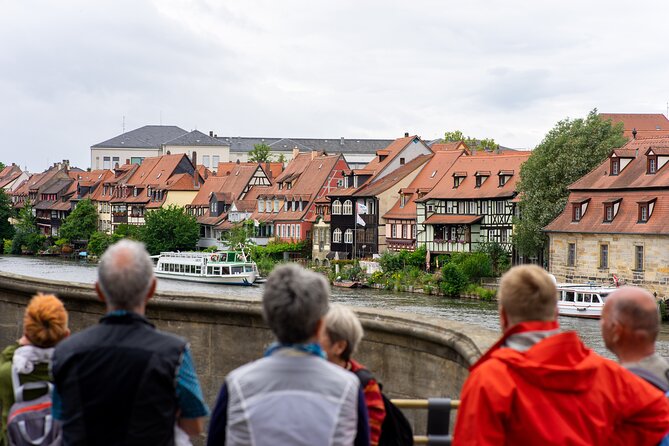
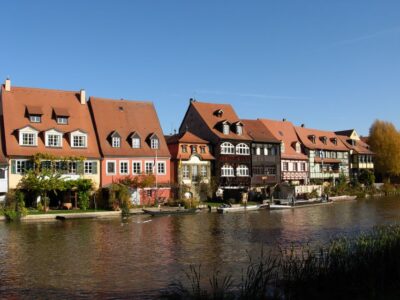
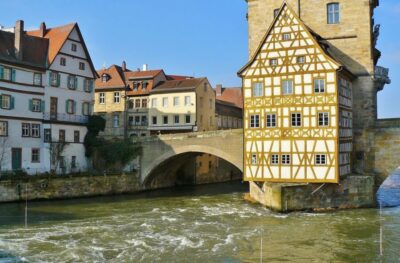
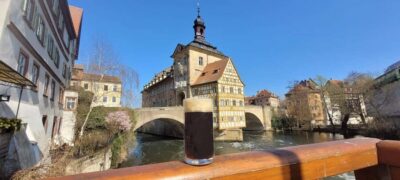
At Untere Brücke, the walk turns toward the river and the old fishermen’s houses. This is the point where Bamberg’s nickname Little Venice makes the most sense, with the Regnitz and its waterfront buildings providing the setting.
The river is treated as more than scenery. The guide explains its role as a lifeline for the city, linking food, movement, work, and settlement. From your point of view, this is a valuable pause because it ties the culinary theme to geography. Brewing and cooking do not happen in isolation. They depend on water, trade, ingredients, and people who can move goods through town.
You spend roughly ten minutes here. The Lower Bridge can be a busy public spot, and the tour does not promise exclusive access or a long photo stop. Still, it is one of the most visually rewarding parts of the walk. The former fishermen’s houses create a clear picture of Bamberg’s river life, while the guide’s food angle gives the view more meaning than a quick snapshot.
More walking tours in Bamberg:
- Bamberg: Guided Walking Tour
★ 4.6 · 3,202 reviews - Bamberg: City Highlights Walking Tour
★ 4.6 · 679 reviews - Bamberg: Private Guided Walking Tour
★ 4.8 · 90 reviews - Bamberg Free Walking Tour
★ 4.7 · 84 reviews
Schlenkerla and Bamberg’s smoked beer tradition
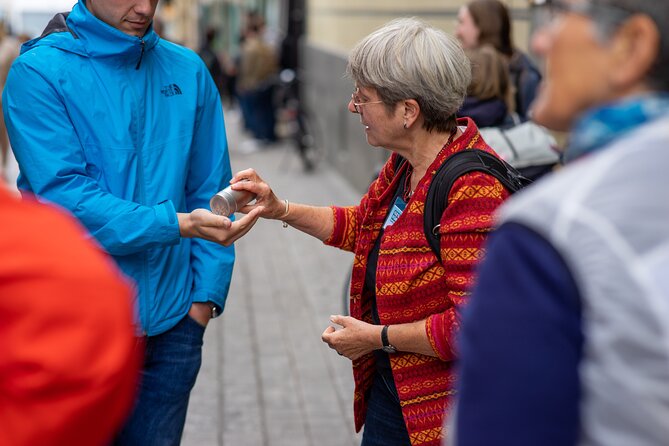
The stop at Schlenkerla, the historic Rauchbier brewery, is the central beer moment. From outside the brewery, you get a closer look at Bamberg’s brewing art and the place smoked beer holds in the city’s identity.
Rauchbier is unusual enough that it deserves context. The important point here is not simply that it tastes smoky. The guide explains the tradition behind it and places Schlenkerla within Bamberg’s long brewing story. The information provided does not promise a brewery-floor visit or a tour of the brewing equipment, so think of this as a historical and tasting stop in front of a famous brewery.
If you already know Bamberg mainly for smoked beer, this section will likely be familiar but still useful. If you are new to the style, it gives you a reason to pay attention to how the drink is made and why it became associated with the city.
The ten-minute limit keeps the stop focused. You may wish for more time to order a full glass at Schlenkerla, but the tour saves its more relaxed beer choice for the final inn. That division makes sense: here you learn the story, and later you choose what to drink.
Hörnla, a cellar reference, and another taste
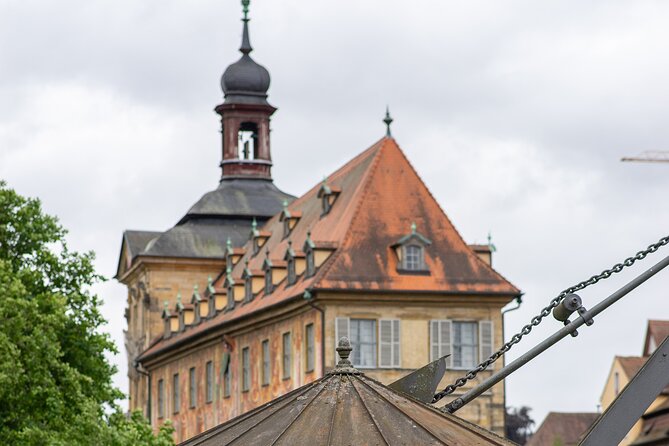
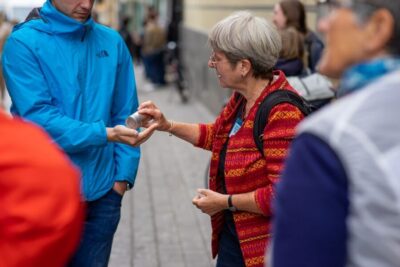
At Pfahlplätzchen, you receive another taste before following the German saying go to the cellar. The tour description also points to two types of Hörnla, one of Bamberg’s notable culinary specialties.
The exact serving details are not given, so you should treat the food as a sample rather than a guaranteed plate of both varieties. Still, this stop is important because it widens the tour beyond meat and beer. Bamberg’s food identity includes baked or pastry-like local treats alongside its drinks and market traditions.
The phrase about going to the cellar likely leads into Bamberg’s old beer-cellar culture, though the supplied details do not name a specific cellar visit. Do not assume that you will walk into a subterranean beer hall. The stop lasts about ten minutes and functions as another story-and-taste point.
For me, this is the kind of small detail that can make a city walk worthwhile. You learn a local expression, connect it to food and drink, and carry it with you after the tour. It is not a grand attraction, but it gives the evening a local flavor.
Finishing at Eckerts Wirtshaus
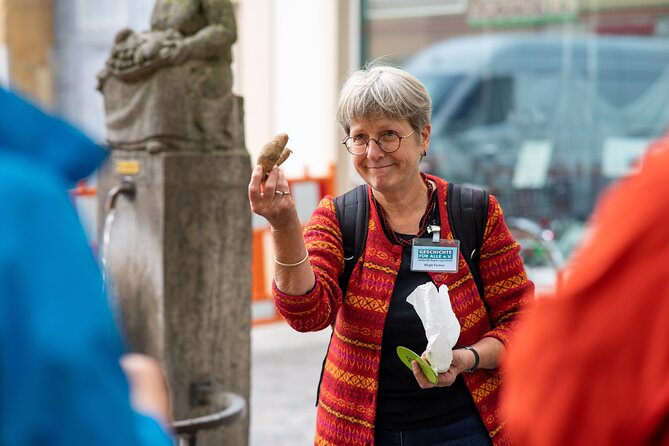
The final stop is Eckerts Wirtshaus at Obere Mühlbrücke 9. This is where the tour ends with a beer of your choice, giving you a chance to judge Bamberg’s brewing style for yourself.
That ending is one of the strongest features of the experience. A final drink in a classic Bamberg inn lets the route settle into a normal local evening rather than ending beside a monument or on a street corner. You can compare what you have learned with what is in your glass.
The price includes the beer at this last stop. The other tastings are part of the experience, but the available details do not list every included serving or provide a complete food menu. If you need dinner, plan to eat separately or continue at the inn after the official walk.
The end point is different from the start, which is useful if you want to continue near the river and old town. It also means you should note both addresses before setting out. The walk is not described as a loop.
What the $28.92 price really covers
At $28.92 per person, the tour is priced as a modest food-and-history introduction rather than a full culinary outing. You are paying for a guide, several tasting moments, historical interpretation, and a beer at the final inn.
That can be good value if you want orientation on your first evening in Bamberg. In two hours, you get a route through several central areas and a framework for understanding why beer, wine, markets, rivers, and local food belong in the same story.
The value is weaker if you measure tours by the amount of food served. This is not advertised as dinner, and the small tastes will not replace a meal. You should book it for context and sampling, then budget separately for a proper meal or more drinks afterward.
The final beer helps the price feel more tangible. You do not only hear about Bamberg’s brewing tradition. You get to choose a beer and taste it in a traditional inn. The experience also has a maximum group size of 30, which is large enough to feel social but may make quiet listening harder in busy public spaces.
Timing, language, and who will enjoy it
The 4:00 pm start is well chosen for an evening activity. You can spend the day sightseeing, join the walk in the late afternoon, and finish in time to continue with dinner. The tour lasts about two hours, though the seven ten-minute stops leave time for walking between them.
The key issue is German. This is a German-speaking tour, and much of the value comes from spoken stories, wordplay, guessing games, and explanations of local food customs. If you understand only a little German, you may still enjoy the route and tastings, but you could miss the main point of the experience.
I would choose this walk if you like:
- Food used as a way to understand a city
- Short stops with frequent changes of setting
- Beer history, especially smoked beer
- River views and old town streets
- A final drink in a traditional inn
- Guided activities conducted in German
I would look elsewhere if you want a full meal, a long brewery visit, an English-language tour, or a slow photography walk. The route is designed for people who enjoy a compact introduction with several tastes and stories.
The tour is near public transportation, and service animals are allowed. Most people can take part, but the information does not give a detailed accessibility assessment for every street or bridge. If you have specific mobility needs, confirm the route before booking.
Booking flexibility and group details
You receive confirmation when you book, and the ticket is mobile, so you do not need a printed voucher. The maximum group size is 30 people.
Free cancellation is available up to 24 hours before the 4:00 pm start time. If you cancel later, the amount paid is not refunded, and changes made within that same 24-hour window are not accepted. Keep the local time in mind when making changes.
The tour is offered by Geschichte Für Alle e.V., an organization whose name reflects the experience’s public-history approach. The walk connects ordinary food and drink with streets, bridges, markets, art, and historic buildings rather than treating history as something limited to museums.
Should you book the Bamberg culinary walk?
Book it if you want a short German-language introduction to Bamberg’s food and beer culture, especially if smoked beer interests you. The best parts are the citywide route, the surprising reminder that Bamberg was once a wine town, the sensory market activities, and the beer choice at Eckerts Wirtshaus.
Skip it if you need English commentary, a substantial meal, or a detailed brewery production tour. At $28.92, it makes sense as an evening orientation and tasting walk, not as your only food experience in Bamberg.
FAQ
Where does the culinary-historical walk begin?
It begins at Alter Schlachthof, Am Kranen 1, 96047 Bamberg, Germany.
Where does the tour end?
The tour ends at Eckerts Wirtshaus, Obere Mühlbrücke 9, 96049 Bamberg, Germany.
What time does the tour start?
The scheduled start time is 4:00 pm.
How long does the experience last?
The walk lasts approximately two hours.
Is the tour offered in English?
No. This is a German-speaking tour.
Is beer included?
A beer of your choice is included at Eckerts Wirtshaus, the final stop. The tour also includes several tastes, though the full list of servings is not specified.
How large is the group?
The tour can include a maximum of 30 participants.
Just added around Bamberg
- Bamberg Countryside Breweries Beer Hike Food Experience★ 5.0 · 27 reviews
- Private Guided Walking Tour of Bayreuth With A Professional Guide★ 5.0 · 3 reviews
- Bamberg – Excursion to Seehof Palace★ 5.0 · 3 reviews
- Bamberg Private Walking Tour With A Professional Guide★ 4.5 · 27 reviews
- Bayreuth Scavenger Hunt and Sights Self-Guided Tour★ 5.0 · 7 reviews
- Outdoor Escape Game with puzzle backpack Bamberg: The Secret of the Horseman★ 4.7 · 39 reviews
- Witch Trials in Bamberg★ 4.4 · 187 reviews
- Bamberg: Immersive Medieval Tour★ 4.7 · 232 reviews
Bamberg Tours, compared.
Browse the lists this tour appears in